

Best AI tools have become indispensable in modern business and daily life, significantly transforming how industries operate and how individuals manage their day-to-day activities. From automating routine tasks to providing deep insights through data analysis, AI tools enhance efficiency, accuracy, and productivity across various sectors. Businesses leverage AI to streamline operations, improve customer experiences, and drive innovation, while individuals use AI-powered applications for personal productivity, entertainment, and more. This blog aims to explore the best AI tools available today, highlighting their features, benefits, and applications to help you harness the power of AI in both professional and personal realms.

What Are AI Tools?
AI tools are software applications or platforms that leverage artificial intelligence technologies to perform tasks that typically require human intelligence. These tasks include but are not limited to learning, reasoning, problem-solving, understanding natural language, and perceiving and recognizing patterns. AI tools can analyze vast amounts of data, make predictions, and automate processes, enhancing productivity and efficiency across various domains.
Benefits of Using AI Tools
- Efficiency and Productivity AI tools streamline processes by automating repetitive tasks, thus enhancing overall productivity. They can quickly analyze vast amounts of data, identify patterns, and make decisions faster than humans. This allows employees to focus on more strategic and creative tasks, ultimately leading to a more efficient workflow.
- Accuracy and Precision AI tools significantly improve accuracy and reduce human errors. They are capable of processing information with a level of precision that minimizes mistakes, whether in data analysis, medical diagnostics, or financial forecasting. This reliability is crucial in fields where accuracy is paramount, such as healthcare and finance.
- Cost Savings Implementing AI tools can lead to substantial cost savings. By automating tasks that would otherwise require significant human labor, businesses can reduce operational costs. Additionally, the increased accuracy and efficiency brought by AI reduce waste and the costs associated with errors, further contributing to cost-effectiveness.
- Scalability AI tools support business growth and scalability by providing the infrastructure needed to handle increasing workloads without a proportional increase in resource usage. As a business grows, AI systems can manage larger volumes of data and more complex operations, ensuring that the company can scale efficiently without sacrificing performance or quality.
Top AI Tools In 2025
There are many great AI tools available in the market that can be used in a variety of industries and applications. Here are some of the best AI tools you can use:
1. TensorFlow
TensorFlow is an open-source machine learning framework developed by the Google Brain team. It is widely used for both research and production purposes due to its versatility and comprehensive ecosystem. TensorFlow allows developers to create and deploy machine learning models across various platforms, from desktops to mobile devices and even web applications.

Key Features:
- Comprehensive Libraries: TensorFlow offers a rich set of APIs for deep learning, including high-level APIs like Keras, which make building and training models more accessible.
- Flexibility and Control: Users can use TensorFlow’s low-level APIs to gain fine-grained control over model construction and training, which is beneficial for complex and custom architectures.
- Scalability: TensorFlow can scale across multiple CPUs and GPUs, enabling efficient distributed training and serving.
- Deployment Options: TensorFlow Serving allows for deploying machine learning models in production environments, and TensorFlow Lite facilitates running models on mobile and embedded devices.
- Community and Ecosystem: TensorFlow has a robust community, extensive documentation, and numerous tutorials, which help developers learn and implement machine learning models effectively.
Applications:
- Image Recognition: Used in various applications like self-driving cars and image tagging.
- Natural Language Processing (NLP): Powers applications like language translation, sentiment analysis, and chatbots.
- Healthcare: Assists in medical imaging and predictive analytics for patient care.
2. PyTorch
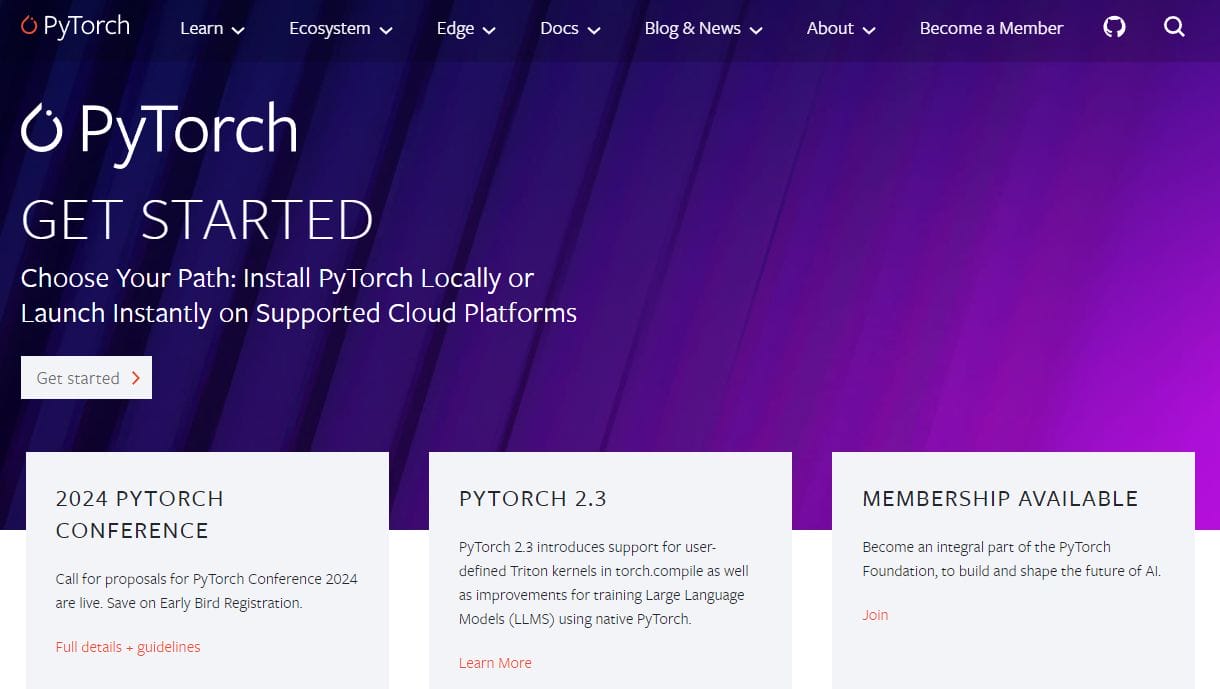
PyTorch is an open-source machine learning library developed by Facebook’s AI Research lab. It has gained significant popularity due to its dynamic computational graph and ease of use, making it a favorite among researchers and practitioners alike.
Key Features:
- Dynamic Computational Graph: PyTorch’s dynamic nature allows for easier debugging and a more intuitive model-building process compared to static graph frameworks.
- Flexibility: It supports both imperative and declarative programming styles, giving users flexibility in developing models.
- Integration with Python: PyTorch integrates seamlessly with Python, making it easy to use and allowing for integration with other Python libraries like NumPy and SciPy.
- TorchScript: This feature allows developers to transition from an eager execution mode to a graph execution mode, which is useful for production deployment.
- Extensive Libraries: PyTorch offers robust libraries like TorchVision for computer vision tasks and TorchText for NLP tasks.
Applications:
- Research: Widely used in academic research for developing state-of-the-art models in deep learning.
- Industry: Implemented in various industry applications, including natural language processing, computer vision, and recommendation systems.
- Prototyping and Production: Facilitates quick prototyping and deployment of machine learning models.
3. IBM Watson
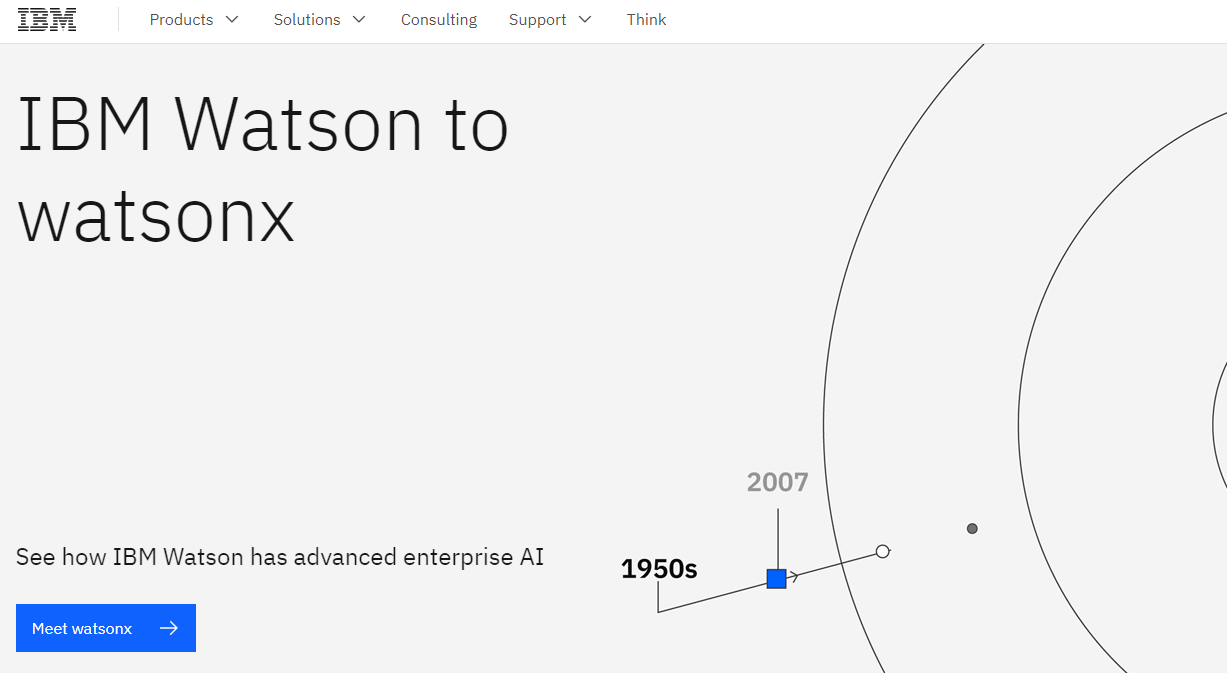
IBM Watson is a suite of enterprise-ready AI services, applications, and tooling. IBM Watson provides an extensive set of tools and APIs that help businesses leverage AI for various applications, ranging from natural language understanding to visual recognition.
Key Features:
- Natural Language Processing: Watson offers advanced NLP capabilities through its Watson Assistant and Natural Language Understanding services, which can interpret and interact with human language.
- Visual Recognition: Provides image and video analysis services to understand visual content and extract metadata.
- Watson Studio: A collaborative environment for data scientists, developers, and analysts to build, train, and deploy models.
- Scalability and Flexibility: IBM Watson services can be deployed on IBM Cloud, on-premises, or in hybrid environments, allowing for flexible scaling.
- Industry Solutions: Offers tailored AI solutions for various industries, including healthcare, finance, and customer service.
Applications:
- Healthcare: Assists in diagnostics, personalized treatment plans, and patient data management.
- Customer Service: Enhances customer service operations with AI-powered chatbots and virtual assistants.
- Business Analytics: Provides predictive analytics and decision-making support in finance, retail, and other sectors.
4. Amazon Web Services (AWS)
Amazon Web Services (AWS) offers a comprehensive suite of machine learning and AI services, including tools for developers, data scientists, and business analysts. AWS AI services provide pre-trained AI services and tools to build, train, and deploy custom machine learning models.

Key Features:
- AWS SageMaker: A fully managed service that provides every developer and data scientist with the ability to build, train, and deploy machine learning models at scale.
- AI Services: Includes a range of AI services like Amazon Rekognition for image and video analysis, Amazon Polly for text-to-speech conversion, and Amazon Lex for building conversational interfaces.
- Integration and Scalability: AWS AI services integrate seamlessly with other AWS services, enabling robust, scalable AI solutions.
- Data Lake and Analytics: AWS provides comprehensive data lake and analytics services that support data collection, storage, processing, and visualization.
- Security and Compliance: AWS ensures robust security and compliance measures, making it suitable for industries with stringent data protection requirements.
Applications:
- Retail: Enhances customer experience through personalized recommendations and automated customer service.
- Finance: Provides predictive analytics for risk management and fraud detection.
- Healthcare: Facilitates medical image analysis and patient data management.
5. Google Cloud AI Platform
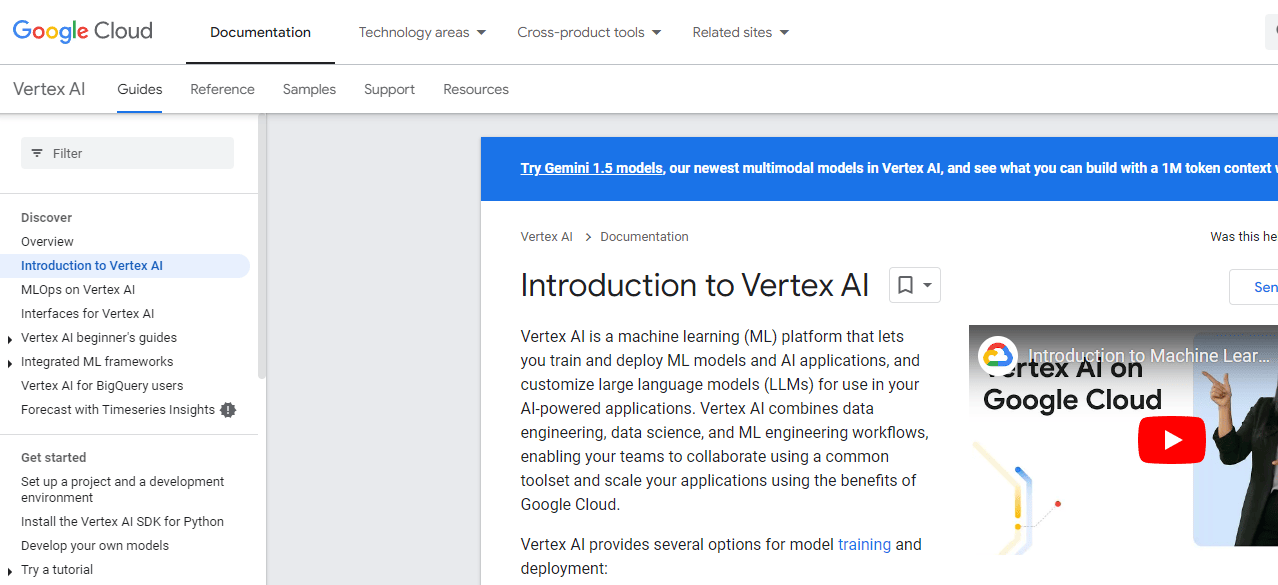
Google Cloud AI Platform is a comprehensive suite of machine learning and AI tools offered by Google Cloud. It provides end-to-end solutions for building, deploying, and managing machine learning models.
Key Features:
- AI Hub: A repository of AI components, including pipelines and models, which can be shared and reused across projects.
- AutoML: A suite of tools that allows developers with limited machine learning expertise to train high-quality models tailored to their specific needs.
- TensorFlow Extended (TFX): An end-to-end platform for deploying production machine learning pipelines.
- BigQuery ML: Enables data analysts to build and operationalize machine learning models directly within BigQuery using SQL.
- Vertex AI: A unified platform for building, deploying, and scaling machine learning models.
Applications:
- Retail: Enhances shopping experiences through personalized recommendations and inventory management.
- Healthcare: Supports medical research, diagnostics, and patient care through advanced analytics.
- Finance: Provides fraud detection and risk management solutions.
6. Hugging Face
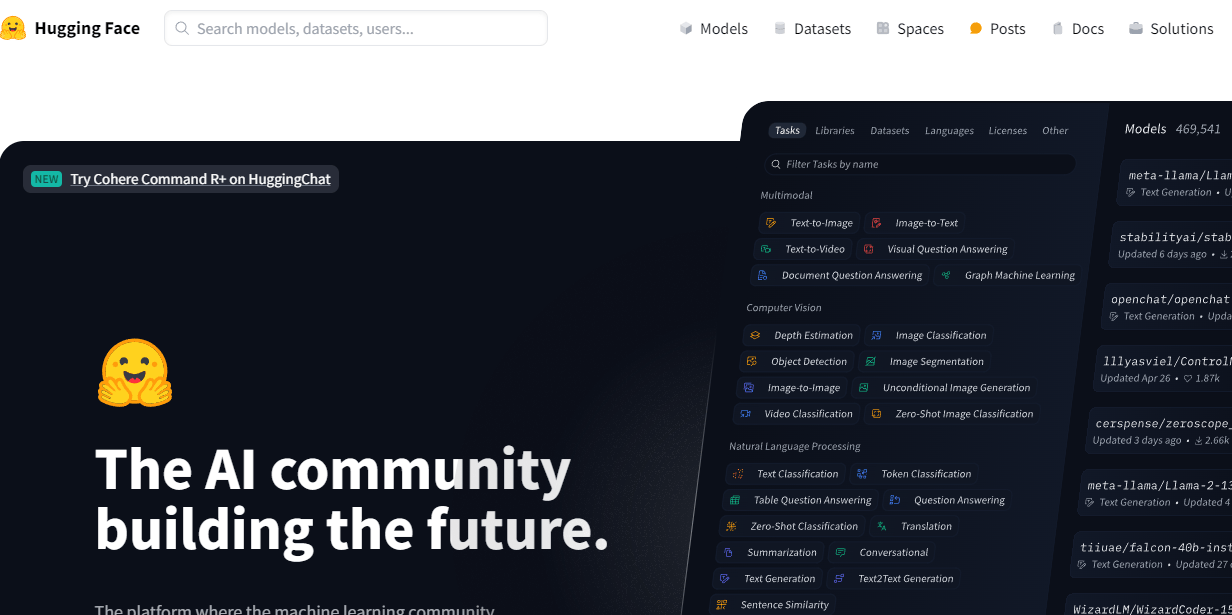
Hugging Face is an AI research organization that has created a comprehensive library of natural language processing (NLP) models and tools. It is best known for its Transformers library, which provides state-of-the-art pre-trained models for NLP tasks.
Key Features:
- Transformers Library: Offers a vast collection of pre-trained models for tasks such as text classification, translation, summarization, and more.
- Model Hub: A central repository where users can share and download pre-trained models.
- Easy Integration: Provides simple APIs for integrating models into various applications.
- Fine-Tuning: Allows for the fine-tuning of pre-trained models to suit specific use cases.
- Community and Support: Strong community support and extensive documentation help users implement NLP solutions effectively.
Applications:
- Customer Service: Implements chatbots and virtual assistants that understand and respond to customer queries.
- Content Moderation: Automates the detection of inappropriate content in social media and forums.
- Healthcare: Supports clinical documentation and patient interaction through NLP-based applications.
7. DataRobot
DataRobot is an enterprise AI platform that automates the end-to-end process of building, deploying, and managing machine learning models. It aims to democratize AI by enabling users with different levels of expertise to leverage machine learning.

Key Features:
- Automated Machine Learning (AutoML): DataRobot automates the process of model selection, training, and tuning, making it accessible to non-experts.
- Feature Engineering: Automatically generates and selects the most relevant features for model training.
- Model Interpretability: Provides tools to understand and interpret the predictions made by machine learning models.
- Deployment and Monitoring: Simplifies the deployment of models into production and monitors their performance over time.
- Scalability: Scales to handle large datasets and complex machine learning workflows.
Applications:
- Finance: Enhances fraud detection, credit scoring, and algorithmic trading.
- Healthcare: Supports predictive analytics for patient outcomes and resource allocation.
- Retail: Optimizes inventory management, pricing strategies, and customer segmentation.

Final Thoughts On Best AI Tools
The transformative impact of AI tools across various industries cannot be overstated. From TensorFlow and PyTorch, which are revolutionizing machine learning research and applications, to IBM Watson and AWS AI which offer comprehensive AI solutions for enterprises, these tools are reshaping how businesses operate and innovate. Google Cloud AI Platform and Hugging Face are leading the way in making sophisticated AI accessible to all, while DataRobot simplifies and automates the machine learning lifecycle for broader adoption.
Interesting Read:

