

Artificial Intelligence (AI) has rapidly become a pivotal force driving innovation across various industries, making it an essential skill for the future workforce. The demand for proficient AI professionals continues to rise, leading to many online courses designed to equip learners with the necessary knowledge and skills. From beginner-friendly introductions to advanced specializations, these courses offer comprehensive coverage of Artificial intelligence courses, machine learning algorithms, deep learning, natural language processing, and more.

Quick Links
What Is An Artificial Intelligence Course?
An Artificial Intelligence (AI) course is an educational program designed to teach students about AI’s principles, techniques, and applications. These courses typically cover various topics, including machine learning algorithms, neural networks, natural language processing, computer vision, and robotics. They also delve into the theoretical underpinnings of AI, such as statistics, probability, and algorithms, as well as practical skills in programming languages like Python and tools such as TensorFlow and PyTorch.
AI courses can vary in depth and complexity, catering to different skill levels from beginners to advanced practitioners. Beginners might start with an introduction to AI concepts and basic machine learning, while more advanced courses might focus on specific areas like deep learning, reinforcement learning, or AI ethics.
Also Read: Learndash Add-ons
Key Features Of Artificial Intelligence Courses
Artificial Intelligence (AI) courses typically offer a range of features designed to equip learners with both theoretical knowledge and practical skills of building AI applications.
Here are some key features commonly found in AI courses:
- Comprehensive Curriculum: AI courses often cover a broad spectrum of topics including machine learning, deep learning, natural language processing (NLP), computer vision, robotics, and AI ethics. This ensures a well-rounded understanding of the field.
- Hands-on Projects and Assignments: To reinforce theoretical concepts, many courses include practical projects and assignments that involve real-world data and scenarios. These projects help learners apply what they’ve learned and build a portfolio of AI applications.
- Expert Instruction: Courses are often taught by industry professionals or academic experts with extensive experience in AI. This provides learners with insights into the latest trends and practices in the field.
- Flexible Learning Options: Many AI courses are available online and offer flexible schedules to accommodate different learning paces and time commitments. This is particularly beneficial for working professionals or students with busy schedules.
- Certification and Accreditation: Upon completion, many AI courses offer certificates that can enhance a learner’s resume and demonstrate their expertise to potential employers. These certificates are often issued by recognized institutions or companies.
- Interactive Learning Tools: Some courses incorporate interactive elements such as quizzes, coding exercises, and discussion forums to enhance engagement and facilitate a deeper understanding of the material.
- Access to AI Tools and Libraries: Courses often provide access to popular AI tools and libraries such as TensorFlow, PyTorch, Keras, and Scikit-Learn, allowing learners to gain hands-on experience with the tools used in the industry.
- Career Support: Some AI courses offer career services, including resume reviews, interview preparation, and job placement assistance. This can be particularly useful for those looking to transition into an AI-related career.
- Community and Networking Opportunities: Many courses offer opportunities to connect with peers, instructors, and industry professionals through online forums, group projects, and networking events.
- Ethical and Societal Implications: Increasingly, AI courses are incorporating discussions on the ethical and societal implications of AI, ensuring that learners are aware of the potential impacts of AI technologies on society and are prepared to develop responsible AI solutions.
Best Artificial Intelligence (AI) Courses
1. Google Cloud’s Introduction to Generative AI Learning Path

Google Cloud’s Introduction to Generative AI Learning Path is a free course designed for beginners to understand generative AI and large language models. Hosted on Google Cloud Skills Boost, it covers fundamental concepts and practical applications using Google tools like Vertex AI. The course includes modules on ethical AI practices, ensuring learners are aware of responsible AI development. Upon completion, participants earn a Prompt Design in Vertex AI skill badge. The course consists of approximately 8.5 hours of content, including quizzes, and is suitable for anyone without prerequisites.
2. IBM’s Introduction to Artificial Intelligence via Coursera

IBM’s Introduction to Artificial Intelligence via Coursera is an eight-hour, beginner-friendly course that provides a comprehensive overview of AI. Taught by an IBM professional, it covers essential AI concepts, including machine learning, neural networks, and ethical considerations in AI. The course includes quizzes and contributes to career certificates in various Coursera programs. It is free if completed within Coursera’s seven-day trial, with subscription fees applicable afterward.
3. AWS Generative AI Developer Kit

The AWS Generative AI Developer Kit is an online, self-guided program that combines foundational AI knowledge with practical skills specific to AWS products. It includes hands-on labs and AWS Jam challenges, providing gamified, AI-powered experiences. The kit is part of the AWS Skill Builder subscription, costing $29 per month after a 7-day trial. The course covers a thorough exploration of generative AI, making it suitable for those familiar with AWS who wish to expand into AI development using tools like Amazon Bedrock.
4. Harvard University Professional Certificate in Computer Science for Artificial Intelligence

The Harvard University Professional Certificate in Computer Science for Artificial Intelligence is an online program available through edX, designed to provide a strong foundation in computer science and AI. This certification consists of two courses: “Introduction to Computer Science” and “Introduction to Artificial Intelligence with Python.” The first course covers fundamental computer science concepts, including algorithms, data structures, and programming languages like C, Python, SQL, and JavaScript.
5. DeepLearning.AI’s AI For Everyone

DeepLearning.AI’s “AI For Everyone” is a popular introductory course available on Coursera, designed to demystify artificial intelligence for a broad audience. Created by Andrew Ng, a leading figure in AI, this course covers the fundamental concepts of AI, its practical applications, and its impact on various industries. It aims to equip learners with the knowledge to understand and discuss AI, making it accessible for non-technical professionals, including business leaders and policymakers. The course includes real-world examples and discussions on the ethical implications of AI, providing a comprehensive overview suitable for beginners.
6. Microsoft Certified: Azure AI Engineer Associate

The Microsoft Certified: Azure AI Engineer Associate certification validates the skills and knowledge of professionals who design and implement AI solutions using Azure AI services. To earn this certification, candidates must pass the AI-102 exam, which tests their experience with Cognitive Services, Machine Learning, and Knowledge Mining to architect and implement Microsoft AI solutions. The certification course covers topics such as Azure AI services, security, logging, cost management, monitoring, and responsible AI principles.
7. ARTiBA’s Artificial Intelligence Engineer (AIE) Certification

The Artificial Intelligence Engineer (AiE™) certification from ARTiBA is a comprehensive program that validates an individual’s expertise in designing and implementing AI solutions using Azure AI services. The certification covers a wide range of topics, including Cognitive Services, Machine Learning, and Knowledge Mining, and is designed to prepare candidates for the challenges of developing AI applications across various industries. The AiE™ certification is organized into three levels – Fundamentals, Associate, and Expert – and is valued by professionals looking to demonstrate their advanced skills in Azure AI engineering
8. IBM AI Engineering Professional Certificate

The IBM AI Engineering Professional Certificate is a comprehensive 6-course series designed to equip learners with the skills needed to succeed as an AI or machine learning engineer. The program covers fundamental concepts of machine learning and deep learning, including supervised and unsupervised learning. Learners apply these techniques to industry problems involving computer vision, image processing, natural language processing, recommender systems, and more. By completing hands-on projects, learners build a portfolio demonstrating proficiency in AI engineering.
9. University of Pennsylvania’s AI For Business
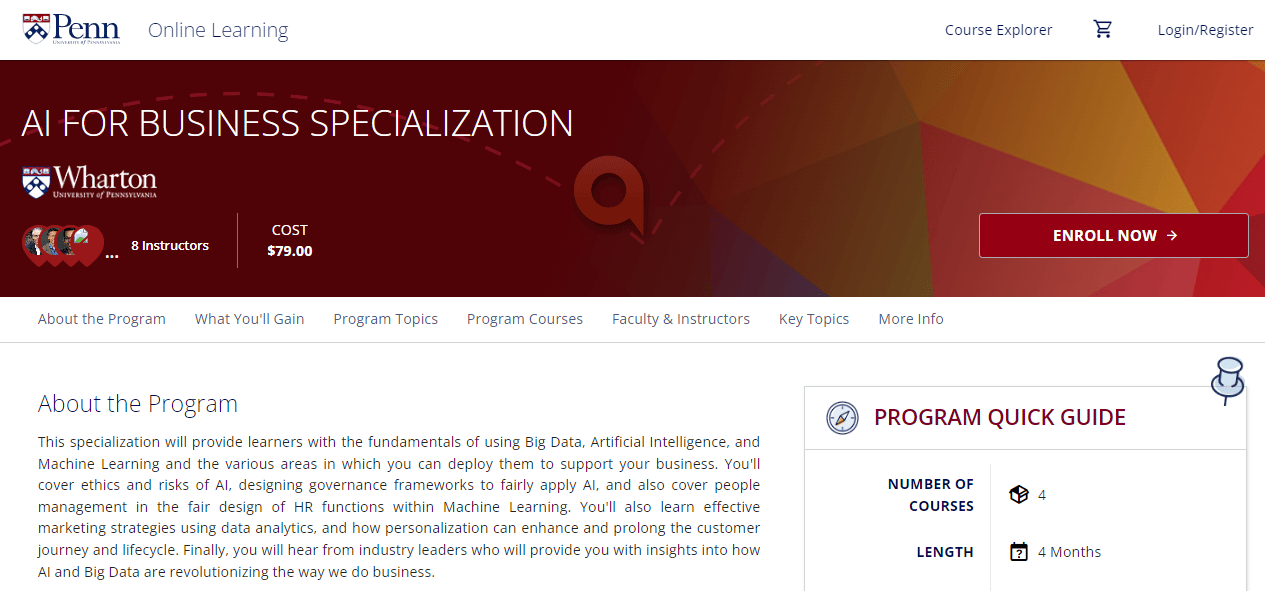
The University of Pennsylvania’s AI For Business specialization on Coursera offers a comprehensive program in AI applications for business. It includes four courses covering AI strategy and governance, AI applications in people management, AI fundamentals for non-data scientists, and marketing strategies using data analytics. The specialization aims to equip learners with the skills to implement ethical AI strategies, manage HR functions, and develop responsible governance frameworks. The program also includes peer-review exercises and cumulative assessments to apply AI concepts in real-world scenarios.
10. Politecnico di Milano’s Artificial Intelligence

Politecnico di Milano’s “Artificial Intelligence: An Overview” course provides a non-technical introduction to the field of AI. The course covers the history and birth of AI, its current state in terms of goals and progress, the taxonomy of AI techniques and technologies, and the need for national AI strategies. It is a 5-week course with no prerequisites and successful completion results in a certificate of accomplishment. The course is part of a broader Artificial Intelligence specialization offered by Politecnico di Milano on Coursera.
Final Thought On Artificial Intelligence (AI) Courses
The best AI courses cover a range of topics from foundational AI concepts to specialized areas like deep learning, natural language processing, and autonomous systems. Top courses come from reputable providers and are taught by leading experts in the field. When choosing an AI course, consider your current skill level, career goals, and the specific AI skills you want to develop. Beginner courses provide a broad overview, while advanced courses dive deep into technical implementation. Hands-on projects are key to gaining practical experience. Investing time in a high-quality AI course can pay dividends in a rapidly growing field with high demand for skilled talent.
Interesting Reads:

