The Real Cost of Running a Community in 2026

You have probably seen the ads: “Launch your community for just $99/month!” It sounds reasonable. But after a year of running your community, you realize you are spending three to five times that amount. The real cost of running an online community in 2026 goes far beyond the sticker price, and almost no platform will tell you the full story upfront.
This guide breaks down every dollar you will actually spend, platform by platform, with real calculations at different membership sizes. Whether you are a yoga instructor building a membership site, a business coach launching a mastermind, or a startup founder creating a customer community, these numbers will help you make a decision based on facts rather than marketing.
The $99/Month Lie: Why Platform Pricing Tells Half the Story
Every community platform advertises a clean monthly price. But that number is just the starting point. What they do not tell you about are the transaction fees on every member payment, the essential add-on tools you will need, and the scaling penalties that kick in as your community grows.
The real question is not “how much is the platform?” It is “how much will I spend in year one, year two, and year three?”
Here is a number that might surprise you: a 500-member community can cost anywhere from $360 per year to over $5,000 per year depending on which platform you choose. That is a 14x difference for essentially the same outcome, a place where your members gather, learn, and engage.
We analyzed the total cost of ownership for five major community platforms in 2026, factoring in every expense most guides ignore. The results will change how you think about your next platform decision.
The 7 Real Costs of Running an Online Community
Before comparing platforms, you need to understand the seven cost categories that make up your true community expense. Most people only think about the first one.
1. Platform or Hosting Fees
This is the obvious cost, the monthly subscription you pay to the platform. It ranges from $0 (free platforms) to $399 per month (enterprise-tier SaaS). For self-hosted solutions, this becomes a hosting fee of $10 to $30 per month plus a one-time theme or software purchase.
2. Transaction and Payment Processing Fees
This is where most people get caught off guard. Every time a member pays you through the platform, you lose 2.9% to 5% in processing fees. On a $47 per month membership with 200 members, that is $274 to $470 disappearing every single month, or $3,288 to $5,640 per year. With a self-hosted setup, you connect your own payment gateway (like Stripe at 2.9% + $0.30) and there is no additional platform cut.
3. Email and Marketing Tools
Not every platform includes email marketing. If yours does not, you will need a separate tool like ConvertKit ($29 to $79 per month), Mailchimp ($13 to $100 per month), or a similar service. This adds $0 to $200 per month depending on your list size and chosen tool.
4. Video Hosting and Streaming
If your community includes courses or live sessions, you may need dedicated video hosting. While some platforms include basic video, others require you to use Vimeo ($12 to $75 per month), Wistia, or similar services. Budget $0 to $100 per month depending on your video needs.
5. Content Creation Time
Your time has value. If you spend 10 hours per week creating content, managing discussions, and planning events, that is time you are not spending on other revenue-generating activities. Alternatively, hiring a content creator costs $500 to $2,000 per month depending on volume and quality.
6. Moderation
Small communities can self-moderate. But once you pass 200 to 300 members, moderation becomes a significant time commitment. A part-time community manager costs $500 to $1,500 per month. A full-time one costs $2,000 to $3,000 or more. This cost exists regardless of which platform you choose.
7. Migration Cost When You Outgrow the Platform
This is the cost nobody talks about until it happens. When you outgrow your platform or it no longer fits your needs, you face weeks of work migrating content, re-inviting members (expect to lose 10% to 30%), and rebuilding your setup. This hidden cost can range from $2,000 to $10,000 in lost time, lost members, and consultant fees.
Platform-by-Platform Cost Breakdown for 2026
Let us look at the five most popular community platform options side by side. If you want a deeper feature-by-feature comparison, read our detailed guide to Circle vs Mighty Networks vs self-hosted platforms. Below, we focus specifically on what each option costs you in year one, including what is included and what is missing.
Skool
- Monthly fee: $99 flat rate
- Transaction fee: 2.9% (via Stripe)
- Year 1 cost: $1,188 + transaction fees
- Included: Unlimited members, courses, gamification, community feed
- Missing: Custom branding, native app, advanced analytics, email marketing
- Hidden cost: No email marketing built in, so you will need ConvertKit or Mailchimp ($29 to $79 per month extra)
Skool has gained popularity thanks to its simplicity and flat pricing. However, the lack of email marketing means you are immediately adding $348 to $948 per year for a third-party email service. For communities that rely heavily on email communication, this turns the “$99 per month” into $128 to $178 per month in reality.
Circle
- Monthly fee: $49 (Basic), $99 (Professional), $219 (Business)
- Transaction fee: Varies by plan
- Year 1 cost: $588 to $2,628
- Included: Spaces, courses, events, workflows, member directory
- Missing: Native mobile app (web-based only), limited features on basic plan
- Hidden cost: Most useful features like workflows and advanced analytics are locked behind the $99 or higher plan
Circle offers a polished experience, but the Basic plan is so limited that most serious community builders end up on the Professional plan at $99 per month. The lack of a native mobile app is a significant gap, especially when your members expect the convenience of an app-based experience.
Mighty Networks
- Monthly fee: $49 (Community), $99 (Business), $219 (Path to Pro)
- Transaction fee: 2% to 3% depending on plan
- Year 1 cost: $588 to $2,628
- Included: Native mobile app, courses, events, member profiles
- Missing: Steep learning curve, can feel overwhelming for simple communities
- Hidden cost: Branded native app costs extra on lower-tier plans (an additional $1,188 per year for the app add-on)
Mighty Networks stands out with its native app, but the transaction fees on top of monthly subscription fees create a double charge. At higher membership numbers, these fees compound quickly. The branded app add-on at lower tiers is essentially paying rent for your own branding.
Kajabi
- Monthly fee: $149 (Basic), $199 (Growth), $399 (Pro)
- Transaction fee: 0% (but highest monthly cost)
- Year 1 cost: $1,788 to $4,788
- Included: Courses, email marketing, website builder, community, funnels, automations
- Missing: Community features are basic compared to dedicated platforms
- Hidden cost: The most expensive monthly option, and you may still want supplementary community tools
Kajabi is the premium all-in-one choice with zero transaction fees, which makes it cost-effective at high revenue levels. However, its community features feel like an afterthought compared to dedicated community platforms. You are paying top dollar for course and funnel features, with community functionality as a bonus rather than a focus.
Self-Hosted (WordPress)
- Monthly fee: $10 to $30 for hosting, one-time theme purchase of $50 to $100
- Transaction fee: 0% platform fee (standard Stripe/PayPal processing only)
- Year 1 cost: $200 to $500
- Included: Unlimited members, unlimited content, full ownership, SEO benefits, complete customization
- Missing: Requires initial setup time (or hire someone for a one-time $500 to $2,000)
- Hidden cost: Initial setup effort, but zero ongoing platform fees. You own everything.
Self-hosted is the long-term winner in every cost scenario. The initial setup requires more effort than signing up for a SaaS platform, but the ongoing savings are dramatic. You own your data, your content, your member relationships, and your SEO rankings. No company can raise your prices, limit your features, or force you to migrate.
Cost Comparison at Different Membership Sizes
Theory is useful, but real numbers are better. The table below shows total annual cost for each platform at four different membership sizes, assuming each member pays $47 per month. This includes platform fees, transaction fees, and essential add-ons.
| Platform | 50 Members ($47/mo) | 200 Members ($47/mo) | 500 Members ($47/mo) | 1,000 Members ($47/mo) |
|---|---|---|---|---|
| Skool | $2,162 | $5,084 | $10,916 | $20,644 |
| Circle (Pro) | $1,986 | $3,974 | $8,530 | $15,872 |
| Mighty Networks | $1,929 | $4,275 | $9,243 | $17,298 |
| Kajabi (Growth) | $2,388 | $2,388 | $2,388 | $2,388 |
| Self-Hosted (WP) | $360 | $360 | $420 | $480 |
Note: Skool, Circle, and Mighty Networks costs include platform fees plus 2.9% transaction fees on all member payments. Kajabi has 0% transaction fee but its high monthly cost stays fixed. Self-hosted costs include hosting ($30/mo) and minimal maintenance. All figures are annual.
At 500 members, a self-hosted community saves you between $1,968 and $10,496 per year compared to SaaS platforms. That is money that stays in your business.
Notice the pattern. SaaS platforms with transaction fees become dramatically more expensive as your community grows. Self-hosted costs stay nearly flat because you are not paying a percentage of your revenue to anyone. At 1,000 members, the gap is staggering: you could be saving over $20,000 per year with a self-hosted solution compared to Skool.
The 3-Year Cost Projection: Where the Real Difference Shows
Monthly costs compound. A $99 per month platform does not cost $1,188 over three years. It costs $3,564 in platform fees alone. Add transaction fees on a growing community, and the number climbs significantly. Here is what each platform costs over three years at 500 members.
| Platform | Year 1 | Year 2 | Year 3 | 3-Year Total |
|---|---|---|---|---|
| Skool | $10,916 | $10,916 | $10,916 | $32,748 |
| Circle (Pro) | $8,530 | $8,530 | $8,530 | $25,590 |
| Mighty Networks | $9,243 | $9,243 | $9,243 | $27,729 |
| Kajabi (Growth) | $2,388 | $2,388 | $2,388 | $7,164 |
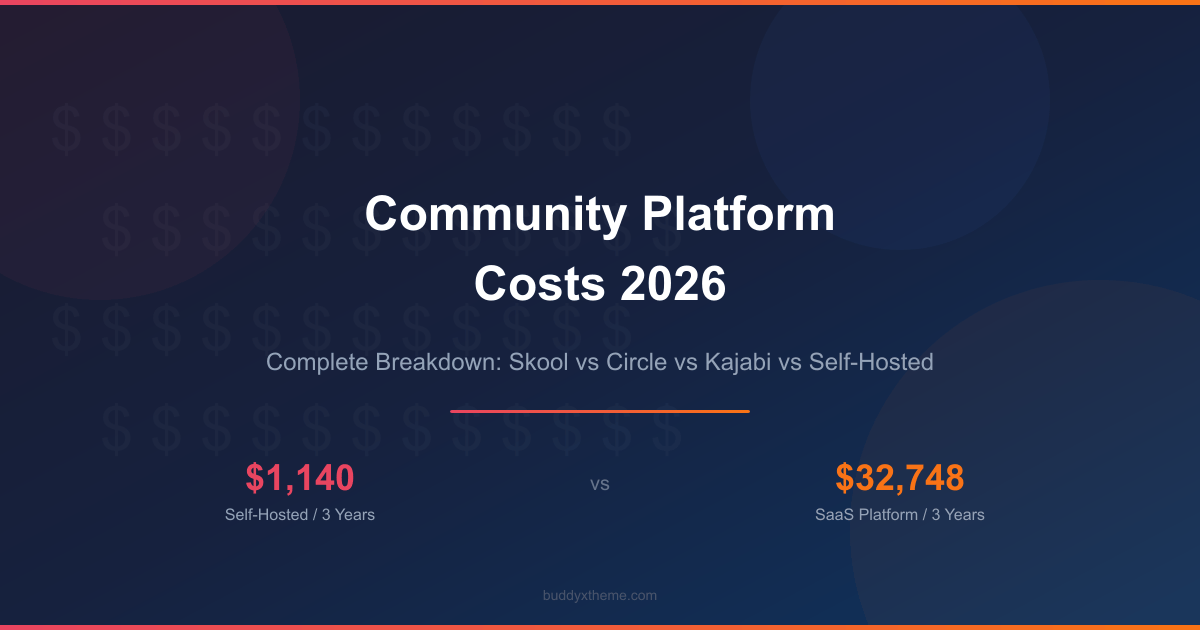
| Self-Hosted (WP) | $420 | $360 | $360 | $1,140 |
Over three years at 500 members, you could spend anywhere from $1,140 on a self-hosted platform to over $32,000 on Skool. That is a difference of more than $31,000. Even comparing self-hosted to the most affordable SaaS option (Kajabi at $7,164), you save over $6,000 in three years.
Think of it this way: would you rather pay rent on a storefront forever, or buy the building and stop paying monthly once you own it? The $31,000 you save over three years could fund content creation, marketing campaigns, live events, or simply become profit. Platform fees should not be your biggest line item after content creation.
And these projections assume your community size stays flat at 500. If you are growing, which is the entire point, the savings from a self-hosted platform compound even further. A community growing from 500 to 1,000 members over three years would see SaaS costs balloon while self-hosted costs barely change.
What About Free Platforms?
Free platforms seem like the obvious starting point. But “free” comes with its own costs, just in less obvious forms.
Facebook Groups
Zero cost, but you do not own your audience. The algorithm controls who sees your posts (organic reach is often below 10%). There are no built-in monetization tools, and Facebook can shut down your group or change its rules at any time. Your member data belongs to Meta, not you.
Discord
Free and feature-rich, but designed for real-time chat rather than structured community content. It is chaotic for course-based or knowledge-based communities. Poor discoverability means members cannot easily find past discussions or resources. The learning curve turns away non-technical members.
Slack
The free tier limits message history to 90 days and file storage to 5 GB. The paid tier at $7.25 per user per month gets expensive fast: a 200-member community costs $1,450 per month, or $17,400 per year. That makes Slack one of the most expensive options on this entire list.
WhatsApp and Telegram
Both are free but lack real community features. No content organization, no courses, no monetization, no member profiles. They work for casual group chats but not for structured, monetized communities.
The “free” trap is real: you pay with your data, your algorithm dependency, and your inability to monetize effectively. When you are ready to grow, you will need to migrate away, and that migration has its own cost.
The Cost Nobody Calculates: Switching Platforms
Research shows that the average community switches platforms within 18 months. Sometimes it is because the platform raised prices. Sometimes it is because features did not scale. Sometimes it is because members demanded a better experience. Whatever the reason, the switch is painful and expensive.
- Lost members: Expect 10% to 30% of your community to not follow you to the new platform. If you have 500 members paying $47 per month, losing 20% means losing $4,700 per month in revenue.
- Lost content: Most platforms do not offer clean data exports. Your carefully curated discussions, courses, and resources may not transfer fully.
- Setup time: Rebuilding your community on a new platform takes 40 to 100+ hours of work. At a consultant rate of $100 per hour, that is $4,000 to $10,000 in time value.
- Momentum loss: The disruption breaks engagement patterns. It takes months to rebuild the daily activity and culture you had.
- SEO impact: If your community content was indexed by search engines on your old platform, you lose all that organic traffic. On a self-hosted platform, your URLs and rankings stay with you permanently.
This is precisely why starting on a platform you own, one that grows with you without monthly fees or forced migrations, saves the most money over the long term. The cost of switching once can exceed the entire three-year cost of running a self-hosted community.
How to Choose Based on Your Budget
Your platform choice should be driven by your budget and expected revenue. Here is a practical framework that eliminates guesswork.
| Monthly Budget | Best Options | What You Get |
|---|---|---|
| Under $50/month | Self-hosted WordPress, free tier platforms | Full ownership at lowest cost, or free platforms with limitations |
| $50 to $150/month | Circle Basic, Mighty Networks Community, or self-hosted with premium tools | Good feature set with some trade-offs on customization |
| $150 to $400/month | Kajabi, Circle Pro, Mighty Networks Business | All-in-one features, but highest ongoing cost |
A useful rule of thumb: your online community platform cost should stay under 10% of your community revenue. If your community generates $5,000 per month, spending $500 on platform and tools is reasonable. If you are just starting out with $500 per month in revenue, a $99 per month platform is already eating 20% of your income.
Another way to think about it: calculate your cost per member per month. With a self-hosted platform at $360 per year and 200 members, your cost per member is $0.15 per month. With Skool at $5,084 per year and 200 members, your cost per member is $2.12 per month. That is 14 times more expensive per member, and none of that extra cost is going toward a better experience for your community.
Our Recommendation: Own Your Platform
After analyzing the numbers, the pattern is clear. If you are still wondering whether a community is right for your business, our article on why smart businesses are choosing community-led growth over paid ads makes the case. Once you are ready, here is what we recommend at each stage of growth.
- Just starting out: Begin where your audience already is, even if that means a free platform like a Facebook Group or Discord server. Validate your idea before spending money on tools. Your first 50 members care about your content, not your platform.
- Growing (100+ members): Move to an owned platform to avoid scaling costs. The sooner you own your infrastructure, the less you pay in cumulative SaaS fees and the lower your risk of forced migration. This is the ideal transition point before transaction fees start eating into your margins.
- Established (500+ members): A self-hosted community saves $2,000 to $4,000 per year minimum compared to SaaS alternatives. Over three years, that is $6,000 to $12,000 back in your pocket. At this scale, you are also building SEO value, brand equity, and data ownership that SaaS platforms cannot offer.
- The bottom line: The best investment you can make is owning your community platform from day one. You avoid monthly fees, you avoid migration nightmares, and you keep 100% of what your members pay you.
Frequently Asked Questions
What is the cheapest community platform in 2026?
For a paid, feature-complete platform, self-hosted WordPress is the cheapest option at $200 to $500 per year with no transaction fees. Among SaaS platforms, Circle Basic ($49 per month) and Mighty Networks Community ($49 per month) are the most affordable starting points, but costs increase significantly as your membership grows due to transaction fees.
Are transaction fees really that significant?
Yes. At 500 members paying $47 per month, a 2.9% transaction fee costs you $8,178 per year. Over three years, that is $24,534 in fees alone, on top of your monthly platform subscription. With a self-hosted platform, you only pay standard payment processor fees (Stripe at 2.9% + $0.30 per transaction) with no additional platform cut.
Is self-hosting too technical for a non-developer?
Not anymore. Modern community themes and hosting providers have made the setup process straightforward. Our guide on why every business needs a private online community in 2026 covers the benefits in detail. Many hosts offer one-click installations and managed services. You can also hire a developer for a one-time setup fee of $500 to $2,000, which still costs less than a single year on most SaaS platforms.
What happens if a SaaS platform shuts down or raises prices?
This happens more often than people expect. When a platform shuts down or significantly raises prices, you are forced to migrate on their timeline, not yours. With a self-hosted platform, you control your data, your content, and your pricing. No third party can force you to move or pay more.
Can I switch from a SaaS platform to self-hosted later?
You can, but it is expensive and risky. Expect to lose 10% to 30% of your members during the transition, plus invest 40 to 100+ hours in migration work. The longer you wait, the more content and members you risk losing. Starting on an owned platform from the beginning avoids this cost entirely.
The Bottom Line: Know Your True Costs Before You Commit
Running an online community is one of the most rewarding things you can do for your business. But going in without understanding the full financial picture can turn a profitable venture into a money pit. The online community platform cost is not just the monthly subscription. It is the transaction fees, the add-on tools, the moderation time, and the potential migration expenses.
Do the math for your specific situation. Use the tables above with your expected membership size and pricing. Look at the three-year projection, not just month one. And seriously consider whether renting a platform forever makes sense when you could own one outright.
The numbers do not lie. At every scale beyond 50 members, self-hosted platforms deliver the lowest cost, the most control, and the highest long-term value. The community you build deserves a foundation that grows with you, not one that charges you more for every new member you bring in.
Want to Skip the Monthly Fees?
We build owned community platforms for a one-time cost. No monthly fees. No transaction cuts. No forced migrations. Your community, your platform, your revenue.