Shopify vs Magento SEO: Which Platform Offers Better Optimization for Your Store?


Shopify and Magento are two of the most widely used e-commerce platforms. But if you are just starting out, it can get pretty confusing knowing which one is best for SEO. Both seem to have solid perks.
Even more confusing is the fact that users of each will swear their CMS is the best!
So, who do you believe? Well, in this post, we’ll take a closer look at the Shopify vs. Magento SEO. This will help you settle the question one last time.
What an SEO-Friendly E-Commerce Platform Looks Like
There are so many e-commerce platforms out there. But not all of them are SEO-friendly. Here’s how you can tell the difference:
Mobile Friendliness
Every SEO-friendly platform will have responsive designs that make it just as good on desktops as on mobile devices.
This is important because mobile devices now drive more than half of the web traffic. So, if you have an online store, a mobile-friendly platform is non-negotiable.
Site Speed
Search engines prioritize sites that can load in no more than three seconds. That means if your CMS platform’s performance isn’t good enough, there’s no point in using it.
Think of it this way — sites in your niche that load faster will rank higher than yours in search engines. This will happen no matter how good your site is or how high-quality your products are.

Source: PageSpeed Insights
Security
With cyberattacks becoming more common, people are very worried about their digital footprint and the safety of their data online.
But it isn’t just your users. Search engines, as well, tend to look down on websites that do not have SSL certificates.
This is one of the absolute fundamentals. If you don’t have great security, all your SEO blogs or dofollow links from quality linked domains won’t be worth anything.
So, you need to make sure that any platform you choose prioritizes safety.
Meta Tag Control
A good CMS platform will allow you some control over your meta tags. You need this to edit your descriptions, titles, and other details for SEO.
This is important for getting search crawlers to understand what your site is about.
Customizable URL
This may not be high on everyone’s list. But just like with meta tags, you need to be able to add in your keywords and customize your URLs.
Your links also give search engines (and your website visitors) a better idea about each page.
Structured Data
You will need a platform that allows you to create rich snippets if you want your online store to rank.
These are just some of the features you want to see in any e-commerce platform you intend to use. The more SEO-friendly your CMS is, the better.
Also Read: PrestaShop vs WooCommerce Which Platform Reigns Supreme?
Magento and Shopify: Main Differences
Now you know some of the features to look out for when choosing e-commerce platforms.
So, it’s time to focus on Shopify and Magento.
These two are among the most popular options out there. But are they the same? Not at all! Let’s look at some of the major differences between Magento and Shopify to give you a better idea.
Note: Magento is now officially called Adobe Commerce, but most people still refer to it as Magento. So, don’t get confused.
#1 Flexibility and Customization
Both platforms offer you good flexibility and customization, but to a different degree.
Magento is open-source (unless you’re using the Cloud version), which means you’ve got tons of customization options.

Source: Adobe
You can integrate nearly all kinds of apps or solutions into it. This makes it great for businesses that need something that can handle multiple complex tasks.
Shopify, on the other hand, is more focused on simplicity. You’ve got prebuilt themes, but that also limits your customization options.

Source: Shopify
#2 Ease of Use
With Magento, you’ll need to figure out how to set it up properly. It takes a lot of technical skills and much time to work with this one, especially if you want to get the full benefit of it.
If something goes wrong, you’ll need even more serious technical know-how to fix it. So, often you require a whole team of people to sustain this CMS. That’s why it’s a popular choice among big companies and corporations, not small businesses.
But with Shopify, you can be up and running in a couple of hours, literally. It’s intentionally designed to be easy to set up and use. So, even if you’re a beginner, you’ll be fine.
#3 Features and Scalability
So far, it isn’t hard to spot that Magento allows you to scale a lot more easily. So, yes, the setup can be a headache, but the expansion is generally simpler.
This CMS can handle more traffic, multiple storefronts, multiple language support, etc.
Shopify allows you to scale up when you upgrade your subscription. It can still be limiting for huge businesses, but for most e-stores, it’s more than enough.
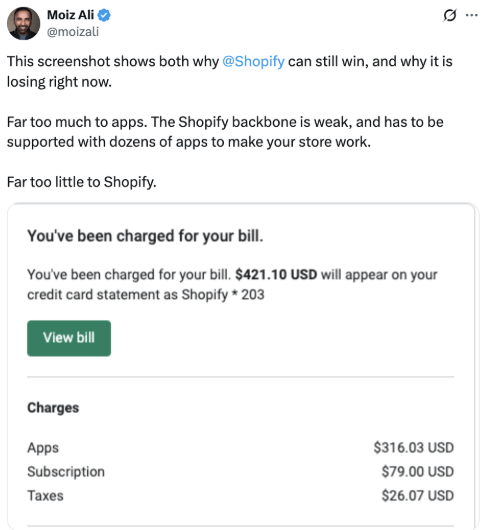
Still, for many, the issue is that you have to pay for third-party apps and add-ons to access more features.
Source: X
#4 Pricing
You can download Magento for free. That probably caused a cheer around the world, but hold on just a bit.
To get any full use out of it, you will need good hosting, a skilled Magento developer (or even a couple of them), and tons of other maintenance expenses. All of this will cause the costs to rise quickly.
Compare this to Shopify, where you hardly need to be a skilled developer before you can properly use it. Of course, you have to pay for your subscription and some apps. Still, usually, it’s much cheaper than Magento.
Also Read: OpenCart vs Magento – Choosing the Right Ecommerce Champion
SEO Features Compared
We have looked at the differences between the two platforms. So, it’s time to compare the SEO features of both.
#1 Built-in SEO Tools
One of the first things you’ll notice when you compare the two is that Shopify gives you some SEO tools right out of the box. You’ll get automatic sitemap generation, responsive themes, etc.
It allows you to easily optimize your content, whether visual or written. But often, you’ll need some SEO extensions for this.
Besides, if you want to get really technical and advanced, Shopify might not be the perfect option.
Magento, on the other hand, has some of the greatest capabilities when it comes to e-commerce CMSs.
Yet, it’s also one of the most complicated platforms out there. So, unless you have a team of developers specialized in Magento, it’ll be tough.
Of course, many also wonder how the situation is with blogging, as it’s very important for SEO and lead generation. The good news is that both allow you to start blogs, add links in the blogs, and use other typical features.
But there are also some huge differences:
- Shopify gives you a blog option out of the box. So, you don’t really need to set up anything. But it’s also limited in terms of optimization features, especially when it comes to advanced SEO.
- Magento is the complete opposite. The setup takes time and resources — you either need a third-party extension or custom coding. Yet, once you have it, your possibilities are almost limitless.
#2 Technical SEO
Technical SEO is huge for your website to get indexed and ranked properly.
But is there any difference between Magento vs. Shopify technical SEO? Short answer — yes.
Shopify makes technical SEO quite easy because most of it is automated. Your sitemap, for example.
The only thing is, you don’t really get control over your URL hierarchy. Since it’s mostly built-in, there’s a limit to what you can change.
Magento gives you even more customizable technical SEO access. You can adjust server-level settings and even advanced caching changes.
If that sounds like a lot of technical jargon, let’s make it simpler — basically, Magento allows you to change everything from top to bottom.
But no matter what your platform’s capabilities are, you’ll still need to keep your eyes on the real-time SERP performance and other SEO data. This way, you can quickly spot what you are doing wrong or right.
#3 Performance and Page Speed
If you’re using Spotify, you’ll generally have decent page speed, and your web performance will be good.
That’s because the platform has a great CDN setup thanks to its cloud hosting service. You don’t have to worry about caching, speed, etc.
You can just go ahead and focus on setting up your store and optimizing your product page content.

Source: Shopify
For those who decide to go with Magento, you’ll not be getting these benefits automatically. You’ll have to make your choice and carefully decide on the right server setup for you.
Still, it can be very fast if you do everything correctly.
Choosing the Right Platform Is Only Half the SEO Battle
So, should you go for Magento or Shopify for SEO? The truth is, it depends on what you need and like. But don’t rush into making any decisions. At least not yet. You need to consider both platforms carefully.
Say you want built-in tools, then Shopify might be more your jam. But if flexibility and advanced SEO optimization are deal breakers for you, then you’ll probably love Magento more.
After all is said and done, there’s more to search engine optimization than just the platform you use. So, no matter what CMS you choose, the most important thing is to put in consistent effort towards your SEO. This is the secret of long-term e-commerce success.
Interesting Reads:

Shashank is a seasoned digital marketing and WordPress expert who specializes in SEO, software tools reviews, and cutting-edge strategies for boosting online presence. With a passion for simplifying complex topics, Goutham crafts engaging blog posts that help readers optimize their websites, improve search engine rankings, and stay ahead in the ever-evolving digital landscape.