

Tableau is widely known as one of the most powerful data visualization and business intelligence (BI) tools on the market. It offers robust dashboards, real-time analytics, and deep integration with data sources. However, many organizations and individuals are now looking for Tableau alternatives due to high costs, steep learning curves, or feature limitations in the free version.
Whether you’re a business analyst, data scientist, or team manager, here are the top Tableau alternatives that offer a wide range of data analytics, visualization, and reporting features—at different price points and levels of complexity.

Quick Links
Why Consider a Tableau Alternative?
Great BI doesn’t have to be expensive or complex. If Tableau’s licensing model, learning curve, or limitations in the free tier are holding you back, some tools match your must-have features—often at lower cost.
From open-source stacks to fully managed cloud suites, the right choice depends on your data sources, governance needs, and how quickly your team needs to go from raw data to decision-ready dashboards.
Top Tableau Alternatives (2025)
Below are standout options across budgets and skill levels, covering self-service dashboards, governed BI, and embedded analytics use cases. Skim the summaries to shortlist a few that align with your stack, then trial them with a real dataset to validate performance and workflow fit.
1. Qlik Sense

Qlik Sense leverages an associative in-memory engine that enables fast, free-form data exploration beyond traditional query paths. Users benefit from self-service analytics, smart AI suggestions, and scalable on-premise or cloud deployment options that handle large datasets efficiently. Its focus on discovery makes it particularly powerful when you want to uncover hidden relationships in your data.
Best for: Enterprises with large datasets and a focus on data discovery.
2. Looker (by Google Cloud)
Looker is a modern, SQL-centric BI platform built for cloud data warehouses and real-time analytics. Its LookML modeling layer enforces consistent metrics and governance across teams, while embedded analytics and API-first design make it easy to surface insights inside other applications. Looker excels when you need tight integration with Google Cloud services and robust, governed reporting at scale.
Best for: Data teams with complex reporting needs and cloud-native architecture.
3. Microsoft Power BI
Power BI is a cost-effective, enterprise-ready BI platform that tightly integrates with Microsoft 365, Excel, and Azure. It offers drag-and-drop dashboard creation, advanced data modeling, and AI-driven insights that make it easy for analysts and business users to turn spreadsheets and databases into interactive reports. With a free desktop version and affordable cloud options, Power BI scales from individual analysts to organization-wide deployments.
Best for: Businesses already using Microsoft products or seeking affordable enterprise BI.
4. Google Data Studio (Looker Studio)
Looker Studio is a free, cloud-native dashboard builder that connects easily to Google Sheets, BigQuery, and many third-party connectors. It supports collaborative report building in the Google ecosystem, offering simple visualizations and shareable links for teams that need quick, no-cost reporting. While it doesn’t match Tableau’s depth of customization, it’s highly accessible for marketing and small-business use cases.
Best for: Marketers, small businesses, and educators needing simple, cloud-based dashboards.
Also Read: Top 10 Alternatives to Amazon and Competitors for Online Shopping and Selling
5. Sisense
Sisense combines ETL-style data preparation, advanced analytics, and embeddable visualizations in a single platform designed for the productization of analytics. It provides strong developer tooling, APIs for white-labeling, and machine learning integrations that let engineering teams weave analytics into SaaS offerings or customer portals. Sisense is built for scale and embedding rather than casual ad-hoc reporting.
Best for: SaaS companies and developers looking to embed BI in products.
6. Metabase
Metabase is an approachable, open-source BI tool that enables non-technical users to ask questions of their data through a visual query builder while still supporting SQL for power users. The self-hosted option is free, and paid hosting is available for teams who prefer managed infrastructure. With scheduled reports, simple dashboards, and a focus on quick setup, Metabase is ideal for teams that want lightweight, community-driven analytics.
Best for: Startups, developers, and technical teams that prefer open-source tools.
7. Zoho Analytics
Zoho Analytics blends a user-friendly interface with AI-powered insights (Zia) and broad connectivity across the Zoho ecosystem and external data sources. It offers guided reporting, drag-and-drop visualization, and natural-language querying that speed up analysis for non-technical users. Pricing is competitive, making it attractive for SMBs already invested in Zoho apps or looking for affordable, integrated BI.
Best for: SMBs and teams already using Zoho products.
8. Domo
Domo is a cloud-native platform that unifies data ingestion, transformation, visualization, and lightweight app building in one environment. It provides real-time dashboards, a large library of connectors, and features designed for organization-wide deployment and executive reporting. While powerful and scalable, Domo typically comes at a higher price point suited to large enterprises with extensive BI needs.
Best for: Large companies needing real-time, organization-wide dashboards.
9. Apache Superset
Apache Superset is an open-source, enterprise-ready visualization platform that supports rich charting and large-scale SQL exploration. It integrates with many relational databases and data lakes and is engineered for teams with the technical resources to deploy, tune, and maintain an open-source stack. Superset is ideal when you want complete control over hosting and customization without vendor lock-in.
Best for: Data teams with engineering resources to manage open-source deployments.
Also Read: The 12 Best Software for AI-Powered Business Intelligence In 2025
10. Klipfolio
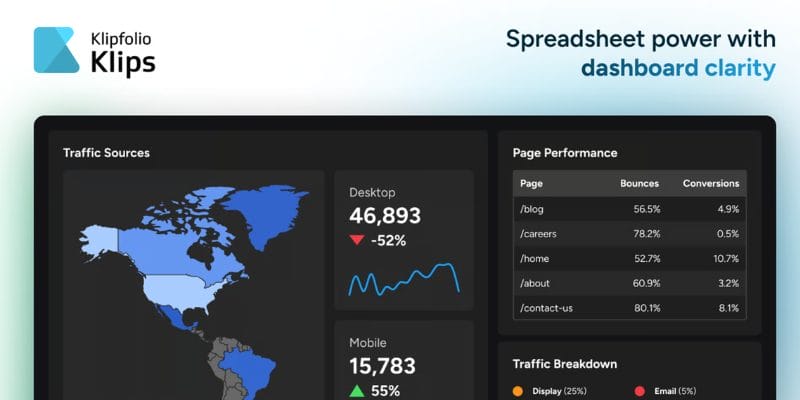
Klipfolio is a cloud dashboard builder focused on real-time KPI visualization from cloud apps, spreadsheets, and custom APIs. It provides an intuitive builder for custom metrics and formulas and supports many out-of-the-box integrations for marketing and sales data sources. With a quick setup and emphasis on live dashboards, Klipfolio helps teams monitor performance at a glance.
Best for: Marketing and sales teams wanting live dashboards and fast setup.
Tableau Alternatives Comparison Table
| Tool | Pricing Model | Open Source | Cloud Support | Best For |
| Microsoft Power BI | Free / Paid | No | Yes | Microsoft users and budget-conscious teams |
| Looker (Google) | Subscription | No | Yes | Cloud-native enterprises |
| Qlik Sense | Subscription | No | Yes / On-prem | Advanced analytics and data discovery |
| Looker Studio | Free | No | Yes | Simple, collaborative dashboards |
| Sisense | Subscription | No | Yes | OEM and embedded analytics |
| Metabase | Free / Paid | Yes | Optional | Developers and open-source adopters |
| Zoho Analytics | Free / Paid | No | Yes | SMBs and Zoho ecosystem users |
| Domo | Subscription | No | Yes | Large enterprise dashboards |
| Apache Superset | Free | Yes | Self-hosted | Tech-savvy teams and engineers |
| Klipfolio | Paid | No | Yes | Real-time KPI dashboards |

Choosing the Right Tableau Alternative
For organisations seeking full-featured enterprise BI at a more affordable price point, Microsoft Power BI stands out as the most direct competitor to Tableau. If your preference is for open-source flexibility, both Metabase and Apache Superset provide strong, community-driven solutions with the freedom to customise. On the other hand, tools like Looker Studio, Klipfolio, and Zoho Analytics are excellent choices for teams needing quick, visual dashboards—particularly in marketing and cloud-based environments.
Meanwhile, Sisense and Qlik Sense are better suited for developers and enterprises
that require scalable, embedded analytics capabilities. Ultimately, the right Tableau alternative depends on your organisation’s technical expertise, collaboration requirements, and integration needs. Whether you aim to scale BI across departments or create simple internal dashboards, these tools deliver strong performance across a variety of use cases.
Interesting Reads:
Top 10 Dropbox Alternatives and Competitors

