BuddyX Finally Has Its Own Forum: Introducing Jetonomy

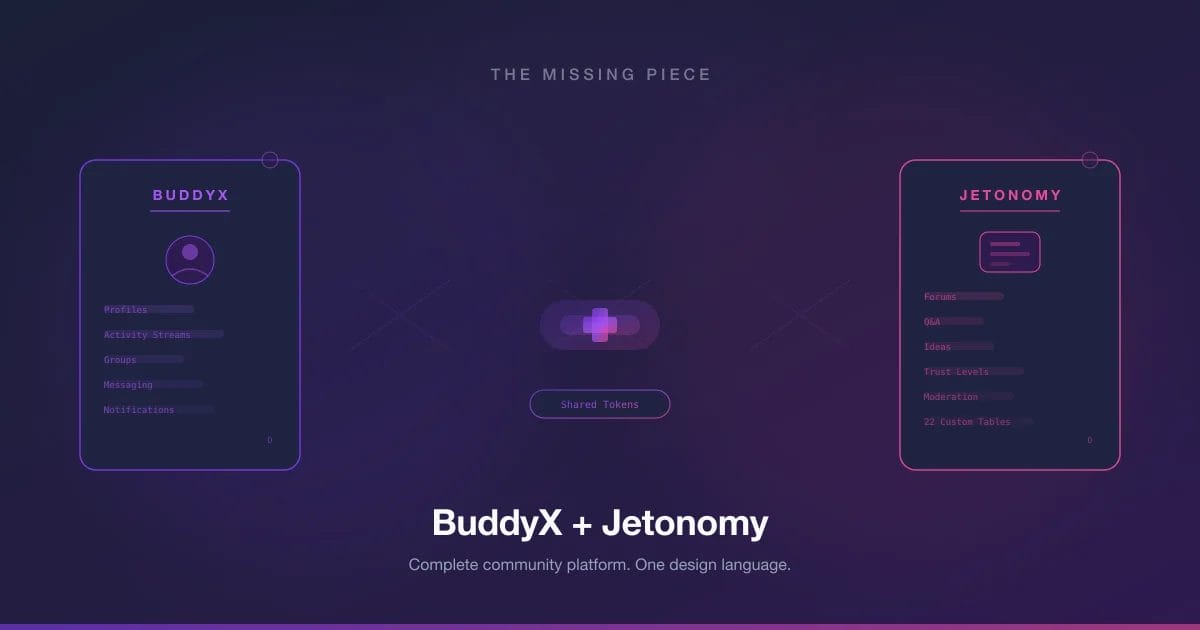
BuddyX has always been about building complete community experiences on WordPress. Member profiles, activity streams, social groups, messaging, notifications, everything a modern community needs, wrapped in a design system that adapts to any brand.
Everything except forums.
For years, BuddyX users who needed discussion spaces had to rely on bbPress. And while bbPress served its purpose, the experience was never seamless. The styling clashed. The permissions were too basic. The performance degraded as communities grew. Every BuddyX site owner running bbPress knows the frustration of a forum that looks and feels like it belongs to a different website.
We heard this feedback constantly:
“bbPress doesn’t match my BuddyX theme.” “My forum slowed down after a few thousand topics.” “I need moderators for specific spaces, not just global roles.” “New users are spamming and I have no way to throttle them automatically.”
We could have built a bbPress compatibility layer. We could have written more CSS overrides. But patches on top of a fundamentally different architecture only go so far.
And here is the thing most people miss: the demand for community discussion spaces is not declining. It is growing faster than ever.
Reddit grew to 1.7 billion monthly visits by proving that people want structured, searchable, persistent conversations around shared interests. Social media feeds are ephemeral. Chat apps are chaotic. But forums create lasting knowledge bases where answers live forever and communities build real identity. The problem was never the format. It was the tools.
Stack Overflow proved that community Q&A is worth more than any documentation team. When developers can vote answers up and mark problems as solved, the best knowledge rises naturally. Every support forum, product community, and learning platform needs this.
ProductHunt, Canny, and UserVoice charge $100-400/month to let users submit and vote on feature ideas. The concept is simple, submit, vote, track status, and there is no reason it should require a separate subscription when your WordPress site can host it natively.
Discord, Circle, Mighty Networks, everyone is building community platforms. But BuddyX users already have the best community foundation on WordPress. What they needed was the discussion layer to complete it.
So we built Jetonomy, a forum plugin designed from the ground up to work with BuddyX.
Why BuddyX Needed Its Own Forum Solution
BuddyX is not just a theme. It is a community design system, CSS custom properties for colors, typography tokens for fonts, spacing scales that respond to theme.json, dark mode that toggles with a single attribute. Every component in BuddyX speaks the same visual language.
bbPress does not speak that language. It brings its own styles, its own layout assumptions, its own idea of what a forum should look like. The result is a community site where the profile pages feel modern and the forum feels dated. Two different design philosophies fighting on the same page.
Jetonomy was built by the same team that builds BuddyX. It reads the same CSS custom properties. It inherits the same fonts, colors, spacing, and border radius. When BuddyX switches to dark mode, Jetonomy switches with it, no configuration, no extra CSS, no compatibility plugin.
This is not a third-party integration. This is the missing piece of BuddyX, built by the people who know the theme best.
What Jetonomy Brings to BuddyX
Three Community Types, Not Just Forums
BuddyX handles social networking, profiles, activity, groups. Jetonomy handles structured discussion in three modes:
Forum Spaces for open discussion. Members create topics, others reply in threaded conversations up to 3 levels deep. Smart loading handles high-traffic threads by showing the first and last replies with a gap loader in between.
Q&A Spaces where the best answer rises to the top. Post authors can mark an accepted answer. Replies sort by votes. This is Stack Overflow inside your BuddyX community, perfect for product support, knowledge bases, and learning communities.
Ideas Spaces where members submit and vote on feature requests. Administrators track status through a roadmap view: Open, Under Review, Planned, In Progress, Completed, Declined. This replaces tools like Canny or UserVoice that charge $100-400/month for the same functionality.
Trust Levels That Stop Spam Before It Starts
Every BuddyX community owner has dealt with spam. New accounts signing up and flooding forums with links before anyone notices.
Jetonomy solves this with a trust level system. Every new user starts at Level 0, they can read everything, but posting is rate-limited to 3 posts per day and they cannot include external links. This single feature eliminates the majority of spam without any moderator intervention.
As members participate legitimately, posting, replying, receiving upvotes, they earn higher trust levels automatically. The system evaluates trust every 12 hours based on activity metrics.
Six levels in total:
- Level 0, Newcomer. Rate-limited. No links. The automatic spam quarantine.
- Level 1, Member. Standard posting. Links and images allowed.
- Level 2, Regular. Higher rate limits. Can edit post titles.
- Level 3, Trusted. Can close topics and move threads between spaces.
- Level 4, Leader. Manually granted. Space management capabilities.
- Level 5, Moderator. Full moderation access.
Your community develops its own immune system. Early contributors become the moderators who keep things healthy. Site owners spend less time policing and more time participating.
Permissions That Match Real Communities
bbPress gives you one layer of control: WordPress roles. Everyone with the same role has the same permissions everywhere.
Jetonomy gives you three layers:
WordPress Capabilities control global access, who can read, post, moderate, or manage settings. Twenty custom capabilities mapped to WordPress roles.
Space Roles give per-space control. A user can be a moderator in the Photography space and a regular member everywhere else. Space admins manage their own space without needing WordPress Admin access.
Trust Level Gates add earned-access controls. Level 3 members can close topics. Level 1 members can send private messages. New users cannot post links until they have earned basic trust.
These three layers resolve together in a single permission check. The result is fine-grained control that scales from a small hobby community to a large membership site with dozens of gated spaces.
Built on Custom Tables, Not Post Types
This is the technical decision that changes everything for growing BuddyX communities.
bbPress stores forum data in wp_posts and wp_postmeta, the same tables WordPress uses for blog articles. When your forum grows past a few thousand topics, the postmeta table balloons to millions of rows. Queries slow down. Your entire WordPress site gets heavier, not just the forum.
Jetonomy uses 22 custom MySQL tables designed specifically for community data patterns. Vote counts, reply counts, and view counts are stored directly on the post row as denormalized counters, no COUNT queries, no multi-join nightmares.
A space with 10,000 posts loads just as fast as one with 10 posts. That is a direct consequence of using the right data model for the job.
And because Jetonomy uses its own tables, it never impacts BuddyX or BuddyPress performance. BuddyPress has its own tables. Jetonomy has its own tables. They coexist without competing for the same database resources.
Design Token Bridge, Zero Styling Conflicts
This is where the BuddyX integration truly shines.
Jetonomy’s CSS uses a token system that reads BuddyX’s custom properties directly:
--jt-accentinherits from BuddyX’s brand color--jt-textinherits from BuddyX’s text color--jt-bginherits from BuddyX’s background--jt-fontinherits from BuddyX’s body font--jt-radiusinherits from BuddyX’s border radius
When you change your BuddyX accent color, every Jetonomy element updates automatically. When you toggle dark mode, Jetonomy follows. When you switch fonts in theme.json, Jetonomy inherits.
No CSS overrides. No “forum styling” settings page. No compatibility patches. The forum looks like BuddyX because it reads BuddyX.
The Complete BuddyX Community Stack
Here is what your community site looks like with BuddyX + Jetonomy:
BuddyX handles the social layer: – Member profiles with avatars, cover photos, and activity history – Activity streams showing what members are doing – Social groups for organizing members – Friend connections and messaging – Notifications across the entire community
Jetonomy handles the discussion layer: – Forum spaces for open threaded discussions – Q&A spaces where the best answers rise naturally – Ideas spaces with voting and a public roadmap – Moderation queue with flag system and ban controls – Full-text search across all discussions – SEO-ready markup with Schema.org JSON-LD
They share: – The same design tokens, consistent look everywhere – Dark mode, toggles together automatically – Separate data layers, neither slows down the other – The same development team, no compatibility surprises
For BuddyX Pro users, this means the premium community experience now extends from profile page to forum thread. One team, one design language, one community platform.
Why Not Just Fix bbPress Compatibility
We get this question a lot. If the problem is that bbPress does not match BuddyX, why not just write better CSS compatibility? Why build an entirely new plugin?
Because the problems go deeper than styling.
bbPress stores data in wp_posts and wp_postmeta. Every forum topic, every reply, every vote, every piece of metadata shares the same tables your blog posts use. When your community grows past a few thousand topics, the postmeta table balloons to millions of rows. Queries slow down. Your entire WordPress site gets heavier, not just the forum.
Jetonomy uses 22 custom MySQL tables designed specifically for forum access patterns. Vote counts, reply counts, and view counts are stored directly on the post row. No COUNT queries. No joins across million-row meta tables. A space with 10,000 posts loads just as fast as one with 10.
bbPress permissions are one-dimensional. You get WordPress roles. A Subscriber is a Subscriber everywhere. An Editor is an Editor everywhere. There is no concept of “moderator in this space but member in that one.”
Jetonomy gives you three permission layers: WordPress capabilities for global control, space roles for per-space authority, and trust level gates for earned access. A user can moderate the Support Q&A space while being a regular member in General Discussion. Space admins manage their own spaces without needing WordPress Admin access.
bbPress has no anti-spam intelligence. Without trust levels, every new user has the same posting capabilities as a two-year veteran. CAPTCHA catches bots but does nothing about human spammers. Manual moderation does not scale.
Jetonomy’s trust levels mean new users are automatically rate-limited and cannot post links. They earn posting freedom through legitimate participation. The community polices itself.
bbPress pagination breaks on active forums. It uses offset pagination, “give me posts 21-40.” When new content appears while someone is browsing, they see duplicates or miss posts entirely.
Jetonomy uses cursor-based pagination on every endpoint. “Give me the next 20 after this specific ID.” Your browsing position stays consistent no matter how active the forum gets.
These are not CSS problems. They are architecture problems. And the only way to solve architecture problems is to build the right architecture from the start.
What Ships Free
Jetonomy’s free version is not a limited demo. It is a full community platform:
- Unlimited spaces, sub-spaces, and categories with drag-sort ordering
- Forum, Q&A, and Ideas space types
- Rich text editor for posts with threaded replies (3 levels deep)
- Upvote/downvote on posts and replies
- Full 6-tier trust level system with automatic evaluation
- Reputation points and community leaderboard
- 3-layer permission system
- Flag/report system with 4-tab moderation queue
- MemberPress and Paid Memberships Pro adapters included
- MySQL FULLTEXT search
- Web notifications with bell icon
- Schema.org JSON-LD, XML Sitemaps, OG tags
- bbPress, wpForo, and Asgaros Forum importers
- 35+ REST API endpoints with cursor-based pagination
- Template overrides via your theme directory
What Jetonomy Pro Adds
For larger communities that need more, Jetonomy Pro adds 10 modules:
- Private Messaging, 1:1 and group conversations with unread tracking
- Reactions, 8 emoji reactions on posts and replies
- Polls, Single/multi choice polls attached to posts
- Analytics, Community metrics dashboard with CSV export
- Custom Badges, Badge builder with auto-evaluation criteria engine
- Advanced Moderation, Auto-mod rules with keyword filters, regex, and spam scoring
- Custom Fields, 9 field types across posts, profiles, and spaces
- Email Digest, Daily/weekly digest emails with per-user preferences
- SEO Pro, Per-space meta templates and sitemap controls
- White Label, Custom branding, logo, and CSS injection
Plus additional importers for Discourse, phpBB, vBulletin, XenForo, and Simple Machines.
Migrating From bbPress
If your BuddyX site currently runs bbPress, Jetonomy’s built-in importer handles the migration:
- Go to Admin → Jetonomy → Import
- Select bbPress as the source
- Jetonomy auto-detects your bbPress data and shows stats
- Run a dry run to preview what will be imported
- Execute the import with progress tracking
Forums become spaces. Topics become posts. Replies become replies. Users map to their existing WordPress accounts. Your community history is preserved.
The Frontend: WordPress Interactivity API
Jetonomy is one of the first major WordPress plugins built entirely on the WordPress Interactivity API. No React runtime. No jQuery dependencies. No external JavaScript frameworks.
Forum pages are server-side rendered PHP templates, real HTML that search engines can read and index. Interactive elements like voting, reply sorting, and new-reply polling are handled through the Interactivity API with progressive hydration. The total JavaScript footprint is roughly 10KB.
For BuddyX users, this means two things. First, the forum does not add bloat to your site. Pages load fast because there is no heavy JavaScript bundle competing with your theme’s assets. Second, the server-rendered HTML means search engines index every discussion, every Q&A answer, every idea board. Your community content becomes a search traffic asset, not a hidden black box behind JavaScript rendering.
Jetonomy also outputs proper Schema.org JSON-LD markup, DiscussionForumPosting for forum threads, QAPage for Q&A spaces with accepted answers, BreadcrumbList for navigation. Combined with XML Sitemaps registered as WordPress core sitemap providers, Open Graph tags, and Twitter Cards, every piece of community content is optimized for discovery.
The Technical Philosophy
Jetonomy follows the same principles that make BuddyX reliable:
WordPress-native. It uses WordPress capabilities, rewrite rules, REST API, Interactivity API, object cache, and hooks. It is a proper WordPress plugin, not a separate application wearing a WordPress costume.
Scale by default. The architecture handles 10,000 posts in a single space as a baseline, not an edge case. Denormalized counters, cursor-based pagination, and proper indexing are built in from day one.
Adapters over dependencies. Every external integration, membership plugins, search providers, email services, follows an adapter pattern. The core has zero hard dependencies on any external plugin.
Privacy first. Your forum data lives in your database on your server. No external API calls, no telemetry, no analytics pings. The only outbound request is the Pro license check.
Extensible by design. Jetonomy ships with a complete hook system, actions and filters at every meaningful point. Templates are overridable via your theme’s jetonomy/ directory. Every external integration follows an adapter interface, so you can swap membership plugins, search backends, email providers, and real-time transports without touching core logic. And with WordPress Abilities API support (18 registered abilities), AI agents and automation tools can discover and interact with your community programmatically.
For developers building on BuddyX, this means Jetonomy integrates the same way BuddyPress does, through standard WordPress patterns. If you know hooks, you know how to extend Jetonomy.
How Real BuddyX Communities Will Use This
Membership communities can create gated discussion spaces tied to MemberPress or Paid Memberships Pro levels. Free members get access to General Discussion. Premium members unlock exclusive Q&A spaces with direct support from experts. The access rules handle this natively, no custom code needed.
Learning communities can pair BuddyX’s group features with Jetonomy’s Q&A spaces. Students ask questions about course material, instructors and advanced students provide answers, the best answers rise through voting, and everyone benefits from a growing knowledge base.
Product communities can use Ideas spaces as a public roadmap. Users submit feature requests, vote on what matters most, and watch ideas move through statuses from Open to Completed. This replaces expensive SaaS tools like Canny or UserVoice with a native WordPress experience inside your BuddyX community.
Support communities can use Q&A spaces to let users help each other. Accepted answers get pinned. Common questions build a searchable archive. Support teams spend less time answering the same questions and more time on complex issues.
Professional networks can create space-based discussions for different industries, skills, or interest groups. Trust levels ensure quality, new members observe before they participate heavily, and proven contributors earn moderation capabilities over time.
Nonprofit and cause-based communities can use Jetonomy’s access rules to create tiered participation. Volunteers get access to coordination spaces. Donors unlock exclusive discussion forums. Board members have private strategy spaces. All managed through the same permission engine without custom code.
Creator and fan communities can combine BuddyX’s social profiles with Jetonomy’s forum and ideas spaces. Creators run discussions with their audience, fans vote on what content to produce next through Ideas spaces, and Q&A spaces serve as a permanent knowledge archive that grows more valuable over time.
Try It This Friday
Jetonomy launches this Friday on wbcomdesigns.com. If you run BuddyX, this is the forum solution you have been waiting for.
Install it, activate it, and your BuddyX site will have a fully integrated community discussion layer in under five minutes. The setup wizard creates your first category and space. If you are migrating from bbPress, the importer handles everything.
We built BuddyX to be the best community theme for WordPress. Now Jetonomy gives it the discussion engine it always deserved.
Questions? Drop them in the comments or reach out to our support team.