
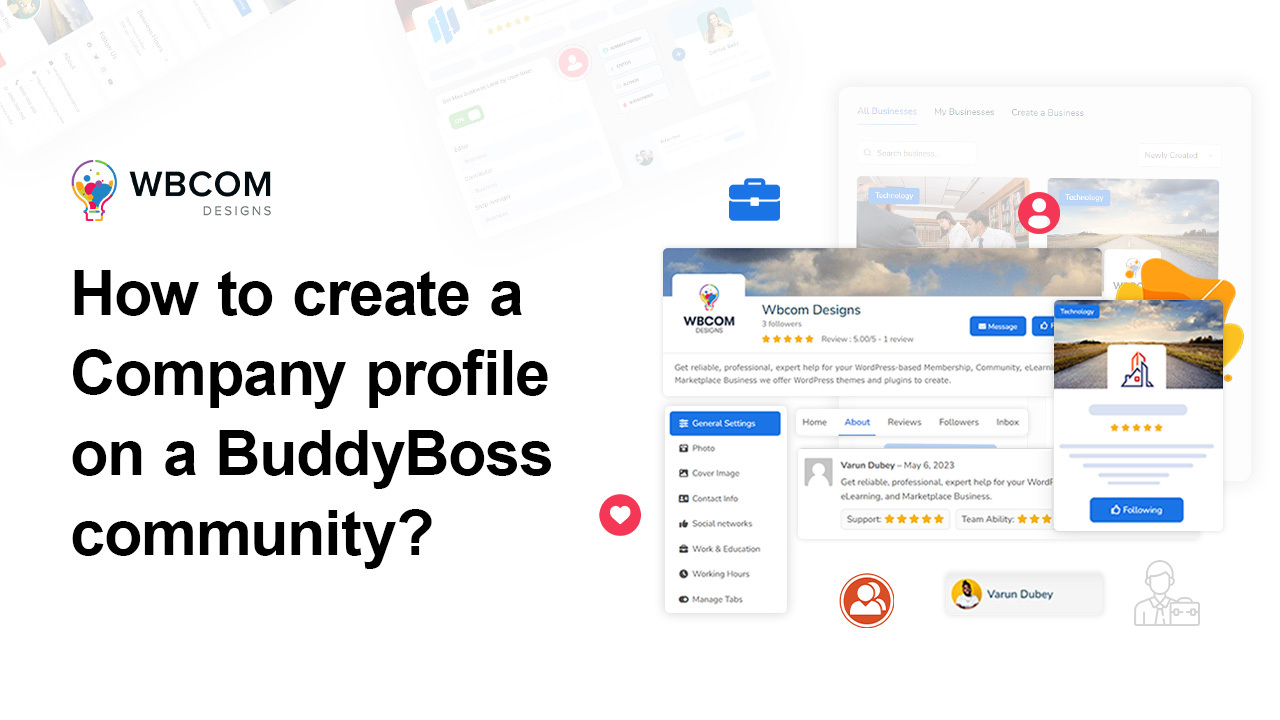
BuddyBoss is a customizable platform for building an online community, course, or membership site on WordPress, and it connects with services like Zoom, YouTube Live, WooCommerce, and LearnDash. One thing it doesn’t do natively is give a business its own dedicated profile page inside the community. That’s a gap worth noticing, because plenty of BuddyBoss communities aren’t just gathering places for individuals, they’re also spaces where local businesses, sponsors, partner brands, or member-run companies want a presence. Bolting that onto a standard member profile never works cleanly: a business isn’t a person, it has hours, a logo, a service list, and reviews from customers rather than a bio and a profile photo.
That’s what the BuddyPress Business Profile plugin from Wbcom Designs adds: a page type built specifically to showcase a brand’s mission, products, services, and reviews to the rest of the community, separate from the regular member directory. This walkthrough covers the actual setup steps, what the plugin has grown into since it was first covered here, and the decisions worth making before you turn a business directory loose on your members.
Why a Standard Member Profile Isn’t Enough for a Business
A default BuddyBoss member profile is built around a person: a name, an avatar, a short bio, maybe some custom profile fields. Try to represent a company through that same structure and you immediately hit friction. There’s no natural place for business hours, no dedicated tab for a service catalog, no review system a customer could use to rate their experience, and no way to distinguish “this is an individual member” from “this is an organization with its own page.” Communities that try to force a business into a personal profile usually end up with an awkward workaround, a shared login for the whole company, a bio field crammed with a service list, or a separate custom post type nobody integrated with the rest of the community.
A dedicated business profile type solves this at the structural level rather than papering over it. The business gets its own page, its own tabs, and its own place in a searchable directory, while individual members keep their personal profiles exactly as they were.
BuddyPress Business Profile Plugin
BuddyPress Business Profile lets members build and manage a company page inside your BuddyBoss community: business details, products, services, reviews, and ratings, with support for multiple profiles assigned to different members or groups. The plugin has grown well past a basic profile page since it was first covered here. It now includes a searchable directory with map view, weekly availability scheduling, photo galleries, follower counts, LocalBusiness SEO schema, and integrations with WooCommerce, Events Calendar, and WP Job Manager. Current pricing runs $59-299/year depending on tier, with the higher tiers unlocking the directory map view and the deeper third-party integrations.
What You Get Beyond the Basic Page
It’s worth understanding the full feature set before you build your first profile, since a lot of what makes this useful isn’t obvious from the setup wizard alone.
Searchable directory with map view. Every business profile created on the site feeds into a central directory members can browse, filter by category, and (on the higher-tier plans) locate on a map. For a community with any kind of local or regional focus, a map-based directory is what turns a list of businesses into something a member would actually use to find a nearby service.
Weekly availability scheduling. A business page can display its hours of operation, and depending on how the profile owner configures it, this can double as a lightweight booking signal, letting members know when a business is actually reachable rather than guessing.
Photo and video galleries. Beyond the logo and cover image, a business can build out a media gallery, useful for a storefront showing off products, a service business documenting past work, or a restaurant posting menu photos.
Follower counts and reviews. Members can follow a business page to stay updated on its activity, and the review/rating system gives the page genuine social proof rather than a static, self-reported description.
LocalBusiness SEO schema. Generated automatically, this structured data helps search engines understand and potentially display rich results for the business, address, hours, rating, without the business owner needing to touch any code.
WooCommerce, Events Calendar, and WP Job Manager integration. A business with a WooCommerce storefront can surface its products directly on its community profile, a business running events can list them, and a business hiring can post open roles through WP Job Manager, all without leaving the business page.
Before You Turn This On: Decide Who Can Create a Page
The plugin supports multiple profiles per site with no fixed limit, which means the real decision isn’t a technical one, it’s a policy one. Will any member be able to create a business page, or is this reserved for verified businesses, paying sponsors, or a specific membership tier? Communities that open business page creation to everyone tend to end up with low-effort, half-filled pages diluting the directory. Communities that gate it, through a paid tier, a manual approval step, or a specific member role, generally end up with a directory that’s smaller but genuinely useful, since every listing represents someone who cared enough to go through an approval process.
If your community monetizes business listings (a sponsor tier, a directory subscription), this decision also has direct revenue implications, and it’s worth settling before the first business page goes live rather than retrofitting access rules onto an already-public directory.
Step 1: Create the Profile
On the Business Directory page:
- Click “Create New Page.”
- Enter your company profile name.
- Choose a category.
- Write a description.
- Upload a logo and a cover image.
- Click “Visit Business.”
The category field matters more than it looks like it does at setup time. Categories are what power the directory’s filtering, so a business that gets miscategorized (or left in a generic “other” bucket) becomes effectively invisible to a member browsing by category later. If you’re the community admin setting this up initially, spend a few minutes defining a clean, non-overlapping category list before businesses start signing up, rather than letting categories sprawl organically as each new page owner invents their own.
Step 2: Configure Profile Settings
From here, page owners manage everything about how the profile looks and behaves: profile and cover photos, contact details, social links, work/education history, and business hours. You can also control which tabs are visible, add a custom action button, adjust the sidebar, or delete the page entirely if you need to.
The tab visibility controls are worth a second look. Not every business needs every tab active, a service business with no physical inventory doesn’t need a products tab cluttering its page, and a business that isn’t hiring shouldn’t display an empty jobs tab. Trimming unused tabs down to what’s actually relevant makes a thinner profile look intentional rather than incomplete.
Step 3: Add Content

A profile with no activity doesn’t do much for you. Post updates to the activity feed tab for announcements, upload photos and logos to the media tab, and list open roles in the jobs tab if you’re hiring. Keeping the page active is what actually keeps members coming back to check it, a business page that hasn’t posted anything since it was created reads as abandoned even if the business itself is thriving offline.
Getting Your First Reviews
A new business page with zero reviews is a common early sticking point, since reviews are what actually build the social proof a directory listing is supposed to provide, and nobody wants to be the first to leave one. A few practical ways businesses on your community typically solve this: directly asking a handful of known customers or community connections to leave an honest first review once the page is live, cross-promoting the profile in the business’s own activity posts or newsletter so existing customers know it exists, and, if you’re the community admin, considering a short onboarding nudge that reminds new business page owners to request their first few reviews within the first week rather than letting the page sit empty.
Keeping the Directory From Going Stale
Business directories have a specific failure mode over time: pages get created with initial enthusiasm, then never updated again, hours go stale, contact details go out of date, and a member who finds the page and shows up during “listed” hours discovers the business closed an hour earlier. If you’re running this at any real scale, a lightweight periodic review, even something as simple as an automated reminder email to page owners every few months asking them to confirm their details are current, meaningfully improves the directory’s reliability over just letting it run unattended.
Mobile Considerations
A meaningful share of members browsing a business directory, especially the map view on higher-tier plans, will be doing it from a phone, often while trying to decide whether to visit a business in person right now. Confirm the directory and individual business pages render cleanly at a narrow viewport before rolling this out broadly: the map view specifically is worth testing on an actual phone rather than a resized desktop browser window, since map interactions (pinch to zoom, tapping a pin) behave differently on touch devices than they do with a mouse.
Common Setup Mistakes
Leaving the category list undefined until businesses start signing up. As covered above, this leads to a messy, hard-to-browse directory once more than a handful of pages exist.
Not deciding on an approval workflow before opening page creation to everyone. Retrofitting a review process onto a directory that already has dozens of unvetted listings is considerably more work than deciding on the workflow up front.
Forgetting to test the WooCommerce, Events Calendar, or WP Job Manager integrations before advertising them to business owners. If your community doesn’t actually run one of these plugins, don’t let a business owner discover that the “products” or “jobs” tab does nothing after they’ve already invested time filling it in.
Real-World Use Cases Worth Planning Around
The generic pitch, “let businesses have a page,” covers a lot of genuinely different scenarios, and it’s worth being specific about which one applies to your community before you configure the directory, since the right defaults differ.
Local or regional communities. A neighborhood, city, or regional community benefits most from the map view and address-based filtering, since the whole point is helping a member find a business they can actually visit. If this is your use case, the map-view tier is worth the extra cost even for a smaller community, since a directory without a map is meaningfully less useful when “nearby” is the actual search intent.
Professional or industry communities. A community organized around a profession or industry (freelancers, a trade association, an alumni network) is less about physical proximity and more about discoverability by service type and reputation. Here, the category structure and the review system matter more than the map, members are searching “who does X well” rather than “what’s near me.”
Sponsor or partner directories. Some communities use this plugin less as an open member feature and more as a benefit tier for paying sponsors, a curated, smaller list of vetted partner businesses rather than a self-serve directory. If this is your model, gate page creation entirely behind admin assignment rather than letting members self-register, and treat the directory itself as a sponsorship deliverable rather than a community feature.
Marketplace-adjacent communities. If your community already runs WooCommerce for member-to-member commerce, pairing that with business profiles turns a plain product catalog into something closer to a proper marketplace, each seller gets a real storefront page with reviews and a following, not just a flat product listing.
Measuring Whether the Directory Is Actually Working
Once the directory has been live for a few weeks, it’s worth checking a handful of concrete signals rather than assuming it’s succeeding just because pages exist. Follower counts per business tell you whether members are actually engaging with specific listings versus just passively browsing. Review volume and recency tell you whether the social-proof mechanism is actually functioning or whether pages are sitting with zero or stale reviews. Directory search and filter usage, if your analytics setup captures it, tells you whether members are using the category and location filters as intended, or whether the directory structure doesn’t match how people are actually trying to search it. A directory with plenty of pages but very little of this underlying activity is a sign the feature was launched but never actively encouraged, worth a dedicated push (a newsletter mention, a pinned activity post, a nudge to page owners to invite reviews) rather than assuming visibility alone will drive usage.
Frequently Asked Questions
Can one member manage multiple business profiles?
Yes, the plugin supports multiple profiles per site with no fixed limit on how many an admin can create or assign to a single member, useful if someone in your community owns or manages more than one business.
Does a business profile replace the member’s personal BuddyBoss profile?
No, the two are separate. A member keeps their individual profile exactly as it was, and the business page exists alongside it as its own distinct page in the directory, typically linked from the member’s personal profile if they’re associated with the business.
Do I need WooCommerce installed to use this plugin?
No, WooCommerce integration is optional. A business profile works fully as a directory listing and activity page without it, WooCommerce (and Events Calendar, and WP Job Manager) integration is an added layer for communities that already run those plugins and want the business page to surface that data directly.
Can I moderate or remove a business page after it’s created?
Yes, as the site admin you retain the ability to edit, unpublish, or delete any business page, which matters if a listing goes stale, violates your community’s guidelines, or the business simply closes.
Is the map view available on every pricing tier?
No, map view is part of the higher-tier plans within the $59-299/year range, confirm current tier breakdowns directly on the plugin’s product page before assuming a specific feature is included at whichever tier you’re evaluating.
What happens to a business page if the member who created it leaves the community?
This depends on your admin configuration rather than fixed plugin behavior. Since an admin can assign a business page to any member, reassigning ownership to a new manager (a co-founder, a new employee handling social media) is the usual fix rather than losing the page entirely. It’s worth having a documented process for this specifically, since a business losing its only page administrator without a handoff plan is a genuinely awkward situation to untangle after the fact.
Can non-members browse the business directory, or does someone need an account?
This is configurable at the BuddyBoss community level rather than something the plugin forces one way or the other. Some communities keep the directory fully public as a discoverability and SEO asset, since a public directory page can rank in search results and draw new visitors into the community. Others restrict it to logged-in members only, treating it as a membership benefit rather than a public resource. Which makes sense depends on whether the directory is meant to attract new members or reward existing ones.
A company profile gives a business its own space inside the community instead of getting lost in the general activity stream, and it’s a reasonable way to let members and partner businesses represent themselves properly, provided you’ve thought through categorization, approval, and upkeep before opening the directory to the whole community rather than after. For a closely related walkthrough, see how to create an influencer profile on a BuddyBoss community, which uses the same underlying plugin for a different kind of page owner.