
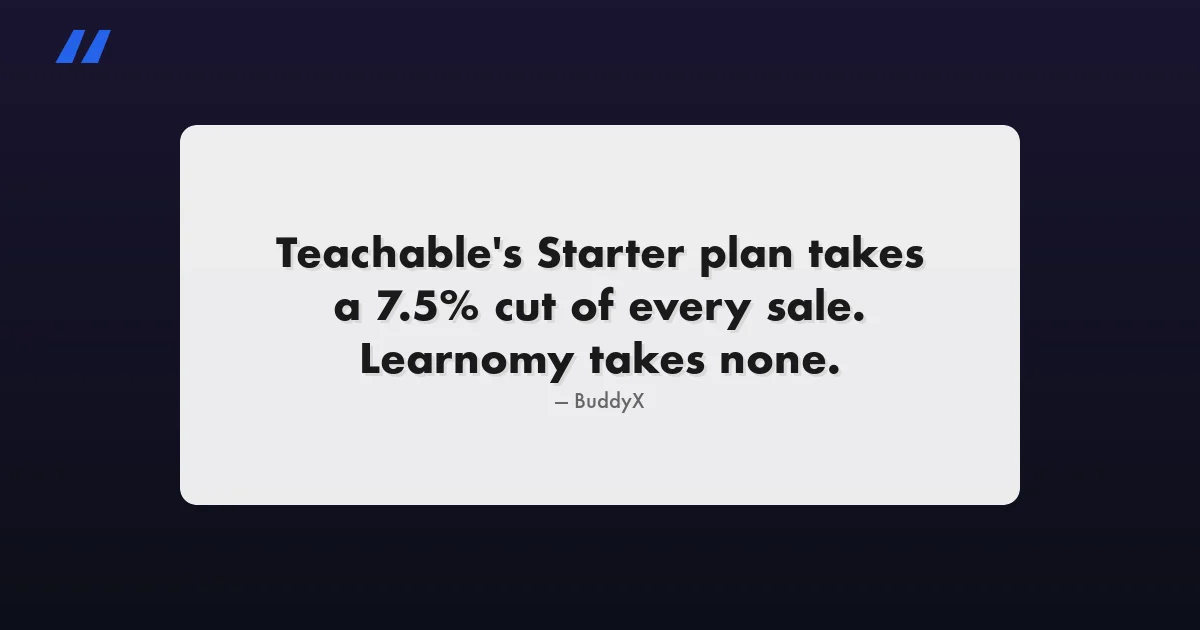
Teachable is a solid platform, but it is not free to run a business on. The entry-level plan takes a cut of every sale, the built-in community tools are thin to nonexistent, and your course lives on Teachable’s servers, not yours. If you are comparing Teachable alternatives, nine platforms are worth a real look, and the right pick depends on how much you want to own versus rent.
Quick answer: For most course creators who want to own their platform and skip transaction fees, Learnomy is the best Teachable alternative in 2026. It is a free WordPress LMS plugin with built-in Stripe and PayPal payments, real quizzes, and verifiable certificates, and it pairs with separate community, forum, and gamification plugins instead of forcing one bundled tab. If you want to stay fully hosted, Thinkific and Podia are the closest matches to what Teachable already does. If transaction fees are your main complaint about Teachable, Heights Platform and Learnomy both skip the percentage cut entirely.
Table of Contents
- Why Course Creators Look for a Teachable Alternative
- Understanding Teachable First
- 1. Learnomy (Best Overall)
- 2. Thinkific
- 3. Podia
- 4. Kajabi
- 5. LearnWorlds
- 6. Systeme.io
- 7. Kartra
- 8. Heights Platform
- How to Choose
- Comparison Table
- FAQ
Why Course Creators Look for a Teachable Alternative
Teachable removed the technical barrier to selling a course when it launched in 2013, and for a first-time creator who just wants something live fast, it still does that job well. The reasons people eventually look elsewhere tend to come down to three things.
- Transaction fees on the entry plan. Teachable’s Starter plan charges a 7.5% fee on every sale, on top of standard card processing costs. That fee only drops to 0% once you move up to a higher-priced plan.
- No built-in community. Teachable has no native forum, social feed, or gamification feature. If you want students to interact with each other, you are adding a separate tool and a separate monthly bill.
- No ownership. Your course content, your student list, and your checkout data all live inside Teachable’s hosted system. Moving to another platform later means a manual rebuild, not an export-and-done migration.
None of this makes Teachable a bad product. It makes it one option with a specific set of tradeoffs, and the nine platforms below solve for different priorities: lower fees, deeper community features, tighter integration with a site you already run, or a completely different pricing model. One of them, Learnomy, moves the whole thing onto WordPress, where the server and the data are yours outright.
Understanding Teachable First
Teachable’s appeal is simplicity. No coding, a genuinely easy course builder, and enough built-in marketing tools, coupons, affiliate support, email capture, to run a small course business without stitching together separate software. For someone starting from zero with no existing website, that is a real advantage, and it is why Teachable remains a reasonable default for a first course launch.
The tradeoffs show up as the business grows. The Starter plan’s 7.5% transaction fee eats into margin fast once sales volume picks up, and that fee only goes away on Teachable’s higher-priced Pro and Business tiers (also sold under the Builder and Grow names depending on when you signed up), which start well above the Starter price point. There is no built-in way for students to talk to each other or to you outside of course comments, and customizing the checkout or sales page beyond the built-in templates has real limits. None of this is a flaw exactly, it is the cost of the simplicity that made Teachable appealing in the first place. The alternatives below are mostly relevant once you have outgrown Teachable in one of these specific directions.
1. Learnomy: Best Overall Teachable Alternative
Learnomy is a WordPress LMS plugin built for creators who want to own their course platform instead of renting it. It is our own product, so take this as an honest recommendation rather than a neutral third-party ranking. Here is why it earns the top spot on this list.
What Learnomy Actually Includes
- Drag-and-drop course builder: add video, audio, PDF, embeds, downloadable files, live sessions, and rich text lessons without touching code.
- Real quizzes: six question types, automatic grading, partial credit, and an essay grading inbox for instructors who assign written work.
- Certificates that can be checked: a canvas certificate designer, QR code verification, and Ed25519 digital signatures. The Pro version adds Open Badges 3.0 support.
- Payments and memberships built in: Stripe and PayPal checkout, coupons, and a transaction ledger, with no WooCommerce or separate payment plugin required.
- Instructor payouts: commission splits and a withdrawal queue, useful for a course marketplace with more than one teacher.
- A real API: over 200 REST API routes with JWT authentication, for teams that want to connect Learnomy to other tools or build a custom app on top.
The free version is not a trial. It is a fully working LMS you can launch a paid course on today, with no feature countdown waiting to lock you out. Pro costs $149 a year and adds AI-assisted course authoring, cohort scheduling, learning paths, content dripping, advanced quizzes with rubrics, and deeper analytics.
The Community Question: Why This Is Actually an Advantage
Learnomy does not include a built-in community, forum, or gamification system, and we are not going to pretend otherwise. What it does instead is more honest and, for most creators, more useful: it pairs with separate WordPress plugins built for each job.
- BuddyNext for a full social community: profiles, activity feeds, and spaces.
- Jetonomy for forums and Q&A, if your students learn best by asking questions.
- WB Gamification for points, badges, and leaderboards that reward course progress.
- Eventonomy for live events and cohort meetups tied to your courses.
Teachable ships no community feature at all, so a Teachable creator who wants one is already shopping for a separate tool. Kajabi and a few others bolt on one fixed community tab you cannot swap out. On WordPress, you pick exactly the pieces you need and you own every one of them outright. Run Learnomy alone for a simple course, or add BuddyNext and WB Gamification once your audience grows. You decide the order, not a vendor’s roadmap.
If you are also weighing Learnomy against dedicated WordPress LMS plugins, our Learnomy vs LifterLMS vs LearnDash comparison breaks down quizzes, certificates, and checkout side by side. And if Teachable is not the only platform on your shortlist, see how Learnomy stacks up in our Kajabi alternatives guide, our LearnDash alternatives guide, and our Tutor LMS alternatives guide.
Try It Before You Install Anything
You do not need to install WordPress to see if Learnomy fits. A live sandbox site with Learnomy pre-installed is one click away, no signup required: launch the Learnomy demo and it stays active for four hours.
2. Thinkific
Thinkific is the alternative most directly comparable to Teachable on the surface: a similarly polished, no-code course builder with customizable templates, quizzes, and a drag-and-drop lesson builder. There is a free plan for testing an idea before you pay anything, and paid plans scale up from roughly $40 a month. The meaningful difference for most creators is fees, Thinkific does not charge a transaction fee on paid plans, which removes the exact cost that pushes people off Teachable’s Starter tier. Thinkific added a basic community space in recent years, but it is lighter than a dedicated forum or social plugin, and features like certificates or bundles often sit behind higher-priced tiers.
Best for: a creator switching off Teachable’s fees who wants a near-identical course builder with almost no learning curve.
3. Podia
Podia sells more than courses: digital downloads, memberships, and coaching sessions all live under one roof alongside course hosting. A creator selling a flagship course plus a handful of digital templates or a monthly membership does not need three separate tools with Podia the way they might elsewhere. Pricing is tiered by plan, with higher tiers unlocking affiliate marketing and more advanced email automation. Podia includes a basic community feature tied to memberships, a real step up from Teachable’s complete lack of one, though it is still a built-in extra rather than a dedicated social or gamification system.
Best for: creators who sell a mix of courses, downloads, and coaching, not just one product type.
4. Kajabi
Kajabi sits at the premium end of this comparison, built around the idea that marketing automation deserves equal billing with course delivery. Sales funnels, customer journey automation, and native email marketing are all built in, which reduces the number of separate tools a growing course business needs. Plans start around $149 a month and reach roughly $399 a month on the Pro tier, with lower rates if you pay annually. There are no transaction fees at any tier, a real advantage over Teachable’s Starter plan, but the price point itself is a harder sell for someone still validating whether a course idea has an audience at all.
Best for: an established creator who already knows their course sells and wants to consolidate marketing tools into one higher bill. See our full Kajabi alternatives comparison for more detail on where it fits against Learnomy and the others here.
5. LearnWorlds
LearnWorlds leans into interactive learning: clickable video, in-video quizzes, and a course player built to keep students engaged rather than passively watching. Pricing starts around $24 a month on the entry Starter plan billed annually, scaling to roughly $79 a month for the Pro Trainer tier, with a Learning Center tier near $249 a month for larger teams. The interactive video tools are genuinely strong and go further than anything Teachable offers natively. The tradeoff is that richer features, including deeper community and marketing automation, are reserved for the higher-priced plans.
Best for: video-heavy courses where interactive quizzes inside the video itself matter more than price.
6. Systeme.io
Systeme.io is the budget pick if you need courses, email marketing, and sales funnels in one tool and do not want to pay much to start. There is a free plan with real limits, and the paid Startup plan runs about $17 a month, scaling to roughly $47 and $97 a month on higher tiers as your contact list grows. Course features are functional but not as deep as a dedicated LMS, and there is no transaction fee on any plan. If funnels and email matter to you as much as the course itself, Systeme.io is hard to beat on price.
Best for: a tight budget where email marketing and funnels matter as much as the course itself.
7. Kartra
Kartra is a marketing-first platform: funnels, email automation, and a course area bundled together, aimed at creators who sell through a sales funnel rather than a simple course page. The entry plan runs about $99 a month. Kartra’s course tools work, but they are secondary to the marketing automation, so if plain course delivery is your main need rather than funnel-building, you are paying for machinery you may not use.
Best for: businesses already running complex sales funnels who want the course bolted onto the same system.
8. Heights Platform
Heights Platform’s main pitch is its fee structure: the company states it does not hold funds or collect a transaction fee on sales, beyond the standard card processing fees charged by Stripe or PayPal, roughly 2.9% plus 30 cents per transaction, set by the payment processor, not Heights. Plans start around $29 a month. It is a smaller, less widely known platform than Teachable or Kajabi, so expect a smaller library of integrations and tutorials, but for anyone who left Teachable specifically over the Starter plan’s 7.5% fee, Heights Platform’s pricing model is the most direct fix among the hosted options here.
Best for: high-volume sellers who want to keep every dollar of a sale instead of losing a percentage to the platform.
How to Choose the Right Teachable Alternative
Match the platform to what you actually need, not the longest feature list. A few quick rules:
- If Teachable’s 7.5% transaction fee is the problem: Learnomy and Heights Platform both skip the percentage cut entirely.
- If you want to own your platform and pay nothing to start: pick Learnomy. You control the server, the data, and which community tools you add. See our full roundup of self-hosted online course platforms for more self-hosted options.
- If you want a near-identical course builder to Teachable without the Starter-plan fee: Thinkific is the closest match.
- If you sell more than courses, downloads, memberships, coaching: Podia keeps it under one roof.
- If video engagement is the core of your teaching style: LearnWorlds’ interactive video tools are built for exactly that.
- If your budget is tight and funnels matter as much as the course: Systeme.io gets you live for the least money.
Whichever you pick, test the actual course-building and checkout flow before you commit a year of payments to it. A platform that looks good in a pricing table can still feel clunky the moment you upload your first lesson.
Teachable Alternatives Compared
| Platform | Starting Price | Transaction Fees | Hosting | Community / Forum |
|---|---|---|---|---|
| Learnomy | Free (Pro $149/year) | None (your own Stripe/PayPal) | Self-hosted (WordPress) | Via separate plugins (BuddyNext, Jetonomy, WB Gamification) |
| Teachable | Free to start, paid from ~$39/month | 7.5% on Starter, 0% on higher tiers | Hosted (SaaS) | None built in |
| Thinkific | Free plan, paid from ~$40/month | None on paid plans | Hosted (SaaS) | Basic, built in |
| Podia | Paid plans, tiered | None on paid plans | Hosted (SaaS) | Basic, tied to memberships |
| Kajabi | ~$149/month | None | Hosted (SaaS) | Built in, fixed tab |
| LearnWorlds | ~$24/month (annual) | None | Hosted (SaaS) | Limited, higher tiers only |
| Systeme.io | Free plan, paid from ~$17/month | None | Hosted (SaaS) | None dedicated |
| Kartra | ~$99/month | None | Hosted (SaaS) | None dedicated |
| Heights Platform | ~$29/month | None (standard card processing only) | Hosted (SaaS) | None dedicated |
Prices and fee structures change. Confirm current numbers on each platform’s pricing page before you commit.
Frequently Asked Questions
Does Teachable charge transaction fees?
Yes, on its entry-level Starter plan. Teachable charges a 7.5% transaction fee on every sale made through the Starter plan, on top of standard card processing costs. That fee drops to 0% once you upgrade to Teachable’s higher-priced Pro or Business tiers, so the real cost depends entirely on which plan you commit to.
What is the best free Teachable alternative?
Learnomy is the best free Teachable alternative. The free version is a complete, working WordPress LMS plugin with course building, quizzes, certificates, and built-in Stripe and PayPal payments. It is not a limited trial. Systeme.io also offers a usable free plan, but its course tools are lighter than a dedicated LMS. For more options, see our list of the best free WordPress LMS plugins.
Which Teachable alternative has no transaction fees at all?
Learnomy and Heights Platform both avoid taking a cut of your sales. Learnomy connects directly to your own Stripe or PayPal account, so you only pay the standard card processing fee. Heights Platform states it does not collect a transaction fee either, beyond the processor’s standard rate. Thinkific, Kajabi, LearnWorlds, Systeme.io, and Kartra also charge no transaction fee on their paid plans, though their monthly subscription cost is higher than Learnomy’s free tier.
Can I add a community or forum to a Teachable alternative?
Yes, and how depends on the platform. Podia and Thinkific include a basic community feature built in. On WordPress, Learnomy handles the course itself, and you add a separate plugin for whatever kind of community you actually want: BuddyNext for a social feed and profiles, Jetonomy for forums and Q&A, or WB Gamification for points and leaderboards. This gives more control than a single fixed community tab.
Is Learnomy difficult to set up compared to Teachable?
Setup takes longer than signing up for a hosted Teachable account, since you need WordPress hosting first. Once WordPress is running, installing Learnomy and building your first course takes about the same amount of time as Teachable’s course builder. You can test the full workflow on a live Learnomy demo site before deciding whether the tradeoff is worth it.
How do I migrate an existing course off Teachable?
Video content usually transfers cleanly since it is just files, but quiz structures, drip schedules, and student progress data rarely map one-to-one between platforms, so expect to rebuild course structure manually rather than run a clean import. Budget time to email existing students proactively before the switch; a poorly communicated move reads as instability to someone who already paid for access.
Final Thoughts
Teachable is a capable platform, and for a first course launch where speed matters more than fees or community, it is still a reasonable choice. But once the Starter plan’s 7.5% transaction fee starts adding up, or you want students to actually talk to each other, it is worth knowing what else is out there.
Learnomy gives you a free, fully working course platform, no transaction fees, and the freedom to add exactly the community, forum, or gamification tools your audience actually wants. If you are also comparing dedicated course plugins, see our guides on the best LearnDash alternatives, the best Tutor LMS alternatives, and the best LifterLMS alternatives for 2026.
Ready to see it running? Launch the free Learnomy demo and build your first lesson in the next few minutes, no account required.