WooCommerce 10.0 Release: What’s New, What Matters, and What’s Next for Your Store

WooCommerce 10.0 Release is here, marking a major milestone in the evolution of the world’s most popular open-source ecommerce solution for WordPress. Powering over 5 million WordPress stores globally, WooCommerce isn’t just a plugin—it’s the engine driving online businesses of all sizes. With the WooCommerce 10.0 Release, the platform is embracing a more modern, scalable, and user-centric future.
So, what makes version 10.0 such a significant update? Whether you’re a developer crafting complex ecommerce experiences or a small business owner running a WooCommerce store, this release introduces key changes that enhance performance, usability, customization, and compliance.
In this blog, we’ll unpack everything you need to know about WooCommerce 10.0—its new features, compatibility considerations, speed improvements, and what it all means for your WordPress-powered store in 2025 and beyond.
WordPress Management ServiceWooCommerce 10.0 at a Glance
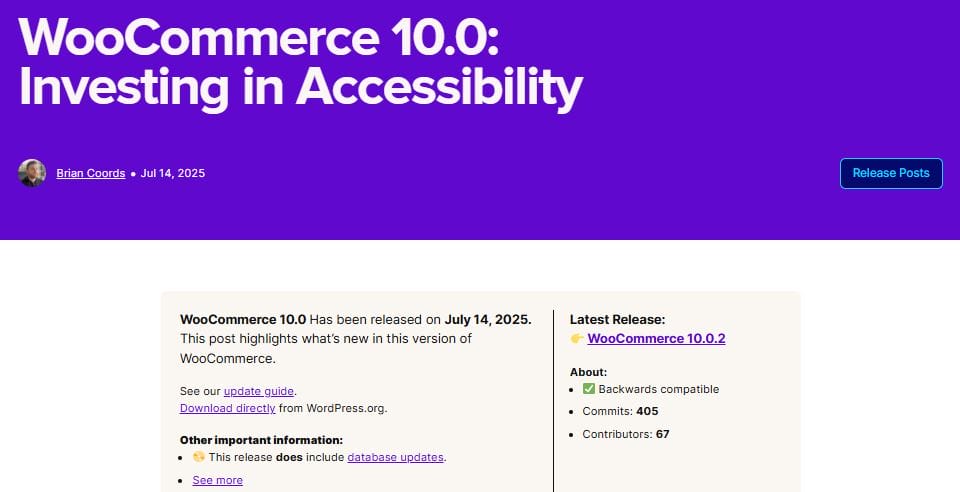
| Item | Details |
|---|---|
| Release Date | July 14, 2025 |
| Current Stable Tag | 10.0.2 (with subsequent 10.0.3 for minor fixes) |
| Contributors | 67 contributors, 405 commits |
| Compatibility | Fully backwards-compatible, no major DB changes |
| Main Focus Areas | Accessibility, checkout UX, content management, developer flexibility |
Why WooCommerce 10.0 Is a Big Deal
Major version numbers usually indicate more than just incremental changes—and WooCommerce 10.0 is no exception. This release is not a simple feature patch; it’s a major step in WooCommerce roadmap to become faster, more secure, and more developer-friendly.
Here’s why this version stands out:
-
It’s the first release under the platform’s new, simplified versioning strategy.
-
Several under-the-hood performance improvements affect frontend and backend speeds.
-
It improves extensibility for developers, especially with blocks and hooks.
-
It introduces new APIs and deprecates outdated ones to move toward modernization.
Let’s break down what’s new.
New in WooCommerce 10.0: Key Features and Enhancements
1. Streamlined Versioning Model
WooCommerce 10.0 officially drops the legacy versioning model that was often tied to WordPress updates and compatibility cycles. Going forward, WooCommerce will follow its own predictable, time-based release cadence.
This is good news for developers and merchants alike. You can now expect feature releases and security patches to roll out on a more consistent and transparent schedule—allowing for better planning, smoother testing, and less anxiety around updates.
What it means for users: Less guesswork, fewer compatibility surprises, and a more dependable upgrade path.
2. Enhanced Performance (Database and Frontend)
WooCommerce 10.0 includes notable performance enhancements across the stack.
-
Improved database queries: Refactored query handling reduces load times on high-product-count stores.
-
Faster checkout experiences: Adjustments to block-based checkout reduce render time, leading to better conversions.
-
Optimized REST API endpoints: RESTful endpoints now return responses more efficiently, making integrations smoother.
Performance is no longer just a bonus—it’s an expectation. With Core Web Vitals and page speed directly impacting SEO and sales, these enhancements aren’t just developer perks; they’re business-critical.
3. Block-Based Product Editor Compatibility
WooCommerce 10.0 moves even closer to full compatibility with the Gutenberg block editor, part of a broader push to modernize content and product management inside WordPress.
-
Block-based product templates: Merchants can now use reusable product blocks with more visual control.
-
Layout customization: Store owners have greater design flexibility without needing custom PHP templates.
-
Improved extensibility: Developers can add, extend, or override individual blocks using new APIs.
If you’re using full site editing (FSE) themes, this change is especially important. WooCommerce is finally meeting WordPress where it is—fully block-first.
4. Checkout and Cart Blocks Now Stable by Default
The once-optional Checkout Block and Cart Block are now the default recommendation. After years of testing and feedback, these blocks are stable, production-ready, and highly performant.
Benefits include:
-
Better UX with fewer steps and distractions.
-
Easier customization using block settings and style controls.
-
Enhanced compatibility with payment gateways and shipping extensions.
More plugin developers are actively adopting this new checkout architecture, and WooCommerce 10.0 makes it clear: block-based is the way forward.
5. Updated Admin Experience with WooCommerce Blocks Integration
The WordPress admin dashboard gets a subtle, but important, facelift in this release:
-
New layout components unify WooCommerce settings with native WP styles.
-
Improved filtering and management of orders, products, and customers.
-
Streamlined onboarding for new users and faster access to WooCommerce extensions.
Store owners now spend less time hunting through menus and more time doing what matters—selling.
Developer Updates and Backward Compatibility Notes
WooCommerce 10.0 is a developer-centric release in many ways. Here’s what coders and agencies need to know:
Deprecated Functions and APIs
Several outdated functions, actions, and filters have been deprecated in WooCommerce 10.0. While this won’t immediately break your store, developers are encouraged to:
-
Audit existing codebases for deprecated calls.
-
Refactor to use newer APIs where available.
-
Use logging tools to identify plugin conflicts early.
PHP 7.4 Minimum Requirement
WooCommerce 10.0 officially requires PHP 7.4 or higher. Support for older PHP versions has ended, which helps the platform adopt modern features and improve security.
Recommendation: Upgrade to PHP 8.1 or 8.2 for best performance and future compatibility.
Improved Testing Framework
Automated testing and quality assurance are becoming more rigorous across WooCommerce core and extensions. WooCommerce 10.0 includes:
-
Expanded unit and integration tests.
-
Improved CLI tools for testing in local environments.
-
Enhanced GitHub workflows for plugin developers.
Security Improvements
Security is always top priority for ecommerce. WooCommerce 10.0 introduces several security-focused changes:
-
Hardened data validation across checkout and account forms.
-
Better CSRF and nonce handling for critical actions.
-
Tighter permission checks on REST API endpoints.
Merchants should also take advantage of:
-
Built-in SSL enforcement.
-
Automatic security patching (when enabled).
-
Compatibility with tools like Wordfence and Jetpack Protect.
What Merchants Should Do Now
If you’re running a WooCommerce store, here’s how to get ready for 10.0 (if you haven’t already upgraded):
-
Backup your site. Always back up files and databases before major version changes.
-
Test in staging. Use a staging environment to test theme and plugin compatibility.
-
Update themes and plugins. Make sure your store’s theme and all plugins are compatible with WooCommerce 10.0.
-
Enable block-based checkout. Test the new Checkout Block with your payment gateways.
-
Review custom code. If you or your developer customized WooCommerce templates or hooks, audit your codebase for deprecated functions.
What’s Coming After WooCommerce 10.0?
The WooCommerce team has already hinted at what’s ahead. Here’s a peek at the roadmap:
-
Improved multi-currency support.
-
Native support for subscriptions and memberships.
-
More REST API endpoints for advanced integrations.
-
Greater alignment with WordPress block editor innovations.
-
Improved mobile-first admin tools for store owners on the go.
By decoupling WooCommerce’s release schedule from WordPress core, the team can now deliver innovations faster and more independently.
How WooCommerce 10.0 Stacks Up Against the Competition
With platforms like Shopify and BigCommerce raising their feature game, WooCommerce 10.0 proves that open-source ecommerce isn’t lagging behind. In fact, it’s leading in several ways:
-
Customization: Unlimited control over every part of your store.
-
Scalability: Cloud-based infrastructure options like Cloudways and Kinsta pair well with WooCommerce 10.0.
-
Developer freedom: Unlike SaaS platforms, WooCommerce lets you own your code, your data, and your future.
And with performance, usability, and extensibility all seeing major upgrades, WooCommerce remains a top choice for WordPress-based businesses.
WooCommerce 10.0 Is Built for What’s Next
Version 10.0 isn’t just a number change—it’s a sign of WooCommerce’s long-term commitment to modern ecommerce. With more control for developers, a cleaner interface for merchants, and a faster shopping experience for customers, WooCommerce 10.0 delivers on all fronts.
For WordPress users, it reaffirms why WooCommerce continues to dominate the ecommerce plugin space. And for developers and agencies, it’s an invitation to build smarter, more scalable, and future-proof stores.
If you haven’t explored WooCommerce 10.0 yet, now is the time. The tools, support, and documentation are all in place—and your next ecommerce breakthrough could be just a few clicks away.
Interesting Reads:
5 Best WooCommerce Membership Plugins In 2025
Affordable Web Design: How to Build a Professional Website Without Breaking the Bank

Shashank is a seasoned digital marketing and WordPress expert who specializes in SEO, software tools reviews, and cutting-edge strategies for boosting online presence. With a passion for simplifying complex topics, Goutham crafts engaging blog posts that help readers optimize their websites, improve search engine rankings, and stay ahead in the ever-evolving digital landscape.