
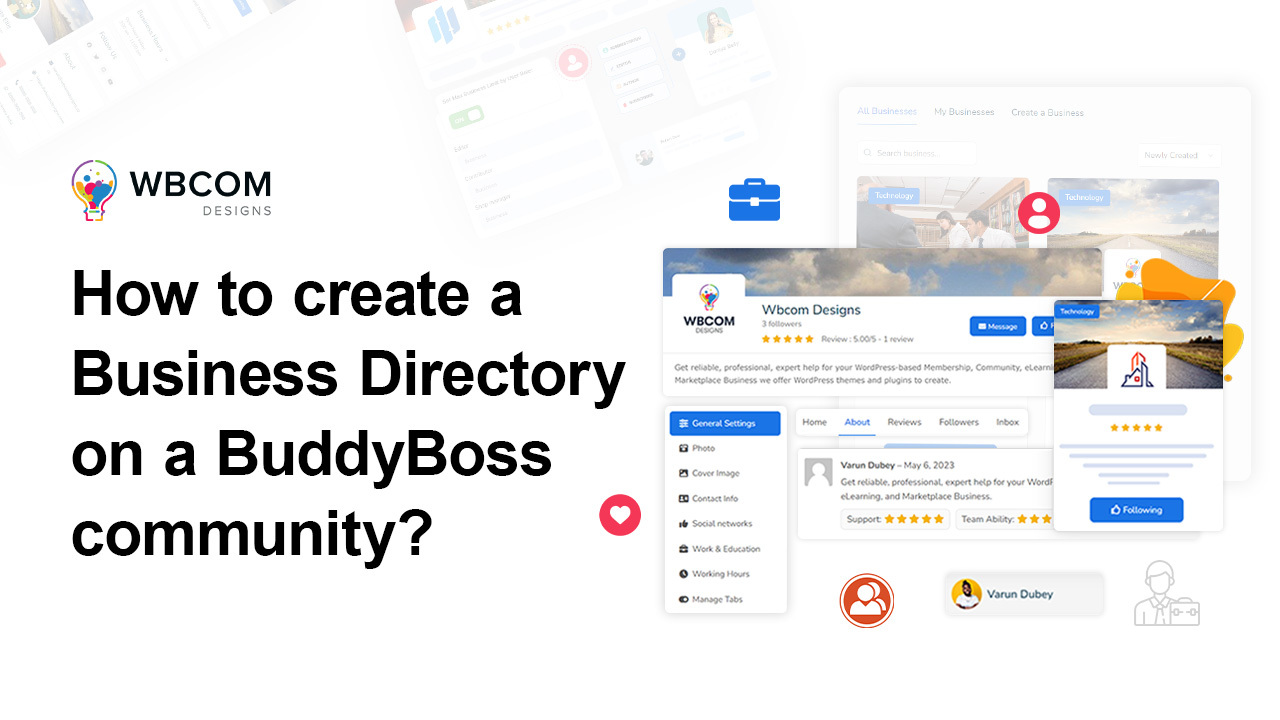
Do you want to create a business directory on your WordPress site that showcases the products and services of your community members? If so, BuddyBoss and the BuddyPress Business Profile plugin are worth a close look. BuddyBoss is a versatile platform for building an online community, course, or membership site. BuddyPress Business Profile is a plugin that lets you create business pages for community members, similar in spirit to Facebook Pages.
What follows walks through creating a business directory on a BuddyBoss community using the BuddyPress Business Profile plugin, then goes further into the decisions that actually determine whether the directory gets used: how listings get discovered, how spam and low-effort listings get kept out, and what to do once the directory has grown past a couple dozen entries. The setup steps take twenty minutes. Getting members to actually use it well is the part that takes ongoing attention.
What is the BuddyBoss Platform
The BuddyBoss Platform is a plugin that lets you build your own online community, course, or membership site on WordPress. It comes with the components common to a typical social network: user profiles, activity streams, groups, messaging, and more. It also supports a wide range of additional integrations and extensions that add more capability to a site. The platform is built to be flexible and reasonably approachable for a non-developer to configure.
Some of the features of the BuddyBoss Platform include:
- Customizability with your brand: the look and feel of the site can be adjusted with a range of built-in options and integrations with popular WordPress themes and plugins.
- Interactive social features: users can create profiles, connect with other users, send private messages, join or create groups, upload media, and more. Live streaming, group calls, events, job boards, and an online store are all reachable through integrations with tools like Zoom, YouTube Live, and WooCommerce.
- Member profiles: different types of user profiles with custom fields and permissions, plus widgets and dashboards for displaying and managing user data.
- Groups: members can organize into public, private, or hidden social groups with their own activity feeds and member listings, along with group forums, group events, and group media.
- Media uploads: members can upload photos, videos, documents, and other files to their profiles or groups, with settings and moderation tools to manage what gets shared.
- Direct communication: private messaging between users or groups, along with notifications and mentions built right into the conversation.
What is BuddyPress Business Profile
BuddyPress Business Profile is a plugin that lets businesses create and manage their own profiles or pages, similar to Facebook Pages, on a BuddyPress- or BuddyBoss-powered site. It includes:
- Custom profile fields: address, phone number, website, and hours of operation.
- Activity streams: businesses can share news and updates that appear in the activity streams of their followers.
- Private messaging: businesses can message their followers directly.
- Events: businesses can create and manage events on their profile.
- Jobs: businesses can post job listings.
- Reviews: visitors can leave reviews of the business.
How to Create a Business Directory on a BuddyBoss Community
To set up a business directory on a BuddyBoss community website:
- Install and activate the BuddyBoss Platform plugin on your WordPress site. This builds the foundation of an online community of engaged, active users.
- Install and activate the BuddyPress Business Profile plugin. This lets community members create business pages showcasing their products, services, portfolio, testimonials, and more.
- After installing both plugins, go to the Business Directory page and click “Create New Page.”
- Type in the business page name.
- Choose the category for the business page.
- Write a description of the business page.
- Upload a logo for the business page.
- Add a cover image for the company page.
- Click “Visit Business” to preview the finished listing.
- Encourage members to create their own business pages by visiting their profile and clicking the Business tab, where they can fill in their business details, upload images, add social links, and more.
- Promote the business directory on your site and social media channels.
Getting Members to Actually Create Listings
Installing the plugins is the mechanical part. Getting members to fill out their business pages is the part that determines whether the directory is worth having at all. A directory with three listings looks worse than no directory, since it signals low activity to every visitor who checks it.
Seeding the directory before opening it to the whole community solves this reliably. If you personally know five or six members with real businesses, ask them directly to set up their listing before the directory launches publicly, so new visitors land on something that already looks active. A directory launched with zero listings and a generic “be the first!” message rarely recovers the momentum it lost in that first impression. First impressions on a feature like this are surprisingly durable; members who check the directory once, see it’s empty, and move on often don’t come back to check again even after it’s filled up months later.
A short, direct announcement explaining exactly what members get from listing, visibility to other members actively looking for services, reviews that build credibility, a place to post job openings, tends to convert better than a vague “check out our new business directory” post. Members respond to specific value, not a general feature announcement. A single well-written announcement post, pinned for a week and mentioned again a few weeks later, usually converts more listings than a permanent nav link that members scroll past without a second thought.
Keeping Spam and Low-Effort Listings Out
Any open directory eventually attracts either spam listings from bots, or low-effort listings from members who fill in a business name and nothing else. Neither is useful to someone browsing the directory looking for a real service provider.
Requiring admin approval before a new business listing goes live, rather than publishing immediately on submission, catches most of this before it becomes visible. It adds a small amount of manual work for whoever’s moderating, but it’s a much smaller cost than letting a directory fill up with empty or fake listings that erode trust in the whole feature. Setting a minimum bar for what counts as a complete listing, at minimum a description and a logo, before approval, also filters out the laziest submissions without requiring active spam detection.
Bot-driven spam listings tend to show a recognizable pattern once you’ve seen a handful: generic business names, a description that reads like it was copied from somewhere else entirely, and a website link pointing to something completely unrelated to the stated business category. A simple checklist for the moderator approving listings, does the description mention anything specific to this business, does the website link actually match, catches the majority of these without needing any dedicated anti-spam software.
Making Listings Discoverable, Not Just Present
A business directory with fifty listings and no filtering or search is nearly as unusable as one with three listings, because visitors can’t find what they’re actually looking for. Category filtering, ideally categories that match how members actually think about the services they need rather than generic labels, matters more as the directory grows past a couple dozen entries.
Featuring a rotating selection of listings on the community’s homepage or in a newsletter, rather than leaving the directory as a page members have to remember to visit, also drives far more traffic to individual listings than passive placement in the main navigation alone. Business owners who see real traffic and inquiries coming from their listing are the ones who keep it updated and tell other members to sign up too, which is ultimately what turns a directory into something that grows on its own instead of needing constant admin promotion.
Monetizing the Directory Without Killing Participation
Once a directory has real traffic, charging for premium placement is a reasonable way to fund the ongoing work of moderating and promoting it. The mistake most communities make is charging for basic listing access itself, rather than for the premium features on top of a free base listing. A directory that requires payment just to appear at all tends to end up with far fewer listings than one where a free tier is genuinely usable, and paid tiers add things like featured placement, additional photos, or a “verified” badge on top of that.
Pricing premium placement modestly at first, then adjusting once there’s real demand data to work from, avoids the common trap of guessing at a price point that either scares away every potential buyer or leaves obvious money on the table. Watching how many members actually click through to view a listing’s full page, not just how many listings exist, is the more useful number for deciding whether premium placement is worth charging for yet. A directory that hasn’t proven it drives real clicks isn’t ready to charge for premium spots regardless of how many free listings it’s accumulated.
What Happens to the Directory as Membership Composition Changes
Directories built early in a community’s life often reflect whatever the founding members happened to do for work, which may not match the community’s audience a year or two later once membership has grown and diversified. A directory built around a handful of freelance designers in month one can look oddly narrow once the community has grown to include consultants and coaches, along with small product businesses too.
Revisiting the category structure every six months or so, adding categories that reflect what members are actually listing rather than what made sense at launch, keeps the directory feeling relevant rather than like a leftover from an earlier phase of the community. Categories that sit permanently empty are worth removing or merging, since an empty category communicates “nobody here does this” just as clearly as a filled one communicates the opposite.
Handling Listing Disputes and Fake Reviews
Once reviews are enabled, disputes are inevitable. A business owner will eventually get a review they consider unfair, and a competitor or disgruntled former customer will occasionally post something clearly retaliatory rather than genuinely descriptive of the experience. Having a clear, published policy for how review disputes get handled, ideally requiring some evidence beyond the reviewer’s word before a review gets removed, protects both the credibility of the review system and the directory’s overall trustworthiness.
Removing every negative review a business owner complains about, without any real review process, quickly turns the review feature into meaningless marketing copy that visitors learn to ignore. Keeping reviews genuinely mixed, honest positives alongside occasional legitimate criticism, is what makes them worth reading in the first place, and community managers who understand this tend to resist pressure to sanitize the directory into an unbelievable wall of five-star ratings.
Mobile Experience Matters More Than It Seems
A meaningful share of directory browsing happens on a phone, someone looking up a service provider while they’re already thinking about the problem, not sitting at a desktop deliberately researching. If the business directory’s category filters and search don’t work cleanly on a small screen, or the individual listing pages render awkwardly, that browsing session ends in frustration rather than a business inquiry.
Testing the actual directory pages on a phone, not just trusting that the theme is generally “responsive,” catches problems that are easy to miss on desktop: a category filter dropdown that’s hard to tap accurately, a phone number that isn’t a clickable link, a map embed that doesn’t resize properly. These are small things individually, but they compound into a directory that technically works but practically frustrates the exact visitors most likely to convert into a real inquiry. Spending an afternoon actually browsing the directory on a phone before launch, clicking through several listings the way a real visitor would, catches more of these problems than any amount of desktop testing ever will.
Directories Built for Directories vs. Directories Bolted Onto a Community
BuddyPress Business Profile works well specifically because the directory lives inside an existing community, where members already have an account, a reputation, and social proof from their activity elsewhere on the site. That context is valuable and hard to replicate with a standalone directory tool.
For a site where the directory is the entire point, not a feature layered onto an existing community, a purpose-built directory plugin like Listora, a free standalone directory plugin, can offer more directory-specific functionality like advanced search, map views, and listing tiers than a community plugin’s directory add-on typically provides. Which approach fits better depends on whether the directory is meant to serve an existing community of members, or stand on its own as the site’s core purpose.
Some communities end up running both at different stages: launching a directory feature inside their existing community first, since it’s a small addition to something already built, and only migrating to a dedicated directory plugin later once the directory itself has grown large enough to need advanced search, geographic filtering, or listing tiers that a community-focused add-on wasn’t really designed to handle at scale. There’s no shame in starting simple and outgrowing the tool; that’s usually a sign the directory is actually working.
Frequently Asked Questions
Do members need a paid plugin license to create a business listing?
No, listing creation is a member-facing feature once the site owner has installed and activated BuddyPress Business Profile. The plugin license covers the site, not individual member listings.
Can a business directory work on a BuddyPress site that isn’t running the full BuddyBoss Platform?
Yes, BuddyPress Business Profile is built to work with standard BuddyPress as well, though BuddyBoss Platform adds a more polished, mobile-friendly interface around the same underlying functionality.
How many listings does a directory need before it feels credible to visitors?
There’s no exact number, but a directory under ten listings tends to read as new or inactive to a first-time visitor. Seeding at least fifteen to twenty real listings before heavily promoting the directory publicly gives a much stronger first impression.
Should reviews be enabled from day one, or added later?
Enabling reviews from the start is usually better, since early reviews build the credibility that makes later members more willing to list and more willing to trust what they find. Turning reviews on after the directory already has dozens of listings means those early listings are competing at a disadvantage against nothing more than their own description.
What’s the fastest way to tell if a business directory is actually working?
Track click-throughs from the directory listing page to an individual business page, and separately track any inquiries or messages business owners report receiving through the directory. Listing count alone is a vanity metric; a directory with sixty listings and no traffic isn’t doing anything for members, while a directory with twenty listings that regularly generates real inquiries is clearly earning its place on the site.
Can business owners edit their own listing after it’s published?
Yes, that self-service editing is one of the core reasons this model works better for an ongoing directory than a static list an admin maintains manually. Members can update their description, add new photos, or adjust contact details whenever their business changes, without needing to file a request with a site administrator every time something needs updating.