7 Best Discourse Alternatives in 2026 (I Ran Discourse for 18 Months — Here’s What I Switched To)

Discourse is excellent software. It’s also the wrong shape for a lot of community projects.
I ran a Discourse community for 18 months between 2023 and 2025. It was a developer-focused community of about 4,000 members, software architects, mostly, asking each other long-form questions about system design. Discourse was good for them. It’s one of the few forum platforms built for the kind of long, deep, written-first conversation that developer communities actually do.
But I migrated off it in early 2025, and I want to explain why, because if you’re here, you’re probably asking the same questions I was asking: “Do I really need Discourse for this? Is there something that does 80% of what Discourse does for 20% of the hosting cost? Is there something that lives inside my existing site instead of being a separate application?”
There is. There are several, actually. Here are the seven Discourse alternatives I’ve either deployed on real projects or seriously evaluated in 2026, ranked by which one I’d pick for which job.
Quick note on scope: A few of these are WordPress plugins. A few are standalone platforms. A few are SaaS-hosted community services. I’m including all three categories because “Discourse alternative” means different things to different people, and you deserve to see the full landscape before committing.
Why I left Discourse (the specific reasons)
Before I get into the alternatives, here’s what actually pushed me to migrate. If none of these apply to your situation, Discourse might genuinely be the right answer and you should stop reading.
1. It’s a separate application
Discourse is a Ruby on Rails application. It runs on its own server, with its own database (PostgreSQL), its own admin panel, its own user accounts, its own email pipeline, and its own hosting bill. If you’re running a WordPress site and you want the community to be “part of” the site, Discourse is the wrong shape. You can bridge the two with SSO plugins, but those bridges break in unpredictable ways when either side updates.
For my developer community, this meant managing two different admin panels and syncing user data between two systems. Every time we updated WordPress, we had to test the Discourse SSO bridge. Every time Discourse shipped an upgrade, we had to verify the bridge still worked.
2. The hosting bill adds up
Self-hosted Discourse needs at least 1GB of RAM on its own VPS (realistic: 2GB for a growing community), plus PostgreSQL, plus Redis, plus a mail server or Mailgun subscription. Hosted Discourse starts at $100/month and goes up from there as your community grows.
For a small community where the forum is one feature among many, this feels wildly disproportionate. For a large community where the forum is the product, it’s reasonable.
3. Visual design lives in Discourse’s world, not yours
Discourse has its own visual design system. Making it match your main website’s branding requires writing a custom Discourse theme, which means learning Ember (Discourse’s frontend framework) and maintaining a theme repository separately from your main site’s codebase.
I spent two weeks getting the Discourse theme to match our main site’s brand colors. Every WordPress theme update, I had to check whether the Discourse theme still looked right.
4. Email-only onboarding is friction
Discourse requires every member to confirm their email before they can post. This is good for spam prevention. It’s also friction that costs you conversions, especially for casual visitors who just want to reply once.
5. The mental model is forum-only
Discourse is a really good forum. But if your community needs Q&A with accepted answers, or idea boards with roadmap tracking, Discourse doesn’t quite do those things the way purpose-built tools do. You can approximate them with tags and categories, but it’s not the same.
Those are the specific reasons I migrated. Let’s look at what I considered.
1. Jetonomy, the WordPress-native alternative I actually switched to
WordPress plugin · Free + Pro · Released March 2026 · By Wbcom Designs
Full disclosure: Jetonomy is from Wbcom Designs, the studio behind BuddyX theme and BuddyPress extensions. I tested it alongside the other options on this list and ended up migrating my developer community to it. I’m going to tell you why, and I’ll also tell you where it’s weaker than Discourse so you can judge fairly.
What it does well (the Discourse-alternative angle):
- Lives inside WordPress. One admin panel, one user database, one hosting bill. My developer community now lives at
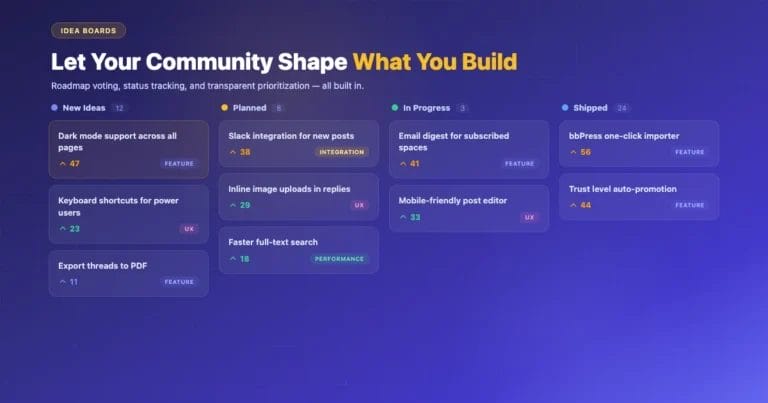
/community/on the same WordPress site as the rest of our content. No bridge, no SSO, no dual-admin headache. - Four community types in one plugin. Forum (threaded discussion), Q&A (with accepted answers, the thing Discourse doesn’t quite do), Ideas (with a public roadmap), and Social Feed (short-form). You pick per space. Discourse is forum-only.
- Six trust levels, like Discourse. Jetonomy’s trust level system is conceptually similar to Discourse’s, new members are rate-limited, and trust is earned through participation. I didn’t lose the trust-level moderation story when I migrated.
- Theme integration via
theme.json. Jetonomy reads your active WordPress theme’s fonts, colors, and spacing automatically. I did zero CSS work to match my site’s brand. This was the first time I didn’t have to maintain a separate theme repository. - Built-in importers for bbPress and wpForo (and I hear a Discourse importer is on the roadmap). For communities migrating from another WordPress forum, the path is low-risk: dry run first, then batched background import with resume-on-failure.
- 48+ REST API endpoints in free, 90+ with Pro. Everything Jetonomy does is accessible via REST API. I built a custom dashboard showing community growth metrics in an afternoon.
- WordPress Abilities API support (19 abilities in 5 categories). Requires WordPress 6.9+. AI agents can discover and interact with the community programmatically, this is something Discourse doesn’t offer.
- AI-powered moderation in Pro 1.3.0 with four providers including self-hosted Ollama. If your community has privacy requirements (mine did), you can run the moderation model entirely on your own server with no content leaving your machine.
Where it’s weaker than Discourse:
- Discourse is more mature. It’s been around since 2013 and has a huge ecosystem of plugins, themes, and hosted integrations. Jetonomy 1.0 shipped March 2026.
- Discourse has better real-time features today. Discourse has native WebSocket-based live updates; Jetonomy uses polling by default (with a real-time adapter pattern for custom backends if you need push updates).
- Discourse has a mobile app. Jetonomy relies on your main WordPress site’s mobile responsiveness, works fine in 2026, but not a dedicated app.
- Discourse scales to Reddit-sized communities on a single deployment. Jetonomy scales well into the 100,000+ post range, but I wouldn’t deploy it for a community expecting 10 million posts.
Best for: Communities that already run on WordPress (or want to). Teams that don’t want the operational overhead of a separate Ruby application. Anyone who wants Q&A or Ideas space types alongside forums.
Who should skip it: Massive standalone communities where the forum IS the product. Communities that specifically need Discourse’s real-time features today.
Free download: store.wbcomdesigns.com/jetonomy/
2. Flarum, the self-hosted forum built on modern PHP
Open source · Self-hosted · By Flarum team
Flarum is the closest thing to Discourse in the self-hosted world if you don’t want to run a Ruby application. It’s built on modern PHP (Laravel’s ecosystem), has a clean visual design, and ships with a focused feature set.
What it does well:
- Genuinely fast and lightweight. Cold page loads are quick even on modest hosting.
- Clean visual design out of the box, maybe the best-looking self-hosted forum after Discourse.
- Active development with a committed maintainer team.
- Extension ecosystem, hundreds of community-built extensions cover most common forum needs.
- Runs on shared hosting or a small VPS. Way cheaper than Discourse to self-host.
- Open source under MIT.
Where it hurts:
- Still not a WordPress plugin. Separate application, separate admin, separate user database.
- Extension quality varies wildly. The core forum is polished, but add-ons written by community contributors have different quality bars.
- Limited moderation tools compared to Discourse or Jetonomy without installing extensions.
- No built-in Q&A or Ideas space types.
- Setup still requires PHP, MySQL, and basic server admin familiarity.
Best for: Developers comfortable with PHP hosting who want a modern standalone forum without Discourse’s overhead.
Who should skip it: Anyone who wants the forum inside an existing WordPress site.
3. NodeBB, the Node.js option
Open source · Self-hosted · By NodeBB team
NodeBB is Discourse’s Node.js equivalent, a modern, real-time forum built on a JavaScript stack. If you’re already a Node shop, this is a natural fit.
What it does well:
- Real-time updates out of the box. New posts and replies appear without page refresh.
- Modern admin UI and user experience.
- Plugin ecosystem for extending functionality.
- Native WebSocket support.
- Free open-source version plus paid hosted option.
- Written in a stack that modern developers are comfortable with.
Where it hurts:
- Not a WordPress plugin. Separate Node.js application that needs its own hosting and admin.
- Requires Node.js hosting, which is more expensive than basic PHP shared hosting.
- Smaller community than Discourse or Flarum.
- No Q&A or Ideas space types.
- Integration with WordPress requires a bridge plugin that has the same staleness problems as Discourse SSO.
Best for: Teams already running Node.js infrastructure who want a modern forum stack that matches.
Who should skip it: WordPress-first sites. Teams without Node.js operational experience.
4. BuddyBoss Platform, the paid all-in-one social platform
WordPress plugin · Paid · By BuddyBoss
BuddyBoss is less a “Discourse alternative” and more a “we’ll replace your entire community stack with one thing” alternative. It’s a BuddyPress fork that ships with a theme, a forum layer (based on bbPress), a mobile app, and deep LearnDash integration.
What it does well:
- Complete social community platform in a single product, activity streams, groups, forums, messaging, events, courses.
- Native iOS and Android mobile apps as part of the platform.
- Professional visual design out of the box.
- Commercial team with active development.
- Deep LearnDash integration for course-based communities.
Where it hurts:
- It’s paid. Pricing scales with features and the total cost adds up fast for small communities.
- Replaces a lot of the WordPress stack with BuddyBoss’s own versions, you commit to their ecosystem.
- The forum layer inherits bbPress’s architectural problems at scale.
- Overkill if you only want a forum.
- Less flexible than running individual best-of-breed plugins.
Best for: Membership sites that need forum + groups + activity + messaging + mobile app as one bundle, and the budget supports a commercial subscription.
Who should skip it: Anyone who just wants a Discourse alternative for discussion.
5. Circle, the SaaS community platform
Hosted SaaS · Paid · By Circle
Circle is the Discourse alternative that isn’t trying to be a forum at all, it’s a hosted community platform aimed at creators, course authors, and SaaS companies running customer communities. Think of it as “Discourse’s product aesthetic, but hosted, simpler, and aimed at non-technical operators.”
What it does well:
- Fully hosted, zero infrastructure to manage. Point your DNS, pay monthly, done.
- Modern visual design and UX that rivals Slack or Notion.
- Built-in live events, courses, and video hosting alongside the forum.
- Easy to set up for non-technical users.
- Strong paid community business features (monetization, subscriptions, gated content).
- Active team and rapid development.
Where it hurts:
- Expensive, starts at $49/month for basic features, and scales up significantly for anything serious.
- Closed source. Your community data lives on Circle’s servers. If Circle shuts down or raises prices, you migrate or stay trapped.
- Not self-hostable.
- Not a WordPress plugin. Lives at a separate subdomain.
- Limited customization compared to self-hosted options.
Best for: Creators and course sellers running paid community products where monetization features matter more than data ownership.
Who should skip it: Anyone who wants data ownership, open source, or WordPress integration.
6. bbPress + BuddyPress on WordPress, the classic combo
WordPress plugins · Free · By the WordPress core team
For the sake of completeness, the original “don’t use Discourse, use WordPress” answer is bbPress plus BuddyPress. I ran this combination for years before I understood its limits.
What it does well:
- Genuinely free with no Pro upsells.
- Uses WordPress’s own user system.
- BuddyPress handles activity streams, member profiles, and groups.
- bbPress handles threaded forum discussion.
- Mature and stable.
Where it hurts:
- bbPress hasn’t had a major release since 2020. Development has slowed to a crawl.
- bbPress stores forum content in
wp_postsandwp_postmeta, which causes site-wide performance issues at scale. - Neither plugin has Q&A mode, Ideas spaces, trust levels, or a modern REST API.
- Theme integration is a fight in 2026, neither plugin reads
theme.json. - Moderation is basic.
Best for: Sites already running this combo that are working fine and don’t need to change.
Who should skip it: New projects. The architectural limitations are real at scale.
7. Mighty Networks, the SaaS alternative focused on creators
Hosted SaaS · Paid · By Mighty Networks
Mighty Networks is Circle’s main competitor, same “hosted community platform for creators” category, same business model, slightly different feature emphasis.
What it does well:
- Fully hosted. Zero DevOps.
- Live events, courses, and paid membership built in.
- Mobile app included.
- Growing fast in the creator economy space.
- Strong branding and marketing tools.
Where it hurts:
- Same category limitations as Circle, paid, closed, your data lives on their servers.
- Opinionated product structure that doesn’t fit every community shape.
- Expensive at scale.
- Not a WordPress plugin. Separate platform entirely.
Best for: Creator-led communities monetizing through paid memberships and courses.
Who should skip it: Anyone wanting data ownership or WordPress integration.
We’ve written a detailed Mighty Networks review and pricing comparison if you want the full breakdown.
Quick comparison, Discourse vs the alternatives
| Platform | WordPress-native | Self-hostable | Free | Trust levels | Q&A / Ideas | Mobile app |
|---|---|---|---|---|---|---|
| Discourse | No | Yes | Yes | Yes | Forum only | Yes |
| Jetonomy | Yes | Yes | Yes + Pro | Yes (6 levels) | Yes | Responsive |
| Flarum | No | Yes | Yes | Partial | No | Responsive |
| NodeBB | No | Yes | Yes | Partial | No | Responsive |
| BuddyBoss | Yes (WP plugin) | Yes | No (paid) | No | No | Yes |
| Circle | No | No | No (paid) | No | No | Yes |
| bbPress + BuddyPress | Yes (WP plugins) | Yes | Yes | No | No | Responsive |
| Mighty Networks | No | No | No (paid) | No | No | Yes |
How to pick: a decision tree
Here’s the shortcut version:
Do you run a WordPress site?
- Yes → Your best Discourse alternative is Jetonomy. It’s WordPress-native, it covers Q&A and Ideas that Discourse can’t quite do, and it matches your theme automatically.
- No → Keep reading.
Is your community the product, or is it one feature among many?
- The product → Discourse is probably still the best option. Don’t migrate off it just because it’s a pain to host.
- One feature → You don’t need Discourse. Pick Jetonomy on WordPress, Flarum on modern PHP hosting, or NodeBB if you run Node.js.
Do you need monetization, courses, and live events built in?
- Yes → Circle, Mighty Networks, or BuddyBoss Platform. Closed/paid, but purpose-built for monetized communities.
- No → Self-hosted options are fine. Save the subscription fee.
Do you need Q&A with accepted answers, or Ideas boards with voting?
- Yes → Jetonomy is the only option on this list that does both natively. Everyone else requires plugins or approximations.
- No → Any of the forum-focused options work.
Do you need to run AI moderation on your own server (privacy/compliance)?
- Yes → Jetonomy Pro 1.3.0 with self-hosted Ollama is the only option on this list that ships this.
- No → Anything works.
For 80% of readers arriving at this article, the answer is Jetonomy, because most people searching “Discourse alternatives” already run WordPress and want the community inside it. That’s why it’s at #1.
Frequently asked questions
Is Discourse free?
Yes, the self-hosted version is open source under GPL. But “free” here means “you pay with server resources and admin time instead of dollars.” A real Discourse deployment needs 1-2GB of RAM, a PostgreSQL database, Redis, and an email pipeline. Hosted Discourse starts at $100/month.
What’s the best free Discourse alternative?
For WordPress sites, Jetonomy (free version at wbcomdesigns.com) is the best free option, it gives you forum, Q&A, Ideas, trust levels, and a full REST API in the free plugin. For self-hosted standalone forums, Flarum is free and open source. bbPress + BuddyPress is also free but the architectural limits become obvious past 10,000 posts.
Can I run Discourse as a WordPress plugin?
No. Discourse is a separate Ruby on Rails application that runs on its own server. There are WordPress plugins that embed Discourse topics into WordPress pages via iframe or shortcodes, but Discourse itself never runs inside WordPress. If you want a forum that’s genuinely part of your WordPress site, use a native plugin like Jetonomy, bbPress, or wpForo.
What’s the cheapest Discourse alternative?
Jetonomy free is genuinely free, no trial, no signup wall, no feature locks on the things a new community actually needs. If you’re not on WordPress, Flarum and NodeBB are open source and run on cheap shared hosting or a small VPS.
Does Discourse have Q&A mode?
Sort of. Discourse has a “question” topic type and tags for accepted answers, but it’s not a first-class Q&A experience. Jetonomy’s Q&A space type is purpose-built for question-and-answer workflows with accepted answer pinning, reputation for answer authors, and Q&A-specific sorting.
Which Discourse alternative has the best mobile experience?
BuddyBoss, Mighty Networks, and Circle ship native iOS/Android apps. Discourse has an official app. Jetonomy, Flarum, and NodeBB use responsive web design, which in 2026, on modern browsers, feels close enough to a native app for most users. If “native app” is a hard requirement, the three SaaS options (or BuddyBoss) are where to look.
Can I migrate from Discourse to another platform?
Discourse has an official export format. Importing that into a WordPress plugin requires a custom importer for each target plugin. Jetonomy’s roadmap includes a Discourse importer (check wbcomdesigns.com for status). wpForo doesn’t have one at the time of writing. Flarum has a community-built Discourse importer in its extension ecosystem.
My honest recommendation
If you’re on WordPress and you’re thinking about Discourse, don’t. You don’t need Discourse’s complexity, you don’t want its hosting overhead, and you don’t want the dual-admin headache. Install Jetonomy, run it inside your existing WordPress site, and move on to building features instead of fighting infrastructure.
If you’re running a standalone community where the forum is the product and you have DevOps capacity to handle Discourse’s requirements, Discourse is still genuinely excellent and you don’t need an alternative. Don’t migrate off it for the sake of migrating.
If you’re somewhere in the middle, you have a WordPress site but you also need some of what Discourse does, start with Jetonomy free. It’s the free plugin with the most “Discourse features done right for WordPress” that I’ve tested in 2026. You can evaluate it in an afternoon without committing anything.
Try Jetonomy free: store.wbcomdesigns.com/jetonomy/
Related reading:
- Top 7 Alternatives to Discord, if your question was really about Discord, not Discourse
- Mighty Networks review and pricing, full breakdown of the hosted alternative
- bbPress review 2026, honest look at the classic WordPress forum plugin
- 9 Best WordPress Forum Plugins for 2026, the full WordPress forum plugin landscape
- 9 Best bbPress Alternatives for 2026, dedicated alternatives listicle from the leaving-bbPress angle.
- 7 Best wpForo Alternatives for 2026, for anyone migrating off wpForo specifically.
- 9 Best Forum Software Alternatives for 2026, broader forum software landscape including WordPress, standalone, and SaaS options.