
You open your member list and sort by “last active.” The top of the list looks fine, a handful of names posting this week, a couple of threads with real replies. Then you keep scrolling. And scrolling.
Three hundred names. Four hundred. People who joined, uploaded a profile photo, maybe left one comment, and then just stopped. Not banned, not unsubscribed, just gone quiet. If your community has been running for more than a year, this list is very likely bigger than the one above it.
That is the part almost nobody talks about. Every community guide you will find is about acquisition: how to get more sign-ups, how to run a launch, how to grow your member count.
Almost none of them are about the people who already signed up and stopped coming back. That is strange, because this group is usually larger than your active group, and reaching them is cheaper than finding new people.
They already trust you enough to have created an account once. You do not need to convince them your community exists. You need to give them a reason to open the tab again.
This article is about that group: how to tell who is actually gone versus who just drifted, what to say to each one, and how to build a community that does not manufacture dormant members faster than it can win them back. If you run a BuddyPress community, on BuddyX or any other theme, most of what follows is something you can act on this week without writing a line of code.
Dormancy is not a verdict on your community
Before anything tactical, sit with this reframe, because it changes how you write every message that follows. A dormant member is not proof that your community failed. Life gets busy.
A parent’s group chat becomes their default social outlet during a hard stretch at work. A hobby forum loses someone to a new hobby. A professional network loses someone who changed jobs and no longer needs it, for now.
Some dormancy really is about you: a bad first week, an unanswered question, a front page that never changes. We will get to that honestly, because pretending your community is blameless would be its own kind of dishonesty.
But a large share of quiet members simply have quiet lives right now, and no message you write is going to out-compete a busy season. The goal is not to win everyone back. It is to make it easy and appealing for the people who could come back, and to stop guilt-tripping the ones who cannot or will not.
Three kinds of quiet, and why the difference matters
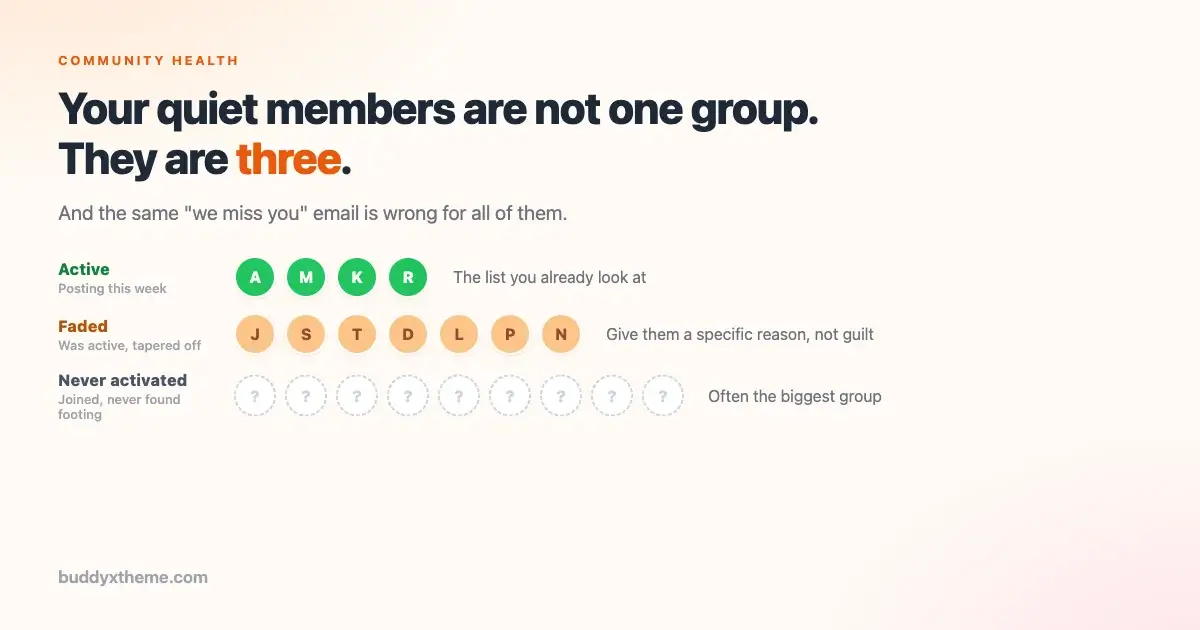
“Dormant” gets used as one bucket, but it is really three very different people, and sending the same message to all three is why most win-back attempts fall flat. Before you write anything, sort your quiet members into these groups.
| Group | How you recognise them | What they need from you |
|---|---|---|
| Never activated | Joined, completed little or no profile, zero posts, zero replies, no connections or group memberships | The first good experience they never had. Not a “we miss you” message, since you never had them to miss |
| Faded | History of real activity (posts, replies, connections), then a clear drop-off point you can see in their activity timeline | An honest, specific reason to look again. Acknowledgment that time passed, without guilt |
| Gone | Explicitly unsubscribed, ignored every past outreach, or told you directly this is not for them | A dignified, easy exit. Not another email |
The never-activated group is often the largest and the most misunderstood. Site owners tend to treat them the same as people who used to be active, and write a nostalgic “come back and see what you missed” message. But someone who never posted has nothing to be nostalgic about.
They looked at your community for ten minutes, did not understand what to do next, and left. Your message to them has to answer the question they never got answered the first time: what do I actually do here?
The faded group is the one most win-back effort should go toward, because they have already proven they can be active. Something changed, either in their life or in what the community offered, and your job is to figure out which and speak to it honestly.
The gone group is small but real, and the healthiest thing you can do is stop chasing them. Not every quiet account is a rescue mission. Some people tried your community and correctly decided it was not for them.
Continuing to email someone who has told you, directly or through total silence over multiple attempts, that they are not interested does not win them back. It just damages your sender reputation and makes your community feel like it does not take no for an answer.
Before you write to anyone, check what they would be coming back to
This is the step that gets skipped, and it is the reason most win-back campaigns fail. Before you draft a single email, look honestly at your own community the way a returning member would see it. If the answer to any of the following is uncomfortable, fix that first, because no message is clever enough to fix a broken landing experience.
Is anyone actually answering?
Picture the exact moment: a member who has been away for two months sees your email, clicks through, and posts a question or a comment. Now imagine three days pass and nobody replies.
That single silent thread teaches them something they will remember much longer than the earlier absence taught them nothing was going on. The first quiet stretch was passive: nothing pulled them back. This is active: they came back, tried, and were ignored. That is a much harder lesson to undo, and it usually means they do not try a second time.
This is why a community cannot sustainably rely on the owner personally answering everything. If you are the only one who replies, you are a bottleneck, and bottlenecks fail exactly when you are busy or away.
Building a layer of members who reliably help others, recognised through reputation, badges, or a simple trust system, means a returning member’s first post lands somewhere with a real chance of a real reply. We wrote about designing that in our piece on trust levels for community moderation, which covers how communities distribute the job of answering instead of concentrating it in one exhausted admin account.
Does your front page look different from last month?
Open your community’s homepage right now and ask yourself honestly: if a dormant member looked at this today versus the day they left, would they notice anything new?
An activity feed that is mostly the same three names, the same kind of post, the same low volume, tells a returning visitor that nothing changed while they were away, so there is no reason to stay this time either.
This does not mean you need constant noise. It means the feed needs to show real signs of life: new topics, new faces, replies happening within a reasonable window, not just the appearance of activity from the same five people posting to each other.
If your feed has gone stale, that is a structural problem worth solving before you invite anyone back to look at it. We go into what a healthy, well-organised feed actually looks like in our BuddyPress activity feed guide, including how to keep it readable and current rather than a noisy stream nobody wants to scroll.
Was there ever a reason to come back?
Some communities are quietly built to reward only the people who already show up every day. Streaks, daily challenges, “you missed the weekly thread” language, leaderboards that reset if you are away too long.
All of that is fine for the people already in the daily habit. But if that is the only structure your community offers, someone who steps away for two weeks does not have a way back in. They did not leave a door open. They locked it behind them without meaning to.
Ask honestly: does your community have anything a person can pick back up on their own schedule, without having missed a window? A resource library, an open question board, a directory of members by interest. If everything is time-bound and cumulative, dormancy is not a bug in your outreach. It is a feature of your structure.
Put plainly: win-back campaigns fail most often not because the message was wrong, but because they successfully brought someone back to the exact same empty room they left. Fix the room first.
Finding your dormant members without a data team
You do not need analytics software to do this. BuddyPress and BuddyX give you what you need in the admin screens you already have.
- Sort the members list by last active. This is the single most useful view you have. Everyone below a cutoff date, say no activity in the last 60 or 90 days, is your dormant pool.
- Check profile completion as a rough proxy for never-activated. An empty or near-empty profile, no photo, no bio, blank custom fields, is a strong signal someone never got past the first screen.
- Look for connections and group memberships. Someone with zero connections and zero group memberships almost certainly never found a foothold, even if they technically logged in a few times.
- Check post and reply counts. Zero posts and zero replies, combined with no connections, is about as clear a never-activated signal as you will get without custom reporting.
Once you have that list, do not try to message everyone in one batch. Split it into the three groups from the table above first. It takes an afternoon with a spreadsheet, sorting by last-active date and activity counts, and it is the difference between a campaign that lands and one that gets ignored.
| Signal you can see in the admin list | What it usually means |
|---|---|
| Registered, empty profile, zero posts, zero connections | Never activated, treat as a first-experience problem |
| Active history, then a clear drop-off in the activity timeline | Faded, treat as a re-invitation problem |
| Emailed multiple times with no open or click, or explicitly unsubscribed | Gone, stop sending and make the exit clean |
Writing to each group, in their language
This is the part that actually moves the needle, and it is where most communities get lazy and send one templated “we miss you” blast to everyone. Each of the three groups needs a genuinely different message, because they are not the same problem.
Never activated: give them the first good moment they missed
Do not say “we miss you.” You never had them, so there is nothing to miss, and the phrase rings false in a way people notice even if they cannot articulate why. Instead, give them exactly what should have happened in their first week: one specific, small, doable thing.
Concrete version of what that looks like: instead of “come see what is new in our community,” try “there is a thread in this space where three people are answering exactly the kind of question people usually ask when they join, take a look.” Or point at one person in a group who is active in their area of interest, and suggest they say hello.
The goal is one click, one small action, ideally something they can respond to in under a minute. A general invitation to “explore the community” recreates the exact confusion that made them leave in the first place. A specific pointer solves it.
Faded: acknowledge the gap honestly, then get specific
This group already knows they have been away. Naming it is not guilt-tripping as long as you do not moralise about it. “It has been a while” is fine. “We noticed you have not been around and we miss seeing you” tips into guilt, because it frames their absence as something they owe an explanation for.
What actually works is leading with something specific that changed, tied to what they used to care about. Not “lots of exciting updates since you have been away,” which says nothing and reads as filler.
If they used to be active in a photography group, say so, and name the threads people are still replying to. If they asked a question once that never got a good answer, that is an even better hook: someone finally posted a solid answer to the kind of question you asked back then.
Specificity is what separates a message that gets opened from one that gets deleted with the rest of the newsletter pile.
Gone: make leaving easy, not another reason to stay away
For members who have shown no response across a reasonable number of attempts, or who have explicitly opted out, the right move is to stop reaching out and make sure the exit is clean.
That means your unsubscribe link actually works and takes one click, not a login and three settings pages. It means account deletion is possible and not buried in a support ticket process. It means you do not keep emailing “one more thing” after someone has told you, through silence or explicitly, that they are done.
This is not just kindness, it protects you too. A clean exit protects your sender reputation, since repeated non-opens and spam complaints hurt deliverability for everyone else. It protects your open-rate metrics, which get diluted by people who will never engage again. And it protects your community’s reputation, because nobody recommends a community that made it hard to leave.
| What not to send | Why it backfires | What to send instead |
|---|---|---|
| “We miss you” to someone who never posted | You cannot miss someone you never had. It reads as generic and rings false, so it gets deleted or ignored | A single specific pointer: one thread, one person, one space to check out |
| A roundup of “lots of exciting updates” | Vague enthusiasm with no specific hook gives the reader nothing to click on or care about | One named, specific thing tied to what they used to engage with |
| “You lost your streak” or “your community misses you” guilt framing | Turns returning into an obligation instead of an interest, which makes people avoid the email entirely next time | A neutral, honest acknowledgment of time passed, paired with something new and specific |
| A bare “come back” link to the homepage | Lands them on a generic page with no clear next step, recreating the exact confusion that caused the drop-off | A direct link to one specific post, thread, or space with an obvious first action |
| A discount or incentive with nothing behind it | Gets the click but not the return, since the underlying room is still empty when they arrive | Fix what they would be returning to first, then invite them back to something genuinely better |
Notice the thread running through all of this: guilt is the wrong lever, every time. “We noticed you have not been around” and “your community misses you” both frame the member’s return as something they owe you.
People do not return to obligations. They return to things that interest them. Every message you send should read like an invitation to something good, not a summons back to something you feel entitled to their attention for.
Timing and frequency, without inventing numbers
There is no universally correct number of days or exact count of emails that works for every community, and anyone who hands you a precise formula is guessing. What matters more are the principles underneath the timing.
- Reach out while the memory is still warm. Someone who joined three weeks ago and has not been back is a much easier win-back than someone who joined fourteen months ago. The former still remembers why they signed up. The latter may not remember your community exists at all.
- Do not repeat the same message. If your first attempt did not land, sending the identical email again a week later is not persistence, it is noise. Each attempt should say something different or point somewhere new.
- Stop after a small number of tries. Two or three genuine attempts, spaced out, is reasonable. Beyond that you are not re-engaging, you are pestering, and it costs you goodwill even among members who are still active and can see your email cadence.
- Treat silence as an answer. If someone has not opened or clicked across several honest attempts, the respectful read is that they are not interested right now, not that you have not tried hard enough.
On cadence: a quarterly review of your dormant list is far more sustainable than a one-off panic campaign after you notice your numbers dipping. A quarterly rhythm means you catch people while they are still in the faded window rather than the gone window, and it turns this into routine maintenance instead of a fire drill that eats a whole week.
Where you land them decides whether it works
Getting someone to click your email is only half the job. What happens in the next ten seconds after they click decides whether the whole effort pays off or gets wasted. A few concrete mechanics matter more than the wording of the email itself.
Land them somewhere specific, not the homepage
If your email mentions a thread, link directly to that thread, not to the community’s front page with an assumption they will find it. Every extra click and every moment of “where do I look” is a chance for them to close the tab. The link in the email should take them to the exact thing you promised.
Do not force a fresh login through a password reset
If it has been months since someone logged in, there is a real chance they have forgotten their password. If your link dumps them onto a bare login screen and they have to dig up a password reset email, request a new password, wait for that email, click it, and then find their way back to what you originally sent them, you have lost most of them along the way.
Where your setup allows it, use a login link that authenticates them directly, or make the password reset step as short and obvious as possible. Every additional step between the email and the destination is a member walking away.
Do not greet them with 300 unread notifications
Picture logging back into an old email account and finding 4,000 unread messages. Nobody opens that inbox with excitement, they close it and feel worse than before. The same thing happens when a returning member logs in and sees a notification count in the hundreds.
It is overwhelming rather than welcoming, and it signals “you have a lot of catching up to do” rather than “here is one good thing waiting for you.” If your platform allows it, consider a way to reset or de-emphasise old notification counts for returning members.
Give one obvious next step, not a tour
Resist the urge to show a returning member everything that is new. A “here is everything you missed” tour is well-intentioned but overwhelming, and it puts the burden of deciding what matters back on them, which is exactly the friction that caused them to drift the first time.
One clear, obvious action, reply to this thread, meet this person, answer this question, converts better than a full tour of features they will get around to on their own once they are actually back.
Prevention is the real answer
Everything above is about winning back people who already went quiet. But the honest truth is that most dormancy gets created in the first week a member joins, not months later.
If someone’s first visit does not give them a clear next step, a person to meet, or a small win, they are likely to drift regardless of how good your win-back messages eventually are. We wrote a full companion piece on that window, the first seven days of member onboarding, which is really the other half of this same problem.
Onboarding stops dormancy from being created in the first place, while this piece deals with the people it already happened to. If you are only going to fix one of the two, fix onboarding first, because every dormant member you win back today is a member your onboarding will need to hold onto tomorrow.
Give people a reason to return that does not depend on perfect timing
A live chat channel only rewards people who happen to be online at the same moment as everyone else. That is a hard bar for people with unpredictable schedules, different time zones, or just busy lives.
A standing, asynchronous space works differently: an open question sitting unanswered is a standing invitation, because someone can arrive at 2am three weeks later and still be useful and welcome. Question-and-answer spaces are particularly good at this, since they do not expire the way a live conversation does. We cover how to set this up in our guide to Q&A spaces replacing support tickets.
Make the value visible even to people who never post
Not every quiet member is dormant. This distinction matters and gets missed constantly. A member who reads every week, never comments, but genuinely gets value from what they read is not the same as someone who has forgotten your community exists.
If your only measure of active is posting or commenting, you will misclassify a large, perfectly healthy part of your membership as a problem to be fixed, and start sending them guilt-laden “we miss you” emails they will find baffling, since from their side, they never left.
A healthy community always has a large quiet majority who read without posting. That is normal, not a warning sign. Treating lurkers as a dormancy problem and pushing them to engage more is one of the more reliable ways to actually drive them away, because it turns a comfortable relationship into one that feels like it is demanding something.
This principle applies differently in smaller, private communities. A private or invite-only group, by design, has fewer members and lower raw volume than a big open forum, and that is the intended shape, not a symptom of decline.
Low activity in a space of forty trusted members reads completely differently than low activity in a space that is supposed to have thousands. We go into that distinction in our piece on private, invite-only WordPress communities.
Building this into a routine, not a one-time push
The best version of this work is not a single dramatic campaign, it is a small recurring habit. Once a quarter, block an hour, sort your members list, split the dormant group into the three buckets, and send a short, specific message to the faded group along with a gentle first-touch to any recently-joined never-activated members.
Skip anyone already in the gone group. That is genuinely most of the work, done consistently, rather than an occasional scramble when your numbers look worse than you would like.
| Check | What you are looking for | Action if it fails |
|---|---|---|
| Answer rate on new posts | Are recent posts and questions getting replies, or sitting untouched | Recruit or formalise a small group of members who reliably help others; consider a trust or reputation system |
| Time-to-first-reply | How long a new post typically waits before anyone responds | Set an informal internal goal and make sure at least one active member or moderator checks new posts daily |
| Front page freshness | Would a member from last month notice anything different today | Review your activity feed structure and prompt more varied, spread-out posting rather than relying on a few regulars |
| Profile completion rate for recent joiners | Are new members filling out profiles, or leaving them blank | Revisit your onboarding flow; a blank profile usually means the first-week experience is not landing |
| Share of members with zero connections | How many people have no connections, follows, or group memberships | Add a specific “meet someone” or “join a group” prompt early in the member journey |
| Unsubscribe and account-deletion path working | Can a member actually leave your list or delete their account in one or two clicks | Test it yourself as a member would; fix any step that requires support intervention |
Notice that four of the six checks in that table have nothing to do with the dormant members themselves. They are about the health of the room those members would be returning to. That is not an accident. The uncomfortable truth behind most win-back work is that the message is rarely the bottleneck. The destination is.
What this looks like on BuddyX
If you are running BuddyPress with BuddyX, most of the diagnostic work above is available without any extra plugins. The members directory gives you last-active sorting out of the box, profile completion is visible per member, and the activity stream is the fastest way to eyeball whether your front page actually looks different from a month ago.
BuddyX, built by Wbcom, is designed to keep that activity feed, member directory, and profile experience clear and easy to scan. That matters more than it sounds when you are trying to judge, at a glance, whether a returning member would find anything worth staying for.
None of that replaces the actual work of writing honest, specific messages to the right group of people. But it does mean the audit step, the one most owners skip, is something you can do this afternoon with tools you already have installed.
The short version
Dormant members are not a verdict on you, and they are usually your largest, cheapest-to-reach group, if you treat them as three different groups instead of one.
Never-activated members need a first good experience, not nostalgia. Faded members need honest, specific reasons to look again, not guilt. Gone members need a clean, dignified exit, not another email.
And before you send anything, check honestly whether the room you are inviting people back to is actually worth returning to, because that is where most of these efforts quietly fail. Fix the room, sort your list, write to each group in its own language, and make coming back require one click instead of a scavenger hunt.