

Picking an email marketing partner is rarely as simple as scanning a pricing page. Deliverability rates, automation depth, segmentation logic, and how a platform plays with your existing CRM or storefront all shape whether a campaign actually reaches an inbox and gets opened. A tool that works beautifully for a five-person SaaS team can buckle under the list size and product catalog of a mid-size e-commerce brand, and the reverse is just as true. Price alone rarely tells the whole story either, since a cheaper plan that caps automation complexity can end up costing more in workaround time than a pricier tier that handles the same job natively. This guide walks through ten email marketing companies that have earned their reputations in 2026, what each one does well, who tends to get the most out of them, and the questions worth asking before you sign a contract.
What Email Marketing Companies Actually Do
The phrase “email marketing company” covers a wide range of services, from software-only platforms you operate yourself to full-service agencies that write, design, and manage campaigns on your behalf. Most of the vendors in this list sit somewhere in between: a self-serve platform with enough support, templates, and pre-built automation that a small marketing team can run sophisticated campaigns without hiring a specialist.
Strategy work usually comes first. A capable provider will help map out a sending cadence, decide which lifecycle moments deserve automated emails, and set expectations for what a healthy open rate and click rate look like in your industry. From there, the day-to-day work splits into a handful of recurring tasks.
Content and design. Subject lines, preview text, body copy, and the visual template all need to be built and then tested against each other, since even small wording changes can move open rates by several points.
List segmentation. Treating an entire subscriber base as one audience wastes the platform’s potential. Segmenting by purchase history, engagement level, or stated preferences turns a generic blast into something that reads as relevant.
Automation and triggers. Welcome series, cart abandonment sequences, re-engagement flows, and post-purchase follow-ups run without a human pressing send each time, which is where most of the long-term revenue from email tends to come from.
Analytics and reporting. Open rates and click-through rates are the starting point, not the finish line. The better platforms tie email activity back to actual revenue, so a marketing team can see which sequences are paying for themselves.
Integrations. An email tool that can’t talk to your CRM, e-commerce platform, or customer data warehouse forces manual exports and imports, which is exactly the kind of friction that causes segmentation to fall out of date.
Some providers stop at software and leave the strategy work to you, while others bundle in a managed service tier where a dedicated account manager builds campaigns on your behalf for an added monthly fee. Neither approach is inherently better; a founder with strong copywriting instincts and a few free hours a week can get more out of a self-serve platform than a rigid managed package, while a busy operations team might prefer paying extra to hand the work off entirely.
How to Evaluate an Email Marketing Provider
Every vendor on this list will claim to be the easiest, most powerful, or most affordable option. A few practical checks cut through the marketing copy faster than reading another features page.
Deliverability track record. A platform with a poor sender reputation can quietly tank your inbox placement no matter how good your copy is. Ask vendors directly about average deliverability rates and how they handle list hygiene.
Depth of automation. Basic autoresponders are table stakes now. Look for branching logic, multi-step journeys, and the ability to trigger sequences off behavioral events rather than just calendar dates.
Segmentation flexibility. Some platforms only let you filter by static tags; others support dynamic segments that update automatically as customer behavior changes. The second kind saves hours every week once a list grows past a few thousand contacts.
Pricing as you scale. Most tools price by contact count, and the jump between tiers can be steep. Model out what your bill looks like at double your current list size before committing.
Support quality. When a campaign misfires at 2 a.m. before a product launch, the difference between live chat and a three-day ticket queue matters more than any feature comparison chart.
Data ownership and export options. Migrating away from a platform later should be straightforward. Ask whether subscriber data, engagement history, and automation logic can be exported cleanly, because vendor lock-in is a real cost that rarely shows up on the pricing page.
Compliance tooling. GDPR, CAN-SPAM, and CASL requirements differ by region, and a platform that handles consent tracking and unsubscribe management automatically saves a legal headache down the road. This matters more than most teams realize until a complaint or an audit forces the issue.
Common Mistakes Teams Make When Switching Providers
Migrating email platforms sounds like a simple export-and-import job, but a surprising number of teams damage their sender reputation in the process. A handful of avoidable mistakes show up again and again.
The most common one is importing an entire historical list into a brand-new platform and sending to all of it on day one. New sending domains need to warm up gradually, and a sudden blast to thousands of contacts, many of whom haven’t engaged in years, is exactly the pattern spam filters are built to catch. A better approach segments the list by recency of engagement and ramps up sending volume over one to two weeks.
A second mistake is rebuilding automation flows from memory instead of documenting the old ones first. Cart abandonment sequences, welcome series, and win-back campaigns often accumulate small tweaks over years of A/B testing, and those refinements get lost if nobody writes down the logic before the migration starts.
The third recurring issue is skipping authentication setup. SPF, DKIM, and DMARC records need to point to the new platform before meaningful volume goes out, and forgetting this step is one of the fastest ways to land in a spam folder regardless of how good the content is.
A fourth, smaller mistake worth mentioning: forgetting to update webhook and API connections that fire off the old platform. Order confirmation triggers, loyalty program syncs, and analytics dashboards often depend on integrations nobody remembers setting up years earlier, and those quietly stop working the day the old account gets canceled unless someone maps every connection first.
Ten Email Marketing Companies Worth Evaluating in 2026
1. Mailchimp

Mailchimp built its reputation as the platform most small businesses reach for first, and more than two decades later that’s still largely true. The drag-and-drop editor, pre-built templates, and generous free tier make it approachable for a founder sending their first newsletter, while the paid tiers add enough automation and reporting to satisfy larger teams.
- What They Do: Design, send, and optimize email campaigns with built-in audience tools.
- Notable Clients: TED, Fader, and Vimeo.
- Services Offered: Email templates, marketing automation, audience segmentation, and campaign analytics.
- Years in Business: Over 20.
- Headquarters: Atlanta, Georgia.
Mailchimp’s biggest strength is the on-ramp it gives to teams with no dedicated email marketer. Its biggest limitation shows up once a list grows large and automation needs get complex, at which point the pricing and interface start to feel like they’re built for a simpler use case than the one you actually have.
2. Constant Contact

Constant Contact leans hard into simplicity and phone support, which explains why it’s stayed popular with nonprofits, local retailers, and service businesses that don’t have a marketing department. It won’t win a feature comparison against the automation-heavy platforms on this list, but for a team that just needs to get a clean newsletter out the door reliably, that’s not really the point.
- What They Do: Offer email templates, list management, and straightforward automation tools.
- Notable Clients: Retailers, nonprofits, and service-based businesses.
- Services Offered: Drag-and-drop editor, event promotion tools, and social media integrations.
- Years in Business: Nearly 30.
- Headquarters: Waltham, Massachusetts.
The event promotion features stand out for organizations that run recurring workshops, fundraisers, or in-person meetups alongside their regular email sends.
3. Klaviyo

Klaviyo built its business almost entirely around Shopify and Magento stores, and it shows in how deeply the platform understands purchase behavior. Rather than treating email as a separate channel, Klaviyo pulls in product catalog data, order history, and browsing behavior to build segments that would take hours to construct manually elsewhere.
- What They Do: Provide data-driven email and SMS marketing built for online stores.
- Notable Clients: Huckberry, ColourPop, and Nomad.
- Services Offered: Dynamic product recommendations, abandoned cart flows, and behavioral segmentation.
- Years in Business: Over 10.
- Headquarters: Boston, Massachusetts.
Pricing climbs quickly as a list grows, which is the main tradeoff teams weigh against the platform’s e-commerce-specific power.
4. ActiveCampaign

ActiveCampaign pairs email marketing with a genuine CRM, which makes it a common choice for sales-driven teams that need to track a contact from first email open through to closed deal. The automation builder supports branching logic and conditional paths that go well beyond a simple welcome sequence.
- What They Do: Combine email marketing with customer relationship management.
- Notable Clients: SaaS companies, digital marketers, and independent consultants.
- Services Offered: Automated email sequences, contact tagging, and personalized messaging.
- Years in Business: Around 20.
- Headquarters: Chicago, Illinois.
Teams that outgrow a basic email tool but aren’t ready for a full marketing suite often land here as the middle step.
5. Brevo

Formerly known as Sendinblue, the company rebranded to Brevo in 2023 as it expanded beyond email into a broader customer relationship platform covering SMS, chat, and CRM. The rename reflects the shift, but the core email product kept the same affordability that made it popular with budget-conscious teams in the first place.
- What They Do: Provide tools for email campaigns, SMS marketing, and chat-based customer interactions.
- Notable Clients: BMW, Louis Vuitton, and Haribo.
- Services Offered: Email templates, transactional emails, and real-time analytics.
- Years in Business: Over 12.
- Headquarters: Paris, France.
Its pricing model, based on emails sent rather than strictly on list size, can work out cheaper for teams with large lists but low sending frequency.
6. Campaign Monitor by Marigold

Campaign Monitor is now part of Marigold, the customer engagement group that also owns Sailthru and Cheetah Digital, but the product continues to operate under its own name and branded site. The design-first approach that built its early reputation is still the platform’s strongest selling point.
- What They Do: Help brands build custom, visually polished email templates.
- Notable Clients: Buzzfeed, Sephora, and Disney.
- Services Offered: Email design tools, analytics, and drag-and-drop editing.
- Years in Business: Nearly 20.
- Headquarters: Nashville, Tennessee.
Brands that care as much about how an email looks as what it says tend to gravitate toward this one.
7. HubSpot

HubSpot treats email as one piece of a much larger inbound marketing and CRM system, which is precisely why B2B teams with longer sales cycles tend to prefer it. Lead scoring, deal tracking, and email activity all live in the same record, so a sales rep can see exactly which emails a prospect opened before picking up the phone.
- What They Do: Offer email marketing, inbound campaign tools, and lead tracking.
- Notable Clients: GoFundMe, Suzuki, and DoorDash.
- Services Offered: Email personalization, lead nurturing, and automated workflows.
- Years in Business: Around 18.
- Headquarters: Cambridge, Massachusetts.
Also Read: What is a Social Media Marketing Panel and How Can It Transform Your Presence?
8. AWeber

AWeber has been around since 1998, which makes it one of the oldest names on this list, and it has stayed focused on the same core audience of solopreneurs and small businesses the entire time rather than chasing enterprise contracts.
- What They Do: Provide tools for list building and marketing automation.
- Notable Clients: Entrepreneurs and solopreneurs across a wide range of industries.
- Services Offered: Email templates, autoresponders, and list segmentation.
- Years in Business: Over 25.
- Headquarters: Chalfont, Pennsylvania.
The tradeoff for that long track record is an interface that occasionally feels less modern than newer competitors, though the reliability and support quality have kept a loyal customer base for decades.
9. Drip
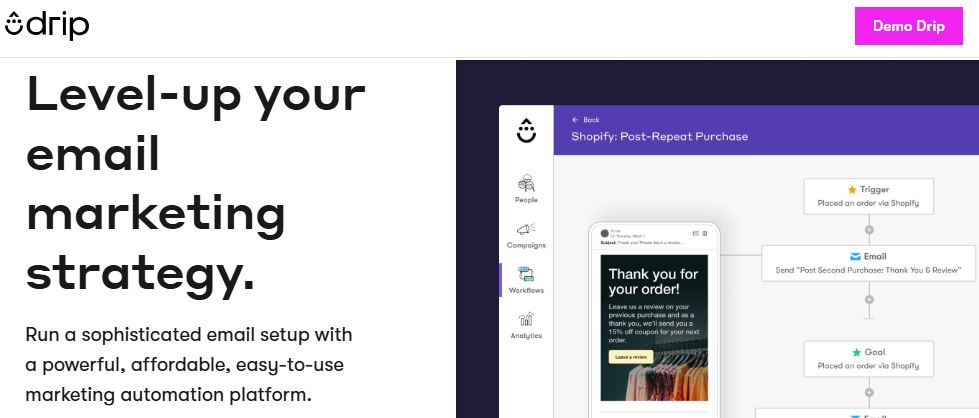
Drip built its platform specifically for e-commerce brands, betting that a smaller, more focused tool could outperform generalist platforms on the specific automation flows an online store actually needs, like cart recovery and post-purchase upsells.
- What They Do: Offer multi-channel marketing built for online stores.
- Notable Clients: Boutique shops, subscription services, and growing e-commerce brands.
- Services Offered: Email automation, product recommendations, and behavior tracking.
- Years in Business: Around 10.
- Headquarters: Minneapolis, Minnesota.
The narrower focus means fewer distractions for stores that just need email and SMS working well together.
10. Omnisend
Omnisend built its platform around the idea that email and SMS should share the same automation workflows rather than living in separate tools, so a cart recovery sequence can start with an email and follow up with a text without a marketer stitching two systems together manually.
- What They Do: Combine email and SMS marketing with pre-built automation for cart recovery, welcome series, and order updates.
- Notable Clients: Independent and mid-size e-commerce brands across multiple platforms.
- Services Offered: Omnichannel automation, segmentation, and AI-assisted campaign tools.
- Headquarters: Vilnius, Lithuania, with a Chicago office.
- Founded: 2014.
Stores already juggling both email and SMS vendors often consolidate onto Omnisend just to cut down on the number of platforms a small team has to manage.
Where Wbcom Designs Fits In
Wbcom Designs is a WordPress plugin and theme company, not an email service provider, and it does not offer email deliverability infrastructure, list management, or marketing automation as a product. It does not belong in a ranking of email marketing companies. Its actual specialty is WordPress community, membership, and learning management system development, and site owners who need email marketing should look to the platforms covered above rather than to a theme or plugin vendor.
Matching a Platform to Your List Size and Business Model
There isn’t a single best email marketing company, only a best fit for a given list size, industry, and internal skill set. A five-person nonprofit sending a monthly newsletter has almost nothing in common with a twenty-person e-commerce brand running daily automated flows, and the ten companies above serve those two teams very differently.
If you’re just starting out and want the shortest path to a professional-looking send, Mailchimp or Constant Contact will get a campaign out the door with minimal setup. If your business runs on an online store, Klaviyo, Drip, and Omnisend were all built with that exact workflow in mind, and the extra cost tends to pay for itself through better segmentation and cart recovery alone. Teams that need email tied tightly to a sales pipeline are better served by ActiveCampaign or HubSpot, both of which treat the inbox as part of a longer customer relationship rather than a standalone channel.
Budget-conscious teams with large, infrequent lists, such as an annual conference sending a handful of campaigns a year, often find that Brevo’s per-email pricing beats the contact-based pricing of most competitors by a wide margin. Design-heavy brands that treat every email as a piece of visual marketing collateral, on the other hand, tend to be happiest with Campaign Monitor, where the template editor was built by people who clearly cared about typography and layout as much as deliverability.
Before signing an annual contract with any provider, run a free trial with your actual list and a real campaign, not just the demo data the vendor provides. Deliverability, automation logic, and support responsiveness all look different once real subscribers and real edge cases are involved, and that thirty-day test will tell you more than any features comparison chart.
One last practical step: send a handful of test campaigns to seed accounts across Gmail, Outlook, and Yahoo before your first real send. Rendering and spam placement vary by inbox provider, and catching a formatting problem on a test send costs nothing compared to catching it after ten thousand real subscribers have already seen a broken layout.
Interesting Reads
Top 10 Content Marketing Agencies 2025