

A business profile on a BuddyBoss community works like a Facebook Page: a presence separate from any single member’s personal profile, with its own activity feed, reviews, and contact channel. It’s the difference between a customer finding “Jane, who happens to run a bakery” in the member directory and finding an actual storefront with hours, photos, and reviews from other customers. Here’s how to set one up properly.
What BuddyBoss Provides on Its Own
Out of the box, BuddyBoss gives you member profiles, groups, activity feeds, private messaging, course delivery if you’re running training alongside the community, tiered memberships, and a route to a branded mobile app. None of that is built around representing a business as its own entity, that’s a separate layer.
What BuddyPress Business Profile Does
BuddyPress Business Profile is the add-on that provides this. It lets members create business pages showing products, services, portfolio pieces, and reviews, and post updates, events, and job listings from the page itself rather than a personal profile.
Current version (v2.1.0):
- Customizable profile fields, logo, cover image, contact info, social links.
- Business activity feed, announcements, images, and video, with comments and likes.
- Private messaging, a dedicated inbox per profile.
- Role management, admins, editors, and moderators, with control over who can create, edit, or delete profiles.
- Weekly availability scheduling, with an automatic “Open Now” status shown on the profile.
- Public, private, or hidden visibility per profile, plus reviews, star ratings, a searchable directory with map view, and LocalBusiness SEO schema.
Requirements
You need an existing BuddyPress or BuddyBoss community, PHP 7.2 or newer, and WordPress 5.0 or later. It runs fine on Chrome, Firefox, and Safari, and is responsive across desktop, tablet, and mobile.
Why a Dedicated Profile Beats a Customized Member Page
It’s fair to ask whether you actually need a separate plugin instead of just adding custom xprofile fields to a member’s existing profile: business name, hours, a description field. For a single-person, very informal setup, that might genuinely cover it.
Where it breaks down is anything beyond static information. Custom fields don’t give you a feed distinct from the owner’s personal activity, a public review system, or the ability to hand day-to-day management to an employee without giving them the owner’s personal login. Those three things, a dedicated feed, reviews with star ratings, and delegated access, are the actual reasons this plugin exists rather than being an unnecessary extra layer on top of what’s already there.
Building Out the Products and Services Section
The About tab’s repeater fields are where a business profile does more work than a plain listing. Instead of one dense paragraph describing everything the business offers, break it into individual entries, specific products, services, or packages, each with its own short description. A visitor comparing options should be able to scan for the specific thing they’re looking for rather than reading a full catalog description to find it.
Photos matter more here than almost anywhere else on the profile. A services list with no images reads like a price sheet, while even one representative photo per entry, a finished project, a product shot, gives a visitor something concrete to evaluate instead of just a name and a price.
Creating a Business Profile
Install and activate the plugin, then click Create a Business.
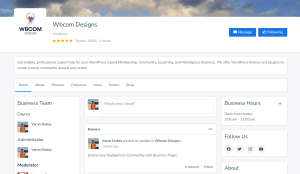
Enter the business name, a short description, and a category. Click Create Business and Continue. Upload a profile photo, then a cover image, and the profile is live.
From there members can fill in the About section, start collecting reviews, and post to the activity feed, none of it required before publishing, all of it improving how the page reads to a visitor. A profile that goes live with just a name and a logo will technically work, but it won’t convert a browsing visitor into a customer the way a fully filled-out one does.
Handling Customer Messages Without One Person Drowning
The private-messaging inbox is where most direct customer inquiries land, and for a solo owner that’s manageable at first. It stops being manageable once the business grows past what one person can respond to promptly. Role management exists for this reason: bring on an employee or a virtual assistant with editor or moderator access to handle routine questions, keeping anything that needs the owner’s direct judgment escalated rather than everything funneled through a single inbox.
Set this division of labor up before message volume becomes a problem, not after a backlog has already built up. A business page with slow or inconsistent replies loses more goodwill than one with no messaging feature at all, since customers who message a business generally expect a response within a reasonable window, and silence reads as indifference even when it’s really just one overwhelmed person.
Reviews and Ratings: The Section Doing the Real Work
Star ratings and written reviews are, in practical terms, the most persuasive part of the entire profile. A business page with a polished description but zero reviews reads very differently to a potential customer than one with a dozen genuine ones, even if the underlying business is identical. Encouraging early customers to leave a review, a follow-up message after a purchase, a mention at checkout, matters more in the first few weeks than almost any other setup step, since an empty reviews tab on a brand-new profile looks the same as an empty reviews tab on a business nobody trusts yet.
Respond to reviews, positive and negative both. A thoughtful reply to a critical review often does more for credibility than the review itself did damage, it shows a real person is paying attention, while an unanswered negative review sitting alone makes a visitor assume nobody’s watching.
Setting Hours That Actually Match Reality
The weekly availability field and its automatic “Open Now” status are easy to set once and forget, which is exactly the problem. A profile showing “Open” when the business is actually closed for a holiday, or “Closed” during hours the owner quietly extended for a busy season, sends a customer away or, worse, brings one to a locked door. Treat the hours field as something that needs the same periodic attention as the phone number or address, not a one-time setup step.
For businesses with irregular hours, seasonal operations, appointment-only services, pop-up schedules, the standard weekly grid may not fit cleanly. In that case, use the description field to point visitors toward the actual booking or contact method rather than leaving a misleading fixed schedule up that technically satisfies the field but doesn’t reflect how the business really operates.
Multi-Location and Franchise Businesses
A business with more than one physical location has a decision to make early: one shared profile representing the whole brand, or a separate profile per location. A single shared profile keeps reviews and follower counts consolidated, which reads as more established to a new visitor, but it blurs location-specific details, hours, address, staff, that matter to someone trying to visit a specific branch.
Separate profiles per location solve the specificity problem but split the review count and social proof across multiple pages, a new location starts from zero credibility even if the brand itself is well established elsewhere. There’s no universally correct answer here, it depends on whether customers usually care which specific location they’re dealing with, a repair shop where you show up in person, or care about the brand more broadly, an online-first service with several regional teams behind it. Decide this at setup rather than restructuring after reviews have already accumulated on the wrong structure.
Extending the Rest of Your Community
Wbcom Designs builds a broader lineup of BuddyPress and BuddyBoss add-ons:
- BuddyPress Member Type (free), custom member classifications with their own roles and fields.
- BuddyPress Member Blog / Member Blog Pro (free / from $49), frontend blogging from a member’s own profile.
- BuddyPress Check-ins / Check-ins Pro (free / from $49), location tagging with maps on the Pro tier.
- BuddyPress Statistics (from $49), registration, post, and engagement tracking across your community.
Browse the full Wbcom Designs catalog for the rest of the lineup.
Onboarding Whoever Actually Runs the Page Day to Day
For a lot of small businesses, the person setting this profile up isn’t the same person who’ll be posting updates and answering messages six months in, an owner might build it, then hand it to an employee or a hired social-media person. Write a short internal guide covering where the key fields live and who to escalate a difficult message to, rather than expecting whoever inherits the account to reverse-engineer the interface on their own.
This matters more than it sounds like it should. A profile that changes hands without documentation tends to develop small inconsistencies over time, an outdated hours field, a cover image nobody remembers uploading, that a five-minute handoff document would have prevented.
Before You Announce the Page Publicly
Treat the launch as a small event rather than something that happens the moment the profile is technically live. Confirm every field is filled in, send a test message to the inbox from a separate account, and check how the page looks on mobile, most customers browsing a local business directory are doing it from a phone, not a desktop.
Have a handful of activity-feed posts ready before announcing anywhere, an empty feed on a brand-new business page looks unfinished even if the About tab and reviews are already solid. Coordinate the announcement with whatever other channels the business already uses, an existing social following, an email list, a physical location’s foot traffic, rather than treating the BuddyBoss profile as an isolated launch.
Writing a Business Description That Actually Converts
The main description field gets read before almost anything else on the page, so it’s worth more care than a rushed paragraph copied from somewhere else. Lead with what the business actually does and who it’s for, rather than opening with a generic mission statement that could apply to any company in the category. Specifics, what you make, who you serve, what makes the approach different, do more persuasive work than broad claims about quality or passion that every competitor’s page also makes.
Keep it to two or three tight paragraphs rather than one sprawling block, both because visitors skim and because the plugin’s directory search weighs this field, natural, specific writing tends to surface better than a dense, keyword-stuffed version saying the same thing. Revisit it whenever the business’s offerings shift meaningfully, a description describing services the business no longer offers actively misleads a potential customer, which is worse than simply being outdated.
Cover Image and Logo: The Two-Second First Impression
Before a visitor reads a single word of the description, they’ve already reacted to the cover image and logo. A stretched, pixelated, or generic stock photo undercuts everything well-written underneath it, while a sharp, on-brand cover image does more to establish legitimacy in the first two seconds than the rest of the page combined.
This doesn’t require professional photography. A clean, well-lit photo of the actual product, storefront, or work being done reads as more trustworthy than a polished but generic stock image that could belong to any business in the category. Update the cover image when it stops reflecting the current state of the business, an old storefront photo after a renovation, a discontinued product line, the same way you’d update the hours or contact details.
Choosing Visibility: Public, Private, or Hidden
Public fits nearly every business profile, since the entire point is being found by potential customers through search or the community directory. Private visibility suits a smaller, invite-only clientele, a boutique service that doesn’t want open discovery. Hidden mostly makes sense as a temporary state while building the profile out before launch, since a hidden profile forfeits the search and directory visibility that’s the main reason to use this plugin over a plain member profile in the first place.
Posting Cadence: Keeping the Activity Feed From Going Stale
A business profile’s activity feed is the clearest public signal of whether a business is actually active. A visitor who lands on a page with a polished About section but a feed that hasn’t posted in four months draws an obvious conclusion, whether or not it’s accurate, and there’s no way for them to know the business is thriving offline if the profile itself looks abandoned.
This doesn’t require daily posting. A steady, modest cadence, a new product or service update, a customer spotlight, a seasonal note, once every week or two reads as far more alive than sporadic bursts of five posts followed by silence. Set a recurring reminder for whoever owns the page rather than relying on remembering to post when things happen to be quiet, consistency matters more here than volume.
Keeping the Profile Current
A business profile set up once and left alone drifts, outdated hours, an old phone number, a product that’s been discontinued for months. None of it breaks the page technically, but each small inaccuracy chips away at trust in a way that’s hard to notice from the inside since there’s no error message flagging it.
A quick monthly check, hours still accurate, contact info still current, recent reviews responded to, keeps the profile feeling actively run rather than abandoned. Fold this into whoever’s already checking the inbox rather than treating it as a separate task that ends up nobody’s responsibility.
Frequently Asked Questions
Can more than one person manage the same business profile? Yes, role management supports multiple assigned managers with different permission levels, each keeping their own login, so an owner and an employee can share responsibility without sharing credentials.
Does this help with local search visibility? The LocalBusiness schema markup applied automatically to profiles gives search engines more structured data than a standard member profile carries, which can help a business surface in relevant local searches.
What happens to reviews if a profile is deleted? Reviews are tied to the profile entry, deleting the profile removes them along with it. If a business is just pausing rather than closing, hiding the profile instead of deleting it preserves the review history for whenever it reopens.
Is there a limit on how many business profiles one community can host? No fixed limit, a site can host as many business profiles as members create, and a single admin account can manage several.
Can a business profile integrate with an existing WooCommerce store? The plugin itself focuses on the profile, feed, reviews, and messaging layer rather than product checkout. For an actual storefront synced into the activity feed, pair it with a separate commerce-focused add-on rather than expecting Business Profile to handle transactions on its own.
Can a customer follow a business profile without creating a full community account? No, following requires a registered community account, the same as any other BuddyBoss interaction. For businesses expecting a lot of casual, one-time visitors rather than repeat community members, this is worth factoring into how much weight you put on follower count as a success metric versus direct inquiries and reviews, which don’t require the same ongoing account relationship.
Does deactivating the plugin remove existing business profiles? Deactivating stops the profiles from displaying and disables profile creation, but it doesn’t delete the underlying data. Reactivating restores everything as it was, which makes it safe to deactivate temporarily for troubleshooting without risking the content itself.
BuddyPress Business Profile itself: Personal (1 site) $59/year, Professional (5 sites) $129/year, Agency (unlimited sites) $299/year, with lifetime licenses available.
Interesting Reads:
How are Member Reviews Displayed on BuddyPress Sites?
How Can We Create a Job Listings Section on a BuddyPress Website?
How Do Shortcodes Enhance The Functionality and Display of BuddyPress Components?