

A general job board competes with Indeed, LinkedIn, and every other site with a “jobs” page. A niche job board doesn’t compete with any of them, it serves one specific audience so well that the audience stops looking anywhere else. Remote-only design roles, union electrician openings, climate-tech startups, veterinary locums: the narrower the focus, the easier it is to become the obvious answer for that exact search.
WP Career Board is built for exactly this kind of launch: a complete public board, employer and candidate dashboards, and a company directory, all free from the first install, with a $69/year Pro upgrade for the applicant pipeline and monetization once the board has traction. This guide walks through picking a niche, seeding it before launch, building an audience, and turning it into revenue.
Table of Contents
- Why Niche Job Boards Outperform General Ones
- How to Pick and Validate a Niche
- Setting Up the Board on WordPress
- Seeding Listings Before Launch
- Building an Audience Before You Have Traffic
- Monetizing Employers
- A Real-World Scenario: Launching a Remote Design Jobs Board
- Keeping the Technical Side Simple as You Grow
- A Few Legal and Trust Basics Worth Setting Up Early
- Common Mistakes That Sink a Niche Board
- FAQs
Niche job boards generate response rates of 30-40%, compared to under 4% on general platforms, roughly 3-4 times higher, while cutting screening time by 60-70%. Early-stage niche boards typically run on $500-5,000 in startup costs, reach first revenue within about 5 months, and operate at close to 90% margin once established, with the job board software market itself growing from $0.66B in 2026 toward $1.29B by 2035.
Why Niche Job Boards Outperform General Ones
The math behind a niche board is counterintuitive until you see it written out: fewer total visitors, but a dramatically higher percentage of them are exactly who an employer wants to reach. A general board attracts everyone, which means an employer’s posting gets buried next to thousands of irrelevant listings, and a job seeker wades through postings that don’t match their skills. A niche board inverts that: every visitor already self-selected into the niche just by finding the site, so the signal-to-noise ratio is naturally higher on both sides.
That’s the mechanism behind the 30-40% response rates niche boards see versus under 4% on general platforms.
A $99 listing on a board of 2,000 highly relevant candidates often outperforms a $500 listing on a board of 2 million irrelevant ones, and employers notice the difference in applicant quality within their first posting.
How to Pick and Validate a Niche
The strongest niches sit at the intersection of three things: a defined audience that already gathers somewhere (a subreddit, a Slack community, a professional association, a Discord server), a hiring pattern that’s currently underserved by existing boards, and a topic you can credibly speak to, since a niche board’s content and outreach work best when they sound like they come from inside the industry, not from a generic SEO playbook.
Validate before building anything. Four checks, in order:
- Search existing job boards for your target niche and note how thin the results are, that gap is your opening.
- Check for an existing community (subreddit, LinkedIn group, Slack, Discord) for the audience, since that’s both proof of demand and your first distribution channel.
- Post in that community asking whether a dedicated job board would be useful, real response, not just polite agreement, is the signal that matters.
- Check what comparable niche boards charge employers elsewhere; if a similar board gets $99-299 per listing paid, that’s a strong proxy for your own niche’s willingness to pay.
Avoid niches that are either too broad (you’re just rebuilding a general board with extra branding) or too narrow (fewer than a few dozen relevant job openings exist across the entire market at any given time). The sweet spot is a niche specific enough that a candidate feels “this was made for me” but broad enough to support a steady trickle of new postings, usually a recognizable job function crossed with an industry, a work arrangement, or a geography.
Setting Up the Board on WordPress
If you already run a WordPress site, whether that’s a blog, a community, or a company site, adding WP Career Board is a plugin install, not a new infrastructure project. The free tier gives you a working public board immediately: live search with instant filtering, front-end dashboards for employers and candidates, single-page job posting, and company profiles organized into a searchable directory, all built on native Gutenberg blocks.
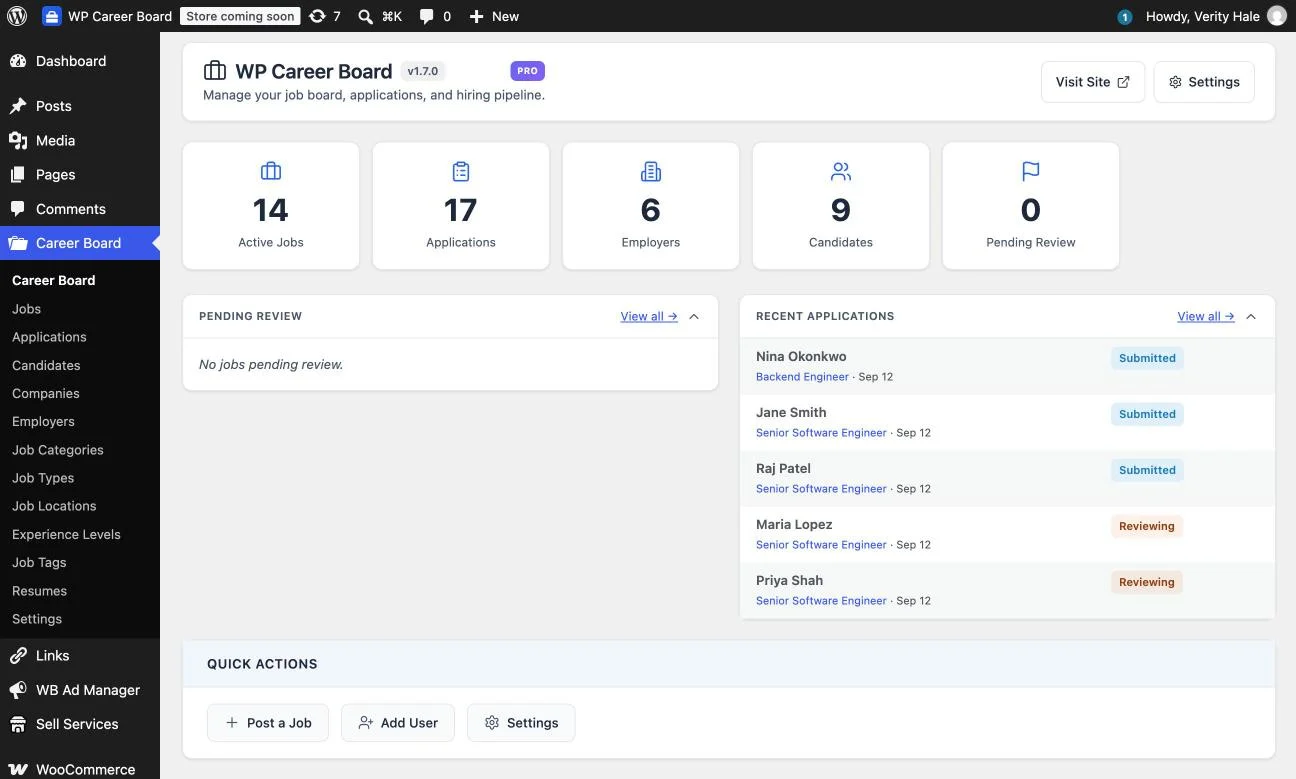
Start with the basics: set your job categories to match your niche’s actual sub-specialties (not generic categories copied from a general board), configure your experience levels and job types to the vocabulary your audience actually uses, and set up at least one employer account yourself so you can test the posting flow exactly as a real employer would experience it before anyone else sees it. If the board will double as a revenue stream later, note that Pro ($69/year single-site) adds the Kanban applicant pipeline, resume search, AI-assisted job writing, and paid listings through Stripe, PayPal, or WooCommerce, but none of that is required to launch; the free tier is enough to go live.
Seeding Listings Before Launch
An empty job board is the single biggest reason niche boards fail to get off the ground. Nobody bookmarks a board with three listings, and no employer wants to be the first one to post somewhere unproven. The fix is manual, unglamorous, and non-negotiable: seed 20-50 real, current listings yourself before you tell anyone the board exists.
Three sources cover most of the first 20-50 listings:
- Company career pages in your niche, most companies are happy to be listed for free early on, it’s free exposure for them.
- The same communities you used to validate the niche, members often already know who’s hiring.
- Publicly posted roles on LinkedIn or company Twitter/X accounts, always link back to the original source and credit the employer accurately.
Use WP Career Board’s company profiles to build out a real employer page for each one as you add their listings, so the directory looks populated and credible from the first day a real visitor arrives, not just the jobs list.
Keep seeding through the first month even after launch. A board that stops adding fresh listings after week one feels stale fast, and job boards live or die on the visitor’s sense that “new things show up here regularly.”
Building an Audience Before You Have Traffic
Distribution matters more than design for a brand-new niche board. Go back to the communities you used for validation and share the board there directly, not as a drive-by link drop, but as a genuine “I built this because I noticed X gap, here’s 30 real listings to start” post. Reach out individually to a handful of respected people in the niche and ask them to take a look; a credible early endorsement from someone the audience already trusts does more than any paid ad at this stage.
Build a simple weekly or biweekly email digest of new listings using whatever email tool you already have, this is often the single highest-leverage channel for a niche board since job seekers want to be notified rather than having to remember to check back. And invest in SEO from day one: WP Career Board’s Gutenberg-native structure and clean URLs give search engines a straightforward structure to index, but the content still needs to exist, write a few genuinely useful posts about the niche (salary benchmarks, “how to break into X,” company spotlights) that bring in search traffic beyond just job-seekers actively browsing listings.
Monetizing Employers
Resist charging employers from day one. The first batch of paying employers almost always comes after the board has proven it can deliver qualified applicants, not before, so the first month or two should be free listings in exchange for being an early, visible presence on the board, which also solves the seeding problem above.
Once the board has a track record, usually a few successful hires employers will mention unprompted, introduce paid listings using WP Career Board Pro’s credit-based system through Stripe, PayPal, or WooCommerce. Common niche-board pricing sits in the $49-299 range per listing depending on the niche’s hiring budgets. A simple three-tier structure covers most employer budgets without overcomplicating the pricing page:
- Standard listing, the baseline, gets the role in the main search and filter results.
- Featured listing, a pinned or highlighted upsell for employers who want extra visibility.
- Multi-listing bundle, a discount for employers posting several roles at once, common for agencies or fast-growing teams.

A Real-World Scenario: Launching a Remote Design Jobs Board
Picture someone who’s noticed that remote-only product design roles are scattered across a dozen general boards, LinkedIn, and a few Discord servers, with no single destination. Week one: validate in two active design Discord communities and a design-focused subreddit, confirm genuine interest, register a domain, and install WP Career Board on a fresh WordPress site with categories built around design specialties (product, UX research, brand, motion) rather than generic “design” buckets.
Week two: manually seed 35 real remote design listings pulled from company career pages and the same communities, building out a company profile for each employer as they go, so the board already looks like a real destination on day one rather than an empty shell. Week three: post genuinely in both communities with the real listing count as proof, reach out to three well-known design Twitter accounts for a mention, and set up a simple weekly digest email. Week four: the first unsolicited employer asks how much it costs to post, that’s the signal it’s time to turn on Pro’s paid listings, not before.
Three months in, the board has 40-60 live listings at any time, a growing email list, and its first handful of paying employers, a modest but real foundation built entirely on WP Career Board’s free tier for the first month and Pro’s $69/year for monetization after that, a startup cost closer to the time invested than to any software bill.
Keeping the Technical Side Simple as You Grow
A niche board’s early technical needs are modest: reliable hosting, a clean theme, and a plugin that doesn’t require constant babysitting. WP Career Board’s Gutenberg-native architecture means the board’s core pages, job listings, company profiles, employer dashboards, update without a full page reload, which matters more than it sounds like once real visitors start browsing and filtering listings regularly; a laggy, old-architecture job board plugin is a surprisingly common reason visitors bounce before applying.
As the board grows past a few hundred listings and a steady trickle of employer accounts, a few practical habits keep it running smoothly: back up the database regularly (most WordPress hosts offer this automatically, confirm it’s actually happening rather than assuming), keep WordPress core, the theme, and WP Career Board itself updated promptly since job board plugins touch forms, file uploads (resumes), and payment integrations, three areas where staying current on security patches genuinely matters, and periodically audit stale listings, an employer who filled a role three months ago but never closed the listing erodes trust with job seekers who apply to dead postings.
None of this requires a developer on retainer for a board of the size most niche launches reach in their first year. It’s routine WordPress maintenance, the same category of work any site owner already does for the rest of their WordPress install, just extended to cover the job board’s specific moving parts.
A Few Legal and Trust Basics Worth Setting Up Early
A job board handling candidate resumes and personal information, even a small niche one, benefits from a few basic safeguards set up before launch rather than retrofitted after a problem. Publish a straightforward privacy policy explaining what candidate data is collected (resumes, contact details) and how it’s used, since candidates uploading a resume to a site they’ve never heard of want some reassurance it isn’t going to be resold or spammed.
Moderate employer submissions, even loosely, before they go live. A niche board’s entire value proposition is relevance and trust; a single obviously fake or scammy listing slipping through can do outsized damage to a small board’s reputation in a way it wouldn’t on a massive general platform where one bad listing gets lost in the noise. WP Career Board’s pending-review queue exists specifically for this, a quick glance at each new employer submission before it publishes catches the obvious problems without adding real friction to legitimate employers.
Finally, be explicit and consistent about what the board promises employers for their listing fee once monetization starts, duration the listing stays live, whether it’s featured or standard placement, and what happens if a role is filled early. Clear, simple terms set upfront prevent the awkward refund conversations that damage a young board’s reputation with the exact employers it needs to keep coming back.
Common Mistakes That Sink a Niche Board
- Launching empty. The single highest-correlation failure mode, covered above, and worth repeating because so many launches skip it anyway.
- Picking a niche too broad. You end up rebuilding a general board with extra branding, all the extra work of a niche launch with none of the response-rate payoff.
- Charging employers too early. Before the board has any proof of delivering candidates, this kills the exact word-of-mouth that would have brought in those employers for free later.
- Going silent after the initial push. A board that visibly stops adding listings reads as abandoned within weeks.
- Over-building the technical side first. Months spent customizing a design before confirming anyone wants the board burns the momentum a scrappy, fast, manually-seeded launch depends on.
FAQs
1. How many listings do I need before launching a niche job board?
Aim for 20-50 real, current listings before any public launch. Fewer than that and the board reads as empty; more than that before launch usually means you’ve delayed too long chasing perfection instead of shipping.
2. Do I need WP Career Board Pro to launch a niche job board?
No. The free tier covers the public board, employer and candidate dashboards, and the company directory, everything needed to launch and seed a board. Pro’s $69/year unlocks the applicant pipeline and paid listings, which matter once you’re ready to monetize, not before.
3. How long does it realistically take to get a niche job board’s first paying employer?
Based on typical niche-board timelines, expect roughly 4-8 weeks from launch to the first organic request to pay for a listing, assuming consistent seeding and community outreach during that window. Pushing to charge earlier than the board has earned trust usually backfires.
4. Should I charge job seekers to use the board?
No, virtually all successful niche job boards are free for job seekers and monetize exclusively through employer listings. Charging candidates shrinks your audience, which directly undermines the value you’re selling to employers.
5. What’s a realistic price to charge employers for a listing on a brand-new niche board?
Most niche boards start in the $49-99 range for a standard listing once they begin charging, scaling toward $149-299 as the board builds a track record and larger audience. Price too high before you have proof of applicant quality and employers simply won’t convert.
6. Can I run a niche job board alongside an existing WordPress community or blog?
Yes, WP Career Board includes BuddyPress integration in its free tier specifically for this case, letting a job board sit naturally inside an existing community site rather than requiring a separate standalone install.
7. How do I keep a niche job board from going stale after the initial launch?
Keep manually sourcing new listings on a regular cadence even after organic employer submissions start, maintain the email digest consistently, and publish occasional niche-relevant content (salary data, hiring trends) to give visitors a reason to return even when they’re not actively job hunting.
8. What’s the single highest-leverage marketing channel for a new niche job board?
Direct, genuine outreach into the existing online communities where your niche audience already gathers, consistently outperforms paid ads or generic SEO content in the first few months, since niche audiences respond far better to a credible insider post than to anonymous marketing.
9. Is it better to build a niche board on WordPress or a SaaS job board platform?
For someone already comfortable with WordPress or already running a WordPress site, a plugin like WP Career Board gets to a working board faster and far cheaper than a SaaS platform charging hundreds of dollars a month. SaaS platforms make more sense for buyers who want zero technical involvement and have the budget for a recurring fee from day one.
10. How do I know if my niche is too narrow to sustain a job board?
If a genuine search across existing job sources turns up fewer than roughly two dozen relevant openings at any given time across the whole market, the niche is likely too thin to keep a board feeling active. Broadening slightly, by role family or adjacent industry, usually solves this without losing the focus that makes a niche board work.
11. Do I need to moderate every job listing before it goes live?
For a new niche board, yes, at least loosely. A quick review before each listing publishes catches obviously fake or low-quality postings, which matters more for a small, trust-dependent niche board than it would on a massive general platform.
12. What happens if an employer doesn’t close a listing after filling the role?
Stale listings are a trust problem more than a technical one, periodically auditing older postings and following up with employers (or auto-expiring listings after a set window) keeps the board feeling current and keeps job seekers from applying to roles that are already filled.
Summary
A niche job board’s advantage isn’t technology, it’s focus: a smaller, more relevant audience that responds at 3-4 times the rate of a general platform. WP Career Board’s free tier removes the cost barrier to testing that focus, a working board, seeded with real listings and shared into the right communities, is the entire bar for finding out whether a niche is worth building further. The plugin and the Pro upgrade are the easy part; picking the right niche and seeding it properly before launch is where a niche board actually succeeds or fails.