Jetonomy Pro vs Discourse vs Flarum vs Vanilla: Self-Hosted Forum Showdown


Running a community on WordPress means making one consequential decision early: which forum software do you stake your platform on? The four options most teams land on are Discourse, Flarum, Vanilla Forums, and Jetonomy Pro. Each promises discussion, engagement, and moderation. But they come from completely different architectural assumptions, and those assumptions determine everything from your hosting bill to how well your members’ experience holds together two years from now.
This comparison does not declare a universal winner. It maps where each platform excels and where it breaks down, so you can match the right tool to the community you are actually building. The data points, tradeoffs, and architecture notes below draw from real deployment scenarios across education platforms, professional associations, SaaS communities, and hobbyist groups running on WordPress.
The Four Contenders at a Glance
Before getting into depth, here is a snapshot of what each platform fundamentally is, not just what it claims to be, but how it actually operates in a live environment.
| Platform | Runtime | WordPress Native | Hosting Model | Pricing Trigger |
|---|---|---|---|---|
| Discourse | Ruby on Rails + Ember.js | No (separate app) | Separate server required | Self-host: free; managed: $100+/mo |
| Flarum | PHP (Laravel) | No (separate install) | Separate database + subdomain | Core free; extensions add cost |
| Vanilla Forums | PHP (vanilla) | No | Mostly SaaS | Starter plans from $0, growth tiers spike fast |
| Jetonomy Pro | PHP (WordPress) | Yes, runs inside WP | Shared with WordPress | One-time per site, no seat pricing |
That table already surfaces the first structural difference: Discourse is not a plugin or even a PHP application. It is a full Ruby on Rails application backed by Postgres and Redis. Installing it means provisioning a separate server, maintaining a separate deployment pipeline, and accepting that your forum will always be a different software system from your marketing site.
Discourse: The Gold Standard That Costs Like One
Discourse earned its reputation. Launched in 2013 by Jeff Atwood and Robin Ward, it modernized forum UX at a time when phpBB and vBulletin were still the defaults. The infinite scroll, real-time notifications, trust-level moderation system, and mobile-first design were genuinely ahead of their time. Many of those ideas have since been copied across the ecosystem, including by Jetonomy Pro’s trust level implementation.
Where Discourse Wins
- Community depth: Discourse has the richest discussion feature set of any platform here. Threading, polls, topic timers, whispers, slow mode, post voting, topic maps, it has been iterating on community UX for over a decade.
- Trust levels: The original implementation. Discourse’s five-tier trust level system automatically promotes users from basic to leader based on activity, granting progressively more moderation authority. It reduces mod workload without manual configuration.
- Plugin ecosystem: Hundreds of plugins including SSO bridges, analytics integrations, AI moderation, and theme components. The plugin API is mature and well-documented.
- Email handling: Discourse treats email as a first-class interface. Members can reply to topics entirely by email. The email threading is reliable in ways most forum platforms are not.
Where Discourse Struggles
The moment you ask whether Discourse fits a WordPress-first stack, you run into architectural friction that does not go away.
- Separate server, always: Discourse requires its own Linux box with at least 2 GB RAM, Docker, Postgres, Redis, and Sidekiq. The minimum viable self-hosted setup starts around $20/month on DigitalOcean, but that is the floor, not a stable operating point under load. A community with 500 active daily users needs at least a $40–80/month droplet.
- No SSO without work: Connecting Discourse to WordPress authentication requires the Discourse SSO plugin or the wp-discourse plugin. Both work but neither is seamless. Users on your WordPress site and users on your Discourse instance live in separate systems until you explicitly bridge them, and that bridge requires ongoing maintenance across version updates.
- No shared design: Your WordPress theme has nothing to do with Discourse’s appearance. Discourse uses its own theme system. Matching the visual identity between your main site and your forum requires separate work in both systems every time you rebrand.
- Ruby on Rails expertise required: Most WordPress developers do not know Ruby. When something breaks, and things break, the debugging requires a different skill set than your team likely has. Managed hosting (Discourse.org) solves this but starts at $100/month for the starter plan, which still has user count limits.
Discourse is the right choice when your forum is the product. If the forum is a feature inside a larger WordPress site, the operational overhead works against you from day one.
Flarum: The Modern PHP Alternative With a Separate-App Problem
Flarum sits in an interesting position: it is written in PHP and Laravel, which makes it superficially closer to WordPress than Discourse. But it still installs as a completely separate application with its own database, its own authentication system, and its own deployment stack. The architectural separation from WordPress is the same problem, just wrapped in a more familiar language.
Where Flarum Wins
- Clean, modern UX: Flarum’s interface is genuinely beautiful. The single-page application design, smooth transitions, and mobile experience are competitive with Discourse. First-time users consistently rate it well on approachability.
- PHP stack: If your team knows PHP, they can read and modify Flarum’s codebase. That matters for custom extensions and debugging. The learning curve is lower than Ruby on Rails for a PHP-native team.
- Lighter than Discourse: Flarum does not require Redis or Sidekiq. A small-to-medium community can run on shared hosting with 1 GB RAM, making it cheaper than Discourse at comparable traffic.
- Active extension market: The Flarum extension ecosystem is growing. Third-party developers publish extensions for subscriptions, language packs, SSO, gamification, and theming. Many are free on Packagist.
Where Flarum Struggles
- Still a separate app: Despite the PHP foundation, Flarum is not a WordPress plugin. It lives on a subdomain, has its own user table, and requires its own deployment process. Every WP-Flarum SSO integration is a third-party extension that may or may not survive a Flarum major version update.
- Slow version progression: Flarum spent years in beta. The 1.0 release did not arrive until 2021. While the project is now stable, the pace of feature development is slower than Discourse and the extension ecosystem has gaps, particularly in advanced moderation tools.
- Extension quality variance: Unlike a curated marketplace, Flarum extensions vary widely in maintenance quality. Some community extensions are abandoned within a year. Relying on a critical feature that depends on a single developer’s continued involvement is a real operational risk.
- No BuddyPress integration: If your WordPress community uses BuddyPress for member profiles, activity streams, or groups, Flarum has no native connection to that data. You are running two parallel social layers with no shared state.
Flarum appeals to developers who want modern UX without the Ruby prerequisite. For teams already committed to WordPress, however, it does not solve the fundamental integration problem, it just makes the separate-app situation feel slightly more familiar.
Vanilla Forums: When SaaS Pricing Meets Open-Source Expectations
Vanilla Forums has the longest history of the four, having launched in 2009. The open-source version (Vanilla 3.x) is still available and runs on PHP, but the company’s commercial focus has shifted heavily toward its cloud platform. That creates a tension that affects anyone who starts with the free tier and expects a smooth path to growth.
Where Vanilla Works
- Proven scale: The Vanilla cloud platform runs communities for large brands. If your primary concern is uptime and scale under enterprise load, Vanilla’s cloud infrastructure is battle-tested.
- Knowledgebase integration: Vanilla has a built-in knowledge base feature that Discourse and Flarum lack natively. For SaaS companies that want to combine customer support documentation with community discussion, this reduces the toolchain.
- Gamification: Vanilla has points, badges, and leaderboards baked in. The engagement mechanics are straightforward to configure and work well for customer communities trying to reward participation.
Where Vanilla Struggles
- Pricing cliff: The free self-hosted version is significantly behind the cloud version in features. The cloud starter plan has member limits. As communities grow, pricing escalates quickly. Teams often discover that the features they actually need sit behind plans that cost $500 to $1,500 per month at scale.
- Self-hosted version is under-maintained: Vanilla’s development resources are directed toward the cloud product. The open-source codebase receives slower updates. Security patches come, but feature development for self-hosters is not the company’s priority.
- WordPress integration is minimal: Like Discourse and Flarum, Vanilla has no native WordPress integration. SSO requires a plugin. Your WordPress user accounts and your Vanilla forum accounts are separate until you wire them together manually.
- Lock-in risk: Moving data out of Vanilla’s cloud platform is possible but not easy. If your community outgrows the free tier and the pricing becomes untenable, migration to another platform requires significant engineering work.
Vanilla’s business model is built around SaaS growth. The self-hosted version exists, but it is not where the company’s attention goes. Plan accordingly.
Jetonomy Pro: The WordPress-Native Argument
Jetonomy Pro takes a different position from the start: instead of asking WordPress communities to bolt on a separate forum system, it runs as a native WordPress plugin. That architectural choice has ripple effects across every dimension of the comparison, performance, authentication, design, moderation, and cost.
The free version of Jetonomy already covers the core forum functionality. Jetonomy’s free tier includes four community space types, automatic trust-based moderation, and a design that adapts to any theme. Jetonomy Pro extends that foundation with advanced moderation controls, deeper BuddyPress integration, analytics, and multi-space management tools suited to larger communities.
The WordPress-Native Advantage
Running inside WordPress is not just a convenience. It changes the fundamental integration story:
- Shared authentication: Jetonomy uses WordPress user accounts directly. No SSO plugin required. No separate user table to sync. A member who registers on your WordPress site immediately has access to the forum with no additional login step.
- Shared hosting: Jetonomy runs on the same server as your WordPress install. No second VPS, no Docker setup, no Redis requirement. Your existing WordPress hosting handles it. For communities in growth mode, this means you are optimizing one infrastructure layer instead of two.
- Theme inheritance: Jetonomy uses WordPress’s native template system. Your active theme controls the visual context around forum spaces. When you update your theme, the forum updates with it. There is no parallel design system to maintain.
- WordPress hooks and filters: Because Jetonomy is a WordPress plugin, every standard WP development pattern applies. You can hook into forum events with the same action/filter API you use for everything else. Third-party WordPress plugins that affect users, roles, and capabilities automatically interact with Jetonomy in expected ways.
Trust Levels: Jetonomy’s Moderation Architecture
Jetonomy Pro implements a trust level system inspired by Discourse’s original design but adapted for WordPress’s role and capability model. New members start at Trust Level 0 with posting restrictions, they can read and reply but cannot start new topics immediately. As they participate, like posts, and complete profile actions, they earn trust level promotions automatically.
At Trust Level 2, members gain the ability to edit topic titles and move posts. Trust Level 3 grants basic moderation controls within spaces they are active in. Moderators and administrators retain full authority at all times. This layered system means communities do not need to manually vet every new member, the forum self-regulates based on demonstrated participation.
The trust architecture is explored in depth in the context of why trust levels represent the future of community moderation, the short version is that manual moderation does not scale, and trust-based automation handles the volume that human moderators cannot.
BuddyPress Integration: Where Jetonomy Has No Competitor
This is the dimension that decisively separates Jetonomy from the other three platforms for WordPress communities that use BuddyPress.
Discourse, Flarum, and Vanilla all exist outside WordPress’s user model. BuddyPress’s member profiles, activity streams, friend connections, groups, and notification system are WordPress-native features. Connecting any external forum to BuddyPress requires custom integration work that is fragile and maintenance-heavy.
Jetonomy Pro’s BuddyPress integration is native. Forum activity appears in BuddyPress activity streams. Member profiles show forum participation stats. Forum notifications flow through BuddyPress’s notification system. Group-specific forums can be linked to BuddyPress groups so that group members see relevant discussions without leaving the group context.
For communities running the complete BuddyPress stack with BuddyX and WPMediaVerse, Jetonomy Pro is the piece that closes the loop on structured discussion. Members have social profiles (BuddyPress), media sharing (WPMediaVerse), and forum threads (Jetonomy) all under one authentication layer and one theme.
Four Community Space Types
Jetonomy Pro is not a single-mode forum. It supports four distinct space types that serve different community purposes:
- Forum spaces: Traditional threaded discussion boards organized by topic. Subcategories, pinned topics, closed threads, and moderation queues work as expected.
- Q&A spaces: Stack Overflow-style question and answer spaces where the best answer can be marked as accepted. Voting surfaces quality answers. Ideal for technical support communities and knowledge-sharing platforms.
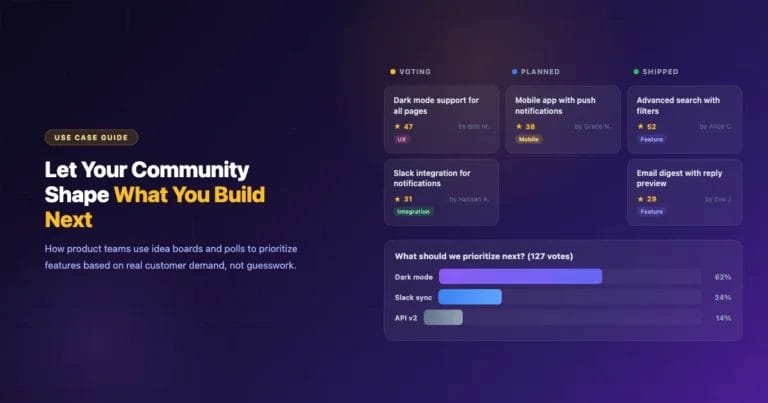
- Idea board spaces: Feature request and idea voting boards where members submit suggestions and vote on priorities. Particularly useful for SaaS products and product teams gathering community input.
- Changelog spaces: Structured spaces for product updates, release notes, and announcements that members can react to and comment on. Creates a record of product evolution that the community can engage with.
None of the other three platforms offer this range of structured space types without additional plugins. Discourse has solved threads and basic Q&A but idea boards require third-party plugins. Flarum and Vanilla do not have native changelog spaces at all.
Where Jetonomy Has Limitations
Honest evaluation requires acknowledging where Jetonomy Pro currently falls short of the established platforms:
- Ecosystem maturity: Discourse has been running large communities for over a decade. Its edge cases are well-documented. Jetonomy is newer and will encounter scale scenarios that require iterative resolution.
- Email threading: Discourse’s email reply feature is among its strongest differentiators. Jetonomy’s email notification system works well for basic notifications but does not yet support the bidirectional email-to-post workflow Discourse pioneered.
- API for external integrations: Discourse exposes a comprehensive REST API that powers third-party integrations with Slack, Zapier, and custom tooling. Jetonomy uses WordPress’s native REST API infrastructure, which is functional but does not yet have the same depth of forum-specific endpoints.
Side-by-Side: The Complete Feature Comparison
| Feature | Discourse | Flarum | Vanilla | Jetonomy Pro |
|---|---|---|---|---|
| WordPress SSO (native) | Plugin required | Extension required | Plugin required | Built-in (same WP users) |
| BuddyPress integration | None | None | None | Native |
| Shared hosting with WP | No | No | No | Yes |
| Trust level moderation | Yes (5 levels) | Extension | Basic roles | Yes (4 levels) |
| Q&A space type | Plugin | Extension | No | Native |
| Idea board / voting | Plugin | Extension | No | Native |
| Changelog spaces | No | No | No | Native |
| Theme from WordPress | No | No | No | Yes |
| Email reply threading | Yes | Basic | Basic | Notifications only |
| Min. RAM requirement | 2 GB (recommended 4 GB) | 512 MB | 512 MB (cloud) | Same as existing WP |
| Base self-hosted cost | $20–40/mo extra | $5–15/mo extra | Free (limited) | $0 extra hosting |
| Pricing model | Free / Managed $100+/mo | Free + paid extensions | Free / SaaS tiers | One-time per site |
| Plugin/extension API | Ruby/JS | PHP/JS | PHP | WordPress actions/filters |
Infrastructure Cost: What You Actually Pay Over Three Years
Pricing pages rarely tell the full story. Here is a realistic three-year total cost of ownership for a community with 1,000 active members across the four platforms. This assumes self-hosted where applicable and typical growth to 5,000 registered users by year three.
| Cost Item | Discourse | Flarum | Vanilla (cloud) | Jetonomy Pro |
|---|---|---|---|---|
| Additional server/hosting | $720–1,440 | $180–540 | $0 (cloud handles) | $0 (shared with WP) |
| Software license | $0 (self-hosted) | $0 + extension costs | $0–18,000 (SaaS tiers) | One-time site license |
| Integration dev work | $500–2,000 | $300–1,200 | $300–1,000 | Minimal |
| Maintenance/updates | High (Ruby stack) | Medium | Low (managed) | Low (WP ecosystem) |
The Vanilla SaaS range is deliberately wide because pricing depends heavily on feature tier and member count. The jump from a free or starter Vanilla plan to a tier that includes analytics, SSO, and advanced moderation can be substantial. Communities that start on free Vanilla often face a pricing cliff when they hit growth milestones.
Discourse’s infrastructure cost is also often underestimated. Running Discourse properly under real load, not the absolute minimum spec, typically requires a $40/month server by the time your community has a few hundred daily active users. The soft cost of maintaining a Ruby on Rails application (server updates, Docker upgrades, Postgres vacuuming) adds ongoing engineer time that has real dollar value.
Migration Complexity: What Happens If You Choose Wrong
Community data migration is painful under any circumstances, but it is not equally painful across platforms. Discourse has a documented import framework and scripts for migrating from phpBB, vBulletin, bbPress, and several others. Flarum has community-contributed migration scripts with varying quality. Vanilla’s cloud platform makes data export possible but not trivial. Jetonomy has a migration path from bbPress.
The deeper migration risk is not technical, it is social. Moving a community from one platform to another means asking members to log in somewhere new, re-learn navigation patterns, and potentially lose their historical post counts and reputation scores. Every migration has churn. The decision you make now has multi-year lock-in implications.
For teams coming from bbPress specifically, the complete bbPress to Jetonomy migration playbook covers the step-by-step process including user data preservation and post history transfer.
Which Platform Fits Which Community Type
The comparison so far shows tradeoffs, not a single winner. The right choice depends on what you are building and how your community relates to the rest of your online presence.
Choose Discourse When
- The forum is your product, not a feature attached to one. Think Hacker News, Reddit-style topic communities, or developer communities where discussion depth is the core value proposition.
- You have dedicated infrastructure budget and a developer comfortable maintaining Ruby on Rails deployments.
- Email-as-interface is a genuine requirement, members who prefer replying to forum threads via email get the best experience on Discourse.
- You need the most mature plugin ecosystem available with the longest track record of large-scale community deployments.
Choose Flarum When
- You want Discourse-caliber UX without the Ruby prerequisite and your team has PHP expertise.
- Budget for hosting is tight and you need a lightweight forum application that runs on minimal resources.
- WordPress integration is not a priority, you are building a standalone community platform that does not need to share identity with a WP site.
Choose Vanilla When
- You need enterprise-grade SaaS reliability without managing server infrastructure and your community budget has room for cloud pricing at scale.
- A built-in knowledge base alongside forum discussion is a genuine product requirement.
- You are building a customer community for a non-WordPress product and WordPress integration is irrelevant to the use case.
Choose Jetonomy Pro When
- Your community is built on WordPress and the forum is a feature, one important component among several including member profiles, media, and content.
- You use BuddyPress and want forum activity to live inside the same social layer as profiles, activity streams, and groups, not bolted on from outside.
- You need multiple space types (forum, Q&A, idea board, changelog) under one plugin without assembling a stack of separate tools.
- Operational simplicity matters: one hosting bill, one WordPress admin, one authentication system, one theme to maintain.
- Trust-level moderation that scales without adding moderators is a priority for your community growth plan.
The Architectural Decision That Shapes Everything
Every other difference in this comparison flows from one underlying architectural question: should your forum be a separate application or an integrated component of your WordPress site?
Discourse and Flarum answer that question as separate applications. Their architectural integrity is not a flaw, for communities where the forum is the core product and WordPress is peripheral or absent, separate-app makes complete sense. The independence gives you more deployment flexibility, more framework-specific tooling, and cleaner separation of concerns at the cost of integration complexity.
Vanilla’s answer depends on which version you are using. The cloud platform is its own managed environment. The self-hosted version is a separate PHP app that happens to exist outside SaaS infrastructure.
Jetonomy Pro answers the question differently: the forum is part of WordPress, not alongside it. That is the right answer when the community has member profiles in BuddyPress, when content lives in WordPress, when e-commerce is WooCommerce, and when the entire platform benefits from shared authentication, shared infrastructure, and a unified development model.
The shift from bbPress, which served this role for years before Jetonomy, to a modern plugin that supports multiple space types, native trust levels, and BuddyPress integration is well-documented for teams evaluating bbPress against Jetonomy for their specific use case.
Practical Setup: Time to First Discussion
Setup time matters for teams making a decision under real constraints. Here is a realistic estimate for getting each platform to a functional state with at least basic WordPress authentication in place:
| Task | Discourse | Flarum | Vanilla (cloud) | Jetonomy Pro |
|---|---|---|---|---|
| Initial install | 2–4 hours (Docker setup) | 1–2 hours | 15 minutes (SaaS) | 5 minutes (WP plugin) |
| WP user sync / SSO | 1–3 hours | 1–2 hours | 1–2 hours | 0 (native) |
| Theme matching to WP | 4–8 hours | 2–4 hours | 2–4 hours | 0 (inherits theme) |
| BuddyPress connection | Not available | Not available | Not available | Built-in |
| Total to launch | 7–15 hours | 4–8 hours | 3–6 hours | Under 1 hour |
The Jetonomy setup time advantage is not marketing, it reflects the reality that there is no SSO bridge to configure, no theme system to reconcile, and no external server to provision. You install the plugin, create your first space, and the forum is live under your existing domain, with your existing user accounts, inside your existing theme.
The Verdict
Self-hosted forum software in 2026 has genuinely good options at every point on the complexity spectrum. Discourse remains the deepest, most feature-complete forum platform available. Flarum is the best modern option for PHP-first teams who want Discourse-level UX without the Ruby requirement. Vanilla’s cloud platform serves enterprise buyers who need managed infrastructure and do not want to run their own servers.
For WordPress communities, particularly those using BuddyPress, BuddyX, or any combination of WP membership and community plugins, Jetonomy Pro makes a strong case that is hard to dismiss on the merits. The architectural integration advantage is real, not theoretical. Running one authentication system instead of two, one hosting environment instead of two, and one theme instead of two has compounding benefits as your community grows and your development team evolves.
The platforms that require a separate application server are excellent forum software. They are not excellent forum software for WordPress communities that need everything to feel like one product. Jetonomy Pro is.
Ready to Build Your Forum on WordPress?
If you are running BuddyX and want to add structured forum discussion without adding a second application to your stack, Jetonomy Pro is the natural next step. It installs in minutes, connects to your existing member base automatically, and gives you forum, Q&A, idea board, and changelog spaces from day one.