
Someone signs up for your community, fills in a profile, maybe posts once in the first week, and then never comes back. You check the numbers a month later and half your members list has one login and nothing else. This is the actual problem behind wordpress community engagement: not that people leave loudly, but that they quietly stop opening the site at all. Fix that, and the place starts to feel alive again. You built it. It should feel like something is happening in it.
Why a WordPress community goes quiet
Most community owners assume people leave because the content is bad or the design feels dated. Usually it is simpler than that. There is nothing pulling them back on day two.
Think about what a new member sees after their first post. Nobody replied yet. Nothing on the site changed. There is no badge, no notification, no reason to check again before next week. A feed with three posts and no acknowledgment reads as empty even when a few people are technically active in it.
The same thing happens with events, or the lack of them. If a community never meets, never has a scheduled moment, it stays a folder of text forever. No rhythm, no reason to plan around it, no reason to tell a friend “we’re doing this Thursday.”
There’s a third quiet cause worth naming: nobody feels seen. A member who has posted twenty times and never once gotten a public nod that their effort counted for anything eventually decides it doesn’t. People will keep showing up for recognition long after they’ve stopped showing up out of curiosity.
Two things fix this, and they are different problems with different solutions:
- Members need a small, visible reason to participate today, not just a reason to have joined originally.
- Members need a recurring moment on the calendar that gives the community a pulse beyond the feed.
The first is a job for gamification. The second is a job for events. Most active communities running on BuddyPress or BuddyX use both, and they solve genuinely different halves of the problem.
| What’s missing | What fixes it |
|---|---|
| No reason to open the site between posts | Points, badges, and a visible leaderboard |
| No shared moment to plan around | Recurring events with RSVPs |
| Effort goes unnoticed | Public recognition tied to real milestones |
Give people a reason to log in: points, badges, and leaderboards
Gamification gets a bad reputation because people picture a slot machine bolted onto a forum. Used well, it is closer to what a good community manager already does by hand: notice who is showing up, and say so publicly. A plugin just does it automatically, for every member, every time.
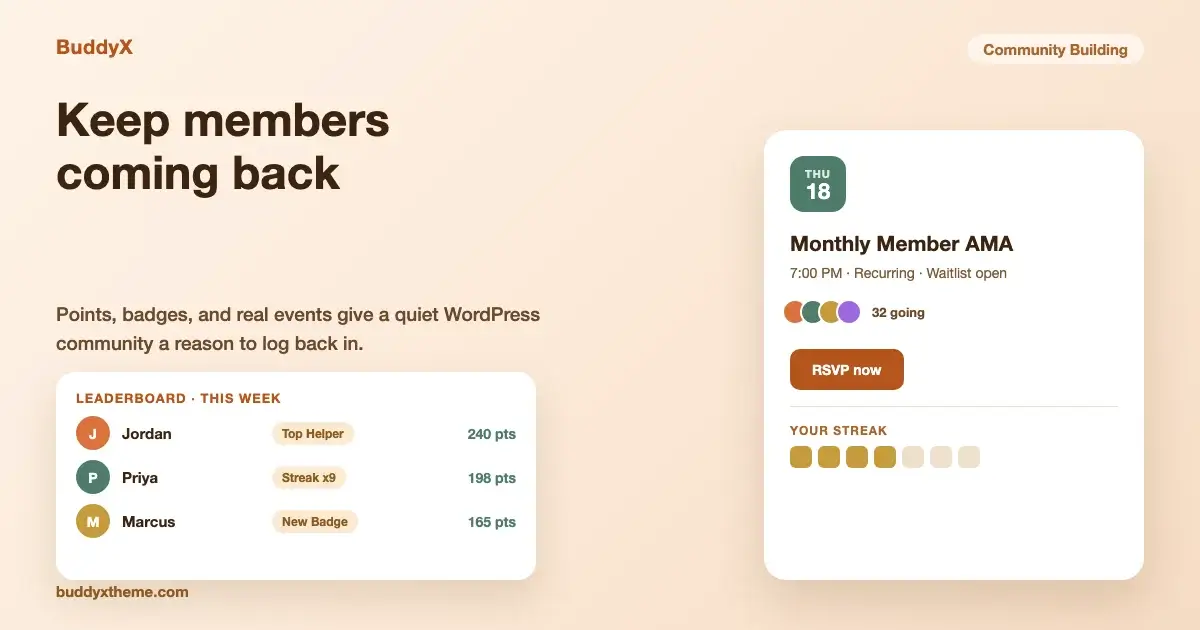
WB Gamification is the free version of this idea for BuddyPress and BuddyX sites. It awards points for the actions that actually matter to your community: posting to the activity feed, replying in a discussion, uploading a photo, completing a profile, finishing a course lesson if you’re running one. Points accumulate into levels. Levels and milestones unlock badges. Badges and points feed a leaderboard members can see.
None of that changes what your community is about. It changes whether logging in has a small payoff attached to it. A member who sees they’re three points from a new badge has a reason to open the site that has nothing to do with whether today’s feed happens to be interesting.
A leaderboard with three names on it after a week looks thin. The same leaderboard after a month of real posting looks like proof the place is alive.
That’s the part worth being honest about. Gamification rewards activity that is already happening. It does not create activity out of nothing. Turn it on before anyone is posting and your first badges go to nobody, which undercuts the entire point. Turn it on once a small group of real people is already showing up, and the points and badges become visible proof of something true, which is a much stronger pull than a badge handed out for free.
Streaks are worth setting up early if the plugin supports them for your use case, because a streak rewards the exact behavior you actually want: coming back regularly, not just posting once and disappearing. A points total rewards volume. A streak rewards the habit.
Pick badges that mean something inside your specific community rather than generic ones lifted from a demo site. A badge for “answered ten questions in the support forum” tells a new member exactly who to trust. A badge that just says “Level 5” tells them nothing about who that person actually is.
Give people something to show up for: real events and RSVPs
Points solve the “why open the site today” problem. They do not solve the “why does this feel like a community and not a message board” problem. That one needs a shared moment, something scheduled that people show up to at the same time.
It does not need to be an in-person meetup, though it can be. A monthly AMA works, or a weekly office-hours thread that goes live at a set time. What matters is that it repeats, and that people can RSVP to it and see who else is coming.
Eventonomy handles this layer for a WordPress community: a calendar, RSVPs with an automatic waitlist once a session fills up, recurring event series that do not require re-creating the event every week, and a member dashboard where people can see what they have already said yes to. Guests can RSVP with just a name and email and manage it later through a link, no account required, which matters if you want a member’s friend to show up to one session without forcing a full signup first.
The free plugin, available on the Eventonomy download page, covers the entire RSVP workflow without a license key: unlimited events, multiple calendar views, recurring series, and the member dashboard. Paid ticketing through Stripe, PayPal, or WooCommerce is a Pro layer for the day you start charging for a seat. Plenty of communities never need that and run every meetup on the free tier.
If you want to see the calendar and RSVP flow before installing anything, there’s a live sandbox at the Eventonomy sandbox you can click through in a few minutes.
Belonging tends to show up in the room, not in the archive. A member who reads two hundred old posts still feels like a visitor. A member who shows up to one live session and gets recognized by name usually doesn’t. That’s the part a feed alone can’t do, no matter how active it gets.
One thing to get right from the start: pick a cadence you can actually keep. A weekly event you cancel half the time trains people to stop checking. A monthly event you run reliably for six months straight builds the habit that makes a community feel like a standing appointment instead of a website.
How this fits underneath BuddyX
BuddyX is the theme that renders what your members actually see day to day, from profile pages to the activity feed. Gamification and events are not competing with that layer, they sit on top of it. Points get awarded for actions inside the same activity feed your members already check, so the reward system lives where the behavior happens instead of on a separate settings page nobody visits.
Run both plugins alongside BuddyPress, or alongside BuddyNext if you’re using the newer engine for feed, groups, and messaging. Either way, they were built to sit next to the rest of a WordPress community stack rather than replace any of it. An RSVP to an upcoming meetup can show up right in the feed next to everything else, so members find out about it without hunting for a separate calendar page.
If you are still assembling that stack from the ground up, profiles, groups, feed, media, forums, this pair is only two of the pieces. The full stack walks through the whole build in order, including where gamification and events fit relative to everything else.
Start here: a sequence that actually works
Do not install everything on the same afternoon. That is how a promising community turns into an admin screen nobody understands. A more realistic order:
- Get a small group of real members posting to the feed regularly first. Gamification and events amplify activity that already exists. They cannot manufacture it from a silent site.
- Turn on WB Gamification and pick three to five actions worth rewarding: posting, replying, uploading, completing a profile. Fewer, meaningful actions beat a long list nobody remembers.
- Put the leaderboard somewhere members actually see it, not buried three clicks deep. Visibility is most of the point.
- Schedule one recurring event through Eventonomy this week. Pick a cadence you can hold for two months before you touch it again.
- Watch what people actually do for thirty days, then adjust point values and event timing based on that, not guesswork.
Five steps. Nothing here needs a developer or a redesign.
Two free layers, one dashboard away
Both of these are free to install today. WB Gamification runs under GPLv2 with no paid tier required to get points, badges, and leaderboards working. Eventonomy’s free plugin covers the full RSVP and calendar workflow on its own.
Get WB Gamification and give your existing activity something to reward. Try the calendar and RSVP flow in the Eventonomy sandbox, or go straight to the download page and schedule your first event this week.
A quiet community is not a lost cause. It is usually just missing a reason to come back tomorrow, and a reason to show up together next month. Give it both, and watch what your members do with them.