

Our guide to community-powered online courses already makes the strategic case for cohort-based learning: why peer accountability drives completion rates that self-paced courses rarely reach, and how to choose between cohort and self-paced models in the first place. This post is the operational playbook for running cohort-based courses once you’ve already made that call. It’s the operational playbook for what happens after you decide to run a cohort, the scheduling, the facilitation, the community-management details that determine whether a cohort actually works or quietly falls apart by week three.
If you’re still deciding whether to add courses to your community at all, our practical guide on adding a course library without LearnDash’s price tag covers that earlier decision, and our guide on whether to build the LMS or the community first covers the sequencing question underneath it. Cohorts fail for boring, fixable reasons far more often than for interesting ones. Not enough people show up to the first live session.
The discussion thread goes silent after day four. One timezone gets a 6am start time and drops out by week two. None of that requires a strategic rethink. It requires operational discipline that most first-time cohort runners simply haven’t built yet, because running a cohort is a genuinely different job from publishing a self-paced course, even when the actual lesson content is identical.
Updated September 2026. None of the operational advice below is tool-specific in the sense of requiring a particular platform, but the checklist assumes you already have some form of cohort scheduling and a community space to run discussion in, since the failure modes described throughout come from missing process, not missing software.
In This Guide
- What actually makes a cohort different from a self-paced course
- Setting up cohort structure inside Learnomy
- Scheduling live sessions without wrecking your own week
- Giving each cohort a home inside your community
- Keeping the discussion alive past week one
- Tracking who’s actually on track, not just who enrolled
- Pricing a cohort differently than a self-paced course
- Deciding cohort frequency: how often to run one
- Handling the cohort that starts strong and fades
- Certifying a Cohort’s Completion Properly
- What happens after the cohort ends
- A pre-launch checklist worth using every single time
- What to tell prospective students before they enroll
- When a Cohort Model Fits Corporate or Team Training
- Running multiple cohorts without the operational load compounding
- Recording the Cohort for Reuse Without Undermining the Model
- FAQ
- A Note on Tooling Versus Discipline
- The operational work is the point, not a tax on it
Key Takeaways
- A cohort is a self-paced course plus a group moving through it together, miss the shared timeline and you lose the entire peer-accountability benefit.
- Give every cohort its own dedicated discussion space; a shared channel across every past cohort dilutes peer presence and buries who’s actually engaged.
- Price a cohort above its self-paced equivalent, facilitator time and a hard capacity ceiling are real costs a self-paced course doesn’t carry.
- Track engagement relative to the timeline, not enrollment counts, and send a direct nudge to anyone falling two sessions behind.
- A certificate tied to a specific, dated cohort completion carries more weight than a generic self-paced badge, issue it promptly when the cohort closes.
What actually makes a cohort different from a self-paced course
A self-paced course is content plus a system for tracking who consumed it. A cohort is content plus a group of people who are supposed to move through it together, on a shared timeline, with some degree of live or synchronous interaction along the way. That shared timeline is the entire value proposition and also the entire operational burden. Miss it, and you’ve built an expensive self-paced course with extra scheduling overhead and none of the peer-accountability benefit that justified running a cohort in the first place.
Three structural elements separate a working cohort from a course that merely has a start date attached: a fixed enrollment window that actually closes, so everyone starts from the same point rather than trickling in over weeks; some form of synchronous or semi-synchronous interaction, whether live sessions, scheduled discussion prompts, or peer review deadlines; and visible peer presence, meaning learners can actually see that other people are moving through the same material at the same pace, not just a private dashboard that shows only their own progress.

Setting up cohort structure inside Learnomy
The mechanics below apply whether this is your first cohort or your tenth, since the structural requirements do not change with experience, only the confidence with which you execute them.

Cohorts is one of Learnomy‘s advanced scheduling capabilities, sitting alongside Learning Paths and Content Drip as tools for structuring how learners move through content over time rather than accessing everything at once. Where Content Drip paces content release for individuals on their own schedule, Cohorts groups learners into a shared timeline with a defined start and end, which is the mechanism that actually enables the peer-accountability model described above rather than just staggering access.
Practically, that means setting an enrollment window with a hard close date rather than leaving registration perpetually open, which is worth being deliberate about even though it feels counterintuitive to turn away a prospective student who shows up a week late. A cohort that lets stragglers join mid-stream dilutes the shared-timeline benefit for everyone already in it, and it creates a two-tier group where some learners are five sessions ahead of others, which undermines exactly the peer-cohesion effect a cohort model exists to create.
Scheduling live sessions without wrecking your own week
Pick a cadence you can actually sustain
The most common facilitator failure mode isn’t a bad first session, it’s an unsustainable schedule that looks fine on a planning spreadsheet and falls apart by week four once the facilitator’s actual workload catches up with the commitment. Weekly is more sustainable than twice-weekly for almost every facilitator running a cohort alongside other responsibilities. Decide the cadence based on what you can maintain for the full length of the cohort at your worst week, not your best one.
Solve the timezone problem honestly, don’t paper over it
If your community spans multiple timezones, and most do once they grow past a certain size, there’s no single live-session time that works well for everyone. Pretending otherwise and picking a time that’s convenient for the majority quietly tells the minority timezone that they’re a lower priority, and they’ll feel it even if nobody says it directly. The more honest approaches are rotating the session time on a schedule so the inconvenience is shared rather than concentrated, running two live sessions at different times covering the same content, or explicitly designing the cohort around asynchronous participation with live sessions as optional supplements rather than mandatory checkpoints.
Pick one of these deliberately rather than defaulting to “whatever time works for me.”
Use whatever video tool your community already relies on
Learnomy doesn’t ship a built-in live video or webinar system, and it’s worth being direct about that rather than implying otherwise. What it provides is the structural scaffolding, the cohort grouping, the enrollment window, the shared timeline, around which you schedule live sessions using whatever conferencing tool you already use for other community events. Post the link inside the cohort’s dedicated discussion space so it’s easy to find, and calendar it consistently at the same day and time each week so learners build the habit without having to check for a new link every session.
Giving each cohort a home inside your community
This decision matters more than most facilitators expect on their first run, and it is worth getting right before enrollment opens rather than patching in after week one.
The single most impactful structural decision for a cohort running inside a community site is giving that specific cohort its own dedicated space rather than dumping all discussion into a general course-wide channel that mixes together every cohort that’s ever run. A dedicated space per cohort does three things a shared channel can’t: it makes peer presence visible and concentrated rather than diluted across cohorts that started months apart, it gives facilitators a clean view of exactly who’s engaged and who’s gone quiet, and it creates a natural artifact, the space itself, that can be archived and referenced after the cohort ends rather than scrolling endlessly through a channel that never resets.
Worth being precise about the integration here rather than overselling it: Learnomy connects with BuddyNext and Jetonomy at a basic level, but there’s no documented, automatic behavior where enrolling in a cohort spins up a matching community space for you. Plan on creating that space manually as part of your cohort launch checklist, and link it clearly from the course itself so learners find it without hunting.
It’s a small manual step, but skipping it is one of the most common reasons cohort discussion never gets off the ground: the content exists, the group exists, but there’s no obvious shared place for the group to actually talk to each other.
Keeping the discussion alive past week one
Our writeup on building a course community where students help each other learn covers the same discussion-space engagement problem from a slightly different angle, worth a look if you want more tactics here. Every cohort facilitator has watched a promising discussion space go quiet by the second week. The pattern is predictable enough to plan around. Early enthusiasm produces a burst of activity around session one, then participation drops as the actual difficulty of the material sets in and the social pressure of a fresh group fades. A few concrete tactics counter this reliably. Post a specific, answerable discussion prompt tied to each session’s content within a few hours of that session ending, while the material is still fresh, rather than leaving the space open-ended and hoping someone starts a thread unprompted.
Respond to early posts quickly and visibly, since the first few replies in a quiet space set the tone for whether it feels alive or abandoned. And assign small peer-accountability pairs or trios partway through the cohort, since a direct one-to-few relationship reliably outperforms a large anonymous group at sustaining engagement once the initial group excitement wears off.
Tracking who’s actually on track, not just who enrolled
Enrollment numbers tell you almost nothing about whether a cohort is working. What matters is session attendance or engagement relative to where the cohort should be in its timeline, and the gap between the two tells you exactly where to intervene. A learner two sessions behind in week three needs a direct, personal nudge, not a generic reminder email blasted to the whole cohort, because a generic nudge to someone already falling behind reads as noise rather than support, while the same message sent to someone who’s already on track just adds clutter.
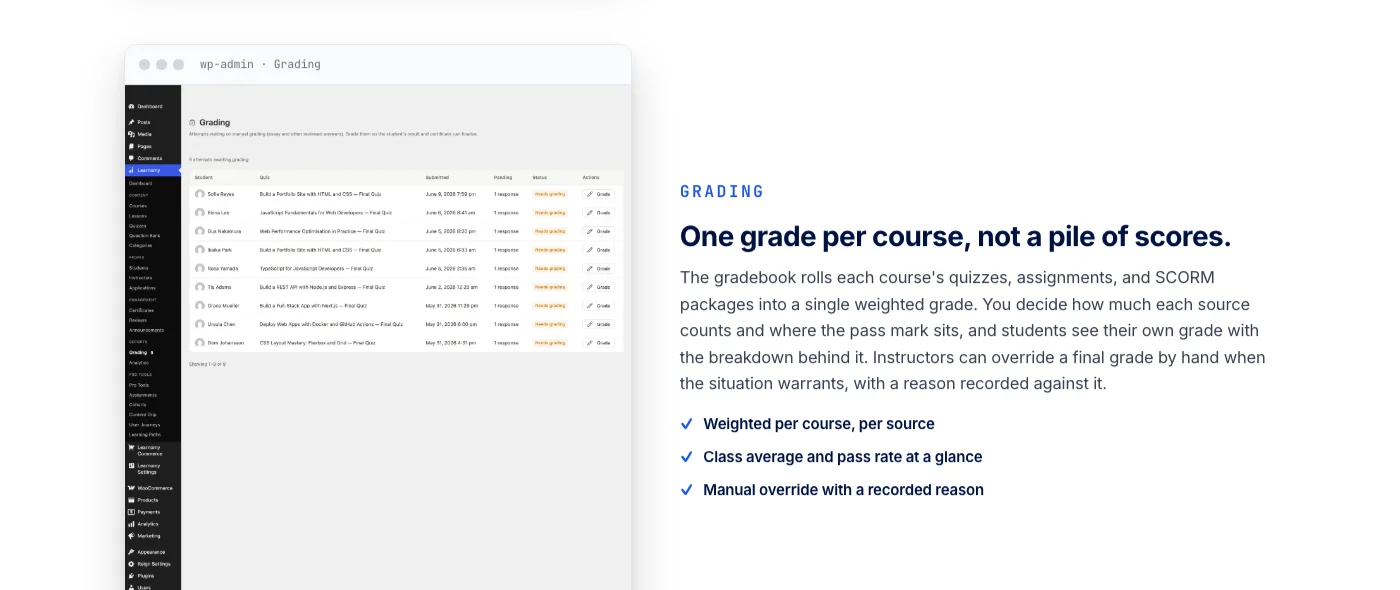
Build a simple tracking habit rather than an elaborate dashboard: after each live session, note who attended or engaged with that week’s content, and flag anyone missing two sessions in a row for a direct check-in message. This is manual work, and it doesn’t scale infinitely, which is part of why cohort sizes tend to stay smaller than self-paced enrollment numbers. A platform with built-in learner analytics takes some of that manual load off; our piece on seeing exactly which cohort members are falling behind covers what that kind of reporting should actually surface.
That’s a feature of the model, not a limitation to engineer around. A cohort loses its core value proposition past a certain size regardless of what tooling you throw at it, because peer presence and facilitator attention both dilute past a point where everyone can genuinely feel seen.
Pricing a cohort differently than a self-paced course
Cohorts justify a different pricing conversation than self-paced content, and undercharging is a common early mistake. A self-paced course is infinitely reusable content that costs the creator nothing extra per additional buyer. A cohort has a hard capacity ceiling set by how many people a facilitator can actually track and support, plus real, recurring facilitator time spent on live sessions and individual check-ins for the duration of the run.
Pricing a cohort the same as an equivalent self-paced course undervalues the facilitation labor and, just as importantly, sends the wrong signal about what’s actually being sold. Learners paying a cohort price should understand they’re buying structured accountability and direct facilitator access, not just the same lesson videos with a start date bolted on.
A workable approach for a first cohort is pricing meaningfully above your self-paced equivalent, if one exists, and treating that first run’s actual time cost honestly when deciding whether the premium was enough. Facilitators who run their first cohort at self-paced pricing routinely discover the actual hourly return doesn’t reflect the real live-session and check-in time invested, and either burn out by the second cohort or quietly stop offering the format. Price it right from the first run rather than discovering the gap the hard way.
Deciding cohort frequency: how often to run one
Running cohorts back-to-back with no gap between them is the single fastest route to facilitator burnout, and it also removes the recovery time needed to actually incorporate what went wrong in the previous run. A gap of several weeks to a couple of months between cohort runs, depending on cohort length, gives room to review what worked, adjust the discussion prompts and session structure based on real feedback, and approach the next cohort rested rather than immediately drained from the last one.
This spacing also creates a useful marketing rhythm inside your community: a clear, predictable “next cohort starts on this date” cadence that prospective students can plan around, rather than a vague, always-open enrollment that never creates the urgency a defined cohort window naturally provides. The scarcity here is real, not manufactured, since a cohort genuinely has a fixed start date and a fixed group, which makes it one of the more honest uses of urgency-driven marketing available to a course creator.
Handling the cohort that starts strong and fades
Not every cohort holds its energy through the full run, and it’s worth planning for that rather than treating it as an emergency each time. If engagement drops sharply mid-cohort, resist the instinct to add more mandatory touchpoints, which usually accelerates the drop-off rather than reversing it. Instead, run a short, direct check-in, a quick poll or a few personal messages asking what’s not working, and adjust the remaining schedule based on the actual answer rather than a guess.
Sometimes the fix is smaller: shortening remaining sessions, moving a rigid live call to an optional format, or simply naming the fatigue openly in the group, which paradoxically often re-engages people who assumed they were the only one struggling to keep up.
Certifying a Cohort’s Completion Properly
A cohort completion carries more weight than a self-paced completion, precisely because it required real, scheduled commitment rather than clicking through videos whenever convenient. That extra weight deserves a certificate that can actually carry it. A certificate cryptographically signed and verifiable on a public page through a QR code lets a graduate share proof of a specific, dated cohort completion, on LinkedIn, in a portfolio, in a job application, in a way a generic completion badge from a self-paced course cannot match.
For cohorts tied to professional skills or team training specifically, this is not a cosmetic detail. It is often the single artifact that determines whether the cohort’s outcome gets recognized outside the community it ran inside.
What happens after the cohort ends
A cohort’s dedicated space and its accumulated discussion are genuinely valuable after the live run finishes, and treating that ending as a hard cutoff wastes it. Archive the space rather than deleting it, and consider granting read access to future cohorts running the same course, since seeing a previous cohort’s real discussion, including the messy parts where people struggled, is often more useful to a new cohort than any polished course material.
It also quietly demonstrates that other real people went through the same material and came out the other side, which is exactly the kind of social proof that makes a prospective student in your community more likely to enroll in the next run.
Certificates matter more here than in a purely self-paced context, since a cohort’s completion carries a specific, dated cohort identity that a generic self-paced certificate doesn’t. Issuing certificates promptly at the cohort’s close, rather than on a rolling individual basis, reinforces the shared-timeline identity of the group one last time before everyone disperses.
A pre-launch checklist worth using every single time
Even experienced facilitators benefit from a fixed checklist rather than relying on memory each cohort launch, because the failures described throughout this post are almost always process gaps rather than content problems. Before opening enrollment, confirm the enrollment window has a hard close date set and communicated clearly, not left open-ended. Confirm the cohort’s dedicated community space exists and is linked from the course enrollment page itself, not buried somewhere a new learner has to search for. Confirm the live-session schedule, including the specific recurring time and video link, is documented somewhere permanent rather than announced once and forgotten.
Confirm certificate criteria are set precisely, tied to actual completion of cohort milestones rather than a vague “participation” standard. And confirm you, as facilitator, have blocked the actual calendar time for every live session and check-in round for the full length of the cohort before a single learner enrolls, since finding out mid-cohort that your own schedule can’t support the commitment is the most preventable failure on this entire list.
What to tell prospective students before they enroll
Cohort marketing inside a community works differently than self-paced course marketing, and being explicit about the format upfront prevents a specific, recurring problem: learners enrolling expecting self-paced flexibility and then feeling ambushed by a fixed schedule they can’t actually keep. State the start date, the live session cadence, and the expected weekly time commitment clearly on the enrollment page itself, not buried in a follow-up email after purchase.
A prospective student who reads “six weeks, one live session per week, roughly three hours of total commitment” and still enrolls is a much better fit for the format than one who assumed a cohort meant the same thing as a self-paced course with a nicer name.
It’s also worth setting expectations about what happens if a learner falls behind. Cohorts that offer zero flexibility for anyone who misses a session tend to lose people entirely rather than getting them back on track, while cohorts that silently allow unlimited catch-up erode the shared-timeline structure that made the cohort worth running in the first place. A middle path, recorded sessions available for a limited catch-up window alongside a clear expectation that live participation is the norm, respects real-life scheduling conflicts without dissolving the model into a self-paced course by another name.
When a Cohort Model Fits Corporate or Team Training
Everything above assumes an individual-enrollment cohort, learners signing up one at a time from a community. Corporate and team training runs a variant worth naming separately: a single company buying seats for a group of employees and managing its own roster, rather than individuals discovering the cohort organically. The operational mechanics mostly transfer directly, a fixed enrollment window, a shared timeline, a dedicated discussion space, but the accountability structure shifts.
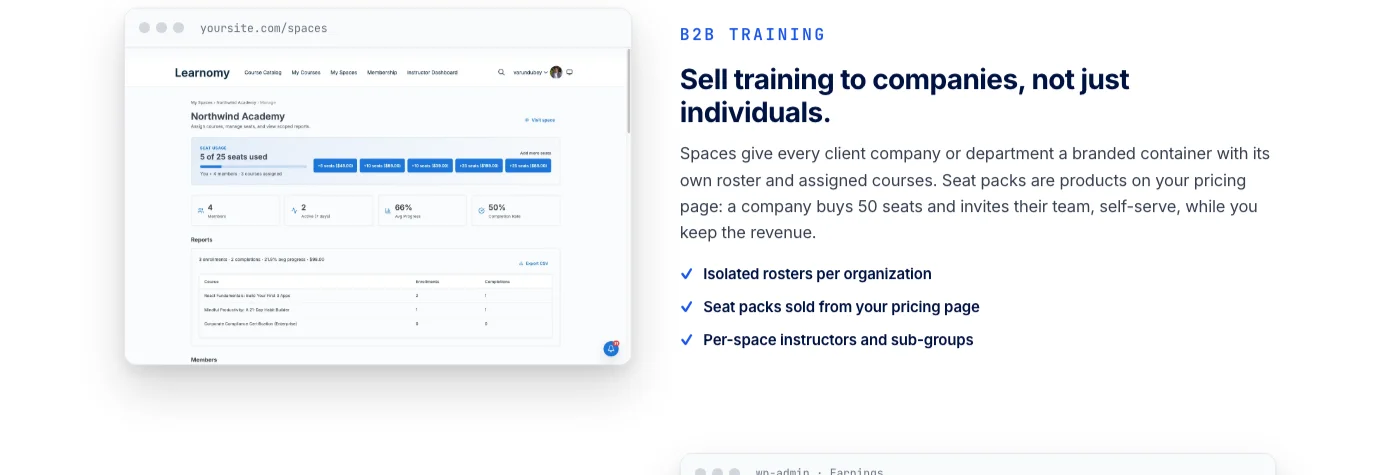
A manager or L&D coordinator often needs visibility into team completion status, not just the facilitator, which means the tracking habit described earlier needs a reporting layer the individual-enrollment model does not.
If you are running cohorts specifically for corporate training rather than a public community, plan for that reporting need explicitly rather than retrofitting it after the first company client asks for a completion summary. A platform that already separates team-based enrollment from individual signups, rather than treating every enrollment as an anonymous individual, saves real rework here.
Running multiple cohorts without the operational load compounding
Once a first cohort proves the format works, the temptation is to run several in parallel to scale faster. Do this carefully. Each concurrent cohort needs its own dedicated space, its own live-session schedule, and ideally its own facilitator attention, because sharing a single facilitator across multiple simultaneous cohorts tends to produce the same thinly-spread attention problem that undermines engagement within a single oversized cohort, just distributed across several groups instead of one. At that point, bringing in other instructors to teach alongside you is usually a better fix than asking one facilitator to stretch further.
If facilitator capacity is the actual constraint, staggering cohort start dates by a few weeks rather than running them fully in parallel usually protects quality better than launching everything at once.
Recording the Cohort for Reuse Without Undermining the Model
Recording live sessions serves two purposes that are easy to conflate but worth separating. The first is catch-up access for enrolled learners who miss a live session, which supports the cohort model as long as it stays limited to a short window rather than becoming a permanent, unlimited replay option that quietly turns the cohort into self-paced content with extra steps. The second is repurposing recordings as the seed for a future self-paced version of the same material, which is a legitimate and common path once a cohort has run a few times and proven the content works.
Keep these two uses mentally separate when deciding how open to make the recordings, since conflating them is how a cohort model erodes into something closer to a self-paced course without anyone deciding that on purpose.
FAQ
Is Cohorts included in Learnomy’s core platform?
Cohorts is one of Learnomy’s advanced growth capabilities, alongside Learning Paths and Content Drip. The core platform supports unlimited self-paced courses with full quiz and certificate functionality, but the shared-timeline, grouped-enrollment structure that defines a cohort specifically requires the advanced scheduling capability. Check Learnomy’s own product page for the current breakdown of what is included where.
Does Learnomy provide live video or webinar hosting for cohort sessions?
No, and it’s worth being direct about that rather than implying it does. Cohorts provides the structural grouping, enrollment windows, and shared timeline. Live sessions run through whatever video conferencing tool your community already uses, with the link shared inside the cohort’s dedicated community space.
How many people should be in a single cohort?
There’s no universal number, but the honest guideline is smaller than feels comfortable if your goal is genuine peer accountability rather than just a shared start date. A facilitator who can’t realistically track individual engagement across the group has exceeded the size where the cohort model’s core benefit still holds.
What if my community doesn’t have a dedicated space or group feature?
A dedicated space isn’t strictly required for a cohort to run, but it substantially improves outcomes by concentrating peer presence and discussion. If your community platform doesn’t support a natural per-cohort space, a clearly labeled discussion thread or a private group chat channel serves a similar function, as long as it’s specific to that one cohort rather than shared across every run of the course.
Should I run a cohort even if I’ve never run one before, or start self-paced first?
Launching a self-paced version of the same content first, even a smaller pilot, is a reasonable way to validate that the material itself works before adding the scheduling and facilitation complexity of a cohort on top. Once the content is proven, converting to a cohort model for the next run adds structure to something that already works, rather than debugging content and facilitation logistics at the same time.
How do I know if a cohort actually outperformed a self-paced version of the same course?
Compare completion rates and, if you collect it, post-course outcome data between cohort and self-paced runs of comparable material. The gap tends to be substantial in favor of cohorts specifically because of the peer-accountability and shared-timeline mechanics described throughout this post, but confirming it against your own data, rather than assuming it, tells you whether the extra facilitation effort is actually paying off for your specific audience.
Can a cohort and a self-paced version of the same course coexist?
Yes, and many successful course businesses run exactly this way, offering a self-paced version at one price point for learners who want flexibility, and a cohort version at a premium for those who want structure and facilitator access. Keep the two enrollment paths clearly labeled so a prospective student picks intentionally rather than assuming one is a discounted version of the other.
A Note on Tooling Versus Discipline
It is tempting to read a post like this and conclude the fix for a struggling cohort is better software. Sometimes it is; a platform that groups learners into a real shared timeline rather than faking it with a shared start date genuinely removes friction the facilitator would otherwise have to manage manually. But most of the failure modes covered here, an unsustainable schedule, a discussion space nobody seeded with the first prompt, a facilitator who never blocked calendar time, are process failures that no feature toggle fixes on its own.
Treat the structural tools as the scaffolding and the operational discipline described throughout this post as the actual work, because scaffolding without the work still produces an empty cohort, just one with a nicer enrollment page.
The operational work is the point, not a tax on it
Running a cohort well is genuinely more labor-intensive than publishing a self-paced course and walking away. That labor is exactly what produces the outcome a cohort promises. Skimp on the scheduling discipline, the dedicated space, the active facilitation, and you’ve built a self-paced course with an artificial start date and none of the benefit. Do the operational work described here consistently, and the peer accountability that makes cohort-based learning outperform self-paced content shows up because you built the conditions for it to happen, not because a feature toggle turned it on.
Cohorts, Learning Paths, and verifiable certificates all run inside the same Learnomy platform, connected to the checkout and community tools your cohort already needs. Give the operational discipline above the right scaffolding to run on.