

BuddyPress’s default templates put activity streams, member directories, and group listings on their own dedicated pages. If you want any of that content embedded somewhere else, a homepage, a landing page, a custom template, you need shortcodes or widgets, not a template override. That distinction trips people up more than it should: overriding a template file changes how an existing BuddyPress page renders, while a shortcode lets you drop a live piece of BuddyPress content into a page that has nothing to do with BuddyPress’s own routing at all.
Shortcode for BuddyPress Pro adds exactly that: three shortcodes, plus matching Elementor widgets for anyone who’d rather not type shortcode syntax by hand.
Why This Is a Real Gap in BuddyPress Core
BuddyPress core is built around the assumption that activity, members, and groups each live on their own dedicated archive page, generated automatically when you activate the relevant component. That works fine if your entire homepage strategy is “send people to the activity page.” It breaks down the moment you want a homepage that shows a taste of community activity alongside marketing copy, a pricing table, or a hero section, without redirecting visitors away to a separate URL first. Plenty of community sites want exactly that: a homepage that proves the community is alive (recent posts, active members, popular groups) before asking a visitor to commit to clicking through. Core BuddyPress has no built-in mechanism for that kind of composed page, which is the actual problem this plugin solves.
The Three Shortcodes
Activity Stream: [bp_activity]
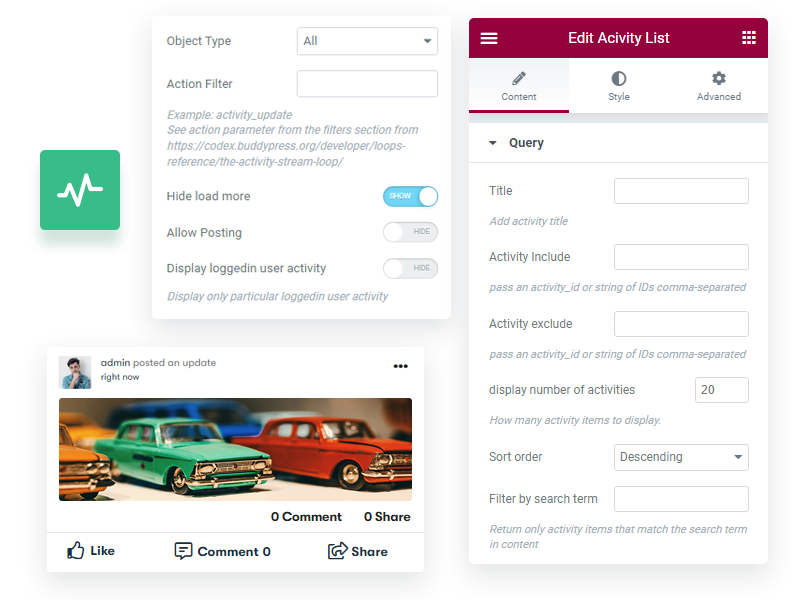
Drops the latest community updates and interactions onto any page or post, useful for a homepage that wants to show live activity without sending visitors to the dedicated activity page. Because it’s pulling from the same underlying activity query BuddyPress’s own template uses, likes, comments, and favoriting all continue to work normally inside the embedded stream, it isn’t a static snapshot, it’s the live feed rendered somewhere else.
Members Directory: [bp_members]
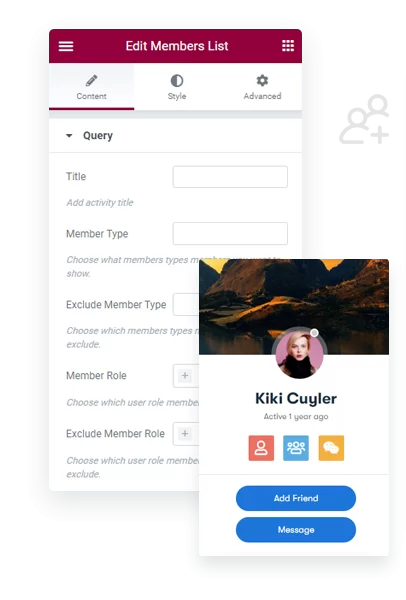
Embeds a member directory anywhere, a landing page showcasing community size, for instance, without linking off to the full members page. This is one of the more effective, low-effort trust signals a community homepage can carry: seeing real avatars and names on the landing page tells a first-time visitor there are actual people here far more convincingly than a claim in marketing copy does.
Group Listings: [bp_groups]

Same idea, for group listings, drop the community’s groups into any page. Useful on a “get involved” or “find your niche” landing page that wants to showcase specific communities within the larger site without forcing a visitor to browse the full groups directory to discover them.
Who Actually Needs This vs. Who Doesn’t
Not every BuddyPress site benefits equally from embedding shortcodes outside the default community pages. A site where the community is the entire product, a forum, a niche membership community with no separate marketing site to speak of, gets less value here, since the default activity, members, and groups pages already are the homepage in every meaningful sense. This plugin earns its place most clearly on sites where BuddyPress is one piece of a larger site, a business with a blog, a store, and a community component bolted on, or a course platform where the community is a retention feature layered on top of the core product rather than the entire reason the site exists. If that describes your setup, being able to surface a taste of community activity on pages that aren’t themselves BuddyPress pages is a genuinely useful capability rather than a nice-to-have.
Shortcode Parameters Worth Knowing
Each shortcode accepts parameters to control how much it displays and in what order, rather than dumping the entire unfiltered stream onto a page. Typical options include limiting the number of items shown (so a homepage embed doesn’t turn into an endless scroll), and choosing a sort order (newest activity first, most popular groups first, most recently active members first). The exact parameter names are documented on the product page and in the plugin’s own settings screen, worth reviewing before dropping a shortcode onto a live page, since the default output without any limiting parameter can be longer and heavier than what a homepage section actually needs.
Elementor Widgets
The current version (v2.2.0) ships three native Elementor widgets matching the shortcodes above: Members List, Activity List, and Groups List. Elementor users get the same functionality through the visual panel instead of typing shortcode syntax, which matters more than it sounds for teams where the person building the landing page isn’t comfortable with shortcode attributes or isn’t a developer at all. The widget panel exposes the same underlying parameters (item count, sort order) as clickable controls instead of shortcode arguments, so a marketing or content team member can adjust the embed without needing anyone to touch code.
A Practical Use Case: The Homepage Trust Signal
The single most common reason site owners reach for this plugin is building a homepage that proves the community is active before asking a visitor to sign up. A typical layout combines a hero section explaining what the community is about, an embedded [bp_activity] shortcode showing the five or six most recent updates, and a [bp_members] block showing a grid of recently active member avatars. That combination does more to convince a skeptical first-time visitor than testimonials or marketing copy alone, because it’s showing rather than telling. A visitor sees real, recent, dated activity from real accounts, which is a much harder thing to fake or overstate than a claim in a paragraph of copy.
The tradeoff worth knowing about this approach: a homepage embed showing recent activity only looks good if the community actually has recent activity. Embedding a live activity stream on a homepage for a community that posts twice a month can backfire, drawing more attention to the quiet stretches than simply not showing the stream at all would. Before building this into a homepage, honestly assess whether your community’s actual posting cadence supports showing it live, or whether a curated, hand-picked showcase of a few standout posts (updated manually on a schedule) would represent the community better than an unfiltered live feed with visible gaps.
Performance Considerations for Embedded Shortcodes
Because each shortcode runs its own query against BuddyPress’s activity, members, or groups tables, stacking multiple shortcodes on a single page, an activity feed and a members grid and a groups list, all on the same homepage, means multiple separate database queries executing on every page load for that page. On a small to mid-sized community this is rarely noticeable, but on a larger site, particularly one running on shared or budget hosting, it’s worth checking your homepage’s load time after adding these shortcodes and confirming your caching plugin is configured to cache the composed page rather than re-running all three queries on every visit. Most standard page-caching setups handle this correctly by default, caching the rendered HTML output regardless of how many shortcodes contributed to it, but it’s worth confirming rather than assuming, especially if the homepage is also showing personalized or logged-in-specific content that might be excluding it from your cache rules.
Where This Fits Against a Full Page Builder Integration
It’s worth being clear about what this plugin is and isn’t. It’s a focused shortcode and widget layer for embedding BuddyPress content, not a full BuddyPress-specific page builder or theme. If what you actually need is a homepage built entirely around BuddyPress content with deep customization of layout, styling, and behavior beyond what a shortcode parameter or widget setting exposes, that’s a bigger project than this plugin is designed to solve on its own, and likely involves either custom template work or a theme genuinely built around BuddyPress from the ground up. For the specific job of embedding a discrete block of activity, members, or groups content into an otherwise normal page, this plugin covers that ground directly and doesn’t try to be more than that.
Styling the Embedded Output to Match Your Page
Out of the box, each shortcode inherits a baseline of styling from the plugin itself, enough to be usable without any custom CSS, but it’s rarely going to match a carefully designed landing page perfectly on the first try. The activity, members, and groups markup each shortcode outputs uses predictable, namespaced CSS classes, which makes targeted styling through your theme’s Additional CSS panel (or a child theme’s stylesheet) straightforward once you’ve inspected the rendered HTML in your browser’s dev tools. Common adjustments worth making before calling an embed finished:
- Matching the avatar size and grid spacing in the members shortcode to whatever grid system the rest of the landing page uses, so the embed doesn’t look visually bolted on.
- Adjusting the activity feed’s font sizing and line height, plugin defaults are often tuned for a full-width dedicated activity page and can look oversized crammed into a narrower homepage column.
- Hiding secondary UI elements (comment counts, timestamps, action links) that make sense on a full activity page but add clutter to a homepage teaser meant to be glanced at quickly rather than interacted with directly.
If you’re not comfortable writing custom CSS yourself, the Elementor widget path is the more forgiving option, since Elementor’s own style panel exposes typography, spacing, and color controls without requiring any code at all.
Keeping the Embedded Content Fresh Without Manual Work
One of the underrated advantages of a live shortcode embed over a manually curated homepage section is that it needs zero ongoing maintenance to stay current. A hand-picked “featured posts” section on a homepage looks great on launch day and stale six months later if nobody remembers to update it, which happens on more sites than anyone likes to admit. A live [bp_activity] embed with a reasonable item limit updates itself automatically every time a member posts, with no editorial process required to keep the homepage looking active. That’s a real advantage specifically for smaller teams without a dedicated content or community manager checking the homepage on a schedule, the mechanism itself does the freshness work that would otherwise require a person remembering to do it.
Troubleshooting Common Issues
- Shortcode displays as plain text instead of rendering. Usually means the plugin isn’t active, or the shortcode was typed into a Custom HTML block or a context that doesn’t process shortcodes by default. Confirm it’s in a Shortcode block or a standard paragraph/text area in the block editor.
- Embedded content looks unstyled or broken. Check for a CSS conflict between your active theme and the plugin’s own styling, particularly if you’re running a heavily customized theme or a page builder with its own global styles that might be overriding the shortcode’s markup.
- Activity or members list is empty. Confirm the relevant BuddyPress component (Activity, Members) is actually active under BuddyPress > Settings, and that there’s genuinely recent data to display, an empty result is sometimes correct behavior rather than a plugin bug.
- Elementor widgets don’t appear in the widget panel. Confirm both Elementor and this plugin are active at the same time, the Elementor-specific widgets only register when Elementor itself is detected as active.
Comparing This Against Custom Template Development
Before installing any plugin for this, it’s worth being clear-eyed about the alternative: a developer could write custom template code pulling the same BuddyPress data directly, using functions like bp_has_activities() or bp_has_members() inside a custom page template, entirely without a shortcode plugin in the mix. That approach gives full control over markup, styling, and query logic, and avoids one more plugin dependency. It also requires ongoing developer time for every adjustment, a site owner without code access can’t change how many activity items show up or reorder a landing page section without submitting a dev ticket. The shortcode-and-widget approach trades some of that granular control for something a non-developer can operate independently once it’s set up, which is usually the better tradeoff for a site where the person maintaining the homepage day to day isn’t a PHP developer. For an agency building sites for community-site clients specifically, defaulting to the shortcode plugin approach also means the client can make small adjustments themselves after handoff, rather than needing to come back to the agency for every minor tweak to what’s shown on the homepage.
Pricing
Personal (1 site) $49/year, Professional (5 sites) $99/year, Agency (unlimited sites) $129/year. See the product page for current terms. All three tiers include the same feature set, the difference is purely the number of sites the license activates on, so pick based on how many properties you’re actually running rather than expecting a feature gap between them.
Beyond the Homepage: Other Places These Shortcodes Get Used
The homepage trust-signal use case gets the most attention, but it isn’t the only place these shortcodes earn their keep. A dedicated “community” landing page, separate from both the marketing homepage and BuddyPress’s own default activity page, can combine all three shortcodes into a single overview screen, part of a broader site structure where the marketing homepage stays focused on conversion while a secondary community-overview page does the job of showing depth to visitors who click through wanting more detail before joining. Some sites also embed a scoped activity shortcode directly on a group’s custom landing page (built outside BuddyPress’s own group template, on a regular WordPress page instead) to show that specific group’s recent posts as part of a broader pitch for why a visitor should join that particular group rather than browsing the full groups directory first. Membership and course sites built on top of BuddyPress sometimes use the members shortcode on a “meet your cohort” page shown right after signup, giving a new member an immediate, concrete sense of who else is in the community rather than an abstract member count.
Quick Answers
Can I use these shortcodes inside a page builder other than Elementor? Yes, the shortcodes themselves work in any context that processes WordPress shortcodes, including most page builders’ own shortcode or text widgets, the dedicated Elementor widgets are simply a more convenient option specifically for Elementor users.
Does this work with BuddyBoss Platform? Since BuddyBoss Platform is built on BuddyPress’s underlying data structures, the shortcodes generally function correctly, though visual styling may need adjustment to match a BuddyBoss-specific theme’s design system.
Can I filter the activity shortcode to show only one group’s activity? Check the plugin’s documented parameters for a group-scoping option, most activity-embedding plugins in this category support scoping to a specific group ID rather than only offering a sitewide feed.
Will this slow down page load if I use all three shortcodes on one page? It adds additional database queries per shortcode used, covered in more detail above, worth testing actual load time on your specific hosting setup rather than assuming it’s negligible on a very large community.
Can non-logged-in visitors interact with an embedded activity feed, or only view it? That depends on your BuddyPress access settings rather than anything specific to this plugin, if guest interaction (liking, commenting) is disabled sitewide for logged-out visitors, that restriction carries through to the embedded shortcode the same as it would on BuddyPress’s own native activity page.
Does upgrading BuddyPress core ever break these shortcodes? Because the plugin builds on BuddyPress’s standard public query functions rather than undocumented internals, it tends to stay compatible across routine BuddyPress updates, though it’s still worth checking the plugin changelog after any major BuddyPress version bump, the same general caution that applies to any BuddyPress add-on.
Interesting Reads:
How To Create A Favorite Notification Feature in BuddyPress?
How Does Profile Pro Enhance the Functionality of BuddyPress Profiles?