
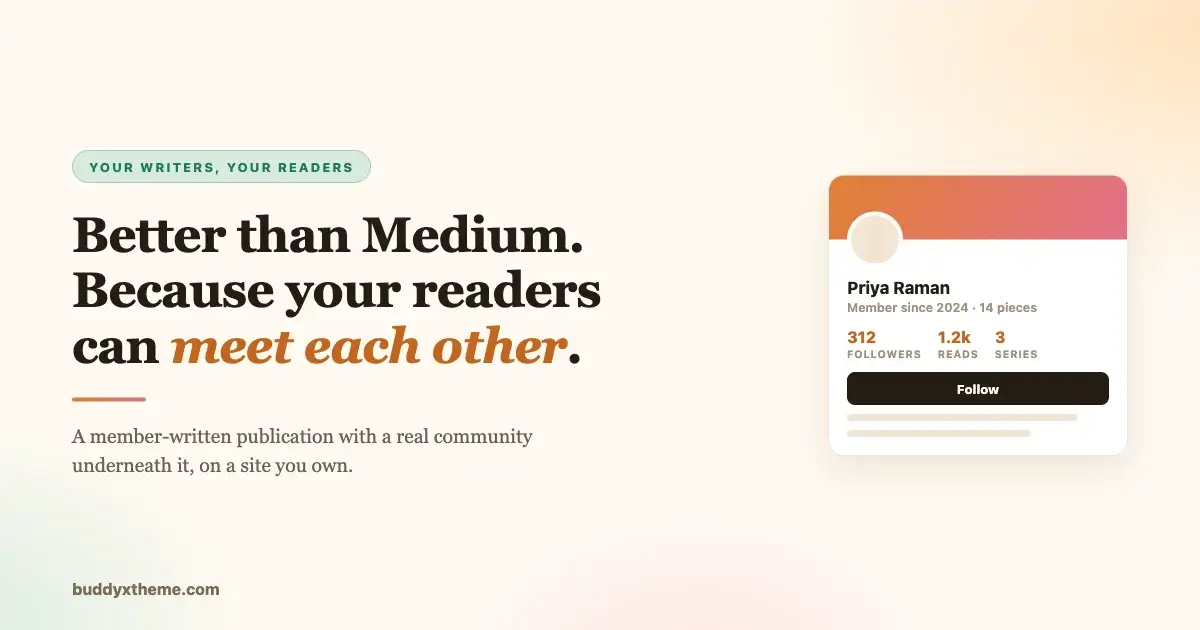
Medium solved a real problem. Before it, anyone who wanted to write online had to run a website, and most writers do not want to run a website. Medium removed all of that and left the writing.
The trade was invisible at first, and it is this: the readers are not yours.
Somebody reads a piece you wrote, likes it, follows you. That follow lives on Medium. If you leave, it does not come with you. You never learn who they are. You cannot email them. And whether your next piece reaches them is decided by a system you do not control and cannot ask.
For a personal blog that might be an acceptable trade. For a community with members who write, it is the wrong shape entirely, because the whole point of your community is that the people in it know each other.
This is about building the alternative: a publication where your members write, with a real community underneath it, on a site you own. The pieces are WB Member Blog for the writing, BuddyNext for the community, and BuddyX to make it look like a publication rather than a plugin.
What Medium gets right, and worth copying
Being fair before being critical, because the things Medium got right are the things most self-hosted attempts get wrong.
Writing is pleasant. The editor is calm, there is nothing to configure, and a writer can start typing within seconds of deciding to.
Writers have an identity. An author page with everything they have written, a follower count, a bio. Writers care about this enormously and most WordPress setups treat the author page as an afterthought.
Readers can save things. The reading list is a small feature that quietly does a lot of work, because most people find something good at a moment when they cannot read it.
Following is per-writer, not per-site. You follow a person. That is the correct unit for anything where individual voices matter.
Feedback is lightweight. A reaction takes one tap. Comments are effortful and most readers will not leave one, but they will react, and writers need that signal.
Any replacement that ignores these is not a replacement. It is a downgrade with better ownership, and your writers will notice within a fortnight.
What it cannot do, at any price
Now the part that matters for a community.
Your readers are not your members. They are Medium’s. You get a number on a page. You do not get a person you can reach, and you cannot build anything on top of a number.
There is no community underneath. Readers and writers on Medium do not know each other. There is no directory, no messaging, no shared spaces. Two people who read every one of your writers’ pieces have no way to meet. On a community platform that is not a missing feature, it is the missing point.
The algorithm sits between your writing and your audience. You publish and hope. Reach varies for reasons nobody explains.
You cannot design it. Every publication looks the same. If you are building something with an identity, that is a real cost.
The rules can change. Paywalls, partner programmes and distribution rules have all changed. The people who built an audience there each time absorbed it.
None of this makes Medium bad. It makes Medium a publishing service rather than a community, and if what you are building is a community, you need the other thing.
The combination, and what each piece does
Three parts, and they are meant to be read as one product rather than a stack.
WB Member Blog is the publication. Members write from the front end without ever seeing wp-admin, get their own author page, and gather followers. Readers can bookmark to a reading list, react, and follow the writers they like. Writers can see how their work performs. Every piece of the Medium experience above has a counterpart here.
BuddyNext is the community that Medium does not have. Member profiles, a searchable directory, connections, private messaging, activity and notifications. Your writers and readers are members of the same place rather than accounts on a service.
BuddyX is what stops it looking like a blog with plugins bolted on. This matters more than it sounds. Writers judge a publication by whether it looks like somewhere worth being published, and readers judge it in about two seconds.
The reason to run them together rather than separately is what happens between them, which is the section after next.
What a writer actually gets
Concretely, from the writer’s side, because this is who you have to convince first.
A front-end editor. They write on the site, not in an admin panel. Nobody has to be told what a dashboard is.
An author page that is theirs. Everything they have written, in one place, at a URL they can share. This is the single most requested thing by anyone who writes regularly, and giving each member a real author page changes how seriously they take contributing.
Followers who are actually theirs. Somebody follows a writer, and that follow lives in your database. The writer can see it. You can see it. Nobody can take it away or decide it no longer counts.
Reactions and views they can see. Writers need signal. Silence is what makes people stop.
Series. For anyone writing something in parts, a series holds it together with navigation between instalments and a table of contents, and readers get their progress tracked through it. This is a better experience than Medium offers for long-form work in parts.
Co-authors. Two people can properly share a byline. Medium handles this poorly and most WordPress setups not at all. For any community where people collaborate, it matters.
Scheduling and a calendar. Writers can plan rather than publish reactively.
Invitations. A writer can bring in another writer, which is how contributor bases actually grow. Not through recruitment campaigns, through one person asking another.
What a reader gets
The reader side is shorter and it is what makes people come back.
A reading list. Bookmark now, read later. The most-used feature on any publication and the most commonly forgotten one.
Following writers rather than the site. A reader who follows four of your writers has four reasons to return, and they belong to those writers rather than to your homepage.
Reactions. One tap. No account creation, no comment box to be brave in.
Discovery that is not a black box. Recent, popular, by topic, by author, related pieces. All of it configurable by you rather than decided elsewhere.
The part Medium structurally cannot do
Here is the argument for the combination, and it is the whole point of this post.
On Medium, a reader who loves a writer’s work can follow them. That is where it ends.
On your site, that same reader can follow the writer, message them, see their member profile, find they are both in the same space, discover they live in the same city, and end up collaborating on something. Because the person who wrote the piece and the person who read it are members of one community rather than two accounts on a publishing service.
That connection is the thing a community exists to produce, and no publishing platform can offer it, because publishing platforms do not have members. They have audiences.
Practically, this shows up in small ways that add up:
A reader clicks the author name and lands on a full member profile rather than a thin author box. A writer gets a notification in the same place they get every other community notification. A discussion that starts in the comments continues in a space where it stays findable. A member who joined to read ends up writing, because the distance between the two is one button rather than an application process.
None of that requires configuration. It is what happens when writing and community share a member list.
What this looks like in practice
Concrete shapes, because the abstract version persuades nobody.
A professional association publishes member-written practice notes. Each contributor gets an author page that doubles as professional credibility, and readers can find the author in the member directory and contact them directly. The publication becomes a reason to join rather than a marketing channel.
A coaching or training community lets members write about what they are learning. Series work well here, because learning happens in instalments. A member’s author page becomes a visible record of their progress, which is more motivating than any completion badge.
A nonprofit or advocacy community gives beneficiaries and volunteers a place to tell their own stories in their own words, rather than having stories collected and rewritten by a communications team. Co-authoring matters here, because these pieces are often written with support.
A local or regional community publishes what is happening, written by the people it happens to. Following by author means readers subscribe to the neighbours whose perspective they trust.
A creator or hobby community is the closest to Medium’s own use case, and the difference is that the writers can find each other, collaborate, and build something collectively rather than each shouting into the same feed.
The common thread: in every one of these, the writing is more valuable because the writer is a known member rather than an anonymous byline.
Medium, Substack, or your own site
Three different shapes, and the right one depends on what you are actually building.
| Medium | Substack | Your own community | |
|---|---|---|---|
| Who owns the reader relationship | Medium | You, by email | You, as members |
| Community between readers | None | None | Directory, messaging, spaces |
| Multiple writers | Publications, awkwardly | Possible, not the design | The whole point |
| Design control | None | Limited | Yours |
| Discovery | Their algorithm | Your list only | Your rules |
| Setup effort | Minutes | Minutes | An afternoon |
| Cost | Free | Free until you charge | Hosting |
Substack deserves credit for solving the ownership problem properly. You get the email addresses, and if you leave you take your list. For a single writer with a mailing list, that is often the right answer and we would say so.
What it does not give you is people knowing each other. A Substack with ten thousand subscribers has ten thousand separate relationships with one writer, and none between the readers. That is a newsletter, and newsletters are good, but it is not a community.
The question to ask yourself is simple: do you want an audience or a membership? If the honest answer is an audience, use Substack and save yourself the work. If you want the people to know each other, you need somewhere they can, and that is a different kind of software.
Making it worth doing for writers
The hard part of any member publication is not the software. It is that people do not write.
A few things that help, learned from watching these succeed and fail.
Ask specific people, personally. A general invitation to “contribute” produces nothing. Asking one member to write the specific thing you know they know produces a piece.
Publish the first ten yourself. An empty publication tells a prospective writer that nobody reads this. Fill it before you invite anyone.
Make the author page visible. Link to it from the member profile, feature writers in the directory, mention new pieces in the community feed. Writers write when writing is visible.
Use series for anything that intimidates. A member who will not write a two-thousand-word article will happily write six short parts, and the series holds them together.
Give feedback yourself, early. The first few pieces need a response from you specifically. Reactions from strangers come later, and if nothing happens on someone’s first piece there is rarely a second. This is the same principle behind a good first seven days for a new member: the early signal has to come from a person, not from the system.
Invitations, not recruitment. The invitation feature exists because contributor bases grow person to person. Let your writers bring their own.
On money, briefly and honestly
Medium’s partner programme pays writers, and that is a genuine draw. Being straight about the comparison: running your own publication means you decide whether and how writers are paid, and you also have to fund it.
The options that work are the ordinary ones. Membership fees that fund the whole community including the publication. Sponsorship of a series or a section. A credit system for contributors. Member Blog Pro includes credit handling if you want to go that way.
What you should not do is promise writers revenue share before you know your numbers. A publication with no money and honest expectations retains writers better than one that promised earnings and quietly stopped.
The more common motivation, in our experience, is not money at all. It is having somewhere your work is read by people who will actually respond, attached to a name that means something in that group. That is what a community publication offers and a general platform cannot.
What it takes to run
Practical expectations before you start.
Setup is an afternoon if you are comfortable with WordPress. Install, choose whether posts need approval, decide who can write, and put the publication somewhere visible in your navigation.
Moderation is a real job. Member-written content needs someone reading it. Not heavy, but not zero, and it is worth deciding up front whether pieces publish immediately or need approval. Approval is the right default until you know your writers.
The ongoing work is encouragement, not administration. Ask people to write, respond when they do, feature what is good.
Hosting is the same as any community site. Nothing about adding a publication changes your infrastructure in a way you would notice at ordinary sizes.
Where to start
Four steps, in order, and none of them are technical.
Decide who writes. Everyone, or an approved contributor group. Both work. Choosing later is harder than choosing now.
Write the first pieces yourself. Ten if you can manage it. This is the whole difference between a publication that starts and one that does not.
Ask five members directly, each about something you already know they know.
Make the author pages prominent so writers can see that being published here is visible.
Then leave it alone for a month and see who writes without being asked. Those are your contributors, and there are usually fewer than you hoped and more than you feared.
Questions people ask
Should everyone be able to write, or only approved members? Start with approval, loosen it later. It is easy to open up once you know your writers and awkward to tighten after somebody has published something you would not have chosen. Approval also gives you a reason to respond to every early piece, which is the encouragement new writers need.
What if nobody writes? Most likely outcome in month one, and the fix is not a feature. Publish ten pieces yourself, then ask five specific members about specific things you know they know. General invitations produce nothing. The same dynamic applies to winning back members who have gone quiet: personal and specific works, broadcast does not.
Can members import what they already wrote on Medium? They can copy it across, and if a writer has an established body of work, seeding their author page with it is a good way to make the publication feel alive on day one. Ask permission and let them decide what moves.
Does this hurt our SEO compared to Medium? It helps it. Content published on Medium builds Medium’s domain. Content published on your site builds yours. That is not a small difference over a couple of years.
How is this different from just letting members have WordPress accounts and write posts? That is the version most people try, and it fails on the details. Contributors end up in wp-admin, which most members will not touch. There are no author pages worth visiting, no follows, no reading lists, no reactions, and no series. The gap between “members can technically publish” and “members actually publish” is entirely made of those details.
Do we need Pro? No for a first run. Author pages, follows, bookmarks, reactions and analytics are in free, and that is a working publication. Series, co-authors, invitations, scheduling and credits are Pro, and you will know when you want them because a writer will ask.
How much moderation does this actually need? Less than a forum, more than a blog. Member-written articles are considered rather than reactive, so the volume is low, but somebody does need to read things before they go out while you are establishing what the publication is.
What happens to a writer’s pieces if they leave the community? Decide this before it happens rather than during an awkward conversation. Most communities keep the writing and the author page intact, since removing published work breaks every link to it and punishes the readers rather than the writer. If somebody asks for their work to be taken down, that is a separate request and worth honouring. Write your position down somewhere visible so contributors know it going in.
The short version
Medium is a good publishing service and a service is all it is. Your writing goes there, your readers stay there, and the relationship between them belongs to somebody else.
If your members write, the better shape is a publication that sits inside your community: author pages your writers own, followers that live in your database, reading lists and reactions for readers, and underneath it a membership where the person who wrote the piece and the person who read it can actually find each other.
WB Member Blog, BuddyNext and BuddyX do that on a site that belongs to you. The software is the easy part. The work is asking people to write, and then reading what they send.
One last thought worth sitting with. The reason people write on Medium is that somebody might read it. The reason people write in a community is that somebody they know will read it, and will say something about it on Tuesday. Those are different motivations, and the second one is far more durable. It is also the only one you can actually build.