

Circle.so sells a genuinely appealing pitch: no WordPress, no hosting, no plugin updates, no server to think about. Pay a monthly fee, get a polished community space with courses, events, and a native app, and spend your time on the community instead of the infrastructure. For a lot of creators that pitch is worth exactly what it costs. But “worth it” and “what you actually own at the end of it” are two different questions, and the second one rarely gets asked until someone is three years in and wondering what happens if they ever want to leave.
This post is about that second question. Not whether Circle.so is well built, it is, but what “hosted” actually means for your data, your domain, and your ability to walk away from a platform decision made years ago. And it looks at what a self-hosted alternative, specifically BuddyNext running on WordPress, actually gives you in exchange for the extra setup work.
Neither side of this comparison is a strawman. Circle.so is a well-funded, well-designed product used by thousands of creators who are happy with the tradeoff they made. The point here is not to argue that choice was wrong. It is to make the tradeoff explicit, in dollars, in data control, and in what happens on the day you might want to leave, so the decision gets made on purpose instead of by default.
What “hosted” means underneath the polish
When you build a community on Circle.so, every piece of it, the member database, the post content, the payment records, the uploaded files, lives on Circle’s infrastructure, under Circle’s terms of service, subject to Circle’s pricing changes. That is not a criticism of Circle specifically, it is what “hosted SaaS” means as a category, and it is true of every platform in that category, not just this one.
The practical consequence shows up in a few specific ways. Your community’s URL is either a Circle subdomain or a custom domain that still routes through Circle’s servers, meaning the platform sits between your members and your brand at the DNS level. Member data, including payment information processed through Circle’s billing, lives in a database you have read access to through their exports but never actually operate. And every feature you rely on, moderation tools, member tiers, the mobile app, exists because Circle chose to build it and continues to choose to maintain it. If a feature gets deprecated, restructured, or moved behind a higher pricing tier, your community absorbs that decision whether you agreed to it or not.
Vendor risk is a real cost, even when nothing goes wrong
Most comparisons of hosted versus self-hosted platforms focus on price and features and skip the risk conversation entirely, because risk is hard to put a number on until it becomes a line item. But it is worth naming directly: any company running a SaaS community platform can change its pricing, restructure its tiers, get acquired, or deprecate a feature your community depends on, and your only recourse as a customer is to accept the change or migrate away under time pressure. That is not a hypothetical specific to Circle, it is the structural reality of building on top of any vendor’s roadmap rather than your own infrastructure.
Self-hosting does not eliminate risk entirely, a hosting provider can also raise prices or have an outage, but it changes the shape of that risk considerably. Moving your WordPress files and database from one host to another is a well-understood, commodity operation that thousands of agencies perform routinely. Moving an entire community’s structure, membership tiers, and moderation configuration out of a SaaS platform whose internal data model you never had full access to is a fundamentally harder problem, and it is the kind of problem you only fully understand once you are already forced to solve it.
The actual cost, stretched over real time
Circle’s advertised pricing looks reasonable in isolation. As of now, Professional runs around $89 a month billed annually, Business around $199 a month, and Enterprise around $419 a month, with a 14-day trial and no permanently free tier. What tends to surprise people is what gets added on top. Circle charges transaction fees on paid memberships processed through the platform, roughly half a percent to two percent depending on plan, and a separate Email Hub add-on runs about $99 a month if you want proper email marketing built in rather than bolted on through a third-party tool. Add those up for a realistically active paid community, a few hundred members on the Business tier with the Email Hub active, and total monthly cost lands somewhere around $275 to $400, before the platform has taken a cut of a single membership payment.
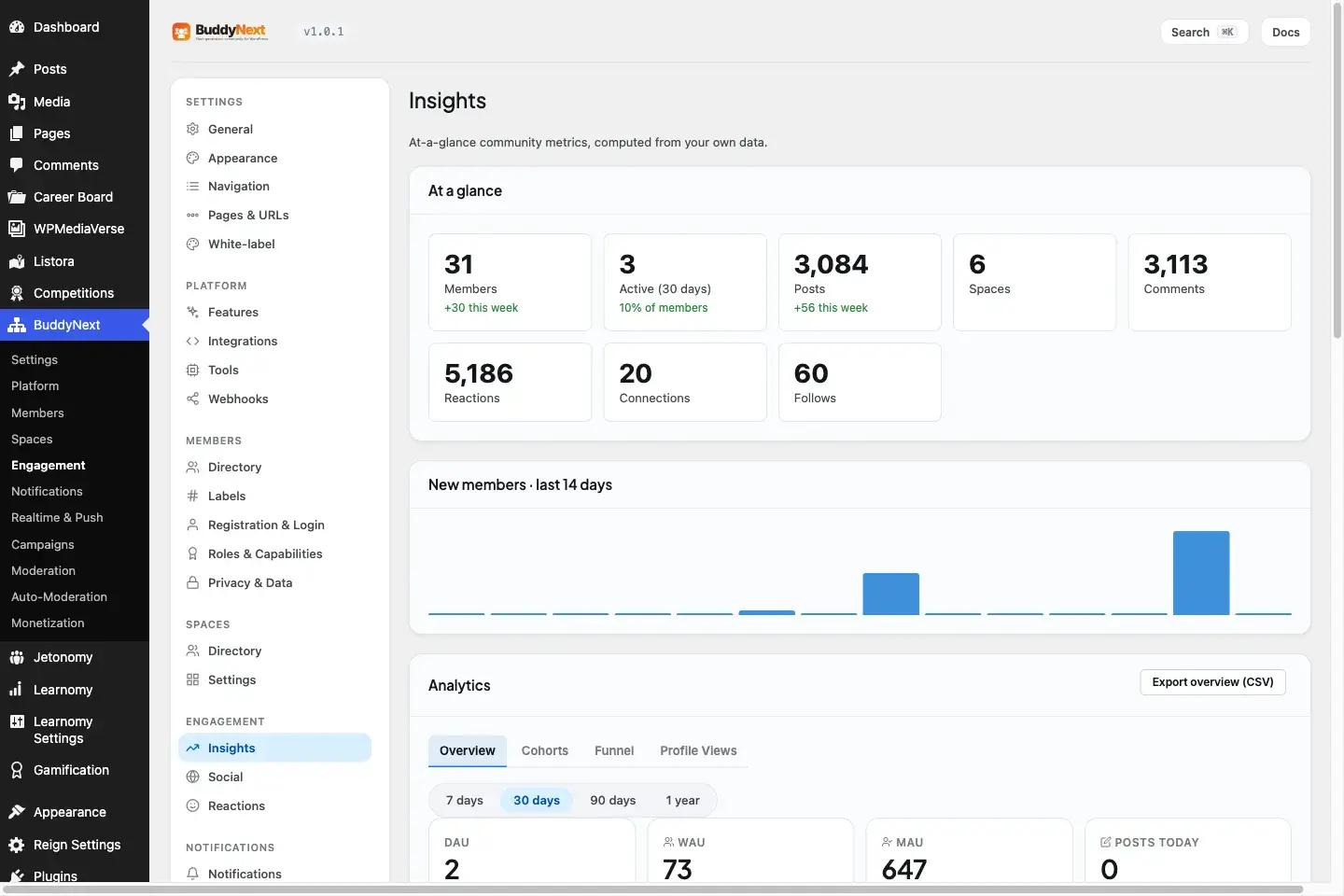
A self-hosted community’s admin dashboard runs on infrastructure you control, not a vendor’s servers.
Run that same math against a self-hosted WordPress community. BuddyNext’s free tier costs nothing in platform licensing. If the community needs paid membership tiers, BuddyNext Pro Professional runs $249 a year, not per month, for five sites, with no transaction fee layered on top of Stripe’s own standard processing rate. Add hosting, which for a community this size typically runs somewhere in the range of $20 to $50 a month depending on the host and traffic. The three-year total for the self-hosted path is a fraction of the equivalent three years on Circle’s Business tier with add-ons, and that gap only widens as the community grows and Circle’s transaction fees scale with revenue rather than staying flat.
What you actually own with a self-hosted platform
Ownership is not an abstract principle here, it has specific, checkable components. The domain is entirely yours, registered wherever you choose, pointed at whatever hosting you choose, with no platform sitting between your brand and your members at the infrastructure level. The database is a MySQL instance you can back up, export, migrate, or query directly, not an API export that approximates your data in whatever format the vendor decided to support. Member payment processing runs through your own Stripe account directly when using BuddyNext Pro’s membership tiers, meaning the money relationship is between you and your members, with Stripe’s standard fees and no additional platform cut layered on.
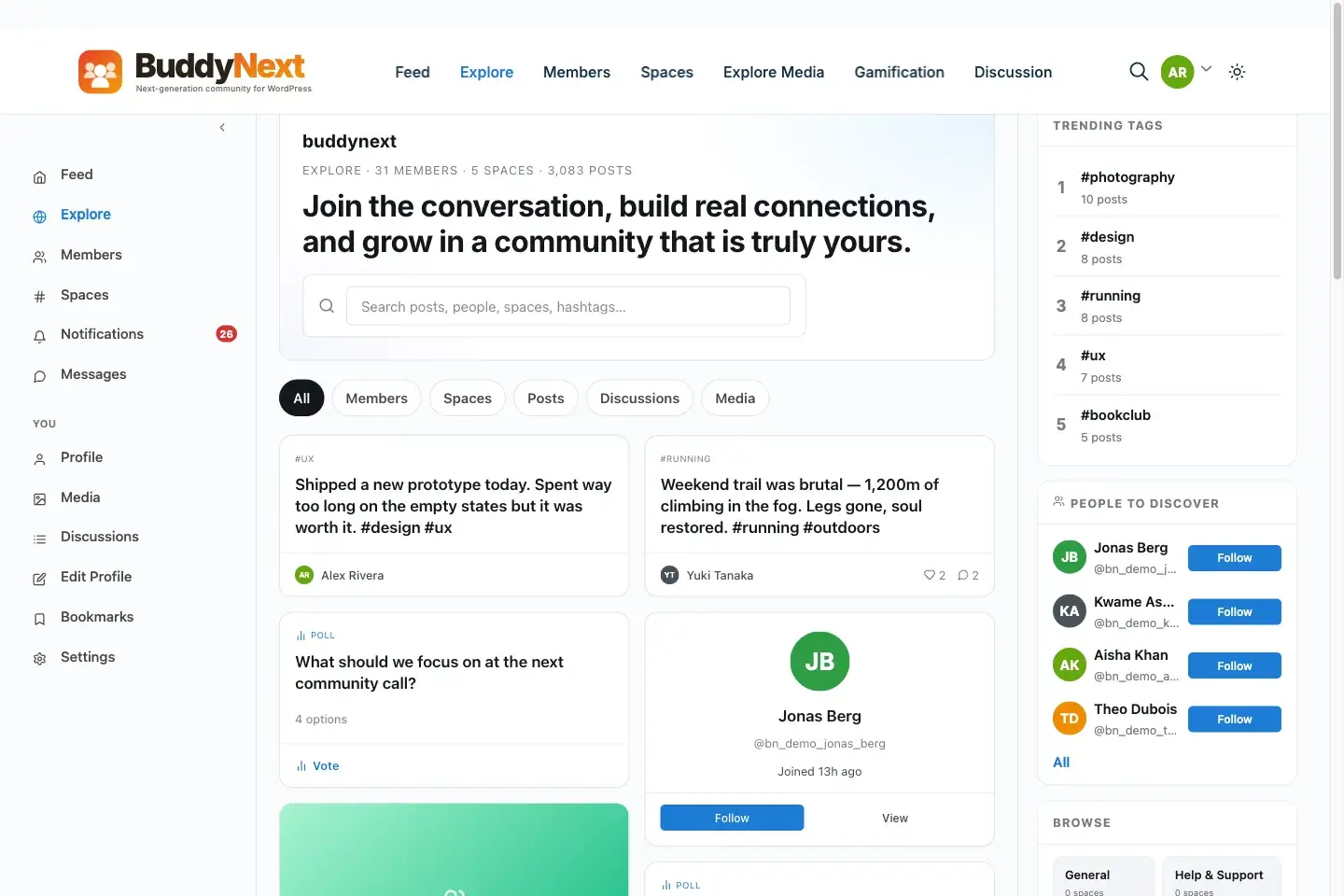
Search, discovery, and content all run on infrastructure the site owner controls end to end.
That ownership extends to the code itself. BuddyNext exposes over a thousand hooks and a complete REST API, so a developer, whether that is you, an agency, or a contractor you hire five years from now, can extend or modify behavior directly rather than filing a feature request and waiting to see if a SaaS vendor’s roadmap agrees with your priorities. We wrote about this tradeoff more broadly in Best Circle.so Alternatives for Online Communities, and the ownership argument is the throughline across every option on that list, not just BuddyNext specifically.
Data residency, compliance, and who actually answers a privacy request
For communities operating under GDPR, CCPA, or any regional data protection regime, the ownership question is not abstract, it determines who is legally accountable for a data subject request. On a hosted platform, when a member asks to have their data deleted, you are dependent on the vendor’s tooling and timeline to actually execute that deletion across their infrastructure, and you have limited ability to verify it happened beyond the vendor’s own confirmation. On a self-hosted community, the database is yours, so a deletion request is something you can execute and verify directly, down to the row.
BuddyNext’s free tier includes GDPR-oriented tooling as part of its baseline feature set rather than a compliance add-on, which matters for site owners who need to answer these requests as a matter of course rather than as an occasional edge case. It is a narrower point than the broader ownership argument, but for any community operating in a regulated jurisdiction, it is often the more immediately practical one.
Branding and design control past the logo upload
Circle allows custom branding, a logo, a color scheme, a custom domain on higher tiers. What it does not allow is control over the underlying interaction patterns, the layout grid, the exact behavior of a card component, the specific flow of a signup form. Those are Circle’s design decisions, applied consistently across every community on the platform, with customization limited to what the platform’s settings panel exposes.
A self-hosted WordPress community pairs a platform like BuddyNext with a theme, and the theme layer is where actual design control lives. BuddyNext’s 18 free Gutenberg blocks mean page layout happens through the standard WordPress block editor, and pairing it with a theme purpose-built for community sites gives a site owner control over far more of the visual and interaction experience than a SaaS settings panel typically exposes, without needing custom development for every deviation from the platform’s defaults.
Where a self-hosted stack now matches Circle’s bundled features
Circle’s appeal has always been the bundle: community, courses, events, and live streams in one subscription. For years, matching that on WordPress meant assembling several unrelated plugins yourself. That gap has narrowed considerably. Learnomy covers structured courses with quizzes, certificates, and direct Stripe checkout at zero platform fees, built to interoperate with BuddyNext rather than being a separate purchase from an unrelated vendor. Eventonomy covers events and RSVP management, recurring events, capacity caps, waitlists, calendar feeds, as a free standalone plugin in the same product family.
What still favors Circle specifically is native mobile app polish. Circle’s mobile experience has been refined over years of dedicated product investment in that one surface. BuddyNext’s free tier ships a progressive web app rather than a native app store listing, with the native mobile app reserved for Pro. For a community whose members live primarily in a mobile app rather than a browser, that is a real consideration, not a detail to wave away.
Moderation depth, side by side
Circle’s moderation tooling covers the fundamentals a hosted platform needs, member removal, content deletion, basic reporting, but it is built to a general standard that has to work across every community on the platform regardless of niche. BuddyNext’s free tier goes considerably deeper on the specific mechanics of self-regulation: strikes that accumulate against repeat offenders before an admin has to intervene manually, shadow-banning so a disruptive member’s posts quietly stop reaching anyone without an immediate confrontation, an appeals process so a ban is not automatically final, and banned word, hashtag, domain, and IP lists that catch a meaningful share of spam and abuse before a human ever sees it.
None of that is exclusive to self-hosted platforms in principle, a SaaS vendor could build the same depth. In practice, a platform whose business model depends on broad appeal across thousands of unrelated communities tends to ship moderation tools at the lowest common denominator that satisfies most customers, while a platform built specifically around community moderation as a core differentiator, the way BuddyNext treats it, has more incentive to go deep on that one area rather than spreading investment evenly across every feature category.
The exit question nobody asks until they need the answer
Here is the test worth applying to any hosted platform, Circle included: if you decided tomorrow to leave, what would that actually involve? On Circle, it means exporting what their export tools support, member lists, some content, and rebuilding the actual community experience, the layout, the moderation rules, the member tiers, from scratch on whatever you move to next. Nothing about the underlying infrastructure transfers, because none of it was ever yours to begin with.
On a self-hosted WordPress community, the exit question has a much shorter answer: you already have the database. Changing hosts is a standard WordPress migration, not a platform migration. Changing themes does not touch community data at all. Even walking away from BuddyNext itself toward a different community plugin someday would involve a data migration project, but it would be a migration between two things you actually possess, not an extraction from a vendor’s servers with an uncertain fidelity to what your community actually looked like.
When the hosted option is honestly the right call
It would be dishonest to write this as though self-hosting is correct for everyone. Someone who genuinely does not want to manage a website, who has no interest in hosting, backups, or plugin updates even in their most minimal form, and who values getting a community live in an afternoon over saving money over three years, is a legitimate Circle customer. The tradeoff is real in both directions: Circle trades ownership for convenience, and a self-hosted platform trades some convenience for ownership. Neither trade is wrong in the abstract. It depends entirely on which side of that tradeoff actually matters to the person building the community, and for a WordPress-native audience already comfortable managing a site, the calculus tends to favor ownership more often than a Circle sales page would suggest.
We looked at this from a broader lens in Social Networks vs Communities: What’s the Difference?, which is worth reading if you are still deciding what kind of member experience you actually need before deciding which platform builds it.
Frequently asked questions
Does Circle.so charge transaction fees on top of the subscription?
Yes. Circle applies a transaction fee, roughly half a percent to two percent depending on plan, to paid memberships processed through the platform, in addition to the monthly subscription cost. A self-hosted community using BuddyNext Pro’s Stripe integration pays only standard Stripe processing fees with no additional platform cut.
Can I export my community data if I decide to leave Circle.so?
Circle provides export tools for member lists and some content, but the underlying community experience, layout, moderation configuration, member tiers, does not transfer. You would rebuild that experience on whatever platform you move to, rather than migrating a working system.
Is a self-hosted community actually cheaper than Circle.so long-term?
For most paid communities, yes, once you account for Circle’s transaction fees and add-ons like the Email Hub. BuddyNext Pro’s annual pricing plus standard WordPress hosting typically lands well below the three-year total of a Business-tier Circle subscription with add-ons active, and the gap widens as membership revenue grows.
Does self-hosted mean I have to build courses and events myself from scratch?
No. Learnomy handles structured courses with quizzes and certificates, and Eventonomy handles events and RSVP management, both as separate plugins in the same product family as BuddyNext, built to interoperate rather than requiring custom development to bolt together.
Is Circle.so’s mobile app actually better than what a self-hosted platform offers?
For communities whose members live primarily in a dedicated app, Circle’s native mobile experience, refined over years, currently has an edge over BuddyNext’s free-tier progressive web app. BuddyNext’s native mobile app is available in Pro, but it is newer and has not had the same length of iteration.
Who should actually choose Circle.so over a self-hosted platform?
Someone who wants zero involvement in hosting, backups, or technical maintenance, and who values speed to launch over long-term cost and data ownership. That tradeoff is legitimate for creators focused entirely on content and community management rather than the underlying platform.
How does data residency work if I need GDPR compliance?
On a self-hosted platform, your database lives wherever you choose to host it and deletion requests are something you execute and verify directly. On Circle, you are dependent on the vendor’s own tooling and timeline to fulfill a data subject request, with limited ability to verify execution beyond their confirmation.
Can I get the same visual branding control on Circle as I can with a self-hosted theme?
Circle allows logo, color, and custom domain branding on its higher tiers, but layout and interaction patterns are fixed by the platform. A self-hosted WordPress theme paired with BuddyNext controls the layout grid and component behavior directly, which is a deeper level of design control than a SaaS settings panel typically exposes.
A practical test before you commit either way
Before choosing a platform, run a specific exercise rather than relying on a gut feeling: write down what your community would need to do, concretely, to move to a different platform in three years if the current one stopped serving you well. On Circle, that answer involves an export process with unclear fidelity and a rebuild of every structural decision from scratch. On a self-hosted WordPress community, that answer involves a standard database migration, the kind any competent WordPress agency handles routinely, because the data was never locked inside a platform-specific format to begin with.
If that exercise makes you more comfortable with Circle’s answer than BuddyNext’s, that is useful information, it means the convenience genuinely outweighs the ownership concern for your specific situation. If it makes you uneasy, that unease is worth acting on now, while the community is smaller and the migration cost is lower, rather than after years of growth have made the decision far more expensive to reverse.
Ownership is a decision you make once, not a feature you can add later
The frustrating part about the ownership question is that it is nearly invisible until the moment it matters, a pricing change, a feature deprecation, a platform acquisition that changes priorities, and by then a community with thousands of members and years of history is not something you migrate on a whim. Deciding where that data lives is worth making deliberately at the start, with the actual tradeoffs on the table, rather than discovering the answer three years into a subscription you never fully controlled.
If you are already on Circle and this comparison has made you uneasy rather than merely curious, that reaction is worth trusting. It does not require an immediate migration, but it is a reasonable prompt to start a parallel evaluation now, while switching is still a choice you are making on your own timeline rather than one forced by a pricing change or a feature you suddenly cannot live without losing. A staging environment costs an afternoon to set up and tells you more about whether self-hosting fits your workflow than any comparison post, this one included, ever will.