
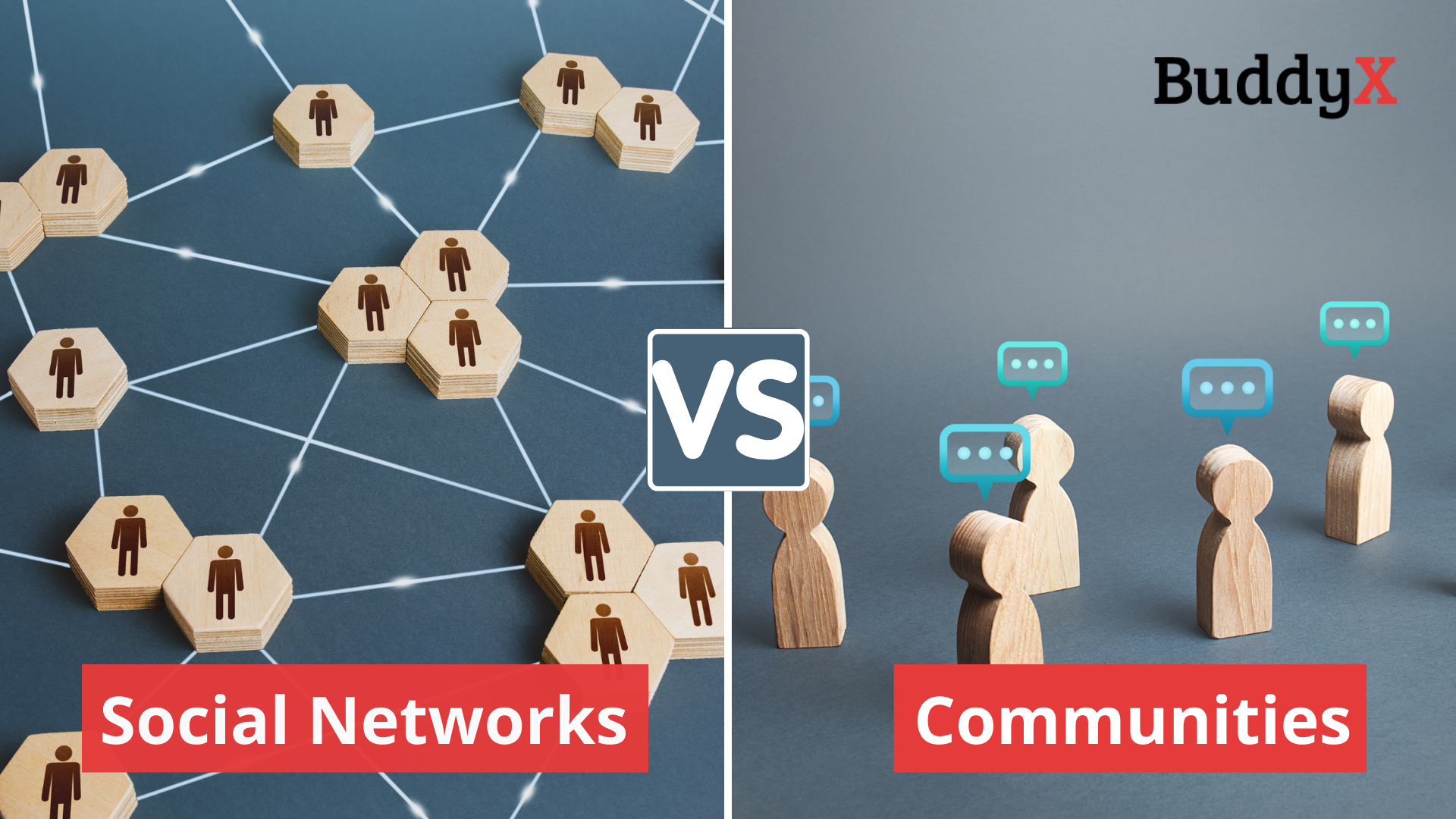
Ask ten people to define “online community” and you’ll get ten different answers, half of which actually describe a social network instead. The two terms get used interchangeably so often that most people building a digital space for the first time never stop to ask which one they’re actually building. That confusion costs real money and real time, because the two things are built differently, grow differently, and need different features to succeed.
Here’s the actual distinction, and how to figure out which one your project needs.
What Makes an Online Community

A community forms around a shared interest, problem, or identity, not around pre-existing relationships. Members join a running community for a specific product because they own that product, not because their friends are there. They join a professional forum for civil engineers because they are civil engineers, not because a coworker sent them an invite. The connections form after joining, built from shared context rather than imported from real life.
That shared context is the whole reason people stick around. Someone joins because they want either to learn something specific or to contribute something they already know, and the community only works as long as it keeps delivering on one of those two motivations. A community that stops teaching or stops giving members a place to be genuinely useful tends to hollow out even if the membership number keeps climbing on paper.
What Makes a Social Network

A social network is built on relationships that already existed before someone signed up. Your friend list on Facebook is mostly people you already knew: school friends, family, coworkers, people you met once at a conference and added out of politeness. The platform’s job is to give those existing connections a place to stay in touch, not to introduce you to strangers who share your interests.
That’s the core distinction. In a social network, visibility and connection flow from relationships you already had. In a community, they flow from a shared interest you’re discovering together with people you’d never have met otherwise. Both models are valid, and plenty of successful platforms blend elements of both, but the underlying growth mechanic is fundamentally different, and confusing the two leads to the wrong feature priorities.
Where the Two Actually Diverge
The clearest divergence is in how each one grows. A social network grows through your existing address book, invite a few friends, they invite a few more, and the network expands along lines that already existed offline. A community grows through discovery: someone searches for an answer to a specific problem, finds your forum, and joins because the content solved something for them, with zero prior connection to anyone already inside.
That difference cascades into everything else. Communities can form and thrive around a specific business, product, or profession, since the shared interest does the work a personal relationship would otherwise need to do. Social networks emerge more organically from people wanting to stay in touch, which is why they tend to be broader and less topic-specific by nature. A brand can absolutely use either model to build value: a community around its product for support and advocacy, or a social presence for staying visible to an audience that already knows the brand.
A Practical Test for Figuring Out Which One You’re Building
If you’re not sure which model fits your project, ask one question: would a total stranger, with zero connection to anyone already involved, have a compelling reason to join tomorrow? If the honest answer is yes, because they share the interest, the problem, or the professional identity your space is built around, you’re building a community. If the honest answer is no, because the value only exists for people who already know someone on the platform, you’re building a social network.
Most projects that fail to grow past a small initial group misjudged this question at the start. They built community-style content and features, forums, resource libraries, discussion boards, but only marketed to their existing contacts, which caps growth at whatever size that personal network happens to be. Or they built social-network-style connection tools expecting strangers to show up and use them, without the personal relationships that actually drive adoption of that model.
Deciding Which Model Fits Your Goals
Building an online community makes sense when your goal is a personalized space with real depth: gated content, structured knowledge sharing, advanced moderation, and features tuned to a specific audience’s needs. It’s the right call when data security and content control matter, since a smaller, purpose-built audience is easier to protect and moderate than an open network.
A social network fits better when the overriding goal is broad engagement and brand visibility. If you’re mainly trying to stay present in front of people who already know you, rather than build deep, structured value for strangers who don’t, the lighter-weight social model usually gets there faster.
If your goal leans toward user engagement and staying top of mind, a social network structure will likely serve you better. If your goal is a platform with genuinely extended features, deep resources, and long-term member value, an online community is the stronger fit. Most projects lean clearly one way once the actual goal is stated plainly instead of left vague.
What Retention Looks Like in Each Model
Communities and social networks lose members for different reasons, which means they need different retention strategies. A community member leaves when the space stops teaching them anything new or stops giving them a reason to contribute, the underlying value proposition has simply run dry for that person. Retention here comes from a steady supply of fresh discussion, new problems to solve, and enough active contributors that the space feels alive rather than stale.
A social network member leaves less because of content quality and more because their real-world relationships shift elsewhere. If their friends move to a different platform, they tend to follow, regardless of how good the original platform’s features are. Retention here comes from network effects: the more of someone’s actual friends and family are present, the harder the platform is to leave, independent of the quality of any single feature.
This is why community platforms tend to survive algorithm changes and feature overhauls better than pure social networks do. The value isn’t tied to a specific set of relationships that could migrate elsewhere all at once. It’s tied to an ongoing supply of relevant content and expertise that’s harder to replicate on a competing platform overnight.
Moderation Looks Different Too
A community built around a specific topic can moderate against a fairly clear standard: does this post relate to the shared interest, and does it meet the quality bar members expect. Off-topic posts, low-effort spam, and content that doesn’t serve the community’s purpose get removed without much ambiguity about the reasoning.
A social network is harder to moderate cleanly because members bring their entire personal lives into the space, not just a narrow topic. What counts as acceptable content is far broader and more subjective, since the platform isn’t organized around a single shared purpose that content can be measured against. This is one of the underappreciated reasons niche communities often feel calmer and more civil than open social networks: a narrower, shared purpose gives moderators a much clearer standard to enforce.
Monetization Paths Differ by Model
Communities monetize well through membership tiers, gated expert content, and services tied directly to the shared interest, a paid tier with advanced resources, a marketplace for members to buy and sell relevant products, or sponsorships from brands that specifically want access to that niche audience. Because the audience is self-selected around a specific interest, targeted monetization tends to convert well without feeling like an intrusion.
Social networks monetize primarily through advertising and data, since the value to advertisers comes from reach and demographic targeting rather than topical relevance. This works at scale but generally requires a much larger user base to generate meaningful revenue per user compared to a smaller, highly engaged community with a paid tier or a relevant sponsor.
Building Either One on WordPress

Once you know which model fits, building it on WordPress follows a similar technical path either way. BuddyPress gives you the core social and community mechanics: member directories and activity feeds, plus groups and private messaging, with only a little drag-and-drop configuration needed to get a fully functional site running.
A theme built specifically for this use case closes the visual gap that a generic WordPress theme would leave open. BuddyX is a free option with the features and functionality needed to launch either model, a broad social space or a focused community, and extends further with a paid version once you know which premium features you actually need.
For teams that want a community-specific platform without configuring BuddyPress from scratch, BuddyNext offers an alternative built as a standalone Community OS rather than a BuddyPress add-on. It’s worth comparing directly against a BuddyPress and BuddyX setup, particularly if your project fits squarely in the community category described above and you’d rather not manage plugin configuration yourself.
Signals You Might Be Building the Wrong Model
A few warning signs suggest a mismatch between what you’re building and what your actual audience needs. If members keep asking for direct messaging and friend-style connections while you’ve built a topic-based forum, they might actually want a social network layered on top of your community, not just discussion threads. If engagement is flat despite a decent member count, and most members joined through personal invites from you rather than organic search or referral, you may have built community features on top of what’s functionally still a small, closed social network, and it will plateau at the size of your personal reach unless you shift the growth strategy.
Watch how new members actually arrive. If nearly all of them come through a direct personal connection to someone already inside, you’re running a social network regardless of what features you’ve built. If a meaningful share arrive through search, referral from unrelated sources, or word of mouth from people who’ve never met you, you’ve built something with genuine community gravity, capable of growing past the ceiling any one person’s contact list would otherwise impose.
What Success Actually Looks Like at Six Months
A healthy community at the six-month mark looks different from a healthy social network at the same point. For a community, the signal to watch is whether members are starting discussions on their own without prompting from you. If every thread is still one you started yourself, the community hasn’t developed independent momentum yet, and it’s worth examining whether the niche is too narrow, the content too thin, or the initial member base too passive.
For a social network, the six-month signal is whether the platform has become part of members’ regular routine independent of you posting anything. Are people checking in to see what their connections are doing, not what the platform owner published? If activity only spikes when you post something yourself, the network hasn’t built the peer-to-peer engagement that defines a genuine social platform.
A Short Case for Starting Narrower Than Feels Comfortable
Whichever model you choose, the single most common early mistake is defining the audience too broadly. “A community for entrepreneurs” competes with a hundred existing options and gives a new member no compelling reason to pick yours specifically. “A community for solo consultants transitioning out of corporate law” is narrow enough that the handful of people who fit it feel like the space was built specifically for them, which is a much stronger pull than a generic pitch to a broad category.
The same logic applies to a social network built around a brand. “Stay connected with our customers” is vague. “A space for people who’ve completed our advanced certification to keep learning from each other” gives members a specific reason tied to something they’ve already invested in, which produces far higher initial engagement than an open invitation with no particular hook.
Frequently Asked Questions
Can a platform be both a community and a social network? Yes, and many successful platforms are. A product-focused community can add social features like direct messaging and follow relationships once the core community value is established, blending both models rather than picking one permanently.
Which one is cheaper to build and run? Neither model is inherently cheaper on the technical side, since both run on the same core plugins on WordPress. The bigger cost difference shows up in growth: a community can grow through organic search and referral without heavy ad spend, while a social network typically needs continued personal outreach or paid acquisition to keep expanding past its founding group.
How do I know if my niche is too narrow for a community? If you can name at least a few hundred people who plausibly share the interest or problem your community is built around, even if you don’t know them personally, the niche is probably wide enough. If the honest number is closer to a few dozen, a community model may struggle to reach the critical mass needed for active daily discussion.
Does SEO work better for one model over the other? Communities generally perform better in organic search over time, since member discussions naturally generate long-tail, specific content that answers real questions. Social networks built around existing relationships don’t generate that same volume of searchable, evergreen content, so their growth relies more heavily on direct traffic and referral.
Should a brand-new project pick a hybrid approach from day one? It’s tempting, but usually a mistake early on. Building both a discovery-driven community and a relationship-driven social layer at the same time splits your limited early attention and dilutes the clarity a new member needs to understand what the platform is actually for. Pick the primary model, prove it can sustain itself, and layer in the other set of features once the core value is established and you understand how members actually want to use the space.
Making the Call
The features you build should follow the answer to one honest question: is a stranger’s reason for joining based on what they already know about the people inside, or on what they’d gain from the topic itself? Answer that clearly before writing a single line of copy for your homepage, and the platform choice, the feature priorities, and the growth strategy all fall into place with a lot less guesswork than trying to build both models at once and hoping one of them sticks.
It’s worth revisiting that answer periodically too, since a project’s actual audience sometimes drifts from what it was originally built for. A community that quietly attracts more members through personal referral than organic search over time might be evolving into something closer to a social network, whether or not that was the original plan. Checking in on where new members actually come from every few months keeps the platform’s features aligned with how people are genuinely finding and using it, instead of optimizing for a model the site left behind a year ago.
Interesting Reads:
Private Community Groups on Facebook: Everything to Know About
How Private Communities Can Promote Healthy Nutrition and Physical Fitness?