

Circle and Skool show up together in almost every “which community platform” conversation, and for good reason: they are the two most-recommended hosted options for creators who want a feed, a course area, and paid memberships without writing a line of code. Circle is the polished, course-and-community-first choice. Skool is the simpler, gamification-first choice with a public discovery directory. Both will have you live today, and both show up at the top of nearly every “best community platform” roundup you’ll find. Neither is a bad choice, which is exactly why the decision is harder than most people expect going in.
There is a third path that rarely gets a fair hearing in these comparisons: owning the platform outright. BuddyNext is a WordPress-based community platform built by the same team as this site, so I will say upfront that this is not a neutral review. It is, however, an honest one, and I will be specific about where Circle and Skool genuinely win, not just where BuddyNext does. If you only read one section, make it the one on transaction fees below, it is the number almost nobody models correctly before they launch.
See BuddyNext running for real before you read another word of comparison.
Why people compare these two specifically
Circle and Skool keep getting cross-shopped because they solve the same problem from opposite directions.
- Skool launched as “one price, one layout, no setup” and built a cult following through its gamified leaderboard and public community directory.
- Circle launched as the premium, highly-customizable option for creators who wanted their community to look and feel bespoke.
Most people start one of two searches: “Skool vs Circle” when they’re choosing where to launch, or “Skool alternative” / “Circle alternative” once they’ve outgrown one of them. What both searches tend to miss is that neither platform was built to be a business operating system. They were built to be community software, and the moment your members start asking for a job board, a service marketplace, or real course certificates, both products hit the same wall from different heights.
How we evaluated these three
We compared Circle, Skool, and BuddyNext on five things:
- Real pricing pulled from each vendor’s public pricing page
- Transaction fees on top of that subscription
- Data and platform ownership
- Course and LMS depth
- What happens when a community outgrows a simple feed-plus-groups model: jobs, marketplace, directory, certificates
We did not accept marketing claims at face value for any of the three, including our own.
Circle vs Skool: the direct comparison
Skool pricing: $9/month (annual) for the Hobby plan with a 10% transaction fee, or $99/month for Pro at 2.9%. One plan, one layout, almost no settings to misconfigure.
Circle pricing: Professional at $89/month (2% transaction fee), Business at $199/month (1%), and Circle Plus at custom pricing (0.5%, branded apps included). Professional caps you at 3 admins, 10 moderators, and 20 spaces, a real limit if you’re running a serious moderation team.
On raw interface polish, Circle wins without much argument. Its course builder, live streams, events, and mobile apps feel considerably more premium than Skool’s, and that polish is a real factor if your brand depends on looking high-production.
Skool wins on simplicity and discovery. Its public community directory sends browsing users your way, something Circle has no real equivalent for, and its gamified leaderboard (points, levels, streaks) became the feature a whole generation of community tools copied.
Where they’re similar is the ceiling. Neither has a native job board, a member-to-member service marketplace, or a real certificate-bearing LMS. Both lock branded mobile apps behind their most expensive, custom-priced tier. Both take a cut of every payment your members make to you, forever, as long as you stay on the platform.
Where BuddyNext fits
BuddyNext’s model: no subscription, no transaction fee, ever, you keep your own Stripe relationship and every dollar your members pay you. The honest cost is WordPress hosting, roughly $20/month, and the setup time of running a WordPress site, which is real and shouldn’t be hand-waved away.
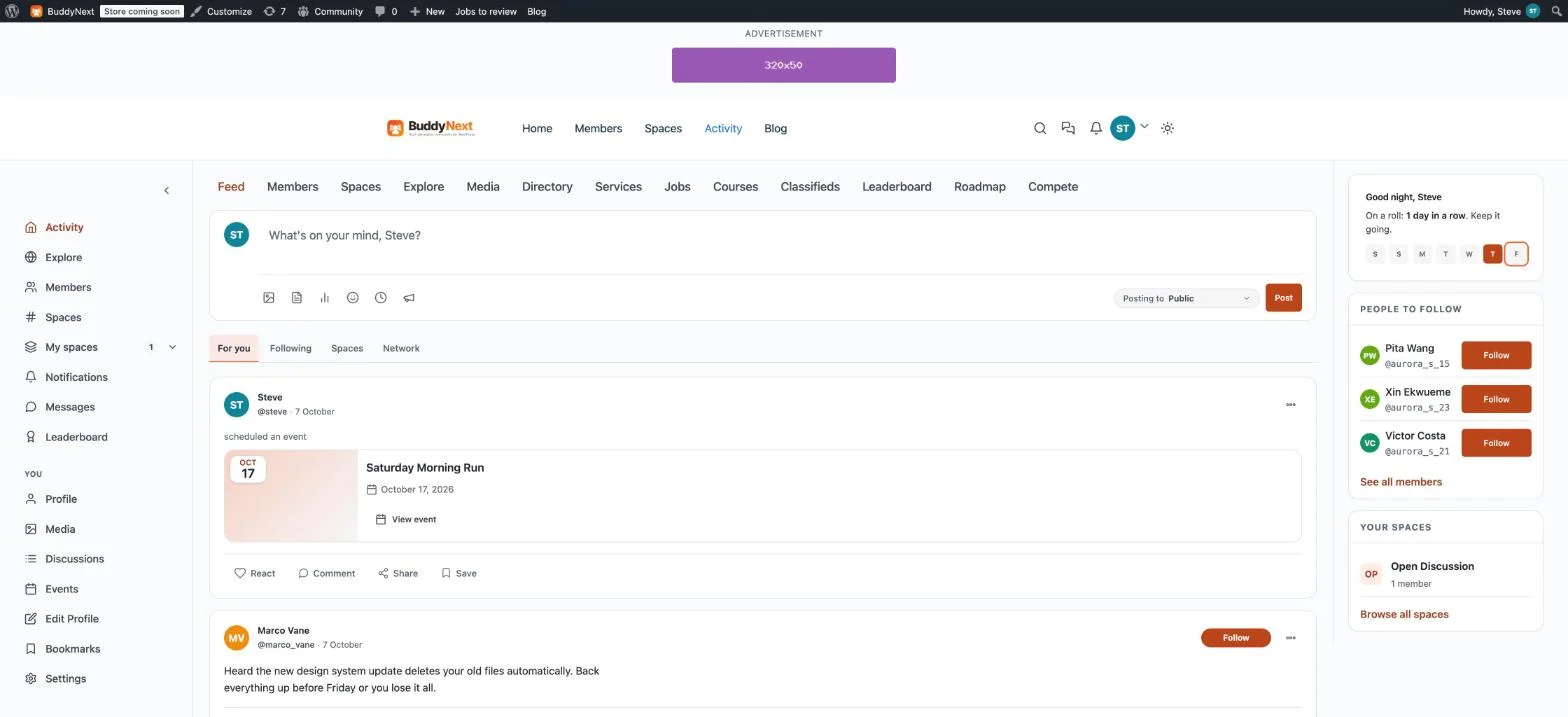
BuddyNext is a complete community platform rather than a single plugin. The core covers the same ground as Circle and Skool:
- Activity feed with reactions and threaded comments
- Spaces: open, private, and request-to-join groups with sub-spaces and per-space moderation
- Member profiles and a searchable directory
- Direct messaging and notifications
- Moderation tools out of the box
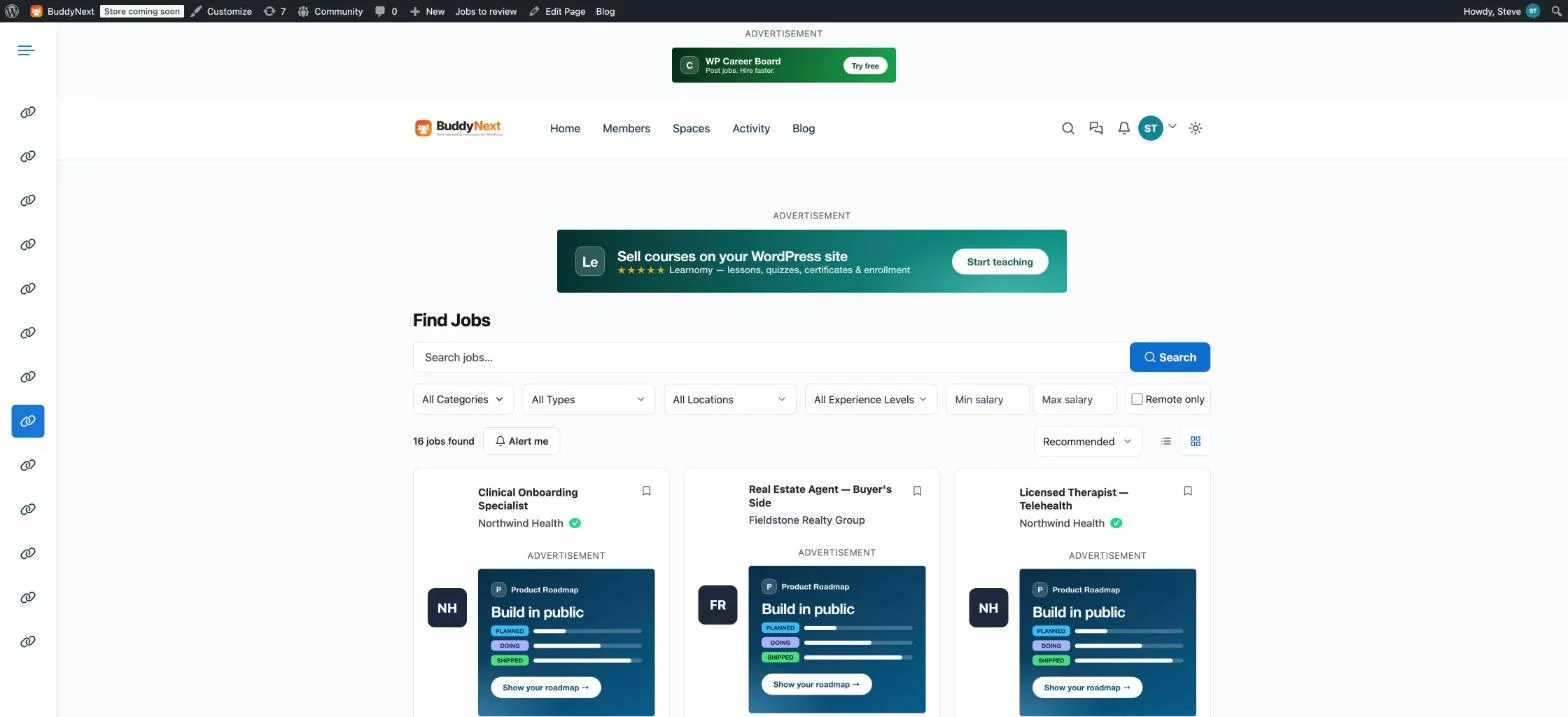
Layered on top of that core, it adds the things neither Circle nor Skool ship at any price:
- A full course and certification system with quizzes, pass marks, drip scheduling, cohorts and instructor revenue splits
- A job board so members hire each other instead of leaving for LinkedIn
- A service marketplace so a member can sell design work or coaching to the rest of the group with orders and reviews attached
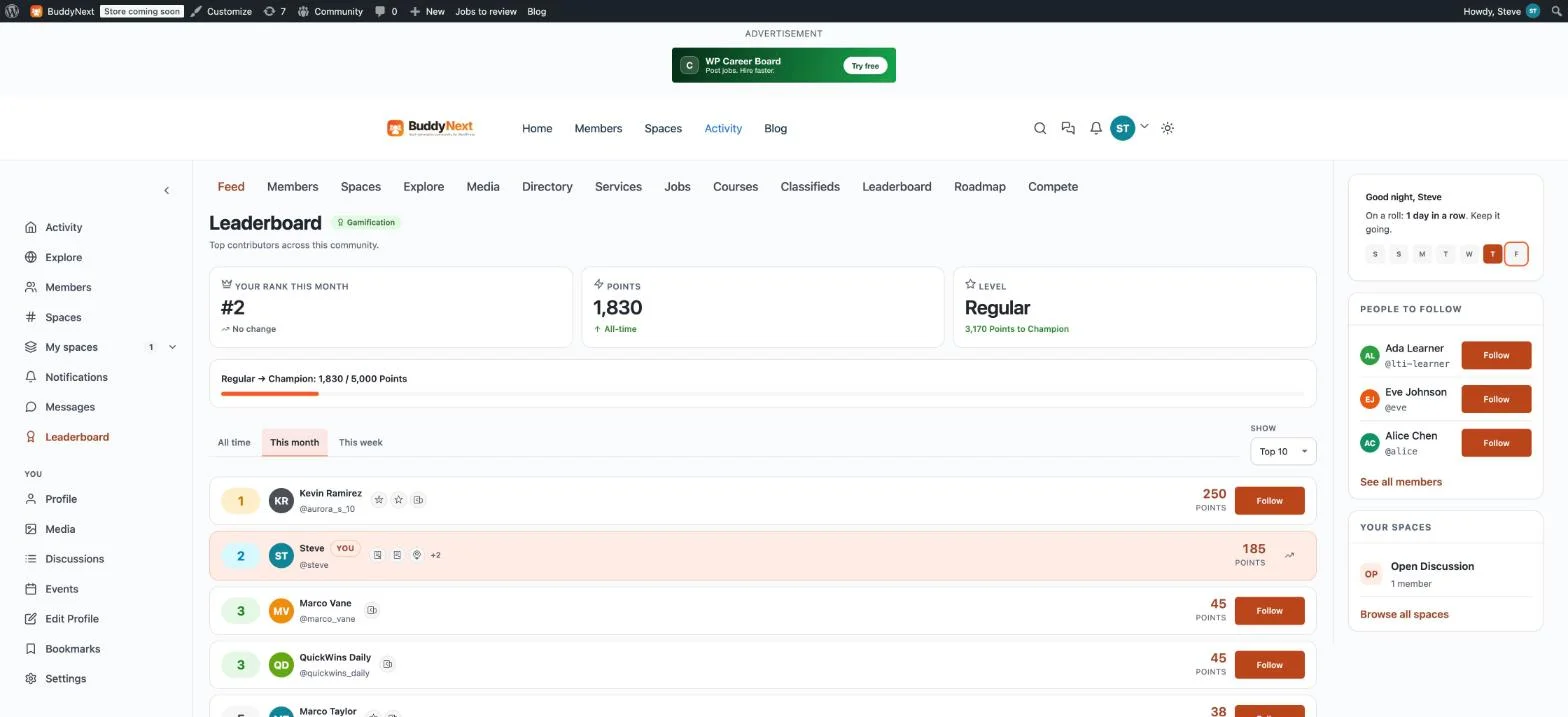
- Gamification with points, levels, streaks and time-windowed leaderboards you fully control the rules for, the one area Skool set the standard, matched here with the added ability to decide what actually earns points

The honest limits: you’re responsible for hosting, backups and updates. There’s no native app store listing, BuddyNext ships a PWA that installs to the home screen plus a REST API, which is enough to commission a native app but isn’t the same as one arriving for free. And unlike Skool’s public directory, discovery is entirely your own job: SEO, email, and word of mouth, with no built-in marketplace sending you browsing traffic.
Circle vs Skool vs BuddyNext at a glance
| Circle | Skool | BuddyNext | |
|---|---|---|---|
| Entry price | $89/month | $9/month | No subscription (+ hosting) |
| Transaction fee | 2% (down to 0.5%) | 10% (down to 2.9%) | None, ever |
| Data ownership | Circle’s servers | Skool’s servers | Your own site |
| Course / LMS depth | Solid, no certificates | Basic video sequence | Full LMS + certificates |
| Job board | No | No | Yes, built in |
| Service marketplace | No | No | Yes, built in |
| Member directory | Basic | Basic | Full, with maps/categories |
| Gamification | Limited | Points/levels/leaderboard | Points/levels/leaderboard, fully configurable |
| Public discovery | No | Yes, built-in directory | No, your own SEO/marketing |
| Branded mobile app | Custom tier only | Not available | PWA + REST API |
| Setup time | Minutes | Minutes | A weekend |
What this costs over three years
Monthly pricing hides the real number, and transaction fees hide it further.
- At Circle’s entry tier, three years of subscription runs about $3,204 before any transaction fees.
- At Skool’s Hobby tier, about $324 in subscription, but the 10% transaction fee is where Skool actually gets expensive the moment you’re selling anything real. A community doing $3,000/month in membership revenue pays $300/month in fees alone, more than the subscription itself.
- BuddyNext’s only real recurring cost over three years is hosting, roughly $720, with no subscription fee and zero transaction fees regardless of revenue.
A subscription is a permanent operating cost that scales with your revenue through the transaction fee. Self-hosting is mostly a one-time setup cost that doesn’t. Those two shapes cross over at different points depending on how much your members actually pay you, but for any community doing meaningful recurring revenue, the crossover tends to arrive faster than people expect. A community charging $30/month to 200 paying members on Skool’s Pro tier, for instance, is paying roughly $174/month in transaction fees alone on top of the $99 subscription, more than $2,700 a year that a zero-fee platform would simply not charge. Scale that same math to 1,000 paying members and the fee alone exceeds a full year of BuddyNext’s hosting cost in a single month.
Common mistakes people make comparing these three
A few patterns show up repeatedly in how creators evaluate this decision, and most of them lead to regret within a year:
- Comparing today’s feature list instead of month-nine’s requests. The feed, groups and basic course area are table stakes on all three platforms now. What actually separates them is what happens when a member asks for a job board or a certificate six months in.
- Ignoring the transaction fee until revenue arrives. A 10% or even 2% cut feels abstract at zero revenue and very concrete at $10,000/month. Model the fee at the revenue you’re hoping to reach, not the revenue you have today.
- Underestimating what self-hosting setup actually involves. A weekend is a realistic estimate for someone comfortable with WordPress; it is not realistic for someone touching WordPress for the first time. Be honest about which category you’re in before committing to BuddyNext on a deadline.
- Overestimating what a hosted platform’s “community” feature actually replaces. Circle and Skool both call their offering a complete community platform, and for feed-and-groups use cases, that’s fair. For anything that resembles a job board, marketplace, or accredited course program, it isn’t, no matter what tier you’re on.
What Circle and Skool genuinely do better
It would be dishonest to write this comparison without saying plainly where the two hosted options win:
- Speed. Both have you live in minutes, not a weekend.
- Skool’s discovery directory. No self-hosted option, ours included, has an equivalent. If you have zero audience, that directory is worth more than any feature comparison.
- Zero technical maintenance. No hosting, no updates, no backups to think about on either platform.
- Circle’s interface polish. If your brand lives or dies on first impressions, Circle’s design quality is hard to match without real design investment on your own site.
None of this disappears because a community outgrows the platform. It just stops being the deciding factor once members start carrying real economic weight inside it.
Who each platform is actually built for
Feature checklists tend to obscure the more useful question, which is less “what can it do” and more “who already succeeds on it.”
Circle tends to suit course creators and coaches who already have an audience from somewhere else, YouTube, a newsletter, a podcast, and need a home that looks as considered as the content that built that audience. It also suits teams with a real moderation workload, since its roles and permissions are more granular than Skool’s.
Skool tends to suit people testing a community idea for the first time, with no existing following and no appetite for setup decisions. Its leaderboard culture also fits competitive, accountability-driven niches particularly well: fitness, sales, trading, anything where members respond to visible rank.
BuddyNext tends to suit communities that have already proven themselves on a hosted platform and are now watching a transaction fee grow alongside their own success. It also fits agencies and consultants building a community as part of a larger WordPress site they already operate, where a second subscription and a second login for members is friction they would rather not add.
Moving off Circle or Skool without losing your members
If you do decide to move, the migration is more about sequencing than tooling:
- Export what you can. Member emails first, that’s the real asset. Then course content and any threads worth preserving.
- Build in parallel. Get the new home to a state where the first ten members would be happy there before announcing anything.
- Move the loudest people first. A dozen active members make a new community feel alive. An empty one kills the move on day one.
- Run both for a month. Overlap is cheaper than a botched cutover.
- Give people a reason, not a notice. “We moved” is not a reason. “We moved and now you can list your services and get hired here” is.
How to choose
Pick Skool if you’re validating an idea with no audience yet and want its discovery directory working for you from day one, or if you’re under 100 members and want zero setup decisions to make.
Pick Circle if you want the most polished hosted experience available and you’re fine paying a subscription plus a transaction cut indefinitely in exchange for not thinking about infrastructure.
Pick BuddyNext if your community has started generating real income for the people inside it, members hiring each other, selling to each other, earning certificates that matter, and the ongoing subscription-plus-fee math has stopped making sense next to owning the platform outright.
Ready to see it for yourself?
FAQs
1. Is Circle or Skool better for beginners?
Skool, for pure speed to launch. One price, one layout, almost no settings to misconfigure, plus a public directory that can bring you your first members without any marketing effort.
2. Which has lower fees, Circle or Skool?
Circle, at every tier. Circle’s transaction fee starts at 2% and drops to 0.5% on its top tier; Skool starts at 10% and drops to 2.9% on Pro. Skool’s subscription is cheaper, but its transaction fee is substantially higher at every comparable tier.
3. Can I run a real course with certificates on Circle or Skool?
Both support course content as a video and text sequence, but neither issues verifiable certificates, tracks quiz pass marks with attempt limits, or supports cohort-based drip scheduling the way a dedicated LMS does.
4. Why would I choose BuddyNext over two established products like Circle and Skool?
Mainly for what happens after launch: no transaction fee regardless of how much revenue your community generates, a full LMS with certificates, a built-in job board and service marketplace, and full ownership of your member data and domain. The trade-off is setup time and the fact that you don’t get Skool’s public discovery directory.
5. Do Circle and Skool let me export my member data if I leave?
Both let you export contact information like email addresses, but neither exports passwords, so members always have to create a new account wherever you move them.
6. Is self-hosting with BuddyNext actually harder than Circle or Skool?
Initial setup is harder, budget a weekend rather than an afternoon. Day-to-day running is comparable: you moderate, post, and answer questions regardless of platform. The ongoing difference is that updates and backups become your responsibility, though managed WordPress hosting handles most of that for you.
7. Does Circle or Skool help with SEO?
Generally no, community content on both platforms sits behind a login on their domain, not yours, so it builds their search authority, not yours. A self-hosted community on your own domain means public spaces, course pages, and directory listings are all indexable and contribute to your own site’s SEO.
8. Which platform has a better mobile app?
Circle and similar competitors offer branded apps only on custom-priced enterprise tiers; Skool has no branded app at all. BuddyNext ships an installable PWA and a REST API, meaning a native app is possible to commission without waiting on a vendor’s roadmap, though it doesn’t arrive by default either.
9. What’s the single biggest trade-off between these three?
Speed versus ownership. Circle and Skool get you live today and both are fairly priced for what they do. BuddyNext takes longer to set up but removes the transaction fee and the platform risk entirely, the trade-off is time now versus cost and control later.
10. Can I run Circle or Skool alongside a WordPress site I already have?
Technically yes, as a separate login outside your site, but you lose the SEO and ownership benefits either way since the community content still lives on their domain, not yours. Most people who already run WordPress find the self-hosted route makes more sense once they’ve compared the two paths directly.
11. Does switching away from Circle or Skool hurt existing members’ trust?
Less than most people expect, as long as the move is communicated as an upgrade rather than an apology. Members generally care more about continuity, the same people, the same conversations, than about which domain the login screen sits on. The migration sequence above is built around preserving that continuity.
12. Is BuddyNext only for technical users?
No, though it does assume comfort running a WordPress site generally. If you or someone on your team already manages WordPress for any other purpose, adding a community is a configuration task, not a development project.
13. Can I test BuddyNext before committing to a full migration?
Yes. Because there’s no subscription commitment to start, the realistic approach is building the new community alongside your existing one on Circle or Skool, inviting a small group to try it, and only moving the rest of your members once that test group confirms it works the way you need before any subscription is cancelled elsewhere.
14. Does this comparison apply the same way to a brand-new community with no members yet?
Partly. The core speed-versus-ownership trade-off still applies, but a brand-new community with zero audience gets disproportionately more value from Skool’s discovery directory than an established one does, since discovery matters most exactly when you have nobody to invite yet. That’s a real reason to start on a hosted platform even if you expect to move later.
15. What happens to course content and certificates already issued if a community moves platforms?
Course video and text content generally exports as files you can re-upload elsewhere, but certificates issued on Circle or Skool don’t carry any portable verification system with them, they’re essentially static records tied to that platform’s own completion tracking. A WordPress LMS layer, by contrast, keeps certificate records in a database you control, which is one more reason communities that care about accreditation tend to move sooner rather than later.
16. Is it realistic to run a hybrid setup, some features on Circle or Skool and others self-hosted?
Not cleanly. Member identity, billing, and content all live inside each platform’s own walls, so bridging two systems means duplicate logins and manually synced data at best. Most people who try a hybrid approach end up picking one platform fully within a few months rather than maintaining the integration long-term.
Summary
Circle and Skool earned their spot at the top of every “best community platform” list because they’re both genuinely good at getting a community live fast. The honest dividing line between them and BuddyNext isn’t quality, it’s what you’re optimizing for.
If speed to launch and zero setup decisions matter most right now, rent the room on Circle or Skool. If your community has started acting like a real business, members hiring each other, paying each other, earning things that matter, the monthly subscription stops being the real cost, and the transaction fee on every dollar your members ever pay you becomes the number worth doing the math on.
Interesting Reads:
Best Skool Alternatives for Community Builders
Circle vs Mighty Networks vs Self-Hosted
BuddyPress vs the Alternatives: Why Owned Niche Communities Still Win