
It is 11:40pm on a Tuesday and someone in your BuddyPress group has just posted a reply that makes three other members go quiet. Nobody reports it right away.
A moderator sees it the next morning, reads it twice, and is not sure what to do. Is this the kind of thing you remove? Warn about? Ignore because it is borderline?
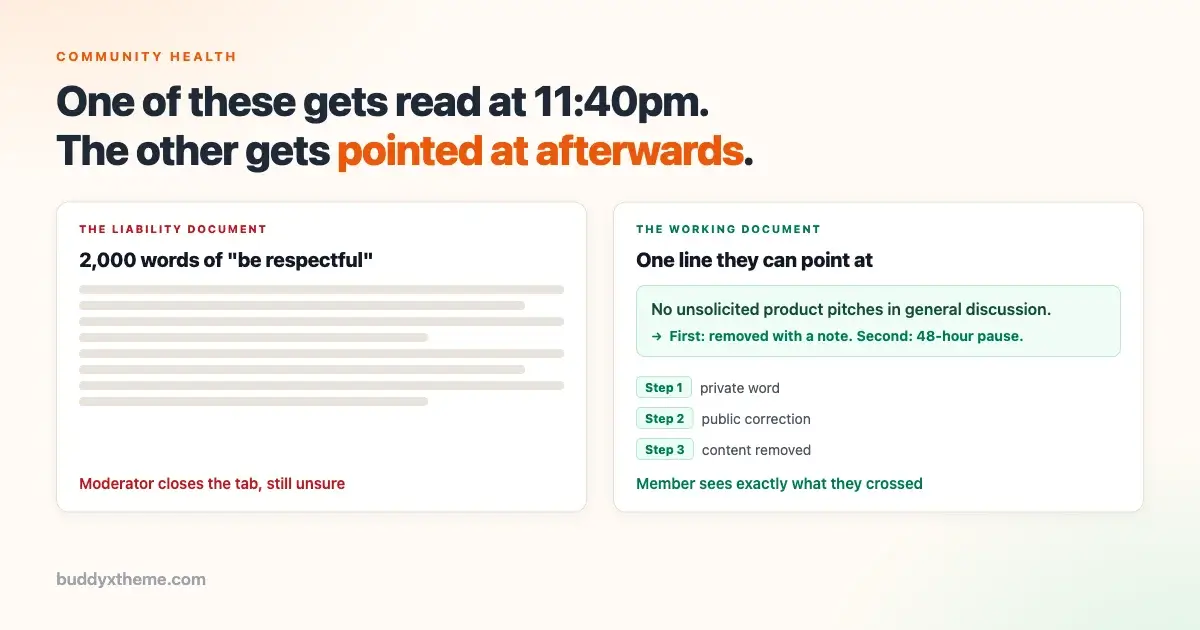
They open the code of conduct page to check, skim two thousand words of “be respectful” and “harassment will not be tolerated,” and close the tab having learned nothing about this specific post.
That moment is the real test of a code of conduct, and most of them fail it. Not because the intentions behind them are bad, but because they were never built to answer a real question at 11:40pm.
They were built to exist, to be linked somewhere, to be pointed at after the fact if a member complains that nobody warned them. That is a liability document. It protects the owner’s paper trail. It does almost nothing for the moderator staring at an actual post, or the member who got removed and wants to know why.
A code of conduct that gets used looks different. It is short enough that a moderator can hold the whole thing in their head. It is specific enough that a member can read one line and see exactly why their post crossed it. And it says, in plain terms, what happens next.
If you are running a community on WordPress, especially one built on BuddyPress with a theme like BuddyX, you already have the tools to make the rules visible at the right moments. What is usually missing is not the software. It is a document written for the situations that actually happen in your community.
When “be respectful” is not a rule
Open a typical code of conduct and you will find a familiar shape. It is written defensively, in language that sounds like it came from a legal template because it probably did.
It tries to cover every conceivable offence in the abstract: harassment, hate speech, spam, impersonation, doxxing, and a dozen other categories, each described in one sweeping sentence. It is long. Genuinely long, the kind of document nobody finishes reading even when they intend to.
The core problem is that it describes categories, not behaviour. “Be respectful” tells a member nothing about what disrespect looks like in your specific community.
Is sarcasm disrespectful? Is disagreeing loudly in a public thread disrespectful? Is posting the same question in five different spaces disrespectful, or just annoying? A document that never answers these questions has not actually set a standard. It has set a vibe, and vibes are argued about, not enforced.
The second problem compounds the first: most codes of conduct list prohibited behaviour and then stop. They never say what happens when someone does the prohibited thing anyway.
So every single incident becomes a negotiation from scratch. Does this get a warning or a removal? Does a first offence get treated the same as a fifth? Nobody knows, because the document never said, and two different moderators will reach two different answers to the exact same post.
That inconsistency is what actually erodes trust in a community, more than any individual rule being too strict or too loose. A member who gets removed for something another member did last month and kept their account is not going to read your code of conduct more carefully next time.
They are going to conclude the rules are arbitrary, and once that conclusion sets in, nothing you post afterward will undo it easily.
One honest note before going further: none of this is legal advice. A code of conduct is about how your community runs day to day, who gets a warning, who gets removed, and how members are told why. If a situation in your community has real legal exposure, that is a conversation for a professional, not a paragraph in a community document.
Three properties: short, specific, consequence-bearing
A working code of conduct has three properties that a liability document usually lacks, and none of them are complicated to describe even though they take real effort to write.
Short. A member should be able to read the whole thing in under two minutes. That is not a stylistic preference, it is the difference between a document people actually read before posting and one they scroll past. If your code of conduct needs a table of contents, it is already too long for the person it is supposed to guide.
Specific. It is written from the actual conflicts your community has had, not from a generic list of internet offences.
If your community has never once had a doxxing incident but has had a dozen arguments over unsolicited product pitches in the general discussion space, your document should say more about self-promotion than about doxxing. Specificity is what lets a moderator point at one line and a member immediately understand why.
Consequence-bearing. Every rule states, or clearly maps to, what happens when it is broken. Not “may result in action,” which tells nobody anything, but something closer to “a first unsolicited product post gets removed with a note, a second gets a 48-hour posting pause.”
When the outcome is known in advance, enforcement stops being a surprise and starts being a known process, which is calmer for everyone including the moderator doing the enforcing.
| Trait | The one nobody uses | The one that gets used |
|---|---|---|
| Length | Two thousand words, multiple sections | Under two minutes to read, fits on one screen |
| Language | Legal-sounding, abstract categories | Plain language, described in terms a new member understands |
| Source of the rules | Copied from a generic template | Built from the community’s own real incidents |
| What happens after a breach | Unstated, decided fresh each time | Named in advance, tied to an escalation step |
| Where it lives | Linked once, buried in the footer | Shown at registration, onboarding, and the report flow |
| Who reads it | Almost nobody, until there is a dispute | New members before their first post, moderators before every decision |
Write it from your own incidents, not a template
The practical way to get from the left column of that table to the right one is not to sit down and imagine every bad thing a stranger could do. It is to look backward at what has actually happened in your community and write rules that would have resolved those specific situations cleanly.
Pull your last ten moderation decisions, or your last ten reported posts if you do not have a formal decision log yet. Read them in a row.
Patterns show up fast: maybe three of them are the same self-promotion pattern in a members-only space, two are heated disagreements in a support thread that turned personal, one is a member repeatedly tagging someone who asked to be left alone. Write a rule for each pattern, in the plain language you would use to explain it to a new member over coffee.
A rule that has never once been needed in your community is noise. It might be technically true and completely irrelevant, and every irrelevant line in the document is one more reason a member skims past the part that does apply to them. Cut anything you cannot point to a real incident for, even if it feels responsible to leave it in just in case.
This does not mean starting from nothing. A template is a fine skeleton to build from, it saves you from staring at a blank page and forgetting an obvious category like harassment or hate speech.
The Contributor Covenant is the most widely used starting point for exactly this reason, and plenty of solid communities began with it. The mistake is stopping there.
A template describes conflicts that could happen anywhere. Your community’s actual conflicts are more specific than that, and the finished document needs to reflect them, not just the categories a template author imagined in the abstract.
- List your last ten moderation actions or reports, however informal the record is.
- Group them into patterns rather than treating each as a one-off.
- Write one plain-language rule per pattern, using the actual example as the mental picture.
- Only then check a template like the Contributor Covenant for categories you might have missed entirely.
- Cut anything left in the document that is not tied to something that has actually happened.
The escalation ladder
This is the piece most codes of conduct skip completely, and it is the one that does the most work. An escalation ladder is a short, ordered list of what happens as a behaviour continues or repeats, published where members and moderators can both see it.
Something like: a quiet private word first, then a public correction if it happens again, then removal of the specific content, then a temporary posting restriction, then a suspension, and only at the far end, permanent removal. The exact steps depend on your community, but the shape matters more than the labels. It should read like a staircase, not a single door marked banned.
Publishing the ladder matters for two reasons. First, it tells members in advance what they are risking, which is a fairer warning than finding out only after the fact. Second, it tells moderators where a given incident sits, which takes the guesswork and the personal negotiation out of an individual decision.
Not every breach starts at the bottom rung. A first-time sarcastic comment in a heated thread might get a quiet word. A first-time threat or targeted harassment campaign might reasonably start much higher, even at suspension.
The ladder is not a rule that everyone gets three chances no matter what they did. It is a structure for how repeated or escalating behaviour is handled, so the same person doing the same thing again moves up a rung instead of the whole conversation being re-argued from the beginning each time.
That last point is worth sitting with. Without a ladder, every incident from the same repeat member becomes its own fresh debate: was this really that bad, should we give them another chance, did we not already warn them about this.
With a ladder, the second occurrence of the same pattern has an obvious next step, which is calmer for the moderator and, honestly, fairer to the member, who already knew this was coming.
| Step | When it fits | What the member sees |
|---|---|---|
| Private word | First-time, minor, likely unintentional | A short direct message explaining what crossed the line |
| Public correction | Repeated, or happened where others saw it | A moderator reply or note visible on the thread itself |
| Content removal | The post itself is the problem, not just the pattern | The post disappears, with a brief note on why |
| Temporary posting restriction | Pattern continues after a correction | A message stating the restriction and when it lifts |
| Suspension | Serious breach, or repeated pattern after restriction | Account paused, with the specific rule cited |
| Permanent removal | Severe breach, or exhausted every earlier step | Account closed, with a final explanation on record |
Who enforces, and why consistency matters more than the rules
Even a well-written code of conduct falls apart if it is applied differently by different people. The fastest way to lose a community’s trust in its own rules is not an imperfect rule, it is watching the same behaviour get a shrug from one moderator and a suspension from another.
Three practical habits fix most of this. The first is a shared place where moderators record what they did and why, even briefly. A single line, “removed post, rule 3, second occurrence,” is enough.
Without a record, the next moderator handling a similar case has no way to match the earlier decision, and inconsistency creeps in simply because nobody remembers what was decided last time.
The second is a rule that a moderator does not rule on a thread they are personally involved in. This sounds obvious until it happens in a small community where the moderator team is also the group of people most active in the discussion. If a moderator was part of the disagreement, someone else on the team makes the call.
The third is having someone specific to appeal to. Not a form that vanishes into a queue, an actual named person or small group a member can reach when they believe a decision was wrong.
This matters even more as a community grows and moderation capacity has to be distributed across more people. Our piece on trust levels and the future of community moderation goes into how giving trusted long-standing members graduated privileges can extend enforcement capacity without diluting consistency, as long as the same shared record and the same escalation ladder apply no matter who is making the call.
None of this requires new software. A shared spreadsheet, a private moderation space inside your BuddyPress community, or even a pinned document works, as long as every moderator actually uses it before making a call rather than after.
Make it visible at the moment it matters
A code of conduct linked once in the site footer is functionally invisible. Almost nobody visits a footer to read policy documents for fun, and by the time a member is in a dispute serious enough to go looking for it, the moment where it could have prevented the problem has already passed.
The document needs to show up at the points where it can actually change behaviour or set expectations, not just after something has already gone wrong.
| Moment | Why here | What it looks like |
|---|---|---|
| Registration | Sets the expectation before the first post exists | An explicit tick box next to a short summary, not buried in terms of service |
| Welcome sequence | Read when attention is highest, in the first week | One email or message that quotes the two or three rules most likely to matter |
| The report button | Reminds the reporter what standard is being applied | A one-line link next to the report action itself |
| A moderation message | Ties the action directly to a specific, cited rule | The exact line quoted, not a vague reference to “the rules” |
| Footer or about page | A permanent, findable home for the full document | The complete code of conduct, for anyone who wants the whole thing |
The welcome sequence placement deserves particular attention, because it is the moment with the most upside that most communities waste. New members are paying close attention in their first days, before habits have formed and before they have seen how things actually work here.
Our piece on the first seven days of member onboarding covers this window in detail. Showing the code of conduct here, in plain terms, as part of a warm welcome rather than a wall of legal text at signup, is what makes it something a member actually absorbs instead of something they clicked past to reach the sign-up button.
If you are running BuddyX, this is easier than it sounds. A short custom message in your registration or activity stream welcome step, or a pinned post in a new-member space, does the job without any custom development. The theme gives you the surfaces. What is usually missing is simply deciding to put the document there instead of leaving it as a single footer link nobody clicks.
What happens when someone reports something
A code of conduct is only half the system. The other half is what happens after a member actually uses the report button, and this is where a lot of communities quietly fail even when the document itself is fine.
A member reporting something should be able to expect a few concrete things, none of which require much infrastructure to deliver:
- A clear, easy way to report, not a buried email address they have to go hunting for.
- Confidence that a real person will actually look at the report, not just log it somewhere.
- A rough sense of how long it usually takes to hear back, even if that is “within a couple of days”.
- Some kind of response, even a brief one, once it has been looked at.
The failure mode to watch for is the phrase “we will look into it,” followed by silence. That is worse than saying nothing at all, because it actively teaches the member that reporting does not lead anywhere.
The next time they see something that bothers them, they will not bother reporting it. They will quietly disengage, and disengagement is much harder to reverse than a single bad moderation decision.
This connects directly to something worth naming plainly: a badly handled moderation outcome, or a report that vanishes into silence, is one of the quiet ways members leave a community without ever announcing it.
Our piece on winning back dormant members covers a range of reasons people go quiet, and a mishandled conflict or an ignored report sits right alongside them. A clean, explained outcome, even an outcome the member does not love, is very often what keeps someone posting instead of disappearing. Uncertainty about whether anyone is even paying attention is what pushes people out the door.
You do not need a ticketing system to fix this. A moderator checking the report queue on a predictable schedule, and a short reply template (“thanks for flagging this, we reviewed it and here is what we did”) covers most of the gap. The bar is not speed, it is that the loop actually closes every time.
Lighter rules for smaller, invite-only spaces
Not every community needs the same weight of document. A large, open BuddyPress community with strangers joining daily needs clear written rules because there is no other way for a new member to learn the norms before they post. A small, invite-only group is a different situation entirely.
In a private, invite-only community, norms travel by example far more than they travel by document. New members watch how existing members behave, how disagreements get handled, what kind of posts get warm responses, and they calibrate off that, often faster than they would calibrate off a written policy.
Our piece on building a private, invite-only WordPress community covers this dynamic: the smaller and more curated the group, the more the existing culture does the work a code of conduct would otherwise have to do.
That does not mean skipping the document entirely. Even a small group benefits from having the escalation ladder written down somewhere, if only so the person running it has a clear answer ready the one time it is needed.
But it does mean the document itself can be shorter and lighter, closer to a short list of shared expectations than a formal policy. Over-formalising a twenty-person invite-only space with the same document weight as a five-thousand-member public community tends to feel cold and out of proportion to the trust already in the room.
The judgement call is proportion. Match the weight of the document to the size and openness of the group, and let the smaller spaces lean more heavily on modelling good behaviour early, since that is genuinely the stronger lever there.
Specialised spaces need their own rules
A general code of conduct rarely covers everything a specialised space inside your community needs. Question-and-answer areas are a clear example. The problems that show up there are not really about tone or harassment, they are about answer quality and self-promotion, and a generic rule about being respectful does not touch either one.
Our piece on Q&A spaces replacing support tickets gets into why these spaces work differently. Members are there to get a specific problem solved, so a low-effort answer, or an answer that is really a pitch for someone’s product, damages the space in a way that is different from a rude comment.
A Q&A space needs its own short addition: answers should actually address the question, self-promotion belongs in a specific space or a specific format (a signature line, not the body of the answer), and repeated low-effort or promotional answers move up the escalation ladder the same as any other pattern.
The general lesson extends past Q&A. Any space with its own distinct purpose, a marketplace area, a jobs board, a support forum, benefits from a short, specific addendum rather than stretching one general document to cover every kind of interaction across the whole community.
Keep the core code of conduct as the shared foundation, and let each specialised space add the two or three lines that are actually relevant to what happens there.
Keeping your code of conduct current
A code of conduct that was written well a year ago and has not been touched since is drifting toward becoming a liability document again, even if it started as a working one. Communities change, new spaces get added, new kinds of conflict show up that the original version never anticipated.
Two triggers are worth building into a routine. The first is reactive: any time an incident happens that the current document does not clearly cover, that is the signal to add a line for it immediately, while the gap is still fresh and obvious, not six months later when it has happened three more times.
The second is a routine review, on a schedule that does not depend on something going wrong first. Once or twice a year, sit down with the moderation record and ask two questions: what is the conflict that actually happened that is not reflected in the document yet, and which rules in here have never once been cited in an actual decision.
Add the first. Remove the second. A rule nobody has ever used is exactly the kind of dead weight that makes the whole document feel longer and less trustworthy than it needs to be.
This is also a good moment to check the visibility points from earlier in this piece. Is the welcome sequence still quoting the current rules, or an older version? Does the report flow still link to the right page? Small drift accumulates quietly, and a review cycle is the natural place to catch it before a member finds the gap for you.
- Add a line immediately after any incident the current document did not cover.
- Review on a routine schedule, not only when something breaks.
- Remove rules that have never once been cited in a real decision.
- Recheck that registration, onboarding and the report flow all point to the current version.
- Keep the whole document under the two-minute read, even as it evolves.
None of this needs complicated software or a formal committee. It needs someone, an owner, a lead moderator, whoever holds the relationship with the community, to treat the document as a living working tool rather than something written once and forgotten.
That is the actual difference between a code of conduct that sits in a footer collecting dust and one a moderator can point to with confidence at 11:40pm on a Tuesday, and a member can read and immediately understand.
Whether you are running BuddyX on a small invite-only group or a large public BuddyPress community, that difference is within reach, and it costs nothing but the honesty of writing from what has actually happened rather than what a template imagined might.