How Product Teams Use Community Feedback to Build What Customers Actually Want

A WordPress plugin company with 8,000 active users had a problem every product team recognizes. Feature requests arrived from everywhere: support tickets, emails, Twitter mentions, blog comments, Slack messages. The product manager maintained a spreadsheet with 340 feature requests. She had no reliable way to know which ones mattered most to the majority of users versus the handful of loud voices.
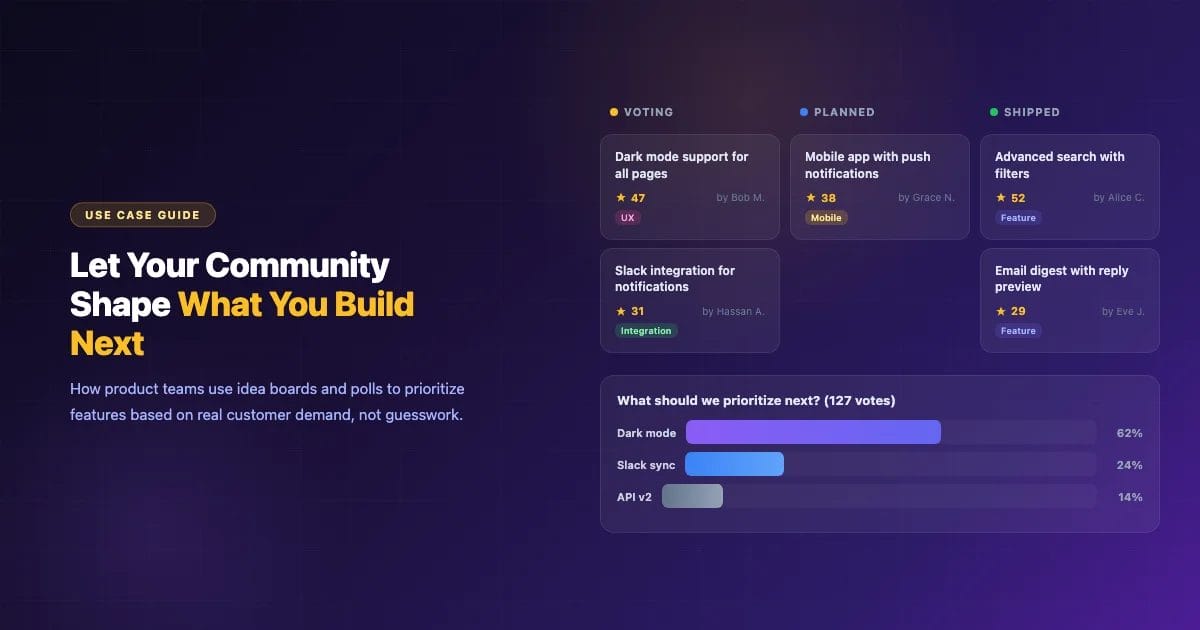
She launched an Idea Board space in their community. Within 60 days, customers had submitted 89 ideas and cast 1,200 votes. The top-voted idea had 47 votes. The feature she had been planning to build next? It had 3 votes. She changed the roadmap and built what customers actually wanted. Churn dropped 18% the following quarter.
Here is how to set up the same system for your product.
The Problem with Traditional Feature Request Collection
Most product teams collect feedback through channels that are fundamentally broken for prioritization:
| Channel | What Goes Wrong |
|---|---|
| Support tickets | Biased toward problems, not opportunities. You only hear from people frustrated enough to write. |
| Requests get lost. No way for other customers to say “me too” or vote. | |
| Social media | Public pressure creates urgency bias. A viral tweet about a missing feature is not the same as broad demand. |
| Sales calls | Prospects ask for features to close the deal. These requests may not reflect what existing customers need. |
| Internal brainstorming | You build what the team thinks is important, not what customers prove is important through behavior. |
The common thread: none of these channels let your entire customer base weigh in equally. Idea boards do.
How Idea Boards Solve This
An idea board is a community space where members submit suggestions, vote on what matters most, and see transparent status updates as ideas move through your pipeline.
The Workflow
- Customer submits an idea with a title and description. Before submitting, they see existing ideas and can vote on those instead of creating duplicates.
- Other customers vote. Each customer gets one vote per idea. The most wanted features rise to the top organically.
- Your team reviews. Sort by vote count to see what the community actually wants. Read the discussion on each idea for context.
- You update the status. Mark ideas as Under Review, Planned, In Progress, or Shipped. Customers who voted get notified at each stage.
- You ship the feature. When the status changes to Shipped, every voter sees it. They know their input shaped the product.
Why Voting Beats Surveys
Surveys capture a snapshot. Idea boards capture ongoing, real-time demand. A survey asks “which of these 5 features do you want?” An idea board lets customers define the options themselves and vote continuously. New ideas can emerge at any time, and votes accumulate over months, giving you a clear signal that improves with more data.
Setting Up Your Product Feedback Community
Step 1: Create Your Spaces
Install Jetonomy and create three spaces:
- Feature Requests (type: Ideas) – the core idea board with voting and status tracking
- Product Discussion (type: Forum) – general conversations about your product, use cases, workflows
- Help & Support (type: Q&A) – separate support questions from feature requests to keep both clean
The separation matters. When feature requests and support questions live in the same forum, both suffer. Support questions drown out feature discussions, and frustrated customers post bug reports as feature requests. Dedicated spaces keep each conversation type focused.
Step 2: Define Your Status Workflow
Configure idea statuses that match your development process:
| Status | What It Means | Who Changes It |
|---|---|---|
| New | Just submitted, open for voting | Automatic |
| Under Review | Your team is evaluating feasibility | Product manager |
| Planned | Approved and on the roadmap | Product manager |
| In Progress | Development has started | Engineering lead |
| Shipped | Live in the product | Product manager |
| Not Planned | Declined (with explanation) | Product manager |
The “Not Planned” status is as important as “Shipped.” Closing ideas with a clear explanation (“We considered this but it conflicts with our privacy architecture”) builds more trust than leaving ideas open indefinitely with no response.
Step 3: Seed with Known Requests
Go through your existing feature request backlog and create the top 15-20 as ideas in the board. This gives customers something to vote on immediately and validates (or invalidates) your existing assumptions about what matters.
You will be surprised. Features you thought were critical may get 2 votes. Features you dismissed as niche may get 40. Let the data speak.
Step 4: Add Polls for Quick Decisions
Idea boards are great for open-ended “what should we build” questions. Polls (available in Jetonomy Pro) are better for specific “which approach should we take” decisions:
- “We are adding dark mode. Should it be: auto (follows system) / manual toggle / always dark?”
- “Which integration should we build first: Slack, Discord, or Zapier?”
- “How important is mobile app support to you? (1-5 scale)”
Polls give you fast, quantitative answers when you need to decide between options. Idea boards give you qualitative insight into what to build. Use both.
Step 5: Make It Visible
An idea board nobody knows about is useless. Put it where customers naturally go:
- In-product link: Add a “Request a Feature” link in your product’s sidebar or help menu that goes directly to the idea board
- Support response: When a customer emails a feature request, reply with “Great idea! Submit it to our community board so others can vote” with a direct link
- Changelog cross-reference: When you ship a feature, link back to the original idea: “This was the #3 most voted idea in our community”
- Product footer: A persistent “Suggest a Feature” link alongside “Contact Support” and “Documentation”
The Product Manager’s Dashboard
Once your idea board has been running for 2-3 months, you have a product planning dashboard that no other tool provides:
- Top voted ideas = what your customers want most (sorted by votes)
- Most discussed ideas = what generates the strongest opinions (sorted by replies)
- Recently submitted = emerging needs you haven’t seen before
- Idea sentiment = read the discussion to understand WHY customers want something, not just WHAT they want
- Shipped ideas = your public track record of listening to customers
This is product research that costs nothing, runs continuously, and gets more accurate over time as more customers participate.
The Trust Factor
Customers who see their ideas get implemented (or clearly explained why they were not) develop a level of trust that no marketing can replicate. They become advocates because they experienced your responsiveness firsthand.
The companies that do this well – Notion, Linear, Discourse – have fanatically loyal customer bases partly because their users feel genuine ownership over the product’s direction. An idea board on your WordPress site gives you the same dynamic.
Real Impact Numbers
| Metric | Before Idea Board | After 6 Months |
|---|---|---|
| Feature requests via email | 45/month | 8/month (-82%) |
| Duplicate requests | ~60% duplicates | Under 5% (voters join existing ideas) |
| Time to prioritize roadmap | 2-week quarterly process | Real-time (sort by votes) |
| Customer confidence in roadmap | Low (“they never listen”) | High (“I voted and they built it”) |
| Features built that flopped | 3 of 8 (38%) | 0 of 6 (0%) |
| Quarterly churn rate | 11% | 9% (-18%) |
The “features that flopped” metric is the most valuable. Building a feature nobody wants costs $20,000-100,000 in engineering time. An idea board that prevents even one flop per year pays for itself many times over – and Jetonomy’s idea boards are free.
Common Objections (and Why They Are Wrong)
“Our customers won’t participate.” They are already requesting features through email and support tickets. You are just giving them a better channel. Participation rates of 15-25% of active users are typical within 3 months.
“We will get overwhelmed with bad ideas.” That is what voting solves. Bad ideas get 0-2 votes and sink. Good ideas surface naturally. You only need to pay attention to the top 10-15.
“What if customers vote for something we can’t build?” Mark it as “Not Planned” with an explanation. Transparency builds more trust than silence. Customers respect honest “no” more than being ignored.
“Competitors will see our roadmap.” Your roadmap visibility is a feature, not a bug. Customers choose vendors who are transparent about direction. And competitors already know what features you lack from your public reviews.
Get Started
Create an Ideas space in Jetonomy (free). Seed it with 15 feature requests from your backlog. Add a “Suggest a Feature” link to your product. In 60 days, you will have better product insight than any survey or analytics tool can provide.
Related Reading: