
Running a WooCommerce store and a BuddyPress community as two disconnected pieces means members shop on one part of your site and interact on another, with no link between the two. Connecting them puts order history, downloads, and shipping details directly on a member’s profile, right alongside their activity feed and connections.

I’ve set this up on stores that started as two separate installs, WooCommerce for selling, BuddyPress bolted on later for community features, and the difference once they’re actually connected is bigger than the setup effort suggests. Members stop treating the shop and the community as two different websites that happen to share a login. The whole site starts feeling like one coherent experience instead of two plugins loosely coexisting under the same domain.
What Connecting WooCommerce to BuddyPress Actually Gets You
The plugin that does this requires no configuration beyond activation, it works out of the box with sensible defaults. Billing and shipping addresses end up living on the member’s profile itself rather than a separate WooCommerce account page buried elsewhere in the site’s navigation. Members can also reach their cart directly from their profile instead of navigating back through the shop to find it.
Past orders and downloads show up right on the profile too, visible without digging through old email receipts trying to remember what was purchased and when. Order tracking works by order number, pulled up directly from the member’s account rather than requiring a separate lookup tool. And purchases and reviews can post to the community activity stream automatically, so other members see a new purchase or review the same way they’d see any other activity update.
Members get individual control over this too. Each person chooses whether their own purchases and reviews show up in the activity stream at all, which matters for anyone who’d rather keep their shopping private from the rest of the community. Behind the scenes, registration and checkout information stays consistent between WooCommerce and BuddyPress without any manual syncing required. And if BuddyPress ever gets disabled, or a shopper isn’t logged in when they visit, the plugin falls back gracefully to standard WooCommerce pages instead of breaking the checkout flow.
The Plugin That Does This: BuddyPress WooCommerce Integration
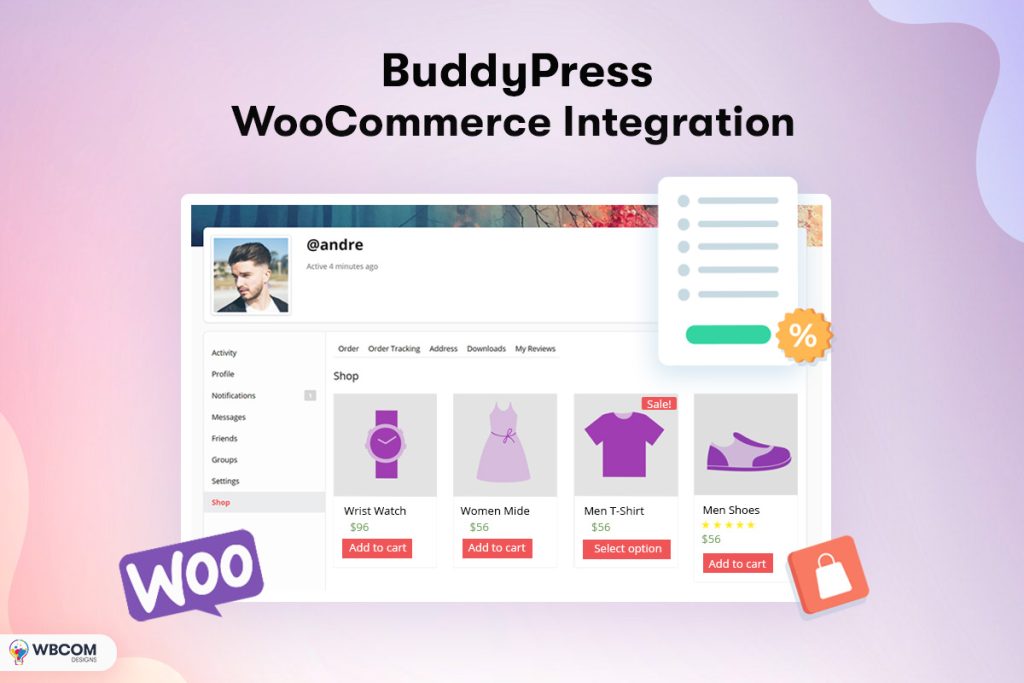
BuddyPress WooCommerce Integration is a free plugin that adds WooCommerce tabs directly to member profile pages, letting members manage orders without leaving their profile. Admins control which tabs show up, so you’re not stuck with every feature exposed if only a subset makes sense for your community. It’s still actively maintained by Wbcom Designs and works with both BuddyPress and BuddyBoss Platform, which matters if your community has already standardized on one or the other.
What Admins Can Do
From the admin side, you can enable or disable individual WooCommerce tabs on member profiles depending on what actually makes sense for your store. Rename tab labels to match your site’s voice rather than using the plugin’s generic defaults. And change tab URL slugs if you want the profile URLs to read a specific way for SEO or branding consistency with the rest of your site.
What Members Can Do
On the member side, the core capability is viewing order details directly from their BuddyPress profile instead of hunting through a separate account area. They can track an order using the order ID and billing email without needing to dig up an old confirmation message. And they can add and edit billing and shipping addresses right there on the profile, keeping their commerce information in the same place as everything else about their account.
Configuring It From the Backend
Go to WordPress Dashboard > WB Plugins > BuddyWoo Integration Plugin Settings. There are three settings groups: general, labels, and activity, each covering a different layer of how the integration behaves.
General Settings
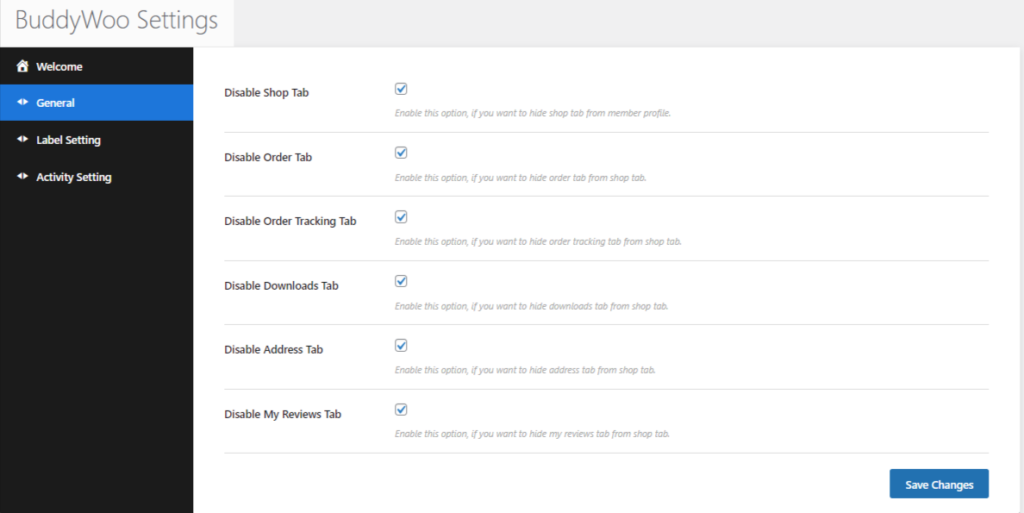
Turn each front-end tab on or off individually here: shop, orders, order tracking, downloads, addresses, and reviews. This is where you decide what actually shows up on a member’s profile, and it’s worth being deliberate rather than leaving every tab enabled by default. A community that doesn’t sell digital products, for instance, gets little value from a Downloads tab cluttering the profile.
Label Settings
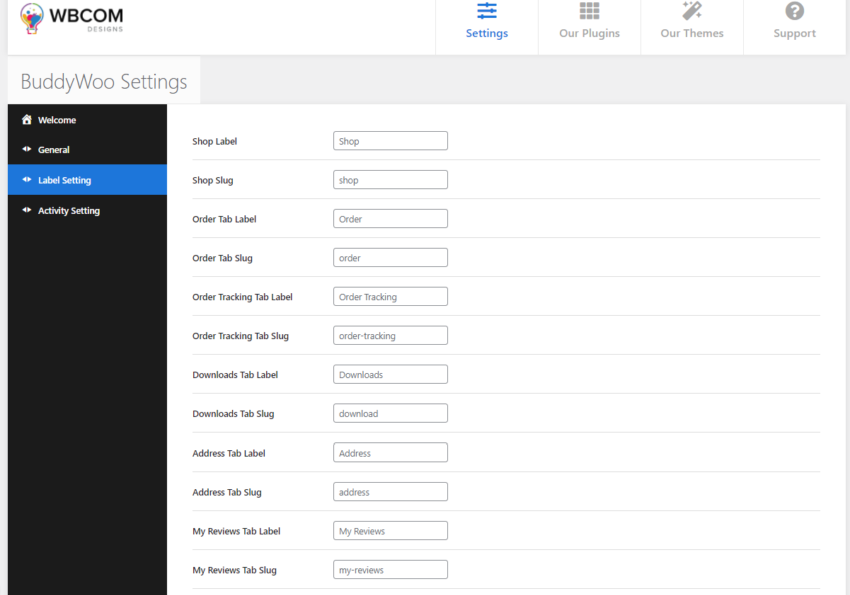
Rename and change the URL slug for the shop tab and each WooCommerce subtab, orders, order tracking, downloads, reviews, and addresses. If your community uses different terminology than the plugin’s defaults, “Marketplace” instead of “Shop,” for example, this is where that adjustment happens.
Activity Settings
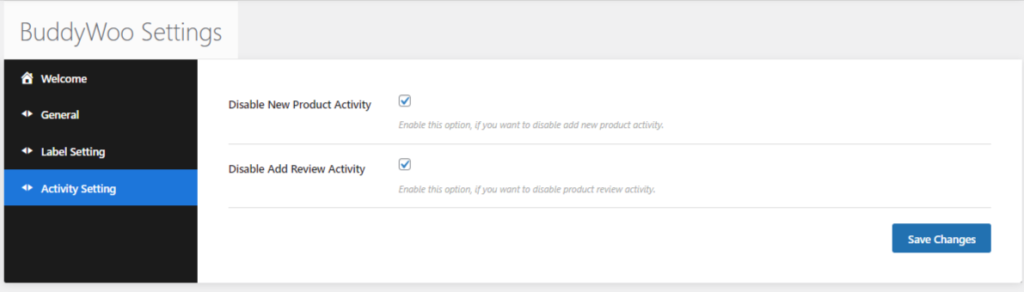
Product-creation and review activity are enabled by default, when a member creates a product listing or reviews a product, that shows up in the activity stream automatically. Turn this off here if you don’t want commerce activity mixed into the general community feed. Some communities prefer keeping shopping and social activity visually separate, and this setting is where you make that call.
What Members See on the Front End
The plugin adds a Shop tab to each member’s profile, and that single tab is where all the commerce functionality lives from the member’s point of view.
Shop Tab
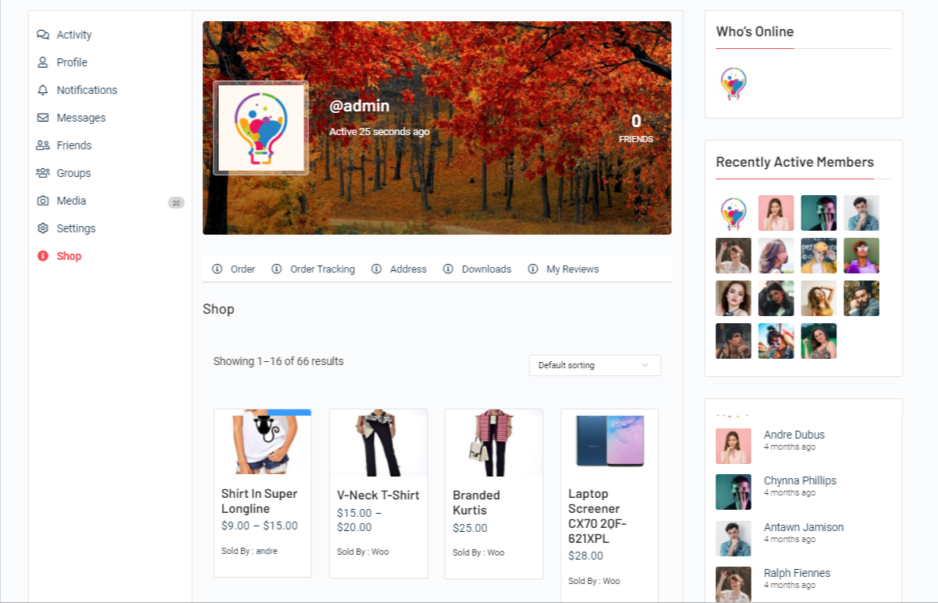
Lists products directly on the profile page, so members can buy without leaving it. Five subtabs live underneath: Orders, Order Tracking, Downloads, Addresses, and My Reviews, each covering a specific piece of the member’s commerce history.
Orders
Order ID, date, status, and total for every order the member has placed, laid out as a straightforward list rather than requiring a click into each individual order just to see its status.
Order Tracking
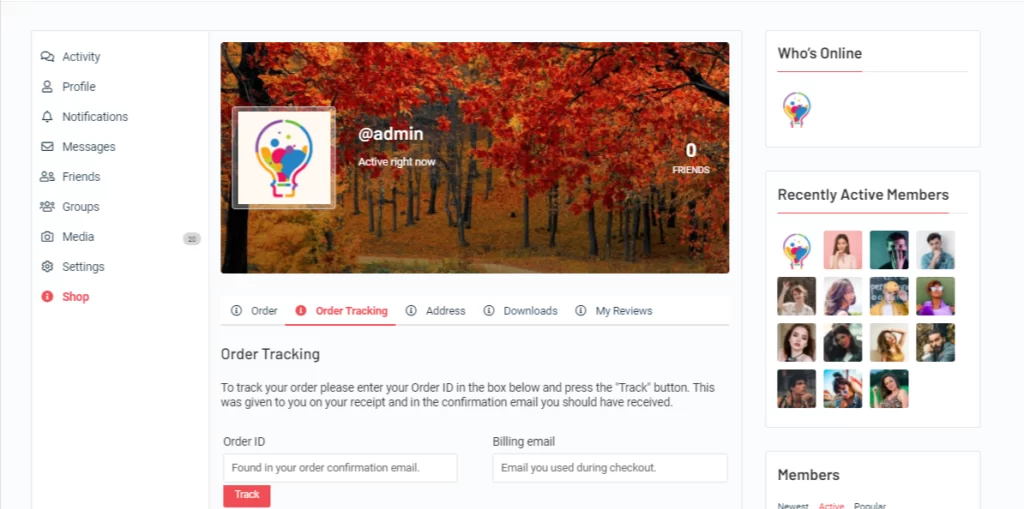
Members enter an order ID and billing email under Profile > Shop > Order Tracking to pull up billing address and current order status, useful for checking on an order without searching through email for a confirmation message that might already be buried under a week of other messages.
Addresses
Billing and shipping addresses, editable directly from the profile rather than through a separate account settings page most members would forget existed.
Downloads
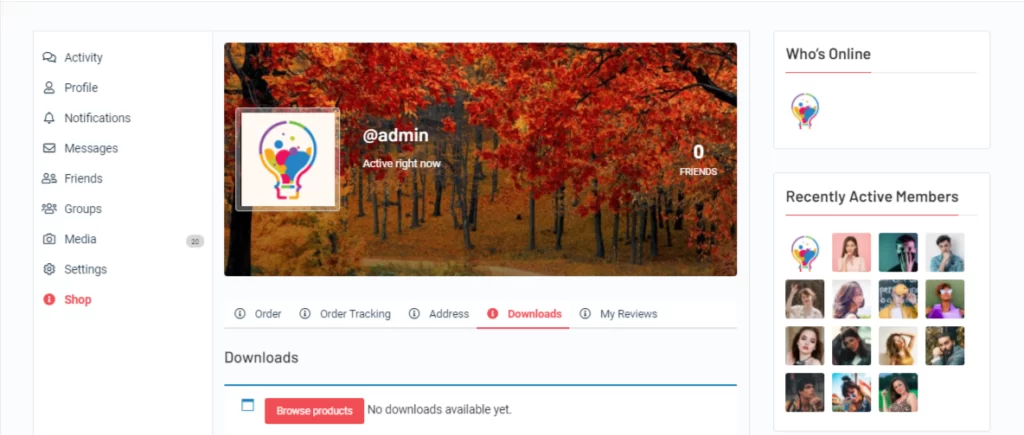
Every digital product the member has purchased, with the ability to browse for more from the same screen rather than getting redirected away from their profile entirely.
My Reviews
Every review the member has left, kept in sync with the product review system, new reviews appear here as soon as they’re submitted without any delay or manual refresh needed.

Why This Matters More Than It Sounds
On the surface, moving order history and addresses onto a member’s profile sounds like a minor convenience. In practice, it changes how members relate to the store. A separate WooCommerce account page feels transactional, a place you visit only when you need to check on a shipment. A profile tab, sitting right next to the activity feed and connections a member already checks regularly, feels like part of the community rather than a bolted-on checkout system.
There’s also a discovery angle. When purchases and reviews surface in the activity stream, other members see real product usage happening around them, not just marketing copy pushed from the store owner. That kind of organic visibility tends to carry more weight than a banner ad ever will, precisely because it’s coming from people the member already knows and trusts within the community. A new product announcement from the store owner competes for attention with everything else in a member’s inbox. A friend’s purchase showing up in the activity feed doesn’t compete for attention the same way, it’s already part of the feed the member checks daily anyway.
Common Setup Mistakes
Enabling every tab without thinking through what your specific community actually needs is the most common one. A community with no digital products doesn’t need a Downloads tab cluttering the profile, and a store that doesn’t run a review system gets nothing from the My Reviews tab beyond visual noise. Walk through the general settings deliberately rather than leaving everything on by default.
Skipping the activity settings review is another. Some communities genuinely want purchases and reviews flowing into the main activity feed as social proof. Others find it clutters a feed meant for genuine community conversation. There’s no universally correct answer here, it depends entirely on what kind of community you’re running, but it’s worth a deliberate decision rather than accepting whatever the plugin defaults to.
Not testing the fallback behavior is a mistake that only shows up when something goes wrong. Confirm that a logged-out shopper, or a scenario where BuddyPress gets temporarily disabled, still lands on a functional WooCommerce checkout rather than a broken page. This is exactly the kind of edge case that never comes up in normal testing but absolutely will happen eventually on a live site with real traffic.
Compatibility With BuddyBoss Platform
A lot of community sites run BuddyBoss Platform rather than stock BuddyPress, since BuddyBoss layers a more polished front-end experience and mobile app support on top of the same underlying architecture. This integration plugin works with both, which matters if you migrated to BuddyBoss at some point and were worried a WooCommerce integration built for plain BuddyPress might not carry over cleanly.
Test the profile tabs specifically after activation if you’re on BuddyBoss, since BuddyBoss’s own profile layout customization can occasionally shift where a plugin’s tabs render relative to native BuddyBoss tabs. It’s rarely a real conflict, more a visual ordering question worth confirming once rather than assuming it’ll look right by default. A five-minute click-through as a test member account settles the question either way.
Performance Considerations
Adding order and product data to every member’s profile page does mean an extra query or two runs whenever that profile loads, though the impact is generally minor for communities under a few thousand active shoppers. If your community runs into the thousands of active buyers with heavy order histories, keep an eye on profile page load times specifically, since that’s where any performance impact from this integration would show up first.
A caching plugin that handles logged-in user pages correctly helps here, though standard page caching often skips logged-in views by default since profile content is inherently personalized. If profile load times become a real concern at scale, object caching for the underlying WooCommerce queries tends to help more than page-level caching, which usually can’t apply cleanly to a personalized profile view anyway.
Frequently Asked Questions
Does this plugin cost anything?
No, BuddyPress WooCommerce Integration is a free plugin from Wbcom Designs, with no premium upsell required for the core functionality described here.
Will this work with my existing WooCommerce store’s product catalog?
Yes, the plugin pulls directly from your existing WooCommerce order and product data. There’s no separate catalog to maintain or sync manually, it reads the same data your store already runs on.
Can I hide the Shop tab for specific member roles?
The plugin’s settings control tab visibility globally by default rather than per role out of the box. If you need role-specific visibility, that typically requires a small custom filter, worth checking the plugin’s documentation or support channel for the specific hook if this is a hard requirement for your community.
What happens to existing order history when I activate the plugin?
Nothing changes about the underlying WooCommerce data. The plugin simply surfaces existing orders on the member’s profile, it doesn’t migrate, duplicate, or alter any order records. Deactivating the plugin later leaves your WooCommerce order data completely untouched as well.
Is this integration reversible if I decide it’s not for my community?
Yes, deactivating the plugin removes the profile tabs and reverts members to standard WooCommerce account pages. No data gets deleted in the process, so there’s low risk in testing this on a staging environment before deciding whether it fits your specific community’s needs.
A Realistic Rollout Plan
If your community already has an active member base and an existing WooCommerce store, don’t flip this on for everyone at once without a heads-up. A member who’s used to checking orders through a separate account page will notice the change, and a short announcement post explaining the new profile tabs prevents confused support tickets asking where the old order page went.
Give it a week running on a staging copy of the site first if you can spare the time. Walk through every subtab as both an admin and a test member account, confirm addresses save correctly, confirm order tracking pulls the right data, and confirm the activity stream behaves the way you configured it. A week of staging testing catches far more than an hour of manual clicking through the admin settings panel alone, and it gives you time to catch a misconfigured label or a tab nobody actually wants before real members ever see it.
Once it’s live, don’t disappear and assume the rollout is finished. Watch the activity stream for the first few days specifically. This is where unexpected behavior tends to surface first, a review activity posting with formatting that looks off, or a purchase notification appearing when a member expected it to stay private. Catching that early, while it’s still a small number of posts, is far easier than untangling a feed full of oddly formatted commerce activity after weeks of members using the integration.
When This Integration Isn’t the Right Fit
Not every community-plus-store setup benefits from merging order data into the profile. A store with a huge, mostly anonymous customer base where community features are a minor add-on, rather than the core of the site, might not see much value from surfacing purchase history on a profile few of those customers ever visit. The integration shines specifically where the community is the primary draw and commerce is layered on top, member-run marketplaces, creator communities selling digital products, niche hobby groups with a branded merch store.
If your store and community genuinely operate as two separate audiences with minimal overlap, the setup and testing effort described here may not pay off proportionally. Know your own audience before assuming this integration is automatically worth adding, since the value comes specifically from members who already engage with both sides of the site. A quick look at how many current customers also hold active community accounts tells you most of what you need to know before committing the setup time.
Getting Started
BuddyPress WooCommerce Integration is a small, free plugin, but it removes a real point of friction: members shouldn’t have to leave their community profile to check an order. If you’re building the site from scratch, BuddyX is a free theme built for exactly this kind of community-plus-commerce setup, with BuddyX Pro and Reign available if you need more advanced layout options.
Start with the plugin’s default settings, run through a real test purchase from a test account, and only then start customizing labels and tab visibility to match your specific community. That order of operations, working defaults first, customization second, catches configuration issues before they compound into something harder to untangle once real members start relying on the integration daily.