
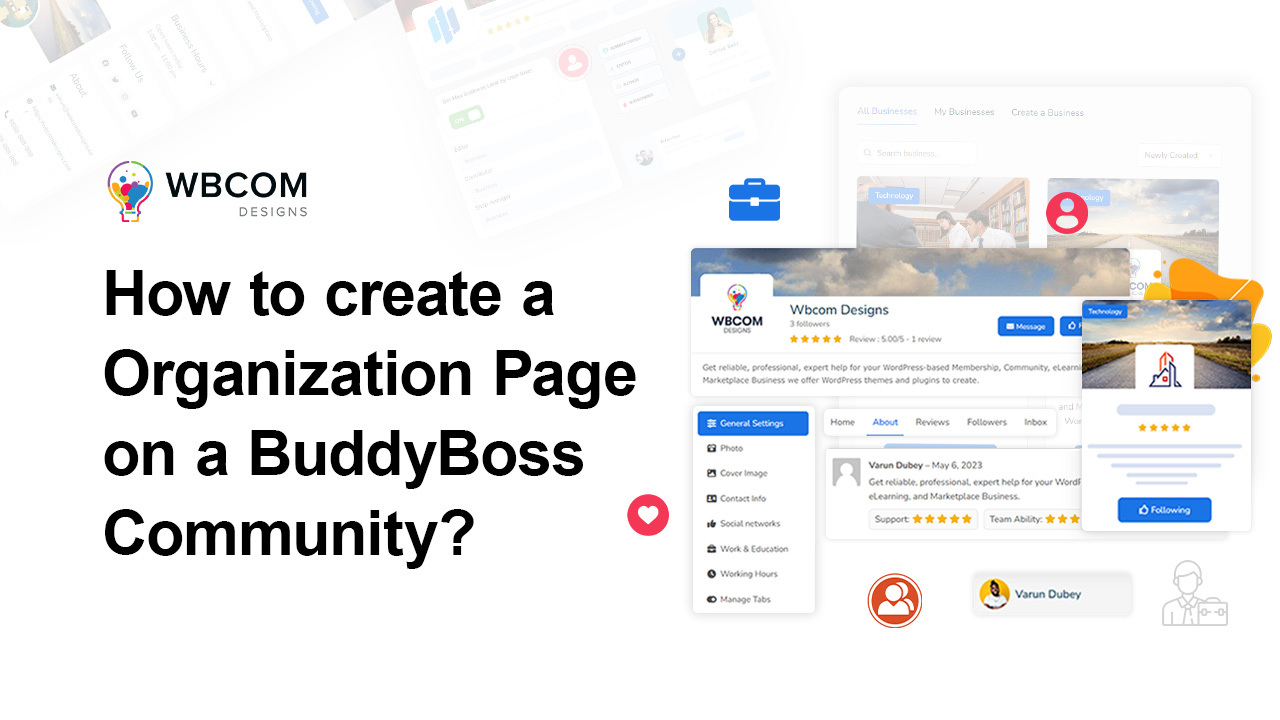
A nonprofit, association, or any organization running a BuddyBoss community needs a page that represents the group itself, not any one member, a place for mission statements, updates, and volunteer recruitment separate from personal profiles. Here’s how to build one, and how to keep it from turning into a page that goes live once and never gets touched again.
What BuddyPress Business Profile Does
BuddyPress Business Profile provides this, functioning like a Facebook Page inside your BuddyBoss site. The same underlying page type covers businesses, organizations, fan pages, and more, category is what tells them apart.
Current version (v2.1.0):
- Customizable profile fields, logo, cover image, contact info, social links.
- A dedicated activity feed, separate from personal member activity, with comments and likes.
- Private messaging via a per-page inbox.
- Role management, admins, editors, moderators, with control over who can create, edit, or delete pages.
- Public, private, or hidden visibility per page.
- Reviews and star ratings, a searchable directory with map view, and LocalBusiness SEO schema.
Requirements
An existing BuddyPress or BuddyBoss community, PHP 7.2+, WordPress 5.0+. Works on Chrome, Firefox, and Safari, and is responsive across devices.
Organization Page vs. a Group You Already Run
Since BuddyBoss already has groups, it’s worth ruling those out first before setting up a separate page. A group is built around member-to-member discussion, a space where people talk to each other around a shared interest, with the organization more as facilitator than as the thing being represented. An organization page is different: it represents the group itself to the entire community, members and non-members browsing the directory alike, with its own feed, reviews, and public follower count.
Groups also don’t have a reviews system, don’t generate LocalBusiness schema for search visibility, and don’t offer the branding controls a page gets. Nothing stops an organization from running both, a page as the public-facing presence and a group as a more focused space where members who care most can actually discuss the work, and for an organization with any real member engagement, that combination tends to work better than either alone.
Setting Up an Organization Page
Install and activate the plugin, then click Create a Business.
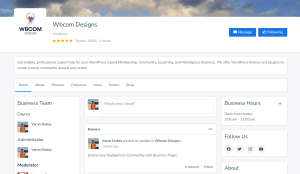
Enter the organization’s name, a short description, and a category. Click Create Business and Continue, upload a logo, then a cover image, and the page is live. Content, updates, and volunteer/job listings can be added any time afterward.
Building Out the About Tab Beyond the Basics
A page that goes live with just a name and logo technically works, but it doesn’t do much to establish credibility with someone landing on it for the first time. The About tab’s repeater fields let you break the organization’s work into distinct entries, individual programs, past campaigns, notable partnerships, each with its own short description rather than one dense paragraph trying to cover everything at once.
Photos attached to each entry make a real difference. A list of program names with no visuals reads like an internal document, while even one photo per entry, volunteers at an event, a completed project, gives a visitor something concrete to look at rather than just names and dates.
Transparency: What to Put Front and Center
Nonprofits and associations face a specific credibility question a typical business page doesn’t: visitors and potential donors often want some sense of how the organization actually operates before engaging further, not just what it says it does. This doesn’t require publishing full financials on the profile itself, but linking out to an annual report, a registered charity number, or a governance page, wherever that already lives, is worth doing prominently rather than burying it.
A page that only ever talks about impact in vague terms, “making a difference,” “changing lives,” without ever pointing to something concrete, a specific program, a specific number of people served, a specific outcome, reads as less credible to a skeptical visitor than one that’s comfortable being specific. This matters more for an organization than for a typical business page, since the ask being made, a donation, volunteer time, isn’t backed by a direct product exchange the way a purchase is.
Handling Messages Without One Person Becoming the Bottleneck
The private inbox is genuinely useful for donor, volunteer, and general public inquiries, but it doesn’t scale to one person forever. Role management exists for this: assign a staff member or communications volunteer to handle day-to-day inbox and comment moderation, escalating anything that genuinely needs a director’s or board member’s personal attention rather than routing everything through one inbox by default.
Set this up before message volume becomes a problem, not after a backlog has already built up. A page with slow or inconsistent replies undercuts the trust an organization is trying to build with supporters, and unclear ownership tends to leave a page either neglected or bottlenecked on one overloaded person.
Posting Updates That Give Supporters a Reason to Check Back
An organization page’s activity feed is the clearest public signal of whether the group is actually active. A visitor who lands on a polished About tab but a feed with nothing posted in months draws an obvious conclusion, fair or not, and there’s no way for them to know the organization is busy doing real work if the page itself looks abandoned.
This doesn’t require daily posting. A steady, modest cadence, a program update, a volunteer spotlight, a photo from a recent event, once every week or two reads as far more active than sporadic bursts followed by long silence. Assign this to a specific person with a recurring reminder rather than relying on someone remembering to post whenever things happen to be quiet.
Reviews and Endorsements: An Underused Trust Signal
The reviews tab is easy to overlook for an organization page since it wasn’t originally designed with nonprofits in mind, but it functions well as a place for testimonials from people the organization has actually helped, or from long-time volunteers describing what working with the group is like. A page with a handful of specific, genuine testimonials reads as more established than one with none, the same effect that makes reviews valuable for a business, repurposed here.
Ask for these naturally rather than as a blanket campaign, a follow-up message to a volunteer after a successful event, a check-in with a program participant some time after they’ve been helped. A testimonial that names something specific, a program, a moment, an outcome, does more for credibility than a generic “great organization” line, so it’s worth a gentle prompt toward specifics when asking.
Extending the Rest of Your Community
Wbcom Designs’ broader lineup:
- BuddyPress Member Type (free), custom member classifications, useful for separating staff, volunteers, and general members.
- BuddyPress Member Blog / Member Blog Pro (free / from $49), frontend blogging, handy for volunteer field reports or program updates.
- BuddyPress Check-ins / Check-ins Pro (free / from $49), location tagging with maps on Pro, useful for organizations running events at multiple sites.
- BuddyPress Statistics (from $49), activity and engagement tracking.
See the full Wbcom Designs catalog for the rest.
Volunteer and Job Listings: When the Extra Setup Pays Off
Organizations that regularly recruit volunteers or post open roles get more out of listing specific opportunities directly through the page than posting a generic “we need help” update and hoping someone follows up. Keeping discovery, application, and eventual involvement inside the same platform members already use removes friction compared to linking off to a separate recruitment site.
This is worth the setup time for a recurring need, ongoing volunteer shifts, a rolling hiring process, seasonal event staffing, but it’s more overhead than it’s worth for a single one-off ask. For an organization with a steady recruitment pipeline, though, the reduced friction tends to convert better than sending an interested volunteer somewhere else to fill out a form they may never finish.
Before the Public Announcement
Treat the actual public unveiling as a small event rather than something that happens automatically the moment the page is technically live. Confirm every field that’s supposed to be filled in actually is, test the inbox by sending a message from a separate account, and check how the page renders on mobile, a meaningful share of supporters will click through from a phone rather than a desktop.
Have a handful of activity-feed posts ready before the first announcement. A brand-new page with an empty feed reads as unfinished even if the About tab is already polished, while three or four posts already up gives an arriving supporter something to engage with right away. Coordinate the announcement with whatever other channels the organization already uses, an email newsletter, social accounts, a printed newsletter for supporters who aren’t online-first, rather than treating the BuddyBoss page as an isolated launch.
Onboarding Your Board or Staff, Not Just One Founder
The person who sets this page up is rarely the same person managing it long-term. It’s often one staff member or volunteer at launch, and ideally a small team once the organization’s presence grows. Design onboarding with that in mind, a short written walkthrough or a quick screen-recorded tutorial covering the relevant fields saves a lot of repeated questions compared to expecting each new person to figure out the interface from scratch.
Include who to contact if something breaks. A clear internal support path matters more here than for an individual member’s profile, since a visible problem on the organization’s page reflects on the whole group, not just whoever happened to be managing it that week.
Writing a Mission Statement That Actually Gets Read
The main description field is the highest-traffic piece of text on the page, most visitors read it before anything else, so it deserves more care than it usually gets. A common mistake is treating it like formal grant-application language, dense with jargon and passive voice, when a more direct, conversational tone, still credible, but written like something a real person would say to a new supporter, tends to hold attention better.
Two or three tight paragraphs beat one long one, both for scannability and because the plugin’s search index weighs this field, clear, natural writing tends to outperform a dense, keyword-stuffed block. Update it periodically as programs shift, a mission statement that hasn’t been touched in two years reads as neglected even if everything else is current.
Coordinating a Page Run by Rotating Volunteers
Unlike a business with a stable owner, many organizations rely on volunteer leadership that turns over regularly, a communications role handed off every year or two as people’s availability changes. That turnover is a real risk to page consistency if there’s no documentation, each new volunteer effectively starting from scratch, reinventing tone, forgetting where certain settings live, or letting the page go quiet during the handoff gap.
A simple, living handoff document, login access process, key settings, tone guidelines, a short history of what’s worked and what hasn’t, turns each transition from a full restart into a smooth continuation. This is a small amount of upfront documentation work that pays for itself every single time leadership changes, which for many volunteer-run organizations is more often than you’d expect.
Choosing Visibility: Public, Private, or Hidden
Public visibility fits most organization pages, since discoverability, supporters and volunteers finding the page through search or the directory, is usually the whole point. Private visibility suits a smaller or more closed group, an internal association wanting a members-only presence rather than open public reach.
Hidden visibility mostly makes sense during setup itself, building the page out fully before any announcement, rather than as a long-term state. A hidden page forfeits the search and directory visibility that’s the main reason to use this plugin over a plain member profile, so treat it as temporary staging, not a permanent configuration.
Cover Image and Logo: What Sets the Tone
Before a visitor reads any of the mission statement, they’ve already reacted to the logo and cover image. A stretched or low-resolution logo, or a generic stock photo that could belong to any cause, undercuts a page that might otherwise be well written and actively managed. A genuine photo, volunteers at work, a program in action, a completed project, does more to establish legitimacy in the first few seconds than the rest of the page combined.
This doesn’t require professional photography, a clear, well-lit photo from an actual event or program beats a polished but generic stock image every time. Swap it out when it stops reflecting current work, an old cover photo from a wrapped campaign years back sends a quietly stale signal even if the rest of the page is active.
Keeping the Page Current
A page set up once and left alone drifts, finished programs still listed as active, an old contact number, a cover image from an event years past. None of this breaks the page technically, but it erodes credibility gradually, and there’s no error message flagging it, just a supporter noticing the content feels stale.
A light quarterly review, checking the programs section for anything that’s wrapped up or newly launched, confirming contact and social-link fields still point to active channels, refreshing the cover image if it’s tied to a past event, keeps the page feeling maintained without demanding constant attention. Fold this into whoever’s already managing the inbox rather than creating a separate task nobody owns.
Frequently Asked Questions
Can the page be verified so supporters know it’s authentic? The plugin doesn’t include a built-in verification badge. Communities handle this at the policy level, either restricting page creation for known organizations to admin-only setup, or applying a manually managed verified indicator communicated through onboarding materials.
Does this help with local or cause-related search visibility? Yes, the LocalBusiness schema markup applied automatically gives search engines more structured information than a standard personal profile carries, which can help visibility for relevant local or cause-related searches.
Can multiple staff members manage the same page at once? Yes, role management supports multiple assigned managers with different permission levels, each keeping their own login, so a team can share responsibility without sharing credentials.
What happens if the organization stops being active in the community? The page persists until someone with admin or owner access deletes or deactivates it. Communities should have a clear offboarding process for this rather than leaving a stale, unmanaged page live indefinitely.
Is there a limit on how many organization pages a site can host? No fixed limit, though a site owner can configure per-role limits to prevent spam pages on a large open community.
Can the page be linked to a group the organization also runs? There’s no automatic linking between a Business Profile entry and a BuddyBoss group, but you can cross-reference them manually, a link to the group in the page’s About section, and a mention of the page in the group’s description.
Can a page list both volunteer opportunities and full-time job openings in the same place? Yes, there’s no structural distinction between the two, both are listed as roles the organization is recruiting for, so a page can mix ongoing volunteer shifts alongside paid staff openings without needing separate sections or plugins.
Does the plugin support recurring donation links or is that a separate integration? Business Profile itself handles the presence layer, feed, reviews, messaging, contact info, rather than payment processing. For an actual donation flow, pair the profile with whatever donation or payment tool the organization already uses elsewhere and link to it clearly from the About section and activity feed.
BuddyPress Business Profile pricing: $59/year (1 site), $129/year (5 sites), $299/year (unlimited), plus lifetime licenses. Every tier includes the same feature set described above.
Interesting Reads:
How to Create a Organization Profile on a BuddyBoss Community?
How Can We Create a Job Listings Section on a BuddyPress Website?
How to Create an Alumni Platform with BuddyPress and WordPress