
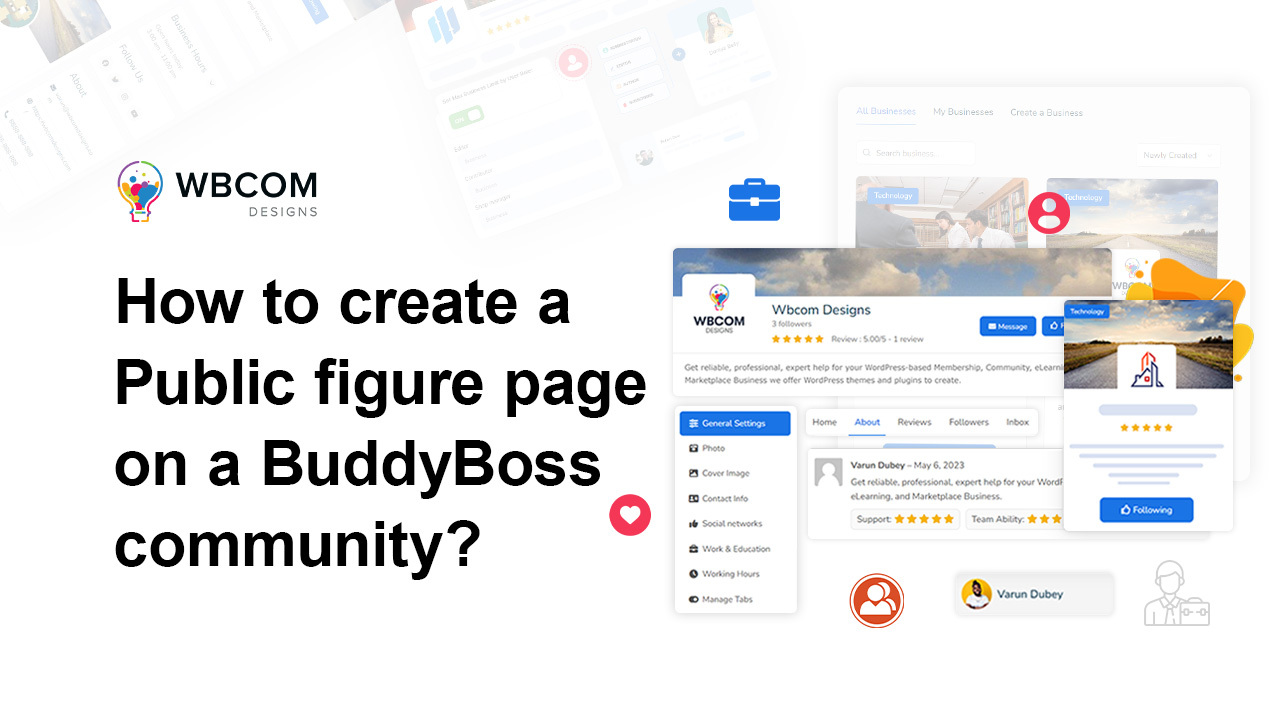
A public figure, an author, a speaker, a local politician, anyone with a following but not a product to sell, needs a different kind of page than a standard member profile. Something with contact details, a map location if relevant, and room for updates separate from personal activity. This covers the admin-side configuration, the settings a site owner works through once, rather than the setup flow an individual public figure clicks through on their own profile.
BuddyPress Business Profile Plugin

BuddyPress Business Profile handles this on a BuddyBoss-powered site. Despite the “business” name, the same page type covers public figures, celebrities, brands, and organizations, the category field is what differentiates them.
The plugin’s current version (v2.1.0) includes, in addition to the basics every page type shares:
- Customizable profile, logo, cover image, contact info, and social links.
- Activity feed for the page itself, separate from the owner’s personal activity, with comments and likes.
- Private messaging through a dedicated inbox per page.
- Roles and permissions, admins, editors, and moderators can be assigned per page.
- Reviews and star ratings, a searchable directory with map view, and LocalBusiness SEO schema, all added since the plugin’s earlier versions.
Public Figure Page vs. Public Figure Profile
This plugin’s setup guides sometimes use “profile” and sometimes “page” for the same underlying object, a Business Profile entry with category set to public figure. There’s no technical difference between the two terms. Where this guide differs from a typical individual setup walkthrough is the angle: the settings a site admin configures once for the whole community, categories, general settings, map integration, rather than what a single public figure sees when creating their own entry.
If your community is going to host multiple public figures, authors, local officials, guest speakers, this admin-side configuration determines how consistent and well-organized that whole section of the directory ends up looking, worth getting right before the first few pages go live rather than patching inconsistencies later. A little upfront planning here saves a much larger cleanup effort once a dozen inconsistently configured pages already exist.
Setting Up a Public Figure Page
Step 1: Install and Activate
Download BuddyPress Business Profile and upload it under Plugins > Add New > Upload Plugin. Once active, a Business Pages menu item appears on your dashboard.
Step 2: Create the Page
Configure the general listing settings first, under WB Plugins > BuddyPress Business Profile > General Settings > Business Listing Page.
Then go to the plugin’s Businesses page and click Create New Business. Select “Business” from the Space Type dropdown, this is the underlying page type regardless of what you’re actually creating.

Fill in the public figure’s name, contact details, address, website, and email, along with a logo and cover image. Add any content you want visible from the start, posts, event listings, or a portfolio, then click Publish.
Step 3: Add a Google Map (Optional)
If location matters for the page, an office address, a district for a local official, a venue for a recurring event, enter a Google Maps API key under WB Plugins > BP Business Profile > General Settings > Google Maps API Key. See how to create the API key if you don’t already have one.
Step 4: Rename the Page Type Label (Optional)
The plugin calls these “Business” pages by default. Change the label and URL slug under WB Plugins > BP Business Profile > General Settings if you’d rather it read “Public Figure” site-wide.

Step 5: Set a Default Cover Image
Admins can set a fallback cover image for any page whose owner hasn’t uploaded their own.

Requirements
An existing BuddyPress or BuddyBoss community, PHP 7.2+, and WordPress 5.0+. Works on Chrome, Firefox, and Safari, and is responsive across desktop, tablet, and mobile, worth confirming on a phone before onboarding the first public figure since most visitors checking a page during a live event or announcement will be on mobile.
Deciding What Counts as a “Public Figure” on Your Community
The category is doing real work here, and it’s worth deciding up front what actually qualifies before members start requesting pages. Some communities use a single broad “Public Figure” category covering authors, speakers, and local officials alike. Others split it further, “Author,” “Community Leader,” “Local Official,” depending on how their membership base is actually structured. A finer split helps visitors filter more precisely; a broader one is simpler to maintain with a smaller community.
Whichever direction you choose, document it somewhere accessible so future admins or moderators approving new pages apply the same standard rather than each person interpreting “public figure” differently case by case. Inconsistent categorization is one of the more common small annoyances that accumulates on a directory left to grow without a documented policy.
Handling Verification and Impersonation Concerns
A page representing a real, identifiable person carries a different risk than a page for an anonymous business, someone could create a page impersonating a public figure without that person’s knowledge or consent. Decide your community’s policy on this before it comes up rather than reacting to a complaint after the fact.
Common approaches include restricting public-figure category pages to admin-only creation, requiring some form of verification before a page goes live, or simply having a clear, fast process for the actual public figure to claim or report an impersonating page if one appears. Whichever you choose, communicate it clearly in your community guidelines, this is a category of content where getting ahead of the problem matters more than for an ordinary business listing, since the reputational cost of an unresolved impersonation complaint tends to fall on the community’s credibility as much as on the impersonated individual.
Configuring Roles for a Team-Managed Page
Public figures frequently have someone else, an assistant, a campaign staffer, a publicist, managing their page day to day. Set expectations during onboarding about how role assignment works, admins and editors can be added per page without sharing the public figure’s own login, which is worth explaining clearly since it’s not always obvious to someone setting up their first page.
If your community regularly hosts public figures who bring their own support staff, consider documenting a short standard process, how to request additional roles be added, who on the admin side approves that, rather than fielding each request as a one-off. This especially matters during high-attention periods, an election season for local officials, a book launch for an author, when message volume and the need for delegated help spikes at a predictable time.
Choosing What Belongs in the About Content vs. the Activity Feed
A public figure page has two distinct places for content, the structured About/description fields and the ongoing activity feed, and it’s worth guiding page owners on the difference rather than letting them dump everything into whichever field they open first. The About content should hold what stays true for months at a time, biography, credentials, general contact information, the kind of thing a first-time visitor needs to understand who this person is.
The activity feed is for what’s timely, an upcoming event, a recent announcement, a new publication. Content that belongs in one place but lands in the other creates two different problems: static information buried in an old feed post that nobody will scroll back to find, or a stale, dated announcement left sitting in the About section long after it stopped being relevant. A quick note in your onboarding materials about which field to use for what heads off a lot of this confusion before it happens.
Setting Up the Directory So Public Figures Are Actually Discoverable
A public figure page only does its job if visitors can actually find it, which depends on decisions made in the directory’s general configuration rather than anything an individual page owner controls. Confirm the business listing page is positioned somewhere in your site navigation a typical visitor would reasonably look, and that the category filter for public figures is clearly labeled rather than buried among unrelated business categories.
If your community’s directory mixes public figures alongside ordinary commercial businesses, consider whether a dedicated top-level filter or a separate landing view for this category would serve visitors better than requiring them to filter through retail and service listings to find it. This is a configuration decision worth revisiting once a handful of public-figure pages exist and you can see how visitors are actually finding, or failing to find, them.
Extending the Rest of Your Community
Wbcom Designs builds a wider set of BuddyPress and BuddyBoss add-ons alongside this one:
- BuddyPress Member Blog: frontend blog publishing from a member’s own profile.
- BuddyPress Member Reviews: members rate and review each other’s profiles, with moderation controls.
- BuddyPress Group Reviews: the same idea, applied to community groups.
- BuddyPress Check-ins: location tagging on activity updates via Google Places, with an optional map view.
- BuddyPress Statistics: activity and engagement tracking across members, groups, and content.
- BuddyPress Activity Social Share: lets members cross-post activity updates to their own social accounts.
- reCaptcha for BuddyPress: spam protection across login, registration, and comment forms.
Reviews on a Public Figure Page: A Different Kind of Signal
The reviews tab wasn’t originally designed around public figures, but it ends up functioning as a place for constituents, readers, or event attendees to leave feedback, which is a more sensitive kind of content than a typical business review. Decide as part of your community guidelines whether reviews on this category get any additional moderation attention compared to ordinary business reviews, a review of a local official inevitably edges closer to political commentary than a review of a plumbing service does.
This doesn’t necessarily mean heavier restriction, open feedback can be genuinely valuable for accountability, but it does mean thinking through the moderation policy specifically for this category rather than assuming the same light-touch approach that works for a restaurant review applies cleanly here too. A clear, publicly stated policy on what’s an acceptable review versus what crosses into harassment or defamation protects both the community and the public figure being reviewed.
Coordinating With the Public Figure’s Existing Communications
A public figure using this feature almost certainly already has other communication channels, a personal website, a campaign page, social media accounts run independently of your community. Encourage cross-linking rather than treating the BuddyBoss page as an isolated silo, a link out from the community page to existing official channels, and ideally a reciprocal mention pointing supporters toward the community presence, helps the page actually get discovered by people who already follow the public figure elsewhere.
This also matters for consistency, if the community page’s bio, contact information, or event listings drift out of sync with what’s posted on the public figure’s other channels, it creates confusion about which source is current. Where possible, encourage whoever manages the public figure’s overall online presence to treat the community page as one more channel that needs the same update discipline as the rest, rather than a lower-priority afterthought.
Planning for Seasonal or Event-Driven Attention Spikes
Unlike a typical business page with roughly steady traffic, a public figure page often sees sharp, predictable spikes, a local election, a book release, an announced speaking event, followed by longer quiet stretches. Plan admin support around that pattern rather than assuming steady-state moderation needs. Ahead of a known spike, confirm the page’s contact information and hours (if using availability scheduling) are current, and make sure whoever’s handling the inbox during that window has been briefed on expected volume.
After the spike passes, this is also a natural moment to review what worked and what didn’t, was inbox response time acceptable, did the map and location information hold up under a surge of visitors, before the next predictable spike arrives. Treating these periods as recurring, plannable events rather than surprises each time makes the whole process smoother for whoever’s managing the page.
Reviewing the Configuration Before Onboarding the First Public Figure
Before inviting the first real public figure onto the platform, walk through the entire flow yourself using a test account: create a page, add an address and confirm the map renders, upload a cover image, send a test message to the inbox, and check how the finished page looks on both desktop and mobile. This catches configuration gaps, a missing API key, an unset default cover image, a mislabeled category, while the stakes are low and nobody real is depending on the page working correctly yet.
It’s worth doing this walkthrough specifically for the public-figure use case rather than relying on general testing done for the plugin’s ordinary business use, since the workflow, category selection, verification concerns, role setup for an assistant, has different edge cases than a straightforward local business listing. A short internal checklist covering these public-figure-specific steps makes onboarding the second and third public figure faster and more consistent than the first.
Frequently Asked Questions
Can a public figure page be set to private during a sensitive period and made public later? Yes, visibility can be changed at any time by someone with admin access to the page, useful if a public figure wants to build out content quietly before an announcement rather than exposing an incomplete page.
Does renaming the page-type label from “Business” affect existing pages’ URLs? The label change affects display text and, depending on configuration, the URL slug going forward. Existing published page URLs may need manual review after a label change to confirm nothing broke, worth checking a sample of existing pages after making this change.
Is the Google Maps API key required even if only some public figures need a map? The API key is configured once at the site level and applies to any page that includes address information, individual pages without an address simply won’t display a map, so it’s safe to enable even if only some entries use it.
Can a site restrict public-figure page creation to verified accounts only? Yes, combined with role and permission settings, or a member-verification plugin, page creation for this specific category can be gated to admin approval or a verified member type rather than open to any registered member.
What happens to an assistant’s editor access if the public figure’s relationship with the community ends? Access is tied to the role assignment on that specific page, an admin can revoke it directly regardless of what happens with the original account, this is worth doing explicitly as part of any offboarding process rather than assuming access lapses automatically.
Can a community host public figure pages for people who aren’t registered members themselves? Technically a page needs to be created by some registered account, but that doesn’t have to be the public figure personally, an admin, a staff member, or an authorized assistant can create and manage it on their behalf, provided the community’s policy on who’s authorized to do that is clear.
Does the category assigned to a page affect which schema markup gets generated? The LocalBusiness schema is generated based on the structured fields filled in, address, contact info, rather than the category label itself, so a public figure page with a complete address and contact set generates the same quality of structured data as any other well-filled-out page.
Browse the full Wbcom Designs plugin catalog for current pricing and the rest of the lineup, most of these add-ons pair naturally with a public-figure page once it’s live and being actively used.
Interesting Reads:
How to Create a Public Figure Profile on a BuddyBoss Community?
How to Create a Business Page on a BuddyBoss Community?
How To Create A Favorite Notification Feature in BuddyPress?