

A public figure, an author, entrepreneur, expert, or anyone building a following around a personal brand, needs a profile with more room than a standard BuddyBoss member page: portfolio, contact details, media mentions, and a following visible to visitors. Here’s how to build one properly rather than trying to stretch a regular profile past what it was designed for.
What BuddyBoss Provides on Its Own
BuddyBoss is the platform underneath: profiles, groups, activity feeds, messaging, course delivery for anyone teaching alongside the community, tiered memberships with payment integrations, and a path to a branded mobile app. None of that is specific to a public figure’s needs.
For a profile built around portfolio, media mentions, and follower visibility, distinct from a standard member’s personal page, you need an add-on.
BuddyPress Business Profile Plugin

BuddyPress Business Profile covers businesses, organizations, celebrities, and public figures under the same underlying page type, category differentiates them. Current version (v2.1.0):
- Customizable profile fields, logo, cover image, contact info, social links.
- A dedicated activity feed, with comments and likes.
- Private messaging through a per-page inbox.
- Role management, admins, editors, moderators.
- Reviews and star ratings, a searchable directory with map view, public follower counts, and LocalBusiness SEO schema.
No fixed limit on how many profiles a site or admin can manage, and there’s no requirement that a public figure’s profile look identical to a business page using the same plugin, the category and the content filled in are what shape how it actually reads to a visitor.
Why This Beats a Customized Member Profile
The obvious cheaper alternative is heavily customizing the standard member profile with extra xprofile fields, a bio field, a links field, maybe a custom “featured work” field. For someone with a small, informal following, that might be enough on its own.
It stops being enough once there’s a real audience to manage. Custom fields don’t give you a feed separate from personal activity, a public follower count distinct from BuddyBoss’s mutual-friend model, reviews or endorsements from others, or the ability to hand inbox management to an assistant without sharing a personal login. Those are structural gaps, not cosmetic ones, and they’re the actual reason a dedicated profile plugin is worth the extra setup step.
Building Out the Portfolio and Media Mentions Section
The About tab’s repeater fields are where a public figure’s profile earns its keep over a plain member page. Rather than a single bio paragraph trying to cover a book, a podcast, a speaking career, and past press coverage all at once, break it into distinct entries: individual publications, notable talks, press features, each with a short description rather than one dense wall of credentials.
Lead with recent or currently relevant work rather than a strict chronological list, especially if there’s a new book, project, or media appearance that’s the actual reason someone’s checking the profile today. Revisit the ordering periodically instead of only ever appending new entries to the bottom of a growing list nobody reorders.
Photos and supporting media attached to each entry make a real difference here. A list of talk titles and publication names with no visuals reads like a résumé, while even one image per entry, a book cover, an event photo, gives a visitor something to actually look at instead of scanning plain text.
Setting Up the Profile
Go to the plugin’s Businesses page and click Create New Business.
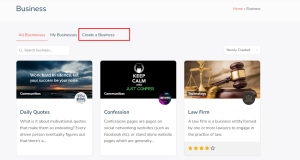
Enter the profile name, description, and category. Click Continue, upload a profile photo, click Next Step, upload a cover image, then click Visit to see it live.
That’s the bare-minimum path. Before pointing anyone to the profile, go back through the About tab and fill in the structured fields properly, a sparse profile undercuts the credibility a dedicated public-figure presence is supposed to establish in the first place.
Handling Fan and Media Messages Without One Inbox Drowning
The private-messaging inbox is genuinely useful for direct contact, fans, journalists, potential collaborators, but it doesn’t scale to personal management once there’s any real following. Role management exists for exactly this: assign an assistant or manager with editor or moderator access to handle routine inbox and comment activity, escalating anything that genuinely needs the public figure’s own attention.
Decide this division of labor before message volume becomes a problem, not after a backlog has already built up. A profile with slow, inconsistent replies undermines the professional image a public figure is usually trying to project, and unclear ownership tends to leave a profile either neglected or bottlenecked on one overloaded person, neither a good look to fans or press reaching out.
Profile vs. a Personal Website: Why Have Both
A public figure with an existing personal website might reasonably ask why a community profile is worth the extra maintenance. The two do different jobs. A personal website is a destination the public figure fully controls, built for whatever structure and content they want. A community profile lives inside an existing audience that’s already there, browsing, discovering, following other members, which means it gets discovered by people who weren’t already specifically looking for that individual.
The profile also carries social proof a personal website can’t replicate on its own, visible follower counts, reviews, and comments from real community members. Treat the two as complementary rather than redundant: the personal website as the fuller, fully controlled presence, and the community profile as a discovery surface with its own social signals, linked to each other so a visitor moving between them experiences a consistent identity either way.
Growing a Following Without It Feeling Performative
A visible follower count creates a temptation to chase numbers directly, encouraging low-effort follows from existing contacts rather than genuine interest. That approach tends to backfire: a follower count that doesn’t match actual engagement, comments, likes, review activity, is noticeable to anyone paying attention, and a mismatch reads worse than a smaller, more engaged following.
Organic growth here comes mostly from consistently useful or interesting activity-feed content, cross-promotion through channels the public figure already has, an email newsletter, existing social accounts, a mention during a talk or interview, rather than any mechanism specific to the plugin. A modest but genuinely engaged following does more for credibility, and for anything commercial built on top of the profile, than an inflated but passive one.
Extending the Rest of Your Community
Check free BuddyPress plugins and premium BuddyPress add-ons from Wbcom Designs for the rest of the lineup, social features, LearnDash integrations for course-based communities, and WooCommerce-facing tools for anyone selling through their profile.
Selling Courses, Coaching, or Merchandise Through the Profile
For public figures whose work includes something sellable, a course, coaching sessions, branded merchandise, keeping that offering visible from the profile itself removes a step compared to sending an interested visitor off to a separate website. This is worth the setup time for someone with an ongoing catalog or recurring offering, but it’s more overhead than it’s worth for a single one-time sale.
If the community already runs LearnDash for course delivery or WooCommerce for products, pairing that with the profile keeps the entire relationship, discovery, purchase, ongoing engagement, inside the same platform fans already use rather than fragmenting the audience across multiple sites and accounts.
Building a Media Kit Straight From the Profile
Journalists, podcast hosts, and event organizers reaching out about a public figure usually want the same handful of things fast: a short bio, a headshot, links to notable past work, contact information. A well-built profile already contains most of that, structured and up to date, which means it can double as an informal, always-current media kit rather than requiring a separate PDF that inevitably goes stale faster than the profile does.
Worth explicitly pointing press or booking contacts to the profile rather than a static document buried in an old email thread. It also means the profile’s accuracy matters more than it might otherwise, a bio or credit list that’s out of date isn’t just a minor inconvenience for a casual fan, it can actively misinform a journalist writing about the public figure, which carries real consequences.
Onboarding a Manager or Assistant, Not Just the Public Figure
In practice, the person setting up and eventually running this profile day to day is often not the public figure themselves, it’s an assistant, a manager, or someone handling social media and correspondence on their behalf. Design onboarding for that reality rather than assuming the public figure will personally learn the plugin’s settings screens.
A short written walkthrough, or a quick screen-recorded tutorial covering the specific fields relevant to this profile’s setup, saves a lot of back-and-forth compared to expecting a busy assistant to self-discover the interface. Include who to contact if something breaks, a clear support path matters more here than for an ordinary member’s profile, since a visible glitch on a public-facing profile reflects on both the individual and the platform hosting it.
What to Do Before the Public Announcement
Treat the actual public unveiling as a small launch event rather than something that happens automatically the moment the profile is technically live. Before announcing anywhere, confirm every field that’s supposed to be filled in actually is, test the inbox from a separate account, and check how the profile renders on mobile, a meaningful share of visitors will be on a phone rather than a desktop.
Have the first few pieces of activity-feed content ready to post immediately after launch rather than leaving the feed empty when visitors first arrive. An empty feed on day one reads as an unfinished setup even if the rest of the profile is polished, while a feed with three or four posts already up gives new visitors something to engage with right away.
Writing a Bio That Actually Works
The main description field is the single highest-traffic piece of text on the entire profile, most visitors read it before anything else, so it’s worth more editorial care than it usually gets. A common mistake is treating this field like a formal press-kit bio, dense with credentials and achievements in list form, when a slightly more conversational tone, still professional, but written like something a person would actually say, tends to hold reader attention better and reads as more approachable.
Length matters too. Two or three tight paragraphs beat one long one, both for scannability and because the plugin’s search index weighs the description field when surfacing results, and natural, well-structured writing tends to outperform a dense, keyword-stuffed block. Update this periodically as the public figure’s work evolves, a bio that hasn’t been touched in two years reads as neglected even if every other part of the profile is current.
Separating Personal Opinion From the Public Figure’s Platform
One thing worth deciding early, before the first post rather than after a difficult one: how much personal opinion belongs on this profile versus the public figure’s other, more private social accounts. A community profile tied to a specific platform or professional identity carries an implicit expectation of staying on-topic in a way a personal Twitter or Instagram account doesn’t, and posts that stray too far from what visitors came for can feel jarring or, in some cases, actively damage the professional reputation the profile exists to build.
This isn’t a call to be bland or overly cautious, a profile with no personality reads as corporate and forgettable. It’s a call to be intentional: know roughly what’s in scope for this specific audience before posting reflexively, especially if someone other than the public figure is managing day-to-day content and doesn’t have the same instinct for where that line sits.
Choosing Visibility: Public, Private, or Hidden
Public visibility fits the overwhelming majority of public-figure profiles, since the entire point is usually discoverability, people finding the profile through search or the community directory. Private visibility, requiring a follow or approval step before full content is visible, suits a smaller-scale or more curated relationship, useful for someone who wants a closer-knit group of engaged followers rather than maximum reach.
Hidden visibility mostly makes sense during setup itself, building the profile out fully before any public announcement, rather than as a long-term state. A hidden profile earns nothing from the search and directory visibility that’s the main advantage of using this plugin over a plain member profile in the first place, so treat it as a temporary staging state rather than a permanent configuration.
Keeping the Profile Current Over Time
A public-figure profile set up once and never revisited slowly drifts out of date, portfolio entries missing recent work, an old cover image tied to a past project, contact details that changed. None of this breaks the profile technically, but it erodes credibility gradually in a way that’s easy to miss because there’s no error message flagging it, just a visitor noticing the content feels stale.
A light quarterly review, checking the portfolio and media-mentions section for anything new to add, confirming contact and social-link fields still point to active channels, refreshing the cover image if it’s tied to a specific past project, keeps the profile feeling maintained without demanding constant attention. Assigning this to whoever’s already managing the inbox and comments folds it into an existing responsibility rather than creating a separate task nobody owns.
Frequently Asked Questions
Can the profile be verified so visitors know it’s authentic? The plugin doesn’t include a built-in verification badge. Communities handle this at the policy level instead, either restricting profile creation for known public figures to admin-only setup, or applying a manually managed verified indicator communicated through onboarding materials.
Is there a difference in how search engines treat this versus a personal profile? Yes, the LocalBusiness schema markup applied to Business Profile entries gives search engines more structured information than a standard personal profile carries, which can help visibility for anyone who wants the profile to surface in relevant searches.
Can multiple people log in and manage the same profile simultaneously? The role-management system supports multiple assigned managers with different permission levels, so a small team can share management responsibilities without everyone needing the same login credentials.
What happens to the profile if the public figure’s community involvement ends? The profile persists until someone with admin or owner access deletes or deactivates it. Communities should have a clear offboarding process, deciding whether to archive, hide, or fully remove a profile when the relationship concludes, rather than leaving a stale, unmanaged profile live indefinitely.
Can a public figure’s profile be linked to a group they run? There’s no automatic linking between a Business Profile entry and a BuddyBoss group, but nothing stops you from cross-referencing them manually, a link to the group in the profile’s About section, and a mention of the profile in the group’s description.
Does upgrading from a related free plugin carry settings over automatically? Business Profile is its own standalone product rather than a free/Pro pair, so there’s no separate upgrade path to worry about, and licensing tiers, Personal, Professional, Agency, affect site count rather than feature availability.
Can the profile list speaking engagements or events separately from other portfolio entries? The About tab’s repeater fields aren’t rigidly typed to a specific category, so a public figure can use one set of entries for publications and another for appearances or talks, organized however makes the most sense for that individual’s body of work.
Is pricing different for a public-figure profile versus a business one? No, pricing is per site license rather than per profile type: Personal (1 site) $59/year, Professional (5 sites) $129/year, Agency (unlimited sites) $299/year, with lifetime options also available. The category assigned to a profile doesn’t change what tier it requires.
Interesting Reads:
How does Profile Pro enhance the functionality of BuddyPress Profiles?
How To Create A Favorite Notification Feature in BuddyPress?
Does the Activity Filter Enhance the Performance of the Activity Stream?