

Fashion blogs cover a wide range of ground: specific apparel and accessory pieces, beauty tips that overlap with style, seasonal trend roundups, celebrity outfit breakdowns, and the slow shifts happening across different clothing markets. They range from the output of major fashion houses down to a single freelance designer posting sketches from a spare bedroom.
Starting one is cheaper and simpler than most people assume. Anyone with a laptop and an opinion about clothes can be publishing within a weekend. The part that actually takes work, and the part most guides skip, is building an audience around it that sticks. Anyone can write a post about a new collection. Fewer people build a following of readers who show up week after week because they trust the voice behind it.
Why start a fashion blog at all
If you’re already immersed in fashion, tracking trends and forming opinions about what’s working each season, a blog is a natural outlet. It lets you document your own style, comment on where designers are heading, and build a recognizable voice in a crowded space instead of just consuming other people’s takes.
Blogging is also one of the more realistic ways to build an income around a creative interest. Bloggers who get genuinely good at connecting readers to products they’d actually buy tend to do well, whether that’s through affiliate links, sponsored posts, or their own product line eventually. None of that happens overnight, but it happens far more often in fashion than in most niches, because clothing is something people buy constantly and need help choosing.
Beyond the content itself, fashion blogging is a door into the industry. Bloggers who publish consistently end up on the radar of designers and PR teams. They get noticed by other bloggers too, and those relationships open doors that cold outreach rarely does.
What a fashion blogging community actually is
A fashion blogging community is a group of bloggers, and often readers too, who gather around a shared interest in style rather than a single blog’s content alone. Members trade opinions on emerging designers, debate whether a trend will stick past one season, and learn from each other’s approach to building an audience.
These groups also function as a support system in a way that solo blogging rarely offers. New ideas for a stalled content calendar, honest feedback on a post that didn’t land, or a collaboration between two bloggers with overlapping but distinct audiences: all of that happens more naturally inside a community than it does through cold DMs.
Why build a community around your blog specifically
A blog with an active community attached behaves differently than one without.
It signals real value. A quiet comment section says little. A living community, where people are asking questions and replying to each other, tells a new visitor immediately that other people find this worth their time.
It creates social proof. People join spaces where other people are already active. A community with visible activity pulls in new members faster than an empty one, simply because nobody wants to be the first person in the room.
It grows page views. For bloggers running ad networks or working directly with sponsors, more page views means more revenue. A community gives readers a reason to return between new posts, not just when a new one publishes.
It increases the value of the blog itself. A blog with an attached, active community is worth more to a potential buyer or partner than a content archive with no audience relationship behind it.
Getting from zero to a working fashion blog
The first real decision is finding your niche. “Fashion” alone is too broad to build a following around quickly. Sustainable fashion on a budget, workwear for a specific body type, vintage sourcing, or streetwear from a particular region are all narrow enough to build real authority in, while “fashion blog” competes with everyone.
From there, pick a platform. WordPress remains the most flexible option because it isn’t locked to a single company’s rules or pricing changes, and it scales from a simple blog to a full community site without switching platforms later.
A domain name matters more in fashion than people expect, since it’s part of your brand identity from day one. Pick something that still makes sense if your niche shifts slightly over the next few years, rather than something so specific it boxes you in.
Hosting is the unglamorous part nobody wants to think about, but a slow site loses readers before they ever see your content. A basic, reliable host is enough to start; you can upgrade as traffic grows.
WordPress itself handles the rest well. It’s approachable for non-developers, has a mature media library for the photo-heavy content fashion blogging requires, and a plugin ecosystem that covers nearly everything you’d want to add later.
Turning a solo blog into a community
Once the blog itself is running, three things need to be in place before “community” is anything more than a comment section.
1. Domain name
Your domain is the permanent address people search for and return to. It should be short enough to remember and specific enough to signal what the blog is actually about.
2. Web hosting
This keeps your files and your community’s data safe. Skimping here to save a few dollars a month tends to cost far more later in downtime, security headaches, or a forced migration once the site outgrows a bargain host.
3. Plugins, and specifically the community layer
A plugin extends what WordPress can do without a custom build. For building an actual community, not just a blog with comments, BuddyPress is the standard choice. It adds member profiles and an activity feed. It adds groups. It adds private messaging between members, all on top of your existing WordPress site, effectively turning the blog into a social space.
A theme built for exactly this
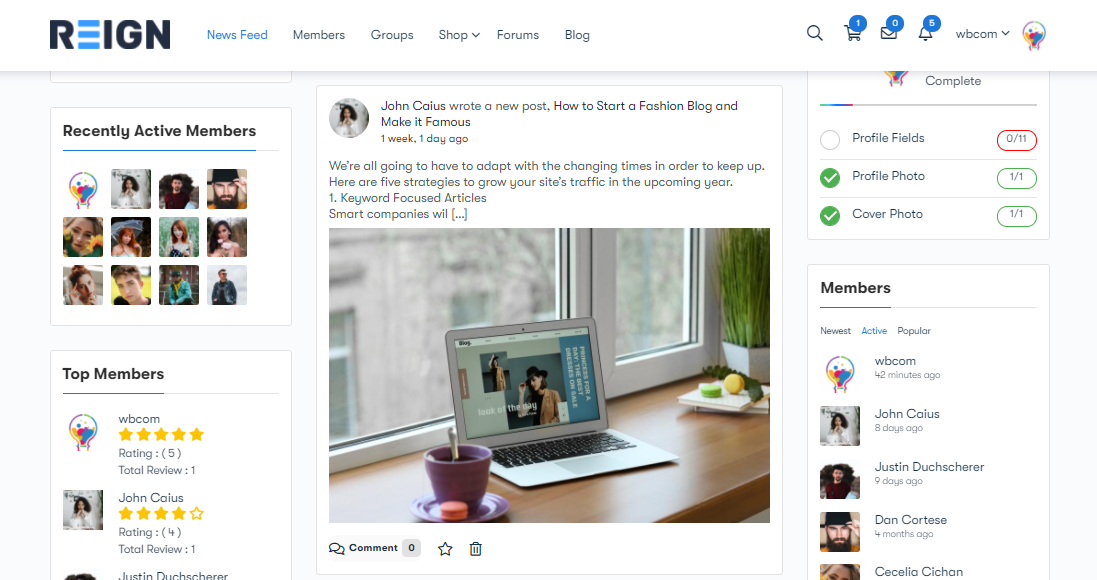
BuddyX is a free, BuddyPress-dedicated theme built to style all of that into something that looks intentional rather than bolted together. Paired with BuddyPress Member Blog, members can publish their own posts directly from their profile on the front end, no admin access required. For a fashion blog specifically, that means readers who want to share their own outfit posts, hauls, or thrift finds can do it themselves, which multiplies your content output without multiplying your workload.
What BuddyPress Member Blog actually adds
BuddyPress Member Blog is a free plugin that lets registered users create and manage their own blog posts from their profile page, rather than through the standard WordPress dashboard. You retain moderation control over everything members submit.
Publishing from the front end
Members set a title, upload media, format the body text, choose a category, and set a featured image, all from a form on their profile. It mirrors what the old classic WordPress editor could do, just accessible without admin credentials.
Posts tied to the member’s profile
Whether a member can post at all depends on their role. Admins can enable publishing for admins, editors, authors, contributors, or subscribers individually, and only members with an enabled role see the posting option on their profile.
Draft or publish, admin’s choice
If publishing is enabled outright, members’ posts go live immediately. If it isn’t, submissions land as pending, giving you a review step before anything reaches the public feed.
Editing after submission
Members can go back and revise their own posts, which is uncommon among front-end publishing tools and saves you from handling every small correction request yourself.
Content ideas that actually pull a fashion community together
The blog post itself is only the opening move. What turns a reader into a community member is what happens after they finish reading.
End posts with a specific question rather than a generic sign-off. “What’s your take on this trend” gets more replies than “let me know what you think” because it gives people something concrete to react to, not an open invitation that’s easy to scroll past.
Run seasonal challenges where members post their own take on a theme, like styling one piece three different ways, or building a capsule wardrobe under a set budget. These work especially well once front-end publishing is turned on, since members can submit their entries as full posts rather than a single comment buried in a thread.
Feature member content regularly, not as an afterthought. A weekly roundup that highlights the best outfit posts or thrift finds from the community gives contributors a reason to keep submitting and gives lurkers a reason to eventually join in.
Host honest debates about trends. Fashion is opinionated by nature, and readers respond to a blogger willing to say a trend won’t last, or that a piece everyone’s raving about isn’t worth the price. Those posts generate far more discussion than uniformly positive coverage.
Growing beyond your first hundred readers
Early growth mostly comes from your own network: friends, existing social media followers, and people who find you through search. Past a certain point, the community itself becomes the growth engine, provided you’ve built something worth talking about.
Collaborations with other bloggers in adjacent niches, like a streetwear blogger partnering with a sneaker-focused account, introduce each community to the other’s audience without either side having to do cold outreach.
Guest posts from members with a strong personal following work the same way. If a member with an established Instagram presence publishes on your community, some portion of their audience follows the link back, and some portion of those visitors stay. That second group, the ones who stay, is worth far more than raw traffic numbers suggest.
Consistency matters more than any single growth tactic. A blog that posts twice a week for a year builds a bigger, more loyal audience than one that posts daily for a month and then goes quiet.
What tends to go wrong
Trying to cover every fashion topic at once instead of picking a lane. A blog that tries to be everything to everyone rarely becomes anyone’s go-to source.
Launching the community feature before there’s an audience to fill it. An empty activity feed and a member directory with three names in it signals the opposite of what you want new visitors to feel.
Ignoring comments and submissions for days at a time. In a fast-moving niche like fashion, a slow reply can mean a trend conversation has already moved on by the time you respond.
Copying other fashion blogs’ voice instead of developing your own. Readers can tell when a blog sounds like everyone else in the niche, and it’s the specific, personal opinions that get shared and remembered.
A few things worth deciding before launch
Decide early whether every fashion topic belongs in one shared feed or whether categories like streetwear and formalwear, or a separate space just for thrifting, deserve their own room to breathe. A single feed works fine under a hundred members. Past that, unorganized categories make it harder for people to find content they actually care about.
Decide how much editorial control you want over member posts before you turn publishing on. A tightly curated blog protects your brand voice but slows down content volume. An open one grows faster but needs active moderation to stay on-brand.
Decide what “active” looks like for your community before you start measuring it. Total members is a vanity number. What matters is how many people are still posting, replying, or reading a month after they join.
Turning the blog into a revenue stream, honestly
Fashion is one of the more monetizable content niches simply because people are constantly buying clothes and need help choosing. That said, the fastest way to lose a community’s trust is to let every post feel like a paid placement.
Affiliate links work best woven into genuine recommendations rather than dropped into every product mention. If you wouldn’t buy the item yourself, don’t link it just because the commission is higher.
Sponsored posts should be disclosed clearly, not buried in fine print. Readers who feel misled by an undisclosed sponsorship don’t just distrust that one post, they start second-guessing everything you’ve published before it. Trust, once lost in a community this size, rarely comes back at the same level.
Once a community has real activity behind it, a small marketplace or classifieds section for members to sell pieces from their own closet can become a genuine feature rather than a bolt-on. It also gives your community members a reason to check in beyond just reading new posts.
What a healthy fashion community actually looks like day to day
Not a flood of posts. A healthy community doesn’t need hundreds of new threads a day to feel alive. What it needs is reliability. A handful of members who show up regularly. Replies that happen within hours rather than days. Content that changes with the seasons instead of sitting stale for months at a time.
Watch for one signal above all others: are members replying to each other, or only to you? A community where conversations happen between members, not just between you and each individual reader, is the one that survives past the point where you personally have time to reply to everyone.
Common questions
Do I need coding skills to set this up? No. WordPress and BuddyPress are both built for people without development experience, and BuddyX styles them without requiring a line of code either. You’ll spend more time on content and community management than on technical setup.
How long before a fashion blogging community feels active? Expect a slow first month or two while you seed content and personally reply to everything. Momentum tends to build once a handful of regular contributors form the habit of posting.
Should I let anyone publish immediately, or require approval first? Start with approval required. Once you trust a member’s judgment and tone, you can loosen that for them individually rather than opening it for everyone at once.
What if nobody posts in the first few weeks? That’s normal, not a sign of failure. Keep seeding content yourself and personally inviting your most engaged existing readers. Momentum in a new community almost always starts with the founder’s own consistency before it ever comes from anyone else.
These steps are straightforward to follow, and the hardest part is usually just starting. The blogs that build real communities are the ones that treat the first few members like collaborators, not an audience to broadcast at.
Fashion moves fast, and so does the audience that follows it. A blog that stays static while the industry shifts around it gets left behind quickly. A community, on the other hand, gives you a live pulse on what your readers actually care about this season, which is worth more than any trend report you could buy. It also means the next post practically writes itself, because the community already told you what they wanted to read.
Interesting Reads:
How to Implement WooCommerce Gamification