
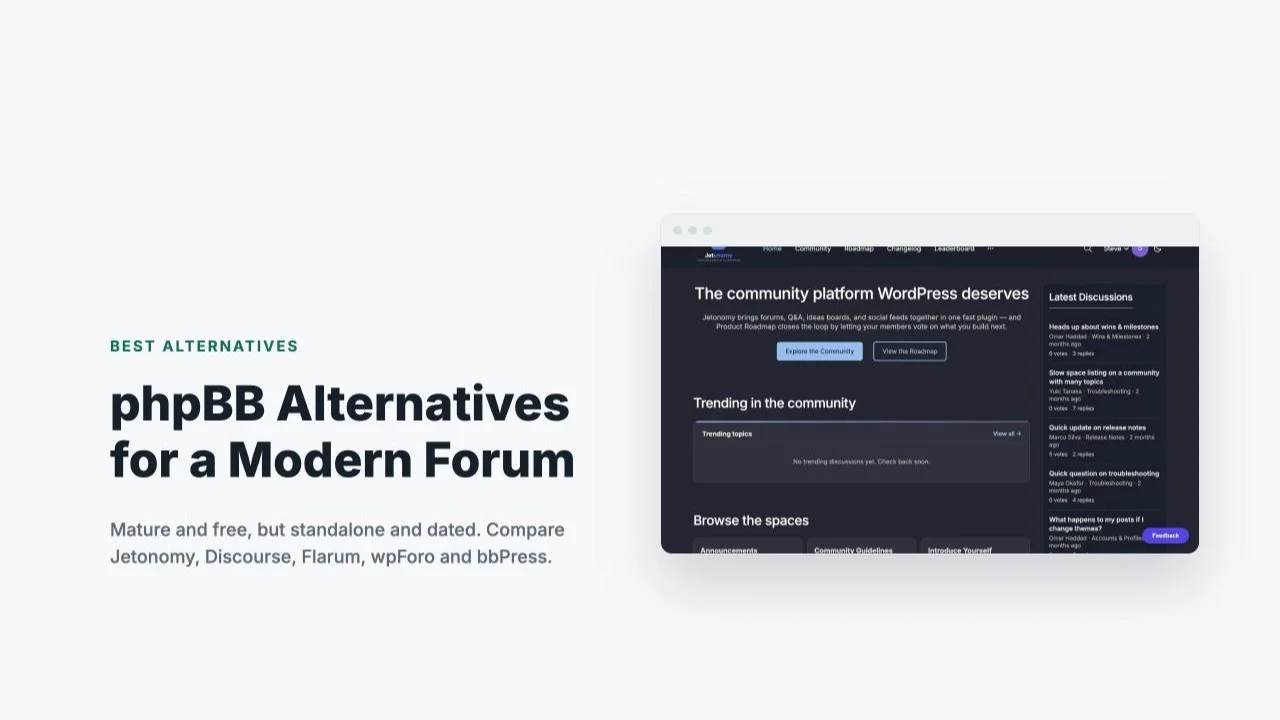
phpBB has been running forums since 2000. Nearly 25 years later, it is still free, still open source, and still one of the most downloaded forum platforms on the internet. Version 3.3.17 shipped in June 2026, which tells you the project is maintained, not abandoned. If you want a traditional bulletin-board forum on the cheapest possible hosting, phpBB remains a completely legitimate choice, and plenty of long-running communities have no real reason to leave it.
Last updated: 6 November 2026
Quick answer: If you are staying on phpBB, it is still maintained. For a new modern forum, pick Discourse or Flarum as standalone options, or bbPress, wpForo or Jetonomy if the forum has to live inside WordPress. Plan a manual export either way, because none of these has a one-click phpBB importer.
But “still works” and “still the right choice for a new forum in 2026” are different questions. phpBB is a standalone application: it needs its own database, its own hosting stack, its own updates, separate from whatever else your organization runs. Its interface, while functional, looks and feels like 2010 next to a modern WordPress-native community plugin. If you’re evaluating phpBB today, or migrating away from an aging install, here’s an honest look at five real alternatives, what each one actually costs, and what migration realistically involves.
Table of Contents
- Market snapshot
- Why People Look for a phpBB Alternative
- Jetonomy
- Discourse
- Flarum
- wpForo
- bbPress
- Two Real-World Scenarios
- What a Year (and Three Years) Actually Costs
- What Migration Actually Looks Like
- Setup Time and What You’re Actually Configuring
- Comparison Table
- How to Choose
- Get Jetonomy for Your WordPress Community
- FAQs
- Sources
Market snapshot
- The online community platform market was valued at about USD 6.5 billion in 2025 and is projected to reach USD 15.2 billion by 2033, a 10.2% annual growth rate (report updated May 2026; definitions vary between research firms), according to Verified Market Research.
- bbPress reports 100,000+ active installations on WordPress.org (checked 6 November 2026).
- wpForo reports 20,000+ active installations on WordPress.org (checked 6 November 2026).
Why People Look for a phpBB Alternative
Three reasons come up repeatedly. First, maintenance overhead: phpBB runs on its own server stack, separate from a company’s or community’s main website, which means a second set of updates, backups, and security patches to stay on top of. Every patch Tuesday, every PHP version bump, every hosting migration has to happen twice, once for the main site and once for the forum, and the two systems rarely stay in sync without someone actively managing both.
Second, the interface: phpBB’s admin panel and front-end templates are functional but visually dated, and younger members in particular bounce off the look before they’ve read a single thread. First impressions matter disproportionately for community platforms, because a visitor deciding whether to create an account is making that decision in the first few seconds on the page, long before they’ve evaluated whether the actual discussions are worthwhile.
Third, isolation: a standalone phpBB install doesn’t share logins, profiles, or content with a WordPress site, a course platform, or a product, so members end up managing yet another account, yet another password, yet another profile picture to upload. Every extra login step is a small amount of friction, and friction compounds, especially for casual members who were never going to make a special trip just for the forum. A fourth, quieter reason shows up in support tickets more than in strategy documents: phpBB’s theming system, while flexible for anyone fluent in its template language, is genuinely hard for a non-developer site owner to customize without hiring help, which locks a lot of communities into whatever default styling they started with years ago.
None of this makes phpBB bad software. It makes it a specific kind of software: a mature, free, standalone forum engine for people who don’t mind running a second system. If that’s not you, the five options below solve the same core problem differently.
Online communities consistently follow what’s known as the 90-9-1 rule: roughly 90% of members only ever read, 9% contribute occasionally, and just 1% create the majority of content. A dated, hard-to-navigate forum interface pushes that already-thin 10% of active participants even further toward silence, which is why the platform’s day-to-day usability matters as much as its feature list.
Jetonomy
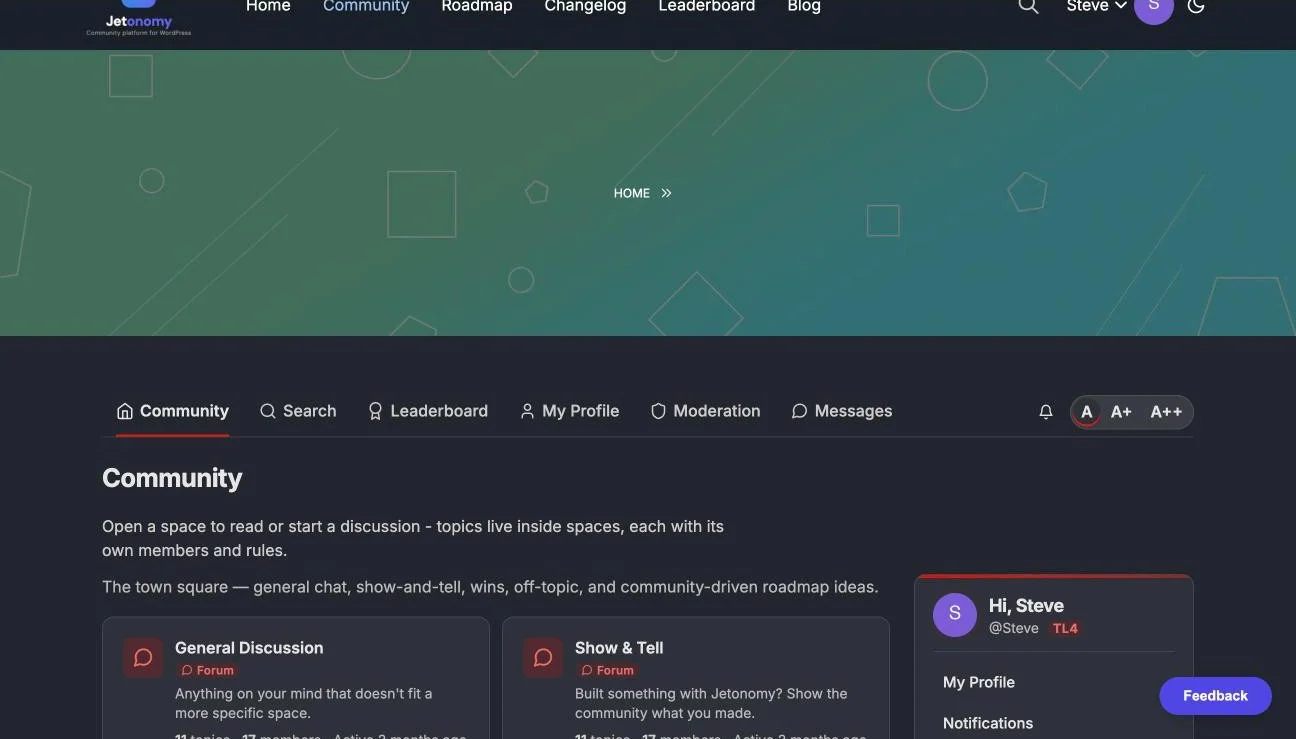
Jetonomy is a self-hosted WordPress plugin that runs forums, Q&A, an ideas board, and a short-form social feed, all inside your existing WordPress install rather than as a separate application. It uses its own dedicated database tables so it doesn’t slow down the rest of your site, and it ships with a one-click migration path from bbPress and wpForo.

Key strengths:
- Free tier includes all four discussion types (forums, Q&A, ideas board, show & tell), trust levels, moderation, search, notifications, and membership gating, with over 80 REST API routes
- Runs inside WordPress, so members use the same login, profile, and theme as the rest of the site, no second account
- Separate database tables mean forum activity doesn’t compete with your main site’s performance the way some all-in-one plugins do
Where it falls short:
- Younger than phpBB by two decades, so it has a smaller library of third-party tutorials and community troubleshooting threads
- Emoji reactions, polls, private messaging, custom badges, AI moderation, analytics, and per-space SEO are Pro-only ($69/year one site, $99/year five sites, $199/year unlimited, or one-time lifetime options)
- Requires an existing WordPress install; it’s not a fit if you specifically want a forum independent of a CMS
Discourse
Discourse is the forum software most often cited as the “modern” alternative to legacy bulletin boards. It’s open source, self-hostable, and built around trust levels that automatically grant more privileges to members who demonstrate good-faith participation over time.
Key strengths:
- Genuinely modern single-page interface with infinite scroll, real-time updates, and strong mobile support
- Trust-level system is one of the most sophisticated anti-spam and community-health mechanisms in any forum platform
- Large, active plugin ecosystem and a well-documented API
Where it falls short:
- Self-hosting Discourse is a genuinely heavier lift than installing a WordPress plugin, it typically runs in Docker and benefits from DevOps familiarity
- Discourse’s official hosting starts in the hundreds of dollars per month for anything beyond a small community
- Not WordPress-native, so it sits alongside your site rather than inside it, the same isolation problem phpBB has
Flarum
Flarum is a lightweight, open-source forum platform built around an “everything is an extension” architecture, where even tags and gamification are first-party extensions you can enable or skip.
Key strengths:
- Free forever with no paid tier at all, genuinely open source top to bottom
- Smallest application footprint of the modern self-hosted forum platforms, fast and lightweight
- Flat, responsive design that looks current without being over-designed
Where it falls short:
- Still a standalone application requiring its own hosting and database, same overhead issue as phpBB
- Core feature set is intentionally minimal; anything beyond basic threaded discussion depends on community-built extensions of varying quality and maintenance status
- No native Q&A, ideas board, or social feed format, it’s a forum and only a forum
wpForo
wpForo is a WordPress forum plugin built with SEO as a first-class concern, a reasonable pitch for anyone whose forum is meant to rank in search and drive organic traffic.
Key strengths:
- Runs inside WordPress, avoiding the standalone-app problem
- Strong reputation specifically for SEO-focused standalone forum websites
- Free core version with a mature plugin history
Where it falls short:
- Narrower feature scope than an all-in-one community plugin, it’s forum-first without Jetonomy’s Q&A/ideas/social-feed combination
- Interface, while WordPress-native, is more utilitarian than cutting-edge
- Advanced features (private messaging extensions, advanced moderation tools) are spread across separate add-ons rather than bundled
bbPress
bbPress is WordPress’s own official forum plugin, built by Automattic, the company behind WordPress.com. It’s about as WordPress-native as forum software gets.
Key strengths:
- Free, officially maintained, and deeply integrated with WordPress’s own user/role system
- Minimal learning curve for anyone already comfortable with WordPress
- Large existing install base means lots of theme and plugin compatibility has already been worked out by the community
Where it falls short:
- Development has slowed significantly in recent years compared to newer plugins; it’s stable but not fast-moving
- No native Q&A, ideas board, trust levels, or social feed, strictly traditional threaded forums
- Interface requires significant theming work to look modern out of the box
Two Real-World Scenarios
Picture a software company running an aging phpBB install for customer support discussions. The forum works, but it lives on a separate domain with its own login, the design hasn’t been touched since 2015, and new hires keep asking why support discussions aren’t inside the same WordPress site as the product’s documentation and blog. Support agents field the same “how do I log in again” question every week, not because the forum is broken, but because nobody can remember which of their three logins belongs to the forum specifically.
Moving to a WordPress-native option like Jetonomy means support threads, the company blog, and product docs all share one login and one design system, member trust levels build automatically as customers help each other, and the migration tool pulls the old phpBB content’s WordPress-compatible neighbors (bbPress, wpForo) in one click, though a direct phpBB-to-WordPress migration still requires manual export/import work since phpBB’s database structure is further from WordPress’s own. Six months after the switch, the company’s support team reports fewer login tickets and a noticeably higher rate of customers answering each other’s questions, a direct result of trust levels surfacing the most helpful members instead of burying everyone equally in a flat thread list.
A second, different scenario: an open-source software project has run community discussion on phpBB since the early 2010s, with thousands of archived threads that still rank well in search and get linked from GitHub issues. Here, the priority isn’t a full migration at all, it’s preserving those search rankings and existing links while deciding whether new discussion should continue on phpBB or move somewhere more active. A project in this position often keeps the old phpBB archive read-only and frozen exactly as-is (preserving every inbound link and search ranking), while standing up a fresh Discourse or Jetonomy instance for new discussion going forward, rather than attempting a risky full-content migration that could break a decade of accumulated SEO equity for marginal benefit.
What a Year (and Three Years) Actually Costs
phpBB itself is free software, but “free” ignores the hosting and maintenance time it still requires as a second system. Flarum is free with no paid tier at all. Jetonomy’s free tier covers forums, Q&A, ideas, and social feed with no cost; Pro runs $69/year for a single site. Discourse’s software is free to self-host but demands real server resources and DevOps time, or its official hosting plan, which starts well into three figures a month for anything beyond a hobby-sized community. wpForo and bbPress are both free WordPress plugins, with wpForo’s advanced features split across paid add-ons as needed.
| Platform | Year 1 | 3-year total |
|---|---|---|
| phpBB | $0 software + separate hosting | $0 software, ongoing hosting/maintenance time |
| Jetonomy (free tier) | $0 | $0 |
| Jetonomy Pro (1 site) | $69 | ~$207 (3 x $69/yr) |
| Discourse (self-hosted) | $0 software + server/DevOps time | $0 software, real infrastructure cost |
| Flarum | $0 | $0, no paid tier exists |
| wpForo / bbPress | $0 core, optional add-ons | $0 core, varies with add-ons |
Figures reflect publicly listed pricing as of October 2026. “Free” software still carries real hosting and maintenance costs that vary by server choice and traffic.
What Migration Actually Looks Like
Nobody migrates a forum for fun, so it’s worth being specific about the actual steps rather than waving at “it’s easy.” Moving off phpBB generally breaks down into three phases regardless of which destination you pick: exporting existing content (threads, posts, user accounts, attachments) from phpBB’s MySQL tables, mapping that data to the new platform’s schema, and handling the inevitable edge cases (deleted users, orphaned attachments, custom BBCode formatting that doesn’t translate cleanly).
For a WordPress-native destination like Jetonomy, wpForo, or bbPress, the practical path is usually a two-step migration if you don’t want to write custom export scripts: first import phpBB content into bbPress using one of the community-maintained bbPress import tools, verify the data landed correctly, then use Jetonomy’s native one-click migration to pull that bbPress content into Jetonomy’s own tables. This avoids writing a direct phpBB-to-Jetonomy script from scratch, at the cost of an extra verification step in the middle.
For Discourse or Flarum, the standalone-to-standalone migration tends to be more direct since both have existing phpBB import tooling in their respective communities, though data fidelity (especially for older phpBB installs with heavily customized BBCode or legacy attachment storage) should always be spot-checked against a handful of real threads before you point the old domain’s DNS at the new platform and consider the migration final.
Setup Time and What You’re Actually Configuring
Installing any of these five takes minutes. The real time investment is deciding your community’s structure: what spaces or categories exist, who can post where, how moderation escalates, and what a new member sees on their first visit. No plugin does this strategic thinking for you, regardless of how polished its onboarding wizard looks.
Where the five genuinely differ is how much that structural decision-making has to happen up front versus how much can evolve later. phpBB and bbPress both expect a fairly complete category structure before launch, since reorganizing an established forum’s categories later tends to break existing bookmarks and search indexing. Discourse’s trust-level system is designed to let the community’s structure emerge gradually, new members start restricted and earn more posting freedom automatically as they participate, which reduces the up-front planning burden at the cost of a slower ramp for legitimately engaged new members.
Jetonomy’s four built-in discussion types (forums, Q&A, ideas, show & tell) give a natural starting structure without requiring you to invent one from scratch, you pick which types your community actually needs and skip the rest, rather than configuring a single forum format to awkwardly serve four different use cases. For a support-focused community specifically, starting with just the Q&A and forum types, and adding the ideas board once you have enough active members to make a public roadmap meaningful, is a reasonable staged rollout rather than launching all four discussion types on day one with nothing in most of them.
Comparison Table
| phpBB | Jetonomy | Discourse | Flarum | wpForo | bbPress | |
|---|---|---|---|---|---|---|
| WordPress-native | No | Yes | No | No | Yes | Yes |
| Free core | Yes | Yes | Yes (self-host) | Yes, fully | Yes | Yes |
| Q&A + ideas board | No | Yes, native | Via plugins | Via extensions | No | No |
| Trust levels | No | Yes, native | Yes, native | No | No | No |
| Active development pace | Steady, mature | Active | Active | Active | Steady | Slowed |
How to Choose
If you specifically want a forum independent of any CMS and don’t mind the standalone-app overhead, Discourse or Flarum are both genuinely modern choices, Discourse for its trust-level sophistication, Flarum for its lightweight, fully-free simplicity. If your forum needs to live inside an existing WordPress site, the real choice is between bbPress (official, minimal, stable), wpForo (SEO-focused), and Jetonomy (the only one of the three with native Q&A, an ideas board, trust levels, and a social feed built in, not bolted on). If you’re migrating off phpBB specifically, budget time for a manual export either way, none of these five have a one-click phpBB importer, though Jetonomy’s one-click bbPress/wpForo migration makes a two-step path (phpBB to bbPress, then bbPress to Jetonomy) worth considering if you want to land inside WordPress.
Get Jetonomy for Your WordPress Community
Forums, Q&A, ideas, and a social feed, free, self-hosted on your own WordPress site.
Get JetonomySummary
phpBB earns its reputation honestly: it’s free, mature, and still actively maintained in 2026. But a standalone app with a 2010-era interface is a real cost, not just an aesthetic complaint, it’s a second system to maintain and a UX gap that measurably discourages the 10% of members who’d otherwise participate. Discourse and Flarum modernize the standalone-forum experience; Jetonomy, wpForo, and bbPress bring the forum inside WordPress itself. For most communities already running WordPress, Jetonomy’s combination of forums, Q&A, ideas, and a social feed in one free plugin is the most complete starting point of the five, while a legacy archive with real search equity is sometimes best left exactly where it is.
FAQs
Is phpBB still safe and maintained in 2026?
Yes. Version 3.3.17 shipped in June 2026, and the project has nearly 25 years of continuous development. Security and stability are not the issue, dated UX and standalone-app overhead are.
Can I migrate phpBB content directly into WordPress?
Not with a one-click tool from any of the five alternatives here. phpBB’s database structure differs enough from WordPress’s that a direct migration typically means exporting content and manually re-importing it, or routing through bbPress as an intermediate step.
What’s the real difference between Jetonomy and bbPress?
bbPress is traditional threaded forums only. Jetonomy adds native Q&A with accepted answers, an ideas board with status tracking, a short-form social feed, and trust levels, all in the same free plugin, with Pro adding reactions, polls, messaging, and AI moderation.
Is Discourse free to self-host?
The software itself is open source and free. Hosting it yourself requires server resources and typically Docker familiarity; Discourse’s own official hosting is a separate paid service starting well above what a WordPress plugin costs.
Does Flarum really have no paid tier at all?
Correct, Flarum is free and open source with no commercial version. Its ecosystem is sustained through community-built extensions rather than a company selling a Pro tier.
Which of these is best for a support forum tied to a product?
A WordPress-native option (Jetonomy, wpForo, or bbPress) makes the most sense if your product’s site, docs, or blog already runs on WordPress, since members share one login and the forum doesn’t live in isolation.
Can I run a Q&A-style forum like Stack Overflow with any of these?
Jetonomy has native Q&A with asker-selected accepted answers built in. Discourse and Flarum can approximate it through plugins/extensions, but it’s not a first-class native format the way it is in Jetonomy.
Do any of these have a mobile app?
None of the five ship a dedicated native mobile app out of the box; all five are responsive web experiences, with Discourse and Jetonomy both having particularly strong mobile browser support.
What happens to my phpBB SEO rankings if I switch?
Moving to a new domain or URL structure risks losing existing search rankings unless you set up proper 301 redirects from old phpBB thread URLs to their new location, this applies to any of the five alternatives, not just WordPress-based ones. As the open-source project scenario above illustrates, sometimes the better answer is leaving the old archive untouched and frozen rather than migrating it at all.
Is wpForo or bbPress the better free WordPress forum plugin?
wpForo leans more SEO-focused for a standalone forum site; bbPress is the official WordPress.org plugin with the deepest core-WordPress integration. Neither has Jetonomy’s Q&A/ideas/social-feed combination.
Can I run more than one of these forum plugins on the same WordPress site?
Technically possible in some combinations, but strongly discouraged. Running Jetonomy alongside bbPress or wpForo on the same site risks confusing members with two parallel discussion systems and duplicate notification streams. Pick one and migrate fully rather than layering a second system on top.
Sources
- Verified Market Research: Online Community Platform Market
- WordPress.org: bbPress
- WordPress.org: wpForo
Interesting Reads:
Best Canny Alternatives in 2026
How to Build a Professional CE Community for Healthcare Professionals on WordPress