

Every directory on the internet runs the same direction: a business posts what it offers, and a visitor searches through those offers to find a match. That model works well right up until a member’s actual problem is the opposite shape. They do not want to browse forty landscaper listings hoping one of them handles a weird sloped backyard with drainage issues. They want to post “need someone who can regrade a sloped yard with a drainage problem, budget around $2,000” and let the landscapers who can actually do that job come to them. That flipped structure is a reverse directory, and it is a genuinely different tool from the listing model most community sites already run, including the standard business directory plugins most WordPress sites reach for first.
What makes a directory “reverse”
A standard directory is supply-first. Someone with something to offer creates a listing, and the directory’s whole job is making that listing findable: search, filters, categories, a map. The visitor’s role is to browse and choose. A reverse directory is demand-first. Someone with a need creates a post describing it, and the directory’s job is making that need visible to the people who could fill it. The roles are swapped: instead of a visitor searching supply, suppliers search demand.
This is not a small UI tweak on top of an existing directory, even though it can look like one from a distance. A standard listing needs fields like hours, address, and services offered, information that describes a stable, ongoing thing. A need post needs fields like budget range, timeline, and a description specific enough that a responder can tell in ten seconds whether it is worth their time to reply. The two data shapes are different enough that bolting “post what you need” onto a standard business-listing form usually produces something clunky, a form asking for a business’s hours when the person filling it out is not a business at all.
Why community sites specifically benefit from this
A reverse directory solves a problem that is worse on a community site than almost anywhere else: members with a specific, somewhat unusual need who do not know which category to search under, or who have already tried browsing the standard directory and come up empty. A member renovating an oddly shaped attic space does not fit neatly under “contractor,” “carpenter,” or “insulation specialist,” they fit under all three loosely and none of them exactly. Posting the actual need, in their own words, with their own constraints, gets in front of anyone who reads it and recognizes the job, regardless of which category they would have filed themselves under.
It also reframes what a directory is for on a community site specifically. A standard directory positions the community as a place members go to find outside help. A reverse directory positions the community as a place where members’ problems get solved by people, inside or outside the community, who are actually paying attention. That is a subtly different value proposition, and it tends to generate more visible activity, since a posted need with several responses is inherently more engaging content on an activity feed than a static business listing sitting quietly in a category page.
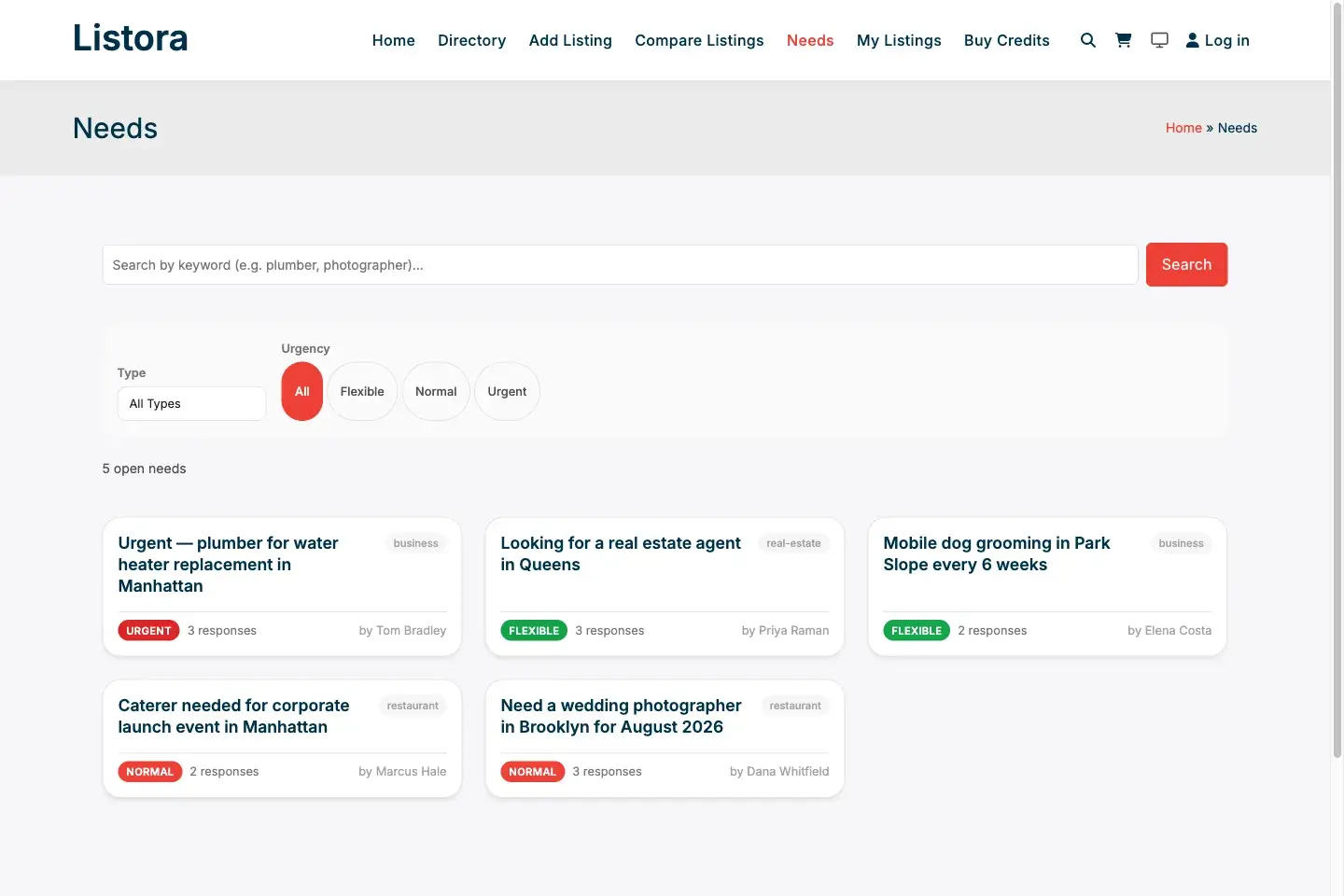
A need post in Listora’s Needs Marketplace, with a description, budget, and business responses attached directly to the post.
How this works in Listora
Listora Pro’s Needs Marketplace is built specifically as this reverse-directory layer. A visitor or member posts what they need, in plain language, with whatever detail they choose to include, and businesses already active in the directory can respond directly to that post. It runs alongside Listora’s standard ten listing types rather than replacing them, so a community can keep its normal business, restaurant, and service listings exactly as they are and add the Needs Marketplace as a second, demand-side entry point into the same pool of businesses.
That “alongside, not instead of” relationship matters more than it might first appear. A reverse directory with no underlying supply-side directory to draw responders from is just a message board, since there is no established, searchable, reviewable pool of businesses who might see a need post and respond credibly. Because Listora’s Needs Marketplace sits on top of the same businesses that already have claimed, reviewed listings in the standard directory, a need post is reaching people with an established reputation on the platform, not anonymous strangers replying to a public ad with no track record attached.
What a good need post actually looks like
The gap between a need post that gets useful responses and one that gets ignored comes down almost entirely to specificity. “Looking for a plumber” produces nothing useful, since it gives a responding business no way to judge fit before spending time replying. “Need a plumber to fix a slow leak under the kitchen sink, available weekday mornings, budget under $150 for the visit” gives a responding plumber everything they need to decide, in seconds, whether to respond at all. The second version gets faster, more relevant responses because it does the filtering work upfront instead of pushing that work onto every business that sees it.
Community sites running a Needs Marketplace should treat the need-post form itself as a place to nudge that specificity, prompting for a budget range, a timeline, and a short, concrete description rather than leaving the field entirely open-ended. A form with just one blank text box tends to produce vague posts, while a form with a few guided prompts, even simple ones like “what’s your rough budget” and “how soon do you need this done,” produces posts that are immediately actionable for anyone reading them.
It also helps to show a poster a small amount of social proof before they submit, a line noting how many businesses in the relevant category are active and typically respond within a day or two, for instance. A member who cannot tell whether anyone will actually see their post is far less likely to spend the extra minute writing a specific, useful description, while a member who knows real businesses are watching that category tends to put in the effort a good need post requires.
Moderation looks different for need posts
Standard directory listings get moderated for accuracy and spam, mostly a one-time check when the listing is submitted. Need posts require a slightly different kind of attention, since they are public requests that can attract low-quality or even predatory responses if left unmonitored. A member posting “need someone to help move a couch this weekend” is putting a small amount of personal information into a public space, timing, sometimes a rough location, and a community site running a Needs Marketplace should think about that the same way it would think about any other member-generated content with a personal-safety dimension.
In practice this usually means keeping responses visible and threaded on the post itself rather than routing them to private messages by default, so a member choosing who to work with can see a business’s full response history and reputation before agreeing to anything off-platform. It also means applying the same anti-spam protection to need posts and responses that a standard listing submission gets, since a reverse directory is just as attractive a target for spam as a normal one, sometimes more so, because a public need post with an attached budget is a more specific, higher-intent target than a static listing page.
Where this differs from a classified ad
It is worth being precise about what a reverse directory is not, because “post what you need” sounds superficially similar to a classifieds section, and the two solve different problems. A classified listing is usually a one-time transaction, selling a couch, finding a roommate, and it typically closes once matched. A need post in a reverse directory is often closer to a lead-generation request aimed specifically at the businesses already active in a directory, structured to produce responses from vetted, reviewable providers rather than from anyone who happens to see a public ad.
Listora actually offers both, with classified as one of its ten standard listing types and the Needs Marketplace as a separate Pro feature, and the difference in intent is exactly why they are separate rather than the same thing with different labels. A classified ad on a community marketplace board is fire-and-forget: post it, wait, take it down once resolved. A need post in the Needs Marketplace is closer to inviting quotes from a curated pool of local businesses, with responses, reputations, and follow-up built around it as an ongoing interaction rather than a single exchange.
The business side of the equation
A reverse directory only works if businesses actually check it and respond, which means the incentive has to be real on both sides, not just convenient for the member posting a need. For a business already claiming a listing in the standard directory, responding to relevant need posts is close to free lead generation, warmer than a cold inquiry, since the poster has already described exactly what they want and roughly what they are willing to pay, which is more qualifying information than most inbound leads ever come with.
That is also where Listora Pro’s Contact Owner lead forms and conversion tracking connect naturally to the Needs Marketplace, even though they were built as a general feature rather than something exclusive to reverse listings. A business responding to a need post is, functionally, generating a lead the same way a Contact Owner submission does on a standard listing, and having conversion tracking available across both surfaces gives a business owner one consistent way to see whether their time on the directory, in either direction, is actually converting into work.
Launching a reverse directory without it going quiet
The same cold-start problem that affects a brand-new standard directory affects a Needs Marketplace even more sharply, because a reverse directory needs both sides active at once to be useful. A need post with zero businesses following the category gets zero responses, and a member who posts once and gets nothing back will not post again. Before opening the Needs Marketplace to your whole community, make sure a meaningful set of your existing claimed business listings, ideally the ones in your most common service categories, know the feature exists and understand that responding to a relevant need post is worth their time.
A short, direct message to businesses that have already claimed a listing, explaining that the Needs Marketplace will start sending qualified leads their way and asking them to check it periodically, does more to seed activity than any amount of member-facing promotion. Once a handful of businesses are actively responding, the member side takes care of itself, since a member who posts a need and gets two or three real responses within a day becomes exactly the kind of word-of-mouth advocate who tells other members to try it too.
A worked example: a home renovation community
Picture a mid-sized community site built around home renovation, DIYers, and homeowners planning bigger projects, running on BuddyX with an active forum and a growing local business directory built on Listora. The standard directory covers the predictable categories well: general contractors, electricians, plumbers, roofers, each with claimed listings, photos, and reviews from members who have used them before. For a member who needs “an electrician” in the ordinary sense, that directory already works exactly as intended.
The gap shows up with the renovation projects that do not fit a single category cleanly. A member converting a detached garage into a home office needs someone who understands insulation, electrical, drywall, and possibly permitting, all at once, for a project too small and too specific for any single contractor listing to obviously match. Before the Needs Marketplace existed on this hypothetical site, that member’s options were browsing four separate categories hoping to get lucky, or posting a long, meandering forum thread asking “does anyone know a contractor who does this kind of thing,” which produces scattered replies from other members rather than actual bids from qualified businesses.
With the Needs Marketplace in place, that same member posts one need: “converting a detached garage into a home office, needs insulation, one new electrical circuit, and drywall finishing, budget around $8,000 to $12,000, flexible on timeline.” That post reaches every claimed business in the directory whose category matches any part of that description, and several respond within days with rough estimates and questions. The member ends up comparing three or four real responses instead of guessing which single-category contractor might also happen to handle the other two-thirds of the job. The directory did not get a new feature bolted onto its interface so much as it got a second way for a fundamentally different kind of request to reach the same pool of businesses it already had.
Reading this alongside the rest of a directory build
The Needs Marketplace is the least intuitive of the four ideas covered across this set of posts, mostly because it inverts the assumption baked into every other directory decision. If you have not yet settled the more basic question of whether your community needs a business directory at all, separate from your existing member roster, the guide to choosing between a member directory and a business directory model is the right starting point, since a reverse directory only makes sense once a standard business directory already exists to draw responders from.
If your directory is specifically local and geography-driven, adding a local business directory to a community site covers the setup work, claims, reviews, and moderation, that has to be solid before layering a Needs Marketplace on top, since a reverse directory inherits whatever quality problems already exist in the standard listings underneath it. And because most need posts include a location, at least loosely, the mapping decisions covered in OpenStreetMap versus Google Maps for a directory plugin apply here too, since showing a need’s rough location on a map can help nearby businesses prioritize which posts to respond to first.
Metrics worth tracking once it launches
A standard directory’s health is usually measured by listing count and review volume, straightforward numbers that accumulate steadily over time. A Needs Marketplace needs a different set of numbers, because the feature only works if it is actually closing the loop between a posted need and a real response. Track the percentage of need posts that get at least one business response within forty-eight hours, since a need post that sits with zero responses for a week is a failure regardless of how many total posts the marketplace has accumulated. Track which categories generate needs but get few responses, since that gap usually means either too few claimed businesses in that category or a category where the reverse model genuinely does not fit as well as expected.
Also watch for the opposite failure, a marketplace that generates plenty of responses but few members ever report the need was actually resolved. A reverse directory that produces conversation without producing outcomes is not actually solving the problem it was built for, even if the response numbers look healthy on a dashboard. Where possible, a simple “mark as resolved” action on a need post, even a lightweight one, gives you a much clearer signal of whether the feature is working than response count alone ever will.
Frequently asked questions
Is the Needs Marketplace available on Listora’s free tier?
No, the Needs Marketplace, Listora’s reverse-directory feature, is part of Listora Pro. The free tier covers the standard ten listing types with frontend submission, reviews, claims, and OpenStreetMap search, all supply-first models where businesses post listings for visitors to browse.
Can a need post be anonymous?
Handling of poster identity is a setting the site owner configures rather than a fixed behavior, and most community sites keep the poster’s community identity visible on the post, since that visibility is part of what gives responding businesses confidence they are dealing with a real member rather than an anonymous stranger.
How is a need post different from posting in a community forum asking for recommendations?
A forum recommendation thread gets replies from other members sharing their own experiences, which is valuable but informal and untracked. A need post in the Needs Marketplace is structured specifically to reach businesses that can respond with an actual offer, tracked and threaded on the post itself, closer to soliciting quotes than to crowdsourcing opinions.
Do businesses need to be claimed and verified to respond to need posts?
The Needs Marketplace draws on the same pool of businesses already active in the standard directory, so a business generally needs an existing, claimed listing to respond, which is exactly what gives a member confidence they are hearing from an established, reviewable provider rather than an unknown party replying to a public post.
What stops a Needs Marketplace from filling up with spam responses?
The same anti-spam protection covering standard listing submissions applies to need posts and responses, and because responses come from already-claimed, reviewable business listings rather than anonymous accounts, the pool of who can respond is inherently more accountable than an open public comment section would be.
Should every category in a directory get a reverse option, or just some?
Just the categories where needs are genuinely varied and hard to browse for, home services, freelance work, and local repairs are common examples. A category where listings are already fairly interchangeable, say a coffee shop directory, gets little benefit from a reverse option, since there is rarely a specific enough “need” that browsing the standard listings would not already satisfy.
A reverse directory is not a replacement for the standard listing model, it is the other half of a complete directory, the demand side sitting next to the supply side that most community sites already have. Members with an unusual, specific need stop getting lost trying to guess the right category, and the businesses already in your directory get a second, higher-intent way to find work. Get the standard directory solid first, then add the reverse layer once there is a real pool of claimed, reviewable listings for a need post to reach.