

Skool and Mighty Networks both show up near the top of every “best community platform” list, and both earned that spot honestly: Skool for its dead-simple, gamified feed-plus-courses layout, Mighty Networks for its polish and genuine depth once you’re on the right tier. Neither is a forum plugin you install on a site you already run, they’re destinations you move your whole community onto, with a monthly bill and a transaction fee attached to every dollar your members pay you.
Last updated: 6 November 2026
Quick verdict: Pick Skool for the quickest gamified community-plus-courses setup, with a 10% fee on Hobby or 2.9% on Pro. Pick Mighty Networks for more depth and lower fees, 2% down to 0.5%, at $79 to $354 a month. Pick Jetonomy when you already run WordPress and want a free forum and Q&A layer with no transaction fee.
Jetonomy is a different kind of product: a self-hosted WordPress plugin that adds a modern forum, Q&A space, ideas board, and Show & Tell space to a site you already own, starting at $0 with no transaction fee ever. It isn’t trying to replace Skool or Mighty Networks’s course-and-membership stack outright, it’s the discussion layer, and a genuinely strong one. This comparison is honest about that scope difference while still laying out exactly what each platform costs and includes.
Table of Contents
- Market snapshot
- Why These Three Get Compared
- Skool: Simple, Gamified, and a Real Transaction Fee
- Mighty Networks: Polished, Tiered, and the Branded-App Catch
- Jetonomy: Free Forum Layer, No Transaction Fee, Self-Hosted
- A Real-World Scenario
- What a Year (and Three Years) Actually Costs
- Side-by-Side Comparison
- Common Mistakes When Comparing These Three
- Who Each Platform Is Actually Built For
- How to Choose
- FAQs
- Sources
Skool’s Hobby plan charges a 10% transaction fee on every sale, dropping to 2.9% only on the $99/month Pro tier. Mighty Networks charges 2% down to 0.5% depending on plan, with branded mobile apps locked behind its custom-priced top tier. A platform’s monthly sticker price is rarely the real cost once members start paying you.
Market snapshot
- The global online community platform market was valued at USD 6.5 billion in 2025 and is projected to reach USD 15.2 billion by 2033, growing at 10.2% a year from 2027 to 2033, according to Verified Market Research. Estimates differ between research firms because they define the category differently.
- Skool lists Hobby at $9 a month with a 10% transaction fee and Pro at $99 a month with a 2.9% transaction fee, both with unlimited members, courses, videos and live calls per the Skool pricing page (checked 6 November 2026).
- Mighty Networks lists Launch at $79 a month, Scale at $179 and Growth at $354, with transaction fees of 2%, 1% and 0.5%, and a custom-priced Mighty Pro tier for branded apps per the Mighty Networks pricing page (checked 6 November 2026).
Why These Three Get Compared
Skool and Mighty Networks get cross-shopped constantly because they solve the same core problem, a feed, discussion, and some form of paid membership, from different price points and different design philosophies. Jetonomy enters this comparison from a different angle: creators and site owners who already run WordPress and want the discussion half of that equation (forums, Q&A, an ideas board for feature requests) without paying a SaaS subscription or handing a cut of every transaction to a third party.
The honest framing matters here. If you need courses, paid memberships, and a full community-platform experience in one hosted product today, Skool or Mighty Networks will get you there faster. If what you actually need is a modern, fast discussion layer on a WordPress site you already run, or already plan to pair with a course plugin like Learnomy, Jetonomy is built specifically for that, and costs nothing to start. The decision really comes down to a build-versus-rent trade-off that shows up across this entire software category, not something unique to these three products, but the gap between the hosted and self-hosted sides of it is unusually wide here because of how aggressively Skool in particular prices its entry tier while taking the largest transaction cut of any option in this comparison.
Skool: Simple, Gamified, and a Real Transaction Fee
Skool’s entire pitch is simplicity: one layout, minimal settings, a public discovery directory that can send you members without any marketing effort, and a gamified points/levels/leaderboard system that a whole generation of competitors has since copied. Hobby runs $9/month, Pro runs $99/month, and both include unlimited members, courses, videos, and live calls.
Key strengths:
- Fastest path from zero to a live, members-paying community, often under an hour
- Public discovery directory sends organic traffic with zero marketing spend
- The gamified leaderboard is genuinely engaging and well-executed
Where it falls short:
- Hobby’s 10% transaction fee is steep, and even Pro’s 2.9% (3.9% above $900/transaction) adds up fast at real revenue
- Minimal customization, by design, so a brand that needs to look distinct will feel boxed in
- No forum-style threaded discussion depth, discussions are a flat feed, not a structured Q&A or ideas board
Mighty Networks: Polished, Tiered, and the Branded-App Catch
Mighty Networks positions itself as the more serious, customizable option: Launch at $79/month (annual billing), Scale at $179/month, Growth at $354/month, and a custom-priced Mighty Pro tier. Transaction fees scale down as you move up tiers, 2% on Launch, 1% on Scale, 0.5% on Growth. Every visible tier shares the same generic Mighty Networks mobile app; a fully branded app with your own name and icon only exists on the custom-priced Mighty Pro tier, a detail that’s easy to miss when comparing the advertised $79-354/month range.
Key strengths:
- Genuinely deep customization and course tooling across its visible tiers
- Lower transaction fees than Skool at every comparable tier
- Storage and host/moderator limits scale generously with each tier
Where it falls short:
- Branded mobile apps are locked behind custom enterprise pricing, not any of the three published tiers
- Meaningfully more expensive than Skool at every published tier
- Still a hosted SaaS platform: your content lives on their domain and their infrastructure, not yours
Jetonomy: Free Forum Layer, No Transaction Fee, Self-Hosted
Jetonomy’s free tier, confirmed directly from its own pricing page, ships four space types (forum, Q&A, ideas board, Show & Tell), voting, accepted answers, trust levels 0 through 5, a moderation queue, full-text search, notifications, data importers, and 80+ REST API routes, all at $0 forever, on unlimited WordPress sites. Pro tiers (Personal $69/year for 1 site, up to Agency $199/year for unlimited sites) add emoji reactions, polls, custom badges, private messaging, AI-assisted moderation, an analytics dashboard, per-space SEO, email digests, custom fields, and announcements.

Each space type is purpose-built rather than a single generic feed repurposed for everything: the Q&A space supports a real accepted answer the community can vote to the top, the forum runs three-level threaded replies on custom database tables (not generic WordPress comments, which matters for performance as a community scales), and the ideas board lets members vote on feature requests with a built-in Planned/In Progress/Shipped roadmap status, the same kind of board a SaaS tool like Canny charges per-tracked-user for.
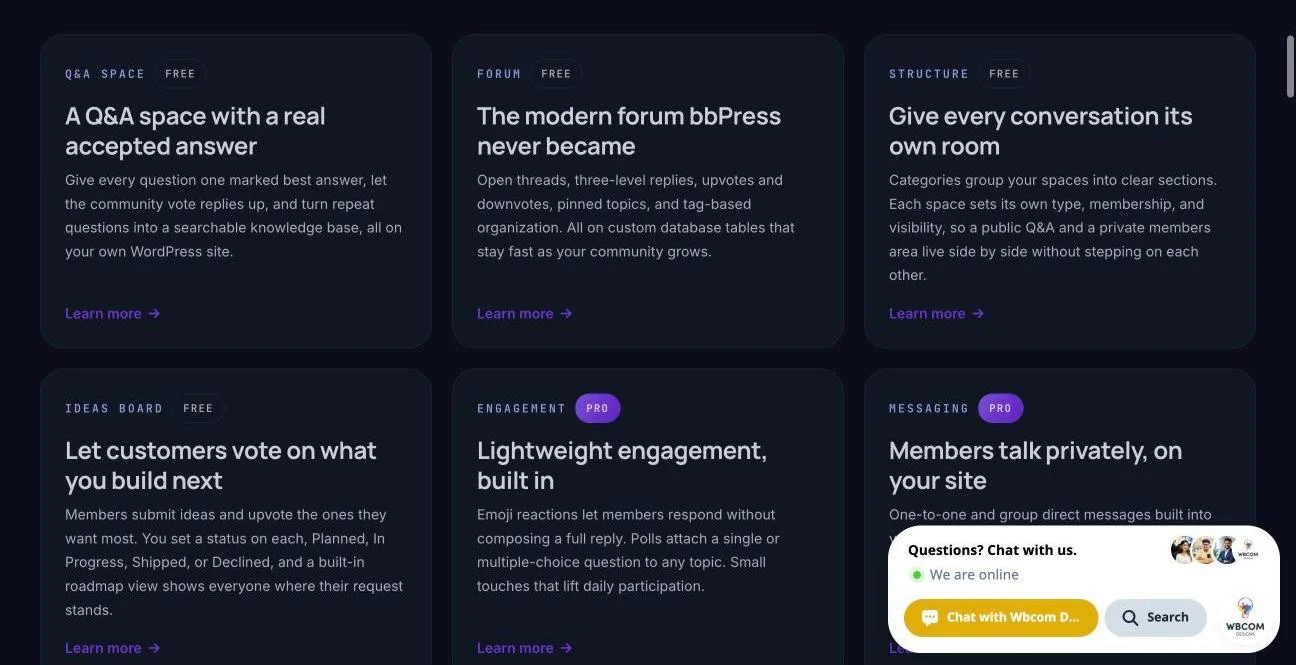
Key strengths:
- Free tier is genuinely complete, not a stripped demo, four distinct space types and 80+ REST routes at $0
- Zero transaction fee, ever, on either tier, since there’s no payment processing built into the discussion layer itself to take a cut of
- Runs on your own WordPress site and domain, so forum/Q&A content builds your own SEO authority instead of a vendor’s
Worth knowing:
- Not a full community+course+membership platform by itself, it’s the discussion layer specifically, pairs naturally with a course plugin like Learnomy or a membership layer if that’s the full stack you need
- No public discovery directory the way Skool has, discovery is your own SEO and marketing, same trade-off as any self-hosted product
- You’re responsible for WordPress hosting, though that’s typically a modest, predictable cost rather than a revenue-scaling transaction fee
A Real-World Scenario
Picture a course creator who already runs a WordPress site for their main business and content, and wants to add a community discussion space, a Q&A area where students can ask questions and see past answers, and a place for members to request features or content ideas. Starting fresh on Skool means a new $9-99/month subscription, a transaction fee on every payment, and content that lives on Skool’s domain rather than the creator’s own site, duplicating infrastructure they already have.
Installing Jetonomy instead adds the forum, Q&A, and ideas board directly onto the WordPress site the creator already owns and already gets SEO credit for, at no cost on the free tier. If they later want gamification, polls, or private messaging on top, Pro runs $69/year, still a fraction of even Skool’s cheapest tier over the same period, with zero transaction fee regardless of how much the creator eventually charges for anything sold elsewhere on the same site.
What a Year (and Three Years) Actually Costs
Skool’s Pro tier costs $1,188/year in subscription alone before transaction fees; at $5,000/month in member payments, the 2.9% fee adds roughly $1,740/year on top, for a real total near $2,928/year. Mighty Networks’s Launch tier costs $948/year (annual billing) plus a 2% transaction fee, around $1,200/year at the same $5,000/month revenue level, for a real total near $2,148/year. Jetonomy’s Pro Personal tier costs $69/year flat, with no transaction fee at any revenue level, because the product isn’t processing those payments in the first place.
| 3-year total (at $5,000/mo member revenue) | Cost |
|---|---|
| Skool Pro | ~$8,784 (subscription + 2.9% fee) |
| Mighty Networks Launch | ~$6,444 (subscription + 2% fee) |
| Jetonomy Pro Personal | $207 (flat, no transaction fee) |
Figures are approximate, based on publicly listed pricing as of October 2026. Jetonomy doesn’t process member payments itself, so this comparison isolates the discussion-platform cost specifically; a full course/membership stack built around Jetonomy would add separate checkout costs (e.g. Stripe’s own processing fees) regardless of which discussion layer sits on top.
Side-by-Side Comparison
| Skool | Mighty Networks | Jetonomy | |
|---|---|---|---|
| Entry price | $9/month | $79/month | $0, forever |
| Transaction fee | 10% down to 2.9% | 2% down to 0.5% | None, ever |
| Forum / threaded discussion | Flat feed only | Flat feed + groups | 3-level threaded, dedicated tables |
| Q&A with accepted answer | No | No | Yes, free tier |
| Ideas / feedback board | No | No | Yes, free tier |
| Branded mobile app | No | Custom tier only | Via your own WordPress PWA/API |
| Data ownership | Skool’s servers | Mighty’s servers | Your own site |
| Public discovery directory | Yes | No | No, your own SEO |
Common Mistakes When Comparing These Three
A handful of patterns show up repeatedly when creators evaluate this specific trio, and most of them cause real regret within the first year:
- Comparing Jetonomy against Skool or Mighty Networks as if they’re interchangeable. They aren’t solving the identical problem. Jetonomy is a discussion layer; the other two are full hosted community-and-course platforms. Comparing apples to apples means deciding first whether you need the full stack hosted in one place, or whether you’re building that stack yourself on WordPress.
- Ignoring the transaction fee until real revenue arrives. A 10% or even 2% cut feels abstract at zero revenue and very concrete at $10,000/month. Model the fee at the revenue you’re hoping to reach, not the revenue you have today, before choosing a platform you’ll regret scaling on.
- Assuming Jetonomy requires giving up a hosted platform’s polish entirely. A well-themed WordPress site running Jetonomy can look and feel just as modern as a hosted SaaS product; the difference is who’s responsible for that design work, not an inherent ceiling on quality.
- Underestimating what Skool’s public directory is actually worth to a brand-new community with zero audience. For someone starting from nothing, that discovery traffic is a genuinely hard thing to replicate on day one of a self-hosted WordPress site, and it’s a legitimate reason to start on a hosted platform even if the long-term plan is to self-host.
- Treating Mighty Networks’s advertised price as the real price once a branded app matters. The jump from any published tier to Mighty Pro’s custom pricing for a branded app is often the single biggest line-item surprise in this whole comparison.
Who Each Platform Is Actually Built For
Skool tends to suit people testing a community idea for the first time with no existing following and no appetite for setup decisions, especially in competitive, accountability-driven niches (fitness, sales, trading) where a visible leaderboard genuinely drives engagement. It also suits anyone who values the public discovery directory more than deep customization.
Mighty Networks tends to suit creators and brands who already have an audience from somewhere else and need a more polished, customizable home than Skool offers, and who are prepared to pay meaningfully more for that polish, with the understanding that a branded app means custom pricing eventually.
Jetonomy tends to suit anyone already running (or planning to run) a WordPress site who wants real discussion infrastructure, forums, Q&A, an ideas board, without adding a second subscription, a second login system for members, or a transaction fee on revenue the discussion layer itself has nothing to do with. It’s a particularly natural fit alongside a WordPress LMS or membership plugin, since all three can share the same login and the same domain, and it also suits SaaS or product companies who want a lightweight support or feedback community without onboarding yet another vendor contract and data-processing agreement into their stack.
How to Choose
Choose Skool if you want the fastest possible path to a live, gamified community with zero setup decisions, and you’re comfortable with a meaningful transaction fee as the trade-off for speed and its public discovery directory.
Choose Mighty Networks if you want deeper customization and lower transaction fees than Skool, and you don’t need a branded mobile app without committing to its custom-priced top tier.
Choose Jetonomy if you already run (or are building) a WordPress site and want a genuinely modern forum, Q&A, and ideas board on your own domain, with zero transaction fee, pairing it with a course or membership plugin if you need the full stack.
Summary
Skool and Mighty Networks both earn their reputations by getting a full community-and-course platform live fast, at the cost of an ongoing subscription plus a transaction fee that scales with your success. Jetonomy isn’t competing on the same axis, it’s the forum, Q&A, and ideas-board layer for a WordPress site you already run, starting at $0 with no transaction fee at any revenue level. If that’s the piece you actually need, especially paired with a course plugin for the rest of the stack, it’s worth testing before committing to a recurring SaaS bill, and since the free tier genuinely has no expiration date or feature trap, testing it costs nothing but a little setup time.
FAQs
Is Jetonomy a replacement for Skool or Mighty Networks?
Not a direct one-to-one replacement. Jetonomy is the discussion layer, forums, Q&A, ideas board, specifically, not a full course-and-membership platform. Pair it with a course plugin like Learnomy if you need that full stack on WordPress.
Does Jetonomy’s free tier expire or have usage limits?
No, it’s described as a complete community experience with no time limit or artificial restriction, confirmed directly from Jetonomy’s own pricing page. Pro tiers add specific advanced features rather than removing a usage cap.
Why does Skool’s transaction fee matter if the subscription is cheap?
Because the fee scales with your revenue, not your subscription tier. At meaningful member-payment volume, the Hobby tier’s 10% fee alone can exceed what the $9/month subscription itself costs many times over.
Does Mighty Networks have a free plan?
No, Mighty Networks offers a 14-day free trial with no credit card required, but no permanent free tier. Jetonomy’s free tier, by contrast, has no time limit.
Can I get a branded mobile app on any of these without the most expensive tier?
Not a fully custom-branded native app on Skool or Mighty Networks’s published tiers, Mighty Networks reserves that for its custom-priced Mighty Pro tier. Jetonomy’s site runs as an installable PWA through WordPress, which isn’t the same as a native app store listing but doesn’t require a custom-priced tier either.
What does Jetonomy’s ideas board actually do?
Members submit feature or content requests and vote on the ones they want most; you set a status (Planned, In Progress, Shipped, or Declined) on each, and a built-in roadmap view shows everyone where their request stands, the same category of tool a SaaS product like Canny charges per-tracked-user for.
How does Jetonomy’s forum differ from a basic WordPress comments section?
Jetonomy’s forum runs on dedicated custom database tables built for community workloads, not generic WordPress comments, supporting three-level threaded replies, upvotes/downvotes, pinned topics, and tag-based organization that stays fast as the community grows.
Is Skool or Mighty Networks better for course content specifically?
Both support video-based course content natively as part of their hosted platform, which Jetonomy doesn’t attempt to replicate, it’s a discussion-layer product. If courses are the primary need, Skool or Mighty Networks (or a dedicated WordPress LMS like Learnomy, paired with Jetonomy for discussion) are the more direct fit.
Does Jetonomy require any coding to set up?
No, it installs as a standard WordPress plugin with an admin interface for configuring spaces, permissions, and moderation. The 80+ REST routes are there for anyone who wants custom integrations, not a requirement for standard setup.
Can I migrate an existing Skool or Mighty Networks community to Jetonomy?
Jetonomy includes data importers as part of its free tier, though member migration between hosted SaaS platforms and a self-hosted WordPress plugin generally means re-inviting members to create new accounts, since passwords and platform-specific data don’t transfer between unrelated systems.
Is it worth running Jetonomy alongside a hosted platform instead of choosing one?
Not cleanly. Member identity and billing live inside each platform’s own walls, so maintaining both means duplicate logins and manually synced data. Most creators who try a hybrid setup settle on one platform fully within a few months rather than maintaining the overlap long-term.
What happens to Jetonomy’s ideas board data if I later add Pro features?
Nothing is lost or reset. Pro tiers add capabilities (polls, custom badges, analytics) on top of the existing free-tier spaces and data; upgrading doesn’t require migrating content, since it’s the same install gaining new features.
Does Jetonomy support trust levels or reputation for long-time members?
Yes, Jetonomy’s free tier includes trust levels 0 through 5, a system that can automatically grant more posting/moderation privileges to members who’ve been active and well-behaved over time, reducing how much manual moderation a growing community needs as it scales, a feature neither Skool nor Mighty Networks offers natively at any tier.
Which of the three is easiest for a non-technical community manager to run day to day?
Skool and Mighty Networks are both built for non-technical day-to-day operation out of the box, since there’s no server or plugin stack to think about. Jetonomy’s day-to-day moderation and posting experience is comparably simple once installed, the real skill difference is in the one-time WordPress setup, not ongoing community management.
How much does Skool cost in 2026?
Skool’s pricing page (checked 6 November 2026) lists Hobby at $9 a month with a 10% transaction fee and Pro at $99 a month with a 2.9% transaction fee. Both include unlimited members, courses, videos and live calls. The page advertises two months free on yearly billing.
Sources
Interesting Reads:
Circle vs Skool vs BuddyNext: Which Community Platform Should You Choose?