
Vanilla Forums shows up in enterprise community-software shortlists for a reason: mature moderation tools, SSO, deep API access, and a track record with large support communities. It also shows up in budget conversations for a reason - the Standard plan starts at $599 a month, Professional runs $1,499 a month, and that is before the $2,000-20,000 in typical implementation costs, $3,000-10,000 in customization, and $1,000-5,000 in training that rarely make it onto the pricing page.
Last updated: 6 November 2026
Quick answer: Pick Discourse or Flarum if you can run a server and want free software, or Jetonomy if your community lives on WordPress and you want a flat annual cost. Vanilla stays a sound choice when you need enterprise SSO and dedicated account management and have the budget for it.
If you are evaluating Vanilla for a support community, a product feedback hub, or a general discussion forum and the number on the invoice does not match the number on the pricing page, you are not imagining things. This guide compares six real alternatives - from other hosted platforms to self-hosted, open-source, and WordPress-native options - so you can see what each one actually costs, what it actually takes to set up, and what you get for it.
The online community management software market is valued at roughly $10 billion in 2026 and is projected to grow at a 14.9% CAGR through 2035, driven largely by enterprise demand for better customer-support and product-feedback communities - exactly the segment Vanilla Forums targets, and exactly where pricing pressure from lighter-weight alternatives is building.
Table of Contents
- Market snapshot
- Why People Look for a Vanilla Forums Alternative
- What Vanilla Forums Actually Costs
- 6 Real Vanilla Forums Alternatives
- Jetonomy: The Flat-Fee WordPress Option
- Setup Time: What Each Option Actually Takes to Launch
- A Real-World Scenario
- Side-by-Side Comparison
- Common Mistakes When Evaluating a Switch
- How to Choose
- FAQs
- Sources
Market snapshot
- The online community platform market was valued at about USD 6.5 billion in 2025 and is projected to reach USD 15.2 billion by 2033, a 10.2% annual growth rate (report updated May 2026; definitions vary between research firms), according to Verified Market Research.
Why People Look for a Vanilla Forums Alternative
Three patterns show up repeatedly in Vanilla Forums reviews and migration stories. First, sticker shock: the advertised Standard and Professional tiers are per-month figures that compound fast, and the 1,000-user cap on both tiers means a growing community needs an Enterprise conversation sooner than expected - often well before the community feels large by any normal measure. Second, implementation drag: Vanilla is not a plugin you install on an existing WordPress site, it is a separate hosted platform, which means a real integration project with its own timeline, its own single sign-on configuration, and its own budget line, distinct from whatever your main site already runs on. Third, a mismatch between Vanilla’s enterprise feature depth and what a mid-size community or a single-product support forum actually needs day to day - most teams use a fraction of an enterprise platform’s feature surface and pay for the whole thing regardless.
None of this makes Vanilla a bad product - it is built for a specific buyer with a specific budget, typically a mid-size-to-large company with a dedicated community manager and an existing enterprise software budget. It does mean a meaningful number of teams evaluating it are better served by something lighter, cheaper, or already living inside infrastructure they control. The rest of this guide is about identifying which of those profiles you are.
What Vanilla Forums Actually Costs
The published pricing is only the starting point. Here is the fuller picture based on typical deployment costs reported by buyers and implementation partners:
| Cost component | Typical range |
|---|---|
| Standard plan (up to 1,000 users) | $599/month ($7,188/year) |
| Professional plan (up to 1,000 users) | $1,499/month ($17,988/year) |
| Implementation (SMB) | $2,000-10,000 one-time |
| Implementation (enterprise) | $20,000+ one-time |
| Customization | $3,000-10,000 |
| Staff training | $1,000-5,000 |
| Typical total annual cost | $1,700-87,000 (avg. ~$22,000) |
Figures reflect publicly reported Vanilla Forums pricing and typical deployment costs as of October 2026.
The width of that average cost range is itself telling - a $1,700 to $87,000 spread means the real number depends enormously on how much customization and hand-holding your deployment needs, and very few buyers get a firm answer to that question before they sign.
6 Real Vanilla Forums Alternatives
1. Discourse
The most direct competitor in the modern, open-source forum space. Self-hosted Discourse is free software (you pay only for hosting), or you can use Discourse’s own hosted plans starting in the low hundreds per month. Strong moderation tooling, trust levels that automatically grant more privileges to established members, and a large plugin ecosystem covering SSO, analytics, and integrations with help-desk tools. The tradeoff: self-hosting Discourse well requires Docker and real sysadmin comfort, which is its own hidden cost if your team does not already have that skill in-house. Discourse’s hosted tier removes that burden but reintroduces a recurring monthly cost, just a much smaller one than Vanilla’s.
2. Flarum
Free forever, open source, no paid tiers at all. Flarum is the lightest-weight of the self-hosted options here - a single-page-app frontend, infinite scroll, mobile gestures, and an “everything is an extension” architecture where even tags and gamification are optional add-ons rather than core bloat. It has the smallest resource footprint of the major self-hosted forum platforms, which matters if you are running on modest hosting rather than a dedicated server. The cost is a smaller extension ecosystem than Discourse, slower community momentum behind third-party extensions, and the same DIY hosting/maintenance burden as Discourse - you are responsible for updates, backups, and security patching.
3. phpBB
Free under GPLv2, and genuinely the lowest cash outlay of any option on this list - it runs on shared hosting that costs a few dollars a month, no dedicated server required. Nearly 25 years of development means permissions, moderation, user management, topic organization, search, and extensions are all mature and extensively documented; whatever customization you want to attempt, someone else has almost certainly already written a guide for it. The interface and underlying architecture feel dated next to Flarum or Discourse, with less emphasis on mobile-first design, and it is a better fit for a traditional bulletin-board-style forum than a modern support or feedback community that expects a contemporary UX.
4. wpForo
A WordPress-native forum plugin with a free core and paid add-ons for deeper functionality like private messaging and advanced moderation. If your community already lives on WordPress and you want a dedicated, SEO-focused standalone forum section rather than a BuddyPress-integrated community, wpForo is a reasonable middle ground between a lightweight plugin and a full platform. It handles traditional forum structure (categories, topics, replies) well but does not natively bundle a Q&A format or an ideas/feature-request board the way some newer tools do - those require separate plugins if you need them.
5. Hosted comment and feedback tools (for lighter use cases)
If what you actually need is lighter than a full discussion forum - article comments, a simple Q&A widget, or a product feedback board - a dedicated comments or feedback tool is usually cheaper and much faster to deploy than standing up a full forum platform. These tools typically run $10-100/month depending on traffic and are worth ruling out before committing to any full forum migration, since a significant share of teams evaluating Vanilla actually need something narrower than a complete forum.
6. Jetonomy
A WordPress-native forum, Q&A, and ideas-board plugin from Wbcom Designs with a free tier and a flat annual (or lifetime) Pro license - no per-member pricing, no transaction cut, ever. Unlike wpForo, it bundles forum discussion, Q&A with accepted answers, and an ideas board with voting into one plugin rather than requiring separate add-ons for each. Covered in detail below.
Jetonomy: The Flat-Fee WordPress Option

Jetonomy runs on your own WordPress install rather than a separate hosted platform, which removes the integration project that Vanilla requires by default - there is no second login system, no separate domain or subdomain to manage, and no SSO bridge to build because your community members are already WordPress users on the same site. The free version is a complete community toolkit: forum discussions with replies, votes, pinning and tags; Q&A spaces with accepted-answer sorting; an ideas board with member voting and status tracking; a Show & Tell feed for member work; trust levels and reputation; search; moderation tools; and one-click importers from bbPress, wpForo, and Asgaros for anyone migrating an existing WordPress-based forum.

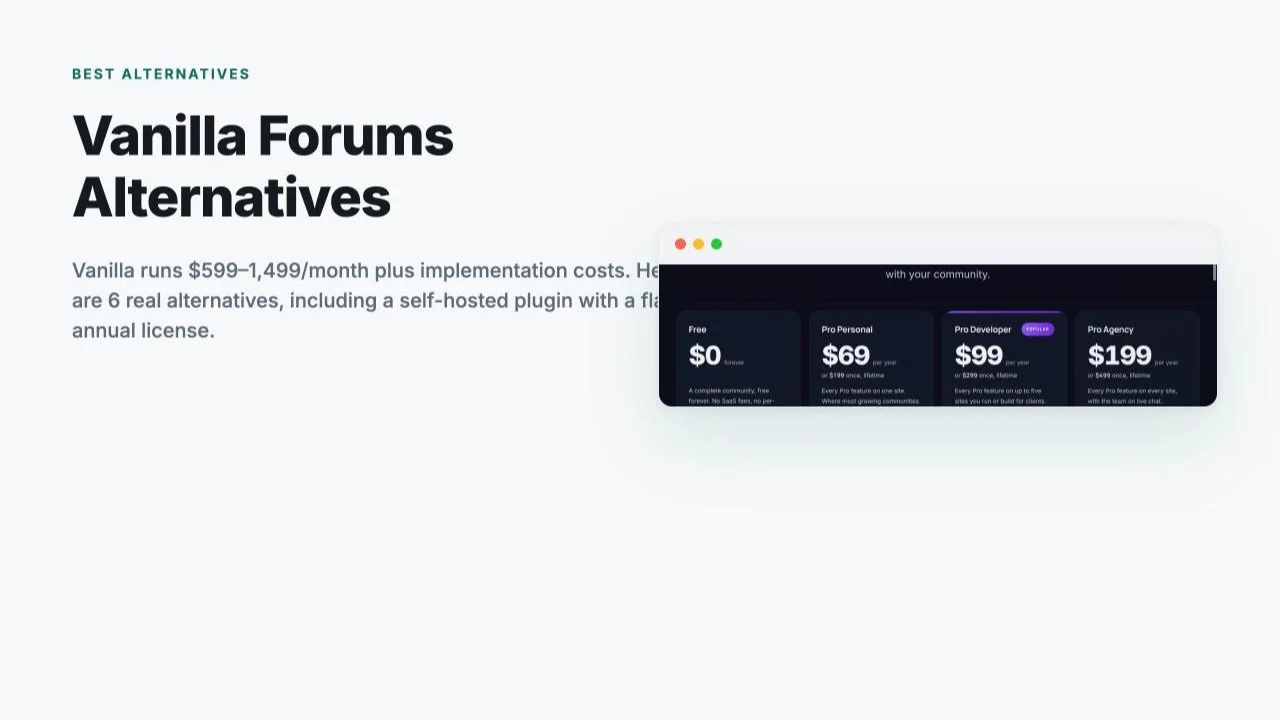
Pro adds emoji reactions, private 1:1 and group messaging, single/multi-select polls, custom badges with earn conditions, AI moderation with content scoring, an analytics dashboard, email digests, and per-space SEO optimization. Pricing is $69/year for one site (or $199 lifetime), $99/year for up to five sites (or $299 lifetime), and $199/year for unlimited sites (or $499 lifetime), each backed by a 30-day money-back guarantee. A full Pro Agency license at $199/year costs less than three weeks of Vanilla’s Standard plan, and less than two days of its Professional plan.
Setup Time: What Each Option Actually Takes to Launch
Pricing tells only part of the story - how long it takes to actually get a community live matters just as much, especially for a small team without a dedicated implementation specialist. Vanilla’s SaaS model means the platform itself is technically live quickly, but the real clock starts with configuring SSO against your existing user base, customizing the theme to match your brand, and training moderators on an unfamiliar admin interface; buyers commonly report four to eight weeks from contract signing to a fully configured, branded launch.
Discourse and Flarum, self-hosted, can technically be running within an afternoon if your team is comfortable with Docker and server administration - but “running” and “production-ready with backups, monitoring, and a tested update process” are different milestones, and the gap between them is where most of the real setup time goes. phpBB and wpForo, installed as more traditional software on shared or WordPress hosting, typically land somewhere in between: faster than Vanilla’s enterprise onboarding, slower than a true one-click install.
Jetonomy’s setup time benefits directly from running on infrastructure you already operate: install the plugin, and because site members already exist as WordPress users, there is no separate account system to provision. A small community can be live with the free tier the same day, and the one-click bbPress/wpForo/Asgaros importers mean a team migrating from one of those plugins specifically does not need to re-create content or user history by hand.
A Real-World Scenario
Picture a SaaS company with 400 active users in its support community, currently on Vanilla’s Standard plan at $599/month ($7,188/year), plus the $5,000 implementation project it took to get live two years ago. The community has not outgrown what it actually uses day to day - threaded discussion, basic moderation, search - but the bill keeps arriving every month regardless, and the finance team has started asking pointed questions during the annual software-spend review.
Moving that same community to Jetonomy on the company’s existing WordPress marketing site means no new platform to host, no separate login system, and a Pro Developer license at $99/year covering up to five sites if the company runs a docs site and a community site separately. The one-click importers do not directly import from Vanilla, so a migration would mean exporting Vanilla’s data via its API and mapping it into WordPress - a real project, best scoped with a developer over a few weeks, but a one-time cost against a recurring $7,188+/year savings from year two onward. At that rate, the migration project pays for itself inside the first year and keeps paying every year after.
Side-by-Side Comparison
| Vanilla Forums | Discourse | Flarum | Jetonomy | |
|---|---|---|---|---|
| Starting price | $599/month | Free (self-hosted) | Free, always | Free, Pro from $69/yr |
| Runs on WordPress | No | No | No | Yes, native plugin |
| Q&A + ideas board | Add-on | Via plugin | Via extension | Built in, free tier |
| Hosting required | Included (SaaS) | Self-managed | Self-managed | Your existing WP host |
| One-click forum importer | No | Limited | Limited | bbPress, wpForo, Asgaros |
| 5-site license | Not offered | N/A (self-hosted) | N/A (self-hosted) | $99/year |
| Typical time to launch | 4-8 weeks | Hours to days | Hours to days | Same day (free tier) |
Common Mistakes When Evaluating a Switch
Teams comparing Vanilla against cheaper alternatives tend to make the same few errors. The first is comparing only the sticker price and ignoring implementation, customization, and training costs entirely - which is exactly why the real cost table above exists, since the gap between $599/month and the true first-year total is often several times larger than the subscription fee alone. The second is underestimating the ongoing maintenance burden of a self-hosted option like Discourse or Flarum; “free software” still needs someone to apply updates, monitor uptime, and handle backups, and that person’s time has a real cost even if no invoice shows up for it.
The third mistake is migrating a forum before confirming what data actually needs to move. Many teams discover mid-migration that years-old threads with zero recent engagement don’t need a perfect 1:1 import - archiving old content as static pages while starting fresh discussion on the new platform is often faster and cheaper than a full historical migration, and it is worth deciding this upfront rather than during the project. The fourth is picking a platform based on feature checklists rather than who will actually administer it day to day; a plugin that lives inside WordPress, where your team already has login credentials and familiarity with the admin dashboard, has a real adoption advantage over a separate platform with its own learning curve, even when the separate platform’s feature list looks longer on paper. The fifth, specific to Jetonomy and the other WordPress-native options, is forgetting to check theme and plugin compatibility before committing - a forum plugin that clashes visually with your existing site design creates its own, smaller-scale version of the customization cost that made Vanilla expensive in the first place.
How to Choose
If you need enterprise SSO, dedicated account management, and your organization has the budget line for it, Vanilla remains a legitimate, well-supported choice, particularly at a company scale where a dedicated community manager and IT support staff already exist. If you are comfortable managing your own server and want the most flexible open-source option, Discourse or Flarum are both strong, genuinely free self-hosted platforms, with Discourse favoring ecosystem breadth and Flarum favoring a lighter footprint. If your community is already going to live on a WordPress site - a product site, a documentation hub, a membership community - Jetonomy removes the separate-platform problem entirely and keeps the cost at a flat annual license instead of a recurring per-month enterprise bill that climbs as your community succeeds.
Try Jetonomy Free
A complete forum, Q&A, and ideas board for WordPress - free forever, with Pro starting at $69/year.
Get Jetonomy FreeSummary
Vanilla Forums earns its enterprise pricing through genuine depth - SSO, dedicated support, and infrastructure built for very large communities. But that depth is wasted budget for a mid-size support forum or a product feedback board that needs threaded discussion, search, and solid moderation and nothing more. Discourse and Flarum are both excellent free self-hosted options if you can manage a server, and phpBB remains the lowest-cost traditional forum for teams who don’t mind an older interface. If your community already lives, or should live, on WordPress, Jetonomy gets you the same core toolkit - forum, Q&A, ideas board, Show & Tell - without a separate platform to manage or a monthly bill that scales with your success.
Start with the free tier on whichever option fits your hosting comfort level, and upgrade only once you hit a feature you genuinely need - not because a sales conversation told you to.
FAQs
How much does Vanilla Forums actually cost per year?
The Standard plan is $7,188/year and Professional is $17,988/year, both capped at 1,000 users. Add typical implementation ($2,000-20,000), customization ($3,000-10,000), and training ($1,000-5,000) costs, and the real first-year total commonly lands between $10,000 and $40,000+ depending on deployment complexity.
Is Discourse really free?
Self-hosting Discourse’s open-source software is free - you pay only for server hosting. Discourse also sells its own hosted plans if you would rather not manage the server yourself, starting in the low hundreds per month.
Can I migrate my existing Vanilla Forums data to another platform?
Vanilla does not offer a direct one-click export to any of the alternatives listed here. Migration typically means exporting your data via Vanilla’s API or database export tools and mapping it into the new platform’s import format - a real project, usually best scoped with a developer.
Does Jetonomy work without BuddyPress?
Yes. Jetonomy runs as a standalone WordPress plugin and does not require BuddyPress, though it does integrate with it if you already run a BuddyPress-based community.
What is the real difference between Flarum and phpBB?
Flarum is a modern, single-page-app forum with a lighter resource footprint and an extension-based architecture, built in the last several years. phpBB is nearly 25 years old, more traditional in design, and has the largest, most mature ecosystem of extensions and documentation of any open-source forum software.
Does Jetonomy support SSO like Vanilla’s enterprise tier?
Jetonomy relies on WordPress’s own authentication system, which supports SSO through standard WordPress SSO plugins. It is not a built-in enterprise SSO feature the way Vanilla markets it, but it is achievable on WordPress with existing tooling.
Is a 1,000-user cap actually a hard limit on Vanilla’s lower tiers?
Yes, both the Standard and Professional plans are capped at 1,000 users; growing past that requires moving to Vanilla’s custom-priced Enterprise tier.
Which alternative is best for a pure product-feedback/ideas board instead of a full forum?
Jetonomy’s free tier includes a dedicated ideas board with member voting and status tracking out of the box, which covers this use case without needing a separate tool.
Do any of these alternatives charge a transaction fee like some community platforms do?
No. None of the forum-specific tools compared here (Vanilla, Discourse, Flarum, phpBB, wpForo, Jetonomy) charge a percentage-based transaction fee; that pricing model is more common on all-in-one community/course platforms, not dedicated forum software.
How long does a typical Vanilla-to-self-hosted migration take?
This varies heavily by community size and customization level, but a mid-size community (a few thousand threads) migrating with developer help typically takes several weeks from data export through testing to going live, not a weekend project.
Sources
Interesting Reads:
Best Canny Alternatives in 2026
Self-Hosted Job Board vs SaaS: What Actually Costs Less Long-Term