

The best WordPress image compression plugins in 2026 are ShortPixel, Smush, Imagify, EWWW Image Optimizer, and Optimole. All five automatically compress images on upload, support WebP conversion, and include bulk optimization for existing media libraries. ShortPixel is the top pick for most sites thanks to its balance of compression quality, pricing, and ease of use. According to Google, a one-second delay in page load time can reduce conversions by 7%, getting your images optimized is one of the fastest ways to recover that performance.
Most WordPress sites carry more image weight than they need to. A blog post with six uncompressed screenshots, a product page with a dozen high-resolution photos, or a portfolio site stacked with full-size JPEGs can easily push page weight past 5MB. Visitors on mobile connections feel that immediately. Search engines notice it too. The plugins below handle the compression work automatically, so you don’t have to run every upload through a separate tool before it goes live.
Why Image Optimization is Essential for Website Performance
Image optimization plays a critical role in website performance, directly influencing loading times, user experience, and SEO rankings. Websites with large image files take longer to load, which frustrates visitors and leads to higher bounce rates. Studies show that 47% of users expect a webpage to load in two seconds or less, and even a small delay can reduce conversion rates significantly. Search engines like Google factor site speed into rankings, so optimizing your images directly impacts your SEO. By compressing and resizing images without compromising quality, you enhance your website’s speed, accessibility, and overall performance.
Unoptimized images are usually the single biggest contributor to a slow Largest Contentful Paint score, which is one of Google’s core web vitals. A hero image that loads three seconds late can drag your entire page’s performance grade down, even if every other asset on the page is fast. Fixing that doesn’t require a developer or a rebuild. Installing a compression plugin, running the bulk optimizer once against your media library, and letting automatic compression handle new uploads from then on solves most of the problem in an afternoon.
There’s a tradeoff worth understanding before you pick a tool. Lossless compression strips metadata and recompresses the file without touching visible quality, so the file gets smaller but you won’t see any difference in the image itself. Lossy compression goes further, discarding some image data to shrink the file more aggressively, which can introduce very slight quality loss at high compression levels. Most of the plugins below let you choose between the two, or set a middle ground, so you can decide how much you’re willing to trade for file size.
Best WordPress Image Compression Plugins
Here are the best WordPress image compression plugins to consider in 2026:
1. ShortPixel

ShortPixel is a popular WordPress image compression plugin that uses advanced algorithms to compress images without sacrificing visual quality. The plugin offers both lossy and lossless compression options, letting you choose the right compression level for your site.
ShortPixel automatically compresses images as they are uploaded, and it can also optimize images uploaded before installation. It includes a bulk compression feature that compresses all existing images at once.
What sets ShortPixel apart from most competitors on this list is how granular the control is. You can set a global compression level and then override it per image, which matters if you run a photography site or portfolio where a handful of hero shots need to stay closer to lossless while the rest of the library can take a more aggressive setting. The plugin also processes PDFs, which none of the free image-only tools handle.
- Resizing: Automatically resizes images to fit specific dimensions.
- WebP conversion: Converts images to the WebP format for further file size reduction.
- Image backups: Automatically backs up all compressed images so you can restore them if needed.
ShortPixel offers a free version as well as paid plans with additional features including PDF compression and page builder integration. For most small to mid-sized sites, the free tier’s monthly image allowance is enough to keep new uploads compressed without ever touching a paid plan, and the bulk optimizer can be run in batches over several days to work through a large existing library within that same free allowance.
2. Smush

Smush is a popular plugin developed by WPMU DEV. It uses lossless compression techniques to optimize images, reducing file size without sacrificing visual quality. Smush automatically compresses images on upload and includes bulk compression for existing media.
Smush has been around long enough that it’s the default recommendation in a lot of WordPress agency workflows, mostly because the free version is genuinely capable rather than a stripped-down trial. It caps individual file size reductions at 5MB per image on the free tier, which covers the vast majority of blog and content site use cases without ever prompting an upgrade.
- Lazy loading: Images load only when they come into view, reducing initial page load times.
- Automatic resizing: Resizes images to configured dimensions to reduce file size further.
- WebP conversion: Converts images to the more efficient WebP format.
Smush offers a free version and a Pro version with bulk smushing and page builder integration. The Pro tier also adds a CDN option, which is worth considering if your site serves visitors across multiple regions and you want images delivered from a server geographically close to each one.
3. Imagify
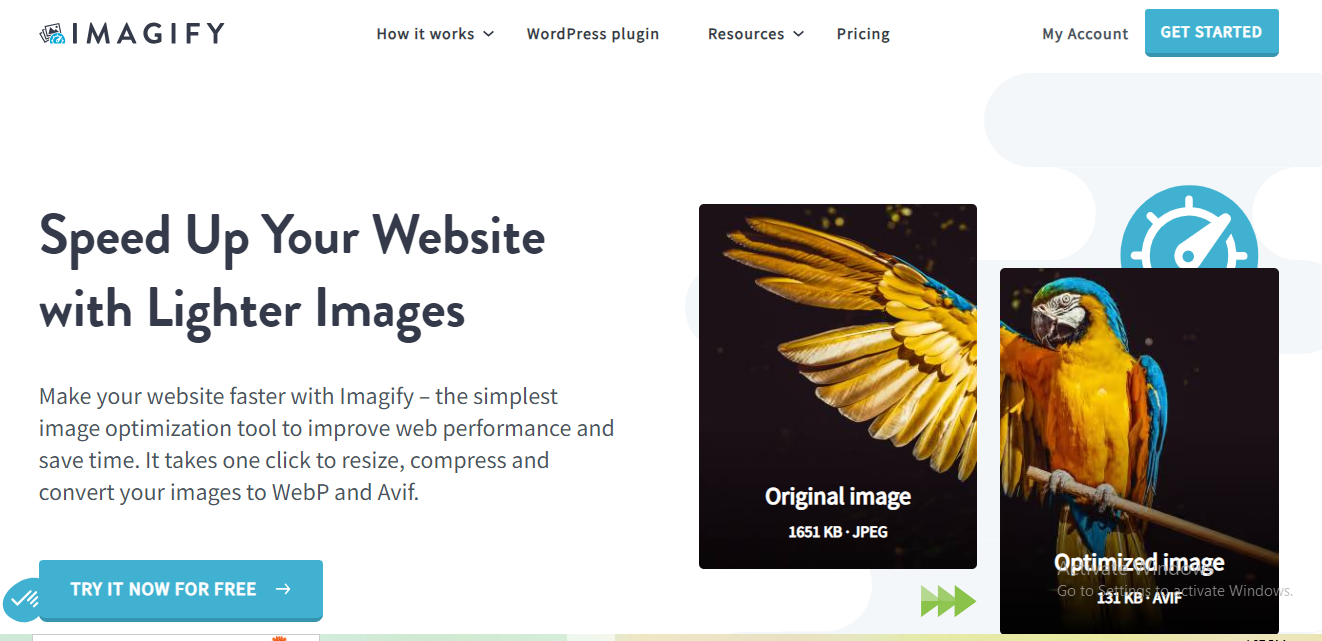
Imagify is developed by WP Media and uses a combination of lossy and lossless compression techniques to reduce image file sizes without sacrificing visual quality. It automatically compresses images on upload and supports bulk optimization.
Imagify comes from the same team behind WP Rocket, which shows in how the settings are organized. There are three compression levels to pick from, normal, aggressive, and ultra, and the plugin shows you a live preview of the quality difference before you commit to a setting for your whole library. That preview step saves a lot of guesswork compared to plugins that only let you judge compression after the fact.
- WebP conversion: Converts images to WebP for additional file size savings.
- Resizing: Automatically resizes images to configured dimensions.
- Image backups: Creates backups of compressed images for easy restoration.
Imagify offers a free tier and paid plans with PDF compression and page builder integration. If you’re already running WP Rocket for caching, Imagify tends to be the more natural pairing since both plugins share the same account dashboard.
4. EWWW Image Optimizer
EWWW Image Optimizer offers both lossy and lossless compression options. It automatically compresses images on upload, supports bulk optimization for existing media, and runs compression locally on your server, meaning no images are sent to external servers.
That local processing is the plugin’s defining feature. Every other tool on this list uploads your images to a cloud service for compression and sends the optimized version back down. EWWW does the work on your own hosting instead, which matters for sites with strict data policies or hosts that restrict outbound API calls. The tradeoff is that compression speed depends on your server’s own processing power rather than a dedicated compression cluster, so very large batch jobs can take longer on modest shared hosting.
- Resizing: Automatically resizes images to configured dimensions.
- WebP conversion: Converts images to WebP format.
- Lazy loading: Loads images only as they scroll into view to improve page speed.
EWWW Image Optimizer offers a free version and paid plans with backup, restore, and page builder integrations. There’s also a paid cloud compression add-on if you’d rather offload the processing after all, which gives you the choice EWWW’s competitors don’t offer.
5. Optimole

Optimole uses a cloud-based service to automatically compress and optimize images. It is lightweight and easy to configure, and it automatically compresses images both on upload and for existing media.
Optimole works differently from the other plugins here in one important way: nothing is precompressed and stored on your server. Instead, images are served through Optimole’s CDN and compressed on the fly to match each visitor’s device, screen size, and connection speed. A visitor on a small phone screen gets a smaller file than someone on a 4K monitor, without you having to generate multiple versions manually.
- Resizing: Automatically resizes images to fit the visitor’s screen dimensions.
- WebP conversion: Converts images to WebP for better compression.
- CDN integration: Delivers optimized images through a global CDN for faster delivery worldwide.
Optimole offers a free version and paid plans with additional features and bandwidth allowances. Because pricing on the paid tiers scales with visitor bandwidth rather than image count, it’s worth checking your traffic numbers before committing if your site gets significant monthly visits.
6. WP Compress

WP Compress offers both lossy and lossless compression and is designed to be fast and straightforward to use. It automatically compresses images on upload and includes bulk compression for existing media.
WP Compress leans on adaptive compression, meaning it adjusts the compression level based on the visitor’s device and connection rather than applying one fixed setting to everyone. It also bundles minification for CSS and JavaScript files into its paid plans, so if your bottleneck isn’t only images, it can address more of the page weight problem from a single dashboard.
- Resizing: Resizes images to configured dimensions automatically.
- WebP conversion: Converts images to WebP for additional file size savings.
- Lazy loading: Loads images only as needed to improve page speed.
- Backup and restore: Lets you easily restore original images when needed.
WP Compress offers a free version and paid plans with page builder integrations and custom compression settings. It’s a reasonable option if you want image compression and basic asset minification handled by the same tool instead of running two separate plugins.
7. Compress JPEG & PNG images

Compress JPEG & PNG images automatically compresses and optimizes images using advanced compression algorithms that reduce file size without sacrificing quality. It compresses images on upload and supports bulk compression for the existing media library.
This plugin is built on the same TinyPNG compression engine that powers one of the most widely used standalone image compressors on the web, so if you’ve ever dragged files into TinyPNG’s browser tool, the results here will look familiar. It keeps the interface deliberately simple, which makes it a good fit for site owners who just want compression to happen without configuring compression levels or resize rules.
- Resizing: Automatically resizes images to configured dimensions.
- WebP conversion: Converts images to WebP format for additional size savings.
- Backup and restore: Lets you restore original images at any time.
Available as a free plugin with paid plans for additional page builder integrations and custom compression settings.
Lossy vs Lossless: What Actually Happens to Your Images
It helps to understand what these plugins are doing under the hood before picking one. A JPEG or PNG file carries a lot of information that a browser never actually needs to display the picture correctly. Metadata like camera model, GPS coordinates, color profile details, and editing history gets embedded in the file automatically by cameras and editing software. Lossless compression strips all of that out and reorganizes the remaining pixel data more efficiently. Nothing about the visible image changes, but the file can shrink by 20 to 30% just from that cleanup.
Lossy compression goes a step further by simplifying the pixel data itself. It groups similar colors together and discards fine detail the human eye is unlikely to notice, especially in areas like skies, shadows, and gradients. Pushed too far, this shows up as visible blocking or banding, which is why every plugin on this list gives you a compression level slider rather than applying maximum compression by default. A setting in the middle of the range typically shrinks a file by 60 to 80% with no visible quality loss on a normal screen.
The right setting depends on what the image is for. A background texture or decorative graphic can usually take aggressive lossy compression without anyone noticing. A product photo on an e-commerce listing, where customers might zoom in to check texture and detail, deserves a more conservative setting. This is exactly why ShortPixel’s per-image override and Imagify’s live preview are worth paying attention to rather than just accepting whatever the plugin sets as its global default.
What Unoptimized Images Actually Cost You
The performance impact isn’t abstract. A typical unedited photo straight from a modern smartphone camera runs 3 to 8MB. Multiply that by even a modest blog post with four or five images and you’re asking a visitor’s browser to download 20MB or more before the page finishes rendering, on top of your theme’s CSS, JavaScript, and fonts. On a fast fiber connection that’s barely noticeable. On a mobile connection in a weak signal area, it can mean the difference between a page that loads in three seconds and one that takes fifteen.
That gap shows up directly in analytics. Pages that load slowly see higher exit rates before the visitor ever reads the content, and Google’s Core Web Vitals report in Search Console will flag pages with poor Largest Contentful Paint scores, which then factors into how those pages get treated in search rankings. Running your existing media library through a bulk compression pass is one of the few technical SEO fixes that produces a measurable result within days rather than months.
How to Choose the Right Plugin for Your Site
Start with how much control you want over compression quality. If you’re running a photography or design portfolio where visual fidelity matters more than file size, ShortPixel’s per-image override or Imagify’s live preview will save you from over-compressing your best work. If you just want new uploads handled automatically without thinking about it, Smush or Compress JPEG & PNG images get out of your way faster.
Server location and data policy matter more than people expect. EWWW is the only plugin here that compresses locally instead of routing images through a third-party cloud service, which is worth knowing if your organization has restrictions on where media can be processed. Everyone else, including ShortPixel, Imagify, Smush’s cloud features, Optimole, and WP Compress, sends images to an external API for processing.
Traffic volume changes the calculation for cloud-CDN tools like Optimole, where pricing scales with bandwidth rather than image count. A high-traffic site with a modest media library might pay more on Optimole than on a plugin that charges per image, and the reverse is true for a large media library with modest traffic.
Finally, check what else the plugin bundles. WP Compress adds CSS and JavaScript minification on its paid tiers, Smush Pro adds a CDN, and several of these tools include PDF compression on their paid plans. If you’re already paying for a caching plugin like WP Rocket or a CDN through your host, some of that overlap might already be covered elsewhere, and a simpler image-only tool could be the more cost-effective pick.

Common Questions About WordPress Image Compression
Does image compression affect image quality? Lossless compression doesn’t change how an image looks at all, it only strips unnecessary data. Lossy compression can introduce a small quality reduction at aggressive settings, but most plugins default to a level where the difference isn’t noticeable to visitors.
Do these plugins compress images already in the media library, or only new uploads? All seven plugins listed here include a bulk optimization tool that works through your existing media library, in addition to compressing new uploads automatically going forward.
Is WebP conversion necessary? WebP files are typically 25 to 35% smaller than equivalent JPEG or PNG files at similar visual quality, and every modern browser supports the format now, so there’s little reason to skip it if the plugin offers it.
Can I use more than one image compression plugin at once? Running two compression plugins together usually causes conflicts, since both will try to hook into the same upload process. Pick one and disable the others.
Optimizing your images with the right WordPress image compression plugin is one of the most direct ways to improve website performance. By reducing image file sizes without sacrificing quality, you improve load times, boost SEO rankings, and give visitors a better experience. Whether you’re running an e-commerce site, a blog, or a portfolio, these plugins keep your site fast, efficient, and responsive in 2026.
Interesting Reads:
10 Essential Free And Premium WordPress Plugins