
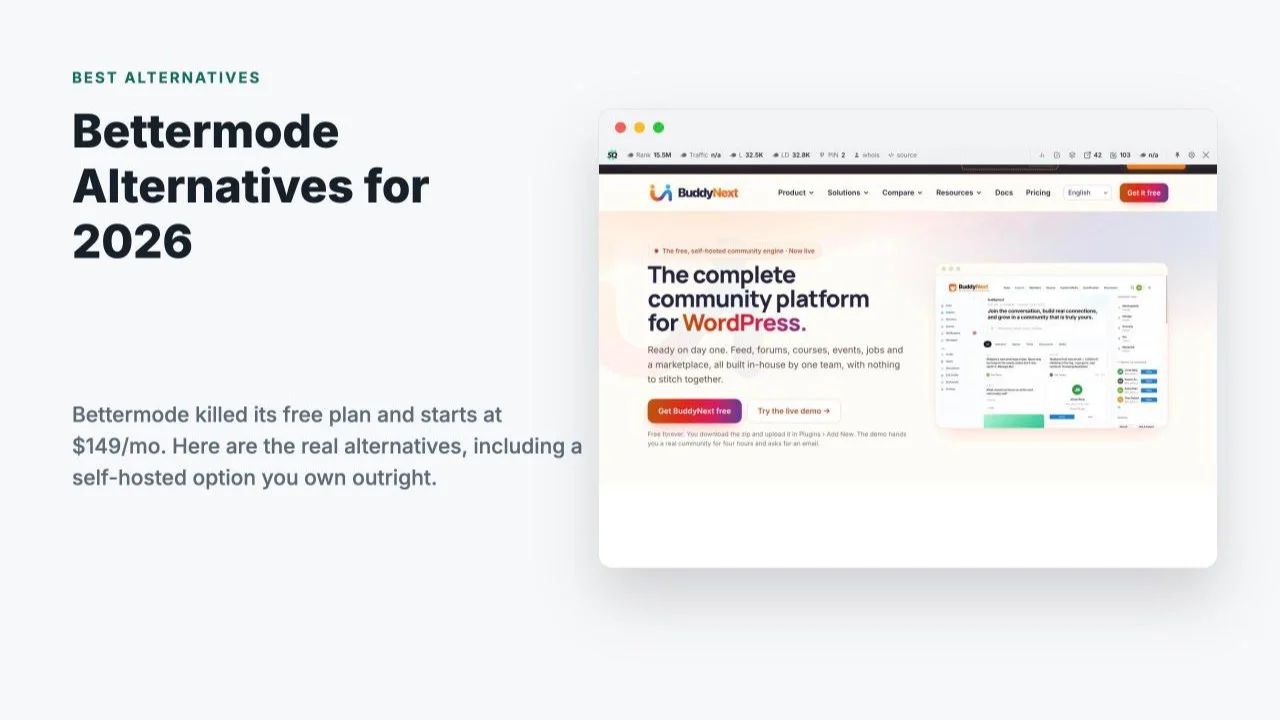
Bettermode, the community platform formerly known as Tribe before its 2022 rebrand, retired its free plan in March 2026. The entry tier now starts at $149 a month for up to 10,000 members - before you’ve added a single integration or custom domain for outbound email. For a creator or small team evaluating community software, that’s a real floor to clear before the platform has proven anything.
Last updated: 6 November 2026
Quick answer: If you want a polished hosted community, pick Circle or Mighty Networks; for the cheapest fast start, Skool; for proven forum software, Discourse. If you run WordPress and want no per-member fee, BuddyNext is the self-hosted option. Bettermode is now aimed at mid-market and enterprise teams.
This guide covers seven real alternatives to Bettermode, from other hosted SaaS platforms to a self-hosted option you install on your own WordPress site and own outright, no monthly per-member fee at any size.
The global community platform market is projected to grow from roughly $2.94 billion in 2026 to $10.18 billion by 2035, a 14.8% CAGR, as more businesses move customer and member engagement off social media onto owned platforms. Pricing pressure at the high end, like Bettermode’s March 2026 move, is pushing a growing share of that demand toward cheaper SaaS options and self-hosted software.
Table of Contents
- Market snapshot
- Why People Look for a Bettermode Alternative
- Circle
- Discourse
- BuddyBoss
- Mighty Networks
- Skool
- Khoros
- BuddyNext
- A Real-World Scenario: Leaving Bettermode Behind
- A Migration Checklist Before You Switch
- What Unpredictable Growth Does to SaaS Pricing
- What a Year Actually Costs
- Comparison Table
- How to Choose
- FAQs
- Sources
Market snapshot
- The online community platform market was valued at about USD 6.5 billion in 2025 and is projected to reach USD 15.2 billion by 2033, a 10.2% annual growth rate (report updated May 2026; definitions vary between research firms), according to Verified Market Research.
Why People Look for a Bettermode Alternative
Bettermode is a genuinely capable platform - customizable forums, a knowledge base, gamification, and a real integration library, positioned for customer and product communities rather than solo-creator audiences. The problem for most searchers isn’t the feature set, it’s the price floor. $149/month annual (or $199 monthly) before you’ve validated whether your community will retain members is a hard ask for a new project, and the next tier up, Growth at $1,500/month, is squarely enterprise pricing. If you’re building a customer community for an established SaaS product with budget to match, Bettermode may be the right tool. If you’re not there yet, or never will be at that budget, the alternatives below cover a much wider range of situations.
There’s also a second, quieter reason people look elsewhere: Bettermode’s March 2026 repricing wasn’t an isolated event. Several SaaS community platforms have tightened free tiers or raised entry pricing over the past two years as the category matured and investors pushed for better unit economics. A platform’s pricing today is not a permanent guarantee, and anyone who has watched a tool they depend on reprice mid-contract has reason to weigh that risk into the decision, not just the feature list.
The real lesson of Bettermode’s 2026 repricing isn’t “avoid Bettermode” - it’s that any SaaS community platform can change the deal after your community has already grown dependent on it. That risk is worth pricing into the decision up front, not discovering after the fact.
Circle
Circle is the most direct SaaS competitor to Bettermode in feel and polish. Pricing: Professional $89/month annual (unlimited members, 3 admins, 10 moderators, 20 spaces, 2% transaction fee), Business $199/month annual (5 admins, 15 moderators, 30 spaces, 1% fee), Scale $419/month, and a custom Circle Plus tier. No free plan - only a 14-day trial.
Key strengths: polished, modern UI that courses and cohort-based programs lean on heavily; strong native course/content delivery alongside community spaces; large existing creator ecosystem and documentation; live streaming and events are first-class rather than bolted on.
Where it falls short: still SaaS pricing that climbs fast with admin/moderator counts; transaction fees on top of the subscription; you don’t own the platform or the data infrastructure it runs on, and migrating away later means rebuilding on someone else’s terms.
Discourse
Discourse is open-source forum software, self-hostable for free (you cover your own server) or available as hosted plans starting around $25-50/month for small communities, scaling with traffic and support level.
Key strengths: mature, battle-tested forum software running some of the largest public communities online; genuinely free to self-host; strong moderation tooling built from years of real abuse patterns; excellent plugin ecosystem for niche extensions.
Where it falls short: forum-first design, not built for profiles/spaces/courses the way Bettermode or Circle are; self-hosting Discourse well requires real server/DevOps comfort (Docker, reverse proxies, backups), it’s not a one-click WordPress plugin; the UI feels more utilitarian than the polished SaaS options.
BuddyBoss
BuddyBoss is a WordPress-based community and course platform, a fork of BuddyPress with its own app builder and LMS integration. Platform pricing runs roughly $228-468/year depending on tier and site count, plus optional app-builder costs for native mobile apps.
Key strengths: deep BuddyPress lineage means mature community features (groups, activity feeds, profiles); strong native mobile app offering; large existing plugin/theme ecosystem; genuine LMS integration for course-plus-community sites.
Where it falls short: annual licensing cost recurs indefinitely even though it’s self-hosted; app-builder costs add up fast for teams wanting branded mobile apps; built on an older BuddyPress architecture rather than a from-scratch modern codebase, which shows in some performance and customization edges.
Mighty Networks
Mighty Networks: Launch $79/month annual (unlimited members, 3 hosts, 10 moderators, 200GB storage, 2% transaction fee), Scale $179/month (5 hosts, 15 moderators, 500GB, 1% fee), Growth $354/month (10 hosts, 100 moderators, 1TB, 0.5% fee), Mighty Pro custom-priced for branded native apps.
Key strengths: strong course + community + events combination in one platform; generic iOS/Android apps included on all tiers; genuinely polished member experience; good for multi-format content (live, async, courses) in one space.
Where it falls short: branded native apps require the custom-priced Mighty Pro tier; transaction fees scale down slowly compared to the subscription cost itself; still meaningfully more expensive than Mighty’s own entry tier once you need more than 3 hosts or 10 moderators.
Skool
Skool: Hobby $9/month ($7.50 annual) with a steep 10% + $0.30 transaction fee, Pro $99/month ($82 annual) dropping the fee to 2.9% + $0.30 up to $899 in a single transaction (3.9% above that). Both tiers include unlimited members, courses, videos, and live calls.
Key strengths: genuinely the cheapest entry point on this list at $9/month; simple, gamified UI (points, levels, leaderboard) that drives real engagement for course-and-community hybrids; fast to launch, minimal setup decisions to make.
Where it falls short: the Hobby plan’s 10% transaction fee is brutal once you’re actually selling memberships at volume - Pro’s lower fee requires the $99/month jump; limited customization compared to Bettermode or Circle; no real self-hosting path at any tier, and no data export path that preserves the full community structure.
Khoros
Khoros Communities is the enterprise end of this category: no public pricing, custom quotes, with Communities module contracts running $75,000-200,000/year mid-market and $300,000+ enterprise. Included for context, not as a realistic option for most searchers coming from Bettermode.
Key strengths: built for the largest brands’ customer communities at massive scale, with enterprise SSO, compliance, and support SLAs most SaaS platforms on this list don’t offer at any price.
Where it falls short: pricing and sales process is built for enterprise procurement, not a team evaluating a $149-199/month platform. If Bettermode felt expensive, Khoros is a different budget conversation entirely, typically involving a multi-month sales cycle.
BuddyNext
BuddyNext is a self-hosted community platform for WordPress - you install it on your own site and own the code and the data outright, with no per-member SaaS subscription at any size. It ships with an activity feed, member profiles and spaces, forums, a jobs board, an events system, and a member marketplace, all built in-house by one team rather than stitched together from third-party add-ons.

The practical difference from everything else on this list: there’s no monthly bill that scales with member count, admin seats, or transaction volume. Your hosting cost is whatever WordPress hosting you’re already paying for (or would pay for any site), not a platform subscription layered on top of it. For a community that’s going to run for years and grow past a few thousand members, that compounds into a meaningful difference versus a per-member SaaS fee.
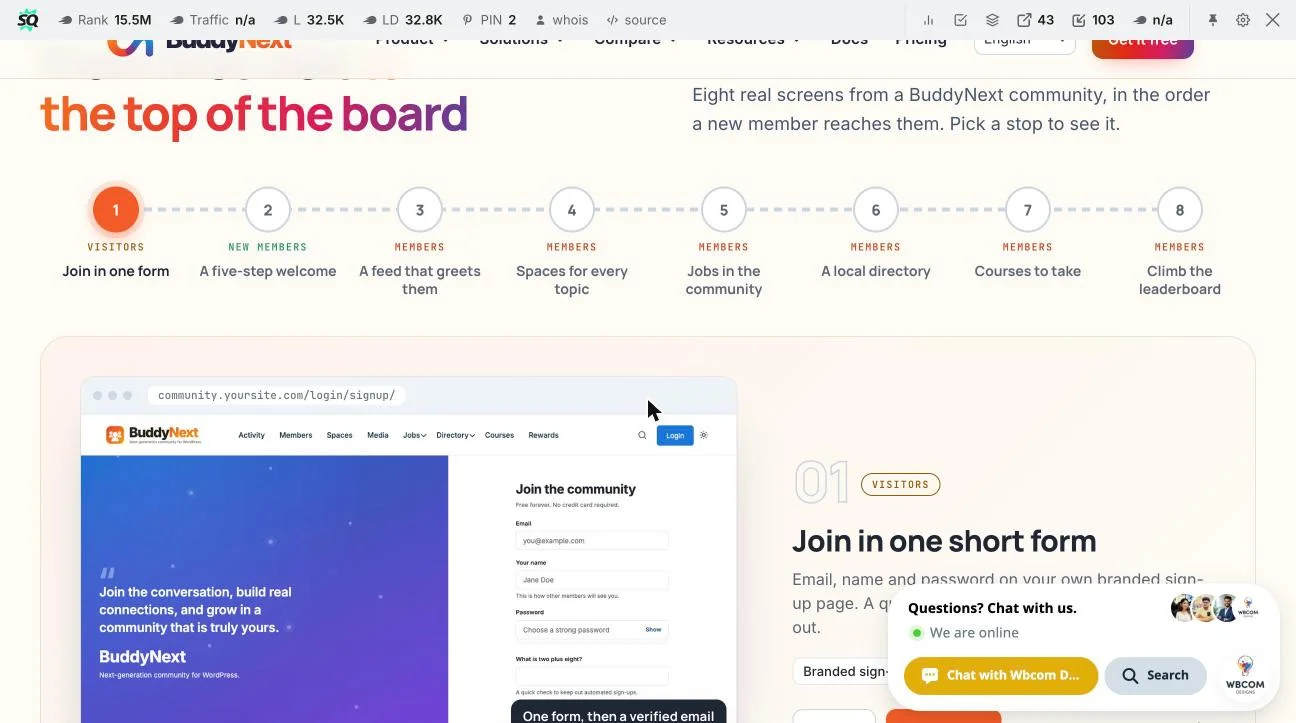
Key strengths: no per-member or per-admin pricing ceiling to run into as the community grows; full data ownership, the member database lives on infrastructure you control, not a third-party vendor’s servers; built-in jobs board, directory, and marketplace that would otherwise require separate paid add-ons on other platforms; an eight-step onboarding journey, from signup through a welcome flow, activity feed, spaces, jobs, directory, courses, and a leaderboard, designed to get new members actually active rather than just registered.
Where it falls short: requires a WordPress site and basic familiarity with WordPress hosting/maintenance, it’s not a zero-setup hosted SaaS; smaller third-party integration marketplace than Circle or Bettermode since it’s a newer, more self-contained product; no managed-infrastructure option for teams who specifically want someone else to run the servers.
A Real-World Scenario: Leaving Bettermode Behind
Picture a SaaS company running a customer community on Bettermode’s Starter tier for product feedback, peer support, and feature announcements. The community grew past 10,000 members, which forced a jump to the Growth tier at $1,500/month, roughly $18,000/year, just as the company’s own budget tightened. The community itself wasn’t the problem, members were engaged, support tickets were down, feature requests were easier to prioritize. The bill was the problem.
The team’s evaluation split into two real paths. Staying SaaS meant either absorbing the Growth-tier cost or migrating to Circle/Mighty Networks at a lower but still recurring and transaction-fee-bearing price point, with migration effort to rebuild spaces, badges, and permission structures either way. Going self-hosted meant a one-time WordPress setup project on BuddyNext, after which the ongoing cost became whatever the company’s existing WordPress hosting plan cost, no per-member or per-admin fee, no transaction cut on anything sold through member-only content. For a community that had already proven its value and was expected to keep growing for years, the self-hosted path’s cost curve flattened out in a way no SaaS tier, including Bettermode’s own lower tiers, ever would.
This is the pattern worth recognizing: SaaS community pricing is attractive early, when member counts and admin seats are small, and becomes a larger line item precisely when the community is succeeding and growing past the tier it started on. Self-hosted platforms invert that curve, the setup cost is real but front-loaded, and the ongoing cost doesn’t climb in step with the community’s own success.
A Migration Checklist Before You Switch
Whichever direction you’re headed, don’t move a live community without a plan. Before switching off Bettermode, or any platform:
- Export everything the current platform allows - member list, posts, badges, permission groups - even if the new platform can’t import all of it directly, it’s your record of what existed.
- Notify members before, not after. A surprise migration with broken links and a new login flow is the fastest way to lose the engagement you built.
- Set up redirects from old community URLs to new ones wherever possible, especially for any content that’s indexed in search or linked from elsewhere on your site.
- Rebuild permission structures deliberately rather than assuming a 1:1 mapping exists between the old platform’s roles and the new one’s.
- Run the new platform in parallel for a short window if the old one allows it, so you can compare real member behavior before fully cutting over.
- Budget real time for support questions in the first few weeks after any migration - even a smooth technical move generates member confusion about where things are now.
What Unpredictable Growth Does to SaaS Pricing
One more factor worth weighing before you commit to any of these seven: how the platform handles growth you can’t predict yet. A community that doubles in size in six months can push a SaaS platform into its next pricing tier almost overnight, turning a budgeted expense into an unbudgeted one. Self-hosted platforms don’t have that failure mode, since there’s no member-count threshold that triggers a bigger invoice; the only scaling cost is whatever your WordPress hosting needs to handle the extra traffic, which is a much smaller and more predictable number than a SaaS tier jump. That predictability is easy to undervalue when you’re comparing month-one pricing, and much harder to ignore once a community actually takes off. It’s also worth noting that admin and moderator seat limits, not just member counts, are a common and easy-to-miss trigger for an unplanned tier jump on several of these platforms - growing your moderation team to handle a larger community can itself force a more expensive plan, independent of member growth.
What a Year Actually Costs
Pricing comparisons across these platforms get murky fast because of transaction fees and tier-gated member/admin limits. Here’s a rough single-site, moderate-traffic comparison for year one, not counting transaction fees on paid memberships:
| Platform | Entry tier, 1 year |
|---|---|
| Bettermode | ~$1,788 (Starter, annual billing) |
| Circle | ~$1,068 (Professional, annual) + 2% transaction fee |
| Mighty Networks | ~$948 (Launch, annual) + 2% transaction fee |
| BuddyBoss | ~$228-468 (platform license) |
| Skool | $108 (Hobby, annual) + 10% transaction fee |
| Discourse | $0 self-hosted (your own server cost) or ~$300-600 hosted |
| BuddyNext | Self-hosted on your own WordPress hosting, no per-member platform fee |
Figures are approximate, based on publicly listed pricing as of October 2026, and exclude WordPress hosting costs for the self-hosted options.
Comparison Table
| Free plan | Self-hosted | Courses built in | Transaction fees | |
|---|---|---|---|---|
| Bettermode | No (retired Mar 2026) | No | Limited | None |
| Circle | No | No | Yes | 1-2% |
| Discourse | Yes (self-hosted) | Yes | No | None |
| BuddyBoss | No | Yes | Yes (LMS integration) | None |
| Mighty Networks | No | No | Yes | 0.5-2% |
| Skool | No | No | Yes | 2.9-10% |
| Khoros | No | No | No | Custom contract |
| BuddyNext | n/a - self-hosted, no SaaS tier | Yes | Yes | None |
How to Choose
If you need enterprise-scale customer community infrastructure with dedicated support and compliance guarantees, Khoros or Bettermode’s Growth tier are the realistic options, budget permitting. If you want the most polished SaaS course-and-community combo and can absorb the subscription plus transaction fee, Circle or Mighty Networks fit well. If cost is the primary constraint and you’re starting small, Skool’s Hobby tier gets you running fast, with the tradeoff of a steep transaction fee once you’re actually selling memberships at volume.
If you already run WordPress, or are open to it, and want to avoid a recurring per-member platform bill entirely while keeping full ownership of your community’s data and infrastructure, BuddyNext is worth evaluating before committing to another year of SaaS subscription fees that scale with your own community’s success.
Summary
Bettermode’s price floor after March 2026 pushed a real segment of its potential customers toward alternatives, and the options above cover most of what those searchers actually need: Circle and Mighty Networks for SaaS polish, Skool for the cheapest fast start, Discourse for proven forum software, BuddyBoss for a WordPress-native course-and-community combo, Khoros for genuine enterprise scale, and BuddyNext for teams who want to stop paying a recurring per-member fee altogether and own their community’s infrastructure outright.
FAQs
Why did Bettermode remove its free plan?
Bettermode restructured its pricing in March 2026 to focus on mid-market and enterprise customer communities rather than hobbyist or early-stage use cases, which is consistent with its newest tiers (Growth starting at $1,500/month) being built around API access, webhooks, and sandbox environments that early-stage communities rarely need yet.
Is there still a way to try Bettermode for free?
Not as an ongoing free tier. Check Bettermode’s own site directly for any trial period currently offered, since trial terms change independently of the base subscription pricing.
What’s the real difference between Tribe and Bettermode?
None functionally - Tribe rebranded to Bettermode in 2022. Searches for either name point to the same current product and pricing.
Which of these alternatives has the lowest total cost at scale?
Self-hosted options (BuddyNext, self-hosted Discourse) avoid per-member and transaction fees entirely, so the gap versus SaaS platforms widens as your community and its revenue grow, since SaaS pricing tiers and transaction percentages scale with that growth while self-hosted costs don’t.
Do I need technical skills to run BuddyNext?
Basic WordPress familiarity (installing plugins, managing a host) is enough for most setups. It doesn’t require the server administration skill that self-hosting Discourse well typically does.
Can I migrate an existing Bettermode community to another platform?
Migration tooling varies by platform and isn’t typically a one-click process for any of these tools. Export what member/content data Bettermode allows and plan for manual reconstruction of spaces, badges, and permission structures on the new platform.
Which platform is best for a customer support community specifically?
Discourse and Bettermode both have strong knowledge-base/Q&A-style features suited to support communities. BuddyNext’s forum and activity-feed combination works for support use cases too, without the per-ticket or per-member SaaS cost.
Do any of these include native mobile apps?
Mighty Networks includes generic iOS/Android apps on all paid tiers (branded apps require Mighty Pro). BuddyBoss offers an app builder as a separate paid add-on. Circle and Skool offer their own generic apps. BuddyNext is browser/PWA-based rather than native-app-first.
What happens to transaction fees if I don’t sell anything through the platform?
They only apply to actual paid transactions processed through the platform (memberships, courses, etc.). A free community pays the base subscription only on platforms that charge one.
Is Khoros worth considering for a mid-sized community?
Generally no - its $75,000+/year contract floor is built for large enterprise customer-community deployments, not mid-sized teams. It’s included here for context on the top end of this market, not as a practical option for most searchers.
How long does it realistically take to set up a self-hosted alternative like BuddyNext?
For a team already running WordPress, initial setup (install, basic configuration, importing an existing member list if applicable) typically takes a few hours to a couple of days, well short of the multi-week migration projects that moving between two SaaS platforms with incompatible data models can require.
Does switching away from Bettermode mean losing community history and engagement data?
Some loss is nearly unavoidable in any platform migration, since no two community platforms store activity, badges, and engagement scores in identical formats. Export what Bettermode allows before committing to a move, and treat the migration as a fresh start for engagement metrics even if member accounts themselves transfer.
Is it risky to run a community on a newer platform like BuddyNext compared to an established one like Bettermode?
Every platform was new once. The meaningful risk difference isn’t age, it’s who controls your community’s data and pricing going forward - a newer self-hosted platform you control directly carries less long-term pricing risk than an established SaaS platform that can, and has, changed its terms with little notice.
Sources
Interesting Reads:
Build a Professional CE Community for Healthcare Professionals on WordPress