
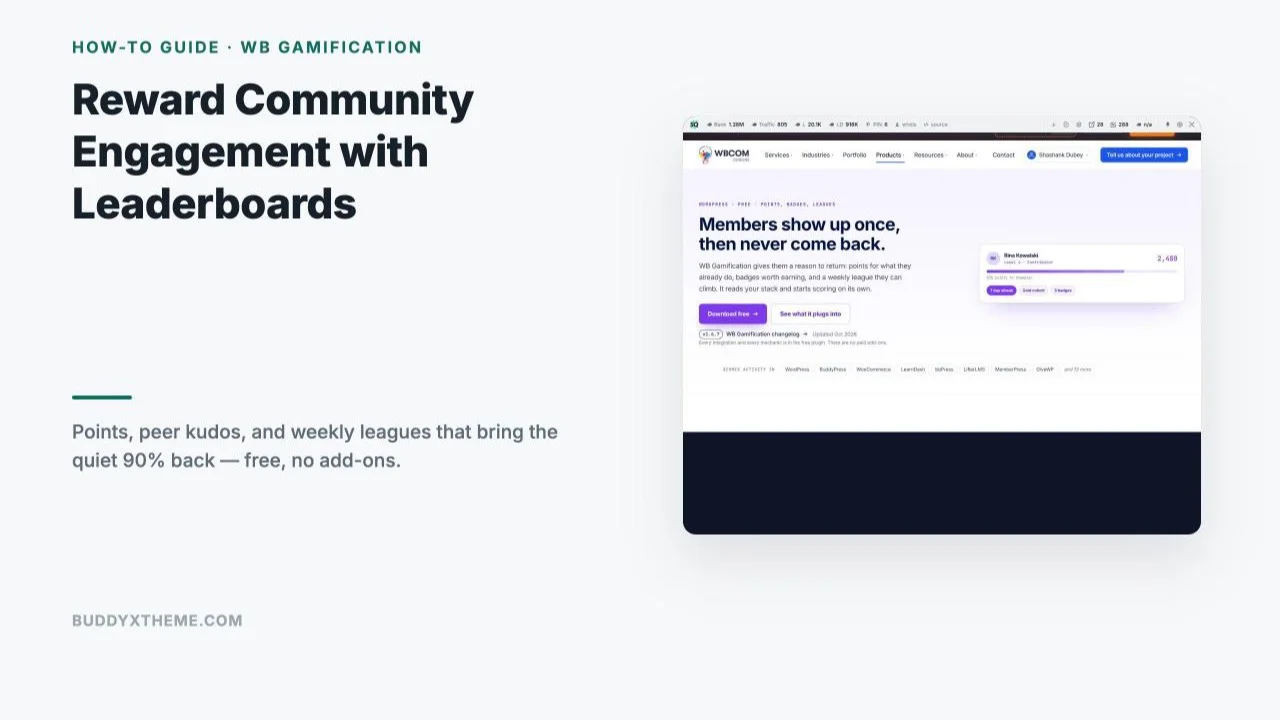
Most BuddyPress communities have the same quiet problem: a handful of members post constantly, a slightly bigger group reacts and comments once in a while, and everyone else joins once, looks around, and never comes back. The feed itself doesn’t fix this, it just shows you the imbalance more clearly. What actually changes the pattern is giving members a visible reason to return, something a static activity stream can’t do on its own.
WB Gamification adds exactly that layer on top of an existing BuddyPress or BuddyNext site: points for activity members are already doing, badges worth showing off, a weekly league they can actually climb, and peer kudos so recognition doesn’t have to come only from the admin. The entire plugin is free, every mechanic described here ships in the core download, with no license key and no paid add-on tier gating any of it.
Table of Contents
- Why Most Communities Skew So Heavily to a Few Active Members
- How WB Gamification Plugs Into BuddyPress
- Setting Up Points for Activity, Comments, and Profile Completion
- Badges, Streaks, and OpenBadges Credentials
- Peer Kudos: Letting Members Recognize Each Other
- Leaderboards and Cohort Leagues
- Community Challenges with Shared Goals
- A Real-World Scenario: Reviving a Quiet Community
- Measuring Whether It’s Actually Working
- Common Mistakes That Make Gamification Feel Hollow
- Who This Is Actually Built For
- FAQs
The classic “90-9-1 rule” popularized by Jakob Nielsen in 2006 holds that 90% of community members lurk, 9% contribute occasionally, and just 1% create most content. More recent research complicates that: in small communities under 5,000 members, up to 33% of members are actively Creators and Contributors, roughly 3x the old benchmark, and highly specialized or professional communities often skew closer to a 70-20-10 split. The common thread across both the old and new data: participation is never evenly distributed on its own, something has to actively pull the quiet majority toward contributing.
Why Most Communities Skew So Heavily to a Few Active Members
A BuddyPress activity feed rewards the people already posting by giving them visibility, which is exactly backwards from what a growing community needs. The members who show up once, read a few posts, and never return aren’t disengaged by nature, they simply never got a signal that their presence or small contributions were noticed or worth repeating.
Points, badges, and leaderboards work because they convert invisible, low-effort actions, logging in, leaving a comment, completing a profile, into something visible and cumulative. A member who sees “520 points to Champion” has a concrete, achievable next step. A member who only sees an anonymous feed has nothing to aim for beyond posting into the void.
How WB Gamification Plugs Into BuddyPress
WB Gamification ships with 22 integrations that load automatically, BuddyPress among them, along with WooCommerce, LearnDash, bbPress, LifterLMS, MemberPress, GiveWP, and more. Once active on a BuddyPress or BuddyNext site, it reads the stack it finds and starts scoring activity on its own, posting, commenting, profile completion, and other native BuddyPress actions, without requiring a manual mapping step for every single trigger.
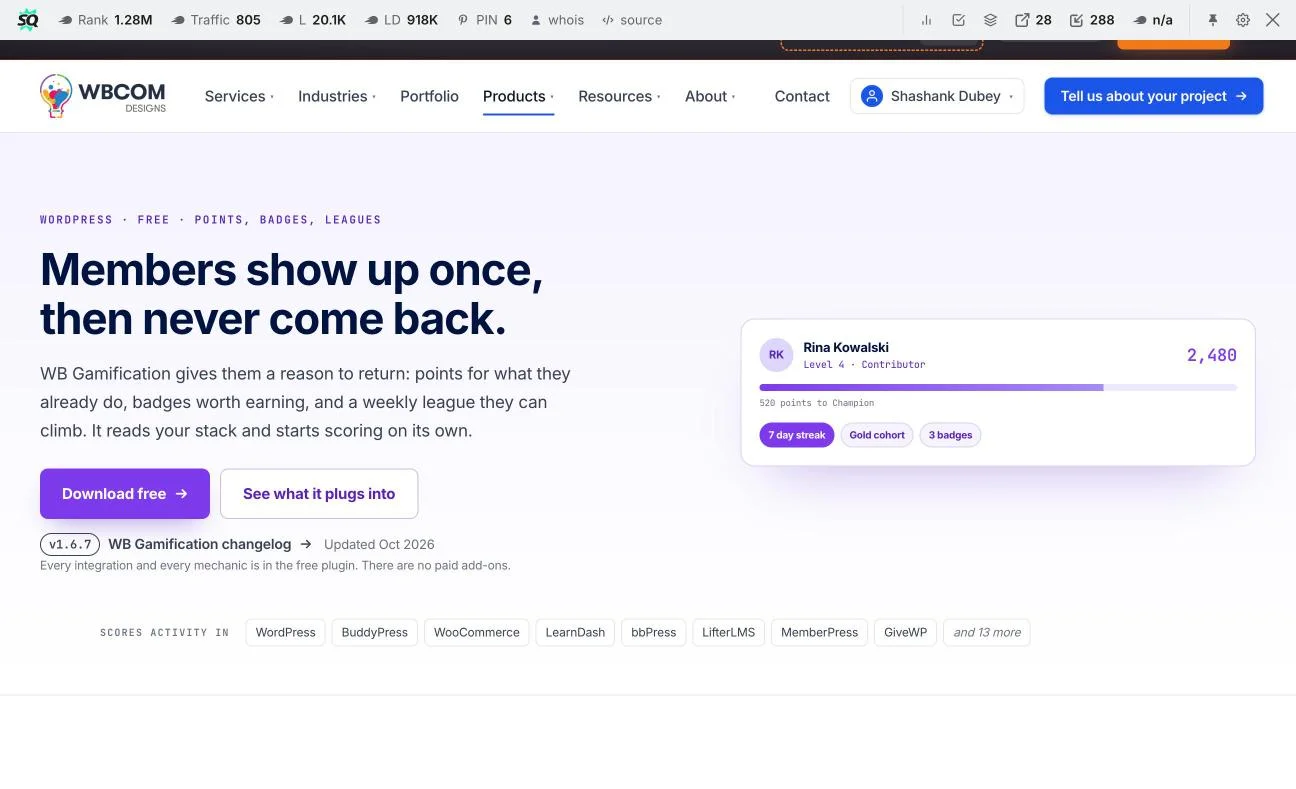
The plugin’s own positioning is specific about what ships free versus what requires an add-on: nothing requires an add-on. Points, badges, levels, leaderboards, cohort leagues, community challenges, a redemption store, streaks, and peer kudos are all part of the same free download, current as of v1.6.7 (updated October 2026).
Setting Up Points for Activity, Comments, and Profile Completion
After installing WB Gamification, the first practical step is deciding what’s actually worth rewarding. Resist the urge to reward everything equally, the goal is nudging specific low-friction behaviors that keep a feed alive, not turning every click into a points event.
A common starting point structure for a BuddyPress community:
| Action | Suggested Points | Why |
|---|---|---|
| Posting an activity update | 10 | Keeps the feed alive |
| Commenting on another member’s post | 3 | Easiest first contribution for a quiet member |
| Completing a member profile | 15 (one-time) | Signals investment early |
| First post in a new group | 5 (bonus) | Encourages cross-group participation |
Point values should scale with effort: a thoughtful comment is worth less than starting a new discussion, but more than nothing. Keep the point scale simple enough that a member can glance at it and understand roughly what’s worth doing next.
Badges, Streaks, and OpenBadges Credentials
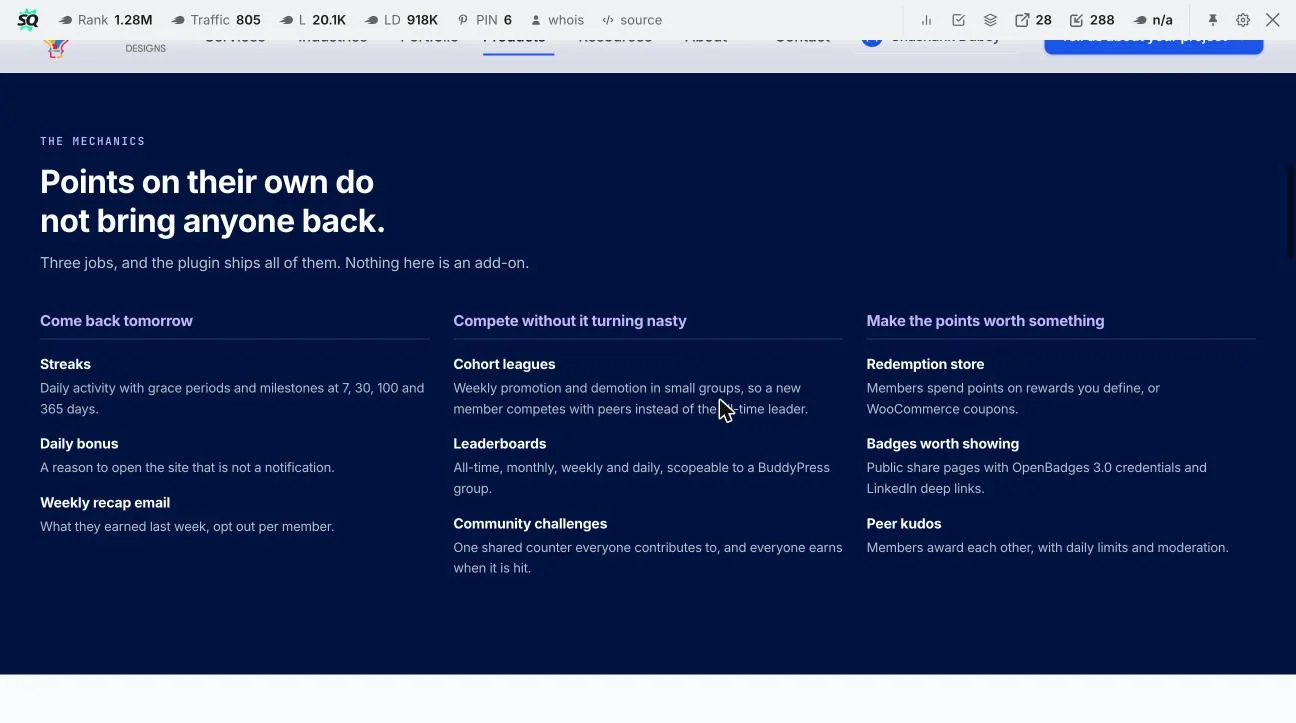
Badges work best when they mark a real milestone rather than an arbitrary point threshold, a member’s first 10 comments, a full year of membership, completing an onboarding checklist. WB Gamification’s badge system supports public share pages with OpenBadges 3.0 credentials and LinkedIn deep links, meaning a badge earned inside the community can double as a genuine, verifiable credential a member might actually share externally, a stronger incentive than an internal-only icon.
Streaks (daily activity with grace periods and milestones at 7, 30, 100, and 365 days) solve a different problem: they reward simply showing up, independent of what a member does once they’re there. A daily bonus notification and a weekly recap email (opt-out per member) give the streak system its own reason to pull someone back without requiring them to craft a post every single day.
Peer Kudos: Letting Members Recognize Each Other
Peer kudos let members award each other directly, with daily limits and moderation built in to prevent abuse, rather than routing all recognition through an admin. This matters more than it sounds: a community where only the owner hands out praise scales poorly past a few dozen active members, while peer-driven recognition scales with the community itself, since every new active member becomes a potential source of recognition for others.
Leaderboards and Cohort Leagues
A single, permanent, all-time leaderboard has a well-known failure mode: the same handful of early, hyper-active members occupy the top spots forever, which demotivates everyone who joined later rather than motivating them. WB Gamification addresses this with leaderboards scopeable to a specific BuddyPress group (so competition stays relevant to the people a member actually interacts with) and separate all-time, monthly, and daily views, so a new member competing on the daily or weekly board has a realistic shot, not just the all-time veterans.
Cohort leagues go further: weekly promotion and demotion within small groups means a brand-new member competes against similarly-new peers rather than the community’s long-time top scorer, the same structural idea behind tiered leagues in gaming and fitness apps, applied to a WordPress community.
Community Challenges with Shared Goals
Community challenges run on one shared counter that every participating member contributes to, with everyone earning a reward once the group hits the target, a monthly comment-count goal, a collective milestone tied to a launch or event. This shifts the dynamic from member-versus-member competition to a collective push, useful specifically for re-engaging a quiet community, since a shared goal gives even a lapsed member a reason to show up once without needing to catch up to a leaderboard they’ve been absent from for months.
A Real-World Scenario: Reviving a Quiet Community
Picture a BuddyNext community that launched with real enthusiasm, a wave of sign-ups and activity in the first month, then settled into the familiar pattern: a dozen regulars posting daily, a few hundred members who joined and never returned. The community manager installs WB Gamification, sets up points for the obvious actions (posting, commenting, profile completion), awards a “Founding Member” badge retroactively to everyone who joined in month one, and launches a 30-day “Welcome Back” community challenge with a shared goal tied to total comments across the whole community.
The weekly recap email goes out automatically, several lapsed members open it purely out of curiosity about their point total, a few return to comment once, and a handful of those become repeat participants once they see their name climb a cohort league populated by other recently-returned members rather than the original dozen regulars. None of this requires manually messaging anyone, the system does the re-engagement nudge on its own, which is the entire point of automating it in the first place.
Six weeks in, the community manager reviews the numbers against the original baseline. Unique weekly contributors are up roughly 40%, mostly driven by members who joined in the first month and had never posted again until the challenge and the recap email gave them a reason to check back.
The original dozen regulars are still the top scorers on the all-time leaderboard, but that no longer matters as much, since most newly active members are competing inside their own weekly cohort league rather than against veterans with a year-long head start. A handful of members redeem points for a WooCommerce discount code on the community’s merchandise store, turning what started as an engagement experiment into a small, measurable revenue line the community manager hadn’t originally planned for.
“Seeing the badge on their own profile again reminded them they’d been part of the community from the start.” That’s a loyalty signal no points total alone would have surfaced.
The founding-member badge turns out to matter more than expected: several early members who’d gone quiet mention it unprompted. That’s the kind of qualitative result that doesn’t show up in a dashboard but still shapes how the community manager thinks about which badges to design next.
Common Mistakes That Make Gamification Feel Hollow
A few patterns consistently undermine an otherwise well-set-up gamification system:
- Rewarding volume over value. Points for every single action, including low-effort spam-adjacent behavior, train members to farm points rather than contribute genuinely.
- A permanent, ungamed leaderboard with no fresh competition. If the same five names sit at the top forever, new members stop checking the board entirely.
- Badges nobody can see or verify. A badge that only the member themselves can view loses most of its social value; public share pages and OpenBadges credentials fix this.
- No redemption mechanism. Points that can never be spent on anything real (a redemption-store reward, a WooCommerce coupon) eventually feel like a meaningless number rather than currency.
A quick pre-launch checklist before announcing anything:
- Confirm the point values make sense relative to each other.
- Test the leaderboard from a brand-new test account to see what a first-time visitor actually experiences.
- Make sure at least one redemption option is live before announcing the system community-wide.
A fifth, subtler mistake worth naming separately: announcing the system once and never mentioning it again. Gamification mechanics compound in value the more members are reminded they exist, a pinned activity post, a mention in the weekly recap, a badge-earners shoutout, not a one-time launch announcement that scrolls out of the feed within a day. Treat the system as an ongoing part of the community’s rhythm rather than a single feature flip, and the engagement gains tend to be far more durable than a launch-week spike that fades once the novelty wears off.
Measuring Whether It’s Actually Working
Installing points and badges is the easy part, confirming they’re actually changing behavior takes a bit more discipline. Before launching, pull a baseline: how many unique members posted or commented in the last 30 days, what the median number of logins per active member looks like, and roughly what share of registered members have made zero contributions since joining. These three numbers, not vanity metrics like total points awarded, are what actually tell you whether gamification moved the needle.
Re-check the same three numbers 30 and 60 days after launch. A healthy result looks like growth in unique weekly contributors and a narrowing (not elimination, narrowing) of the lurker share, not necessarily a dramatic spike in total activity from the people who were already active. If the people already at the top of the leaderboard are simply posting more while everyone else’s participation stays flat, the system is rewarding the wrong behavior, likely because the point structure favors volume from people already engaged rather than first contributions from people who weren’t.
Watch the redemption store specifically. If points accumulate but nobody redeems them, that’s a signal the rewards on offer aren’t compelling enough relative to the effort required to earn them, worth revisiting the reward catalog before assuming the entire gamification approach isn’t working for your community.
It’s also worth tracking retention specifically among members who earned their first badge or climbed into their first cohort league placement in the 30 days after joining. If that cohort sticks around longer than members who joined in the same window but never engaged with any gamification mechanic, that’s a clean signal the system is doing its job, converting a one-time visit into a returning member, rather than just rewarding people who were always going to stick around regardless.
Who This Is Actually Built For
This setup fits any BuddyPress or BuddyNext community manager dealing with the standard lurker-heavy participation curve, course communities wanting to reward engagement alongside course progress, and membership sites where visible status (levels, badges, league standing) is itself part of the value members are paying for. It’s less necessary for a very small, already-tight-knit community where everyone already knows and engages with everyone, gamification mechanics add the most value at the scale where organic recognition alone stops reaching most members.
FAQs
1. Does WB Gamification actually require any paid add-on to use BuddyPress integration?
No. The plugin explicitly states every integration and mechanic ships in the free plugin, with no license key and no paid add-ons, as of the current v1.6.7 release.
2. Can members opt out of the weekly recap email or daily notifications?
Yes, the weekly recap email is opt-out per member, so individual members who find the notifications unwanted can disable them without losing their points or badge progress.
3. How does a leaderboard scoped to a BuddyPress group work?
Rather than one site-wide ranking, a leaderboard can be scoped to show standings only within a specific BuddyPress group, so competition stays relevant to the smaller circle of members someone actually interacts with regularly.
4. What happens when a cohort league’s weekly promotion/demotion cycle runs?
Members are moved between small competitive cohorts based on their activity that week, so a consistently high performer gets promoted into a more competitive cohort over time, while the cohort a new member starts in stays populated with similarly new or less-active peers rather than long-time top scorers.
5. Can points be spent on real rewards, or are they purely cosmetic?
The built-in redemption store lets members spend points on rewards you define, and it connects to WooCommerce coupons, so points can translate into an actual discount or product, not just a number on a profile.
6. Is there a limit on how much peer kudos members can give each other per day?
Yes, peer kudos include daily limits and moderation specifically to prevent members from gaming the system by trading unlimited kudos back and forth.
7. Does this work on a site that doesn’t use BuddyPress or BuddyNext at all?
Yes, WB Gamification integrates with 22+ plugins including WooCommerce, LearnDash, bbPress, LifterLMS, MemberPress, and GiveWP, so it’s useful well beyond BuddyPress-specific communities, though this guide focuses on the BuddyPress/BuddyNext engagement use case specifically.
8. How long does initial setup actually take?
Installing the plugin and configuring a basic points structure (a handful of point-earning actions, one or two starter badges) typically takes under an hour using the five included starter templates; building out a fuller badge and league system is better paced over the first few weeks based on what actually drives engagement.
9. Can developers customize point rules beyond the admin UI?
Yes, the plugin exposes a REST API, WP-CLI commands, and 142 developer hooks, along with HMAC-signed outbound webhooks for Zapier, Make, and n8n, for teams that want custom scoring logic or to pipe gamification events into other systems.
10. Is member gamification data exportable or GDPR-compliant?
The plugin includes GDPR export and erasure capabilities, so a member’s points, badge, and activity history can be exported or deleted on request in line with standard data-subject rights handling.
11. How quickly should a community expect to see engagement improve after launch?
Most of the effect shows up gradually over 30-60 days rather than immediately, since it depends on members actually noticing the new mechanics and the weekly recap email giving lapsed members a reason to check back in. A sudden spike on launch day from already-active members isn’t the real signal to watch for; sustained participation from previously quiet members over the following weeks is.
12. Should every BuddyPress action earn points, or just a curated subset?
A curated subset works better in practice. Rewarding every possible action, including passive ones like simply viewing a page, dilutes the signal and makes the point system feel arbitrary rather than tied to genuine contribution, which is the opposite of what makes gamification effective in the first place.
Summary
The 90-9-1 pattern isn’t a law of nature, it’s what happens by default when a community gives members no visible reason to do anything beyond lurk. Points, badges, peer kudos, and a leaderboard that resets competition regularly give the quiet majority an actual on-ramp, and WB Gamification ships every one of those mechanics free, reading an existing BuddyPress stack and scoring activity without a complicated setup process standing between installation and a visibly more active community.
Before announcing the system community-wide, run it quietly for a week with a small test group or staff accounts first. Watch how point totals accumulate, confirm the leaderboard updates correctly as different accounts earn points, and check that badge notifications and the weekly recap email actually arrive. A gamification launch that visibly breaks in its first days, a leaderboard that doesn’t update, a badge that never unlocks, does more damage to member trust than no gamification system at all, since it signals the community itself isn’t well maintained.
Interesting Reads:
Build a Professional CE Community for Healthcare Professionals on WordPress
How to Set Up Club or Group Event Photo Sharing on WordPress