

Most site owners reach for a plugin because something on the default WordPress setup is too limited to work with. Search is one of the clearest examples on a community site. WordPress ships with a search box built for finding blog posts by keyword, not for finding a specific member by name, age, or a custom profile field buried three tabs deep in their profile. Once BuddyPress adds member profiles, groups, and activity streams to a site, the default search stops being useful almost immediately.
BuddyPress itself adds the community layer: member profiles, activity feeds, groups, and messaging that turn a WordPress site into something closer to a private social network. What it doesn’t ship with, out of the box, is a search tool capable of querying across all of that content at once. That gap is exactly what a dedicated BuddyPress search plugin exists to close.
The cost of skipping this is easy to underestimate until a community actually grows past a few dozen members. At twenty members, everyone roughly knows everyone else and a browsable directory is enough. At two hundred members, a new member trying to find people who share a specific interest or live in a specific region needs an actual search tool, not a directory they’re expected to scroll through manually. Communities that never solve this tend to see engagement flatten as they grow, not because the platform is broken but because finding relevant people gets harder exactly as the community gets bigger.
What is BuddyPress?

BuddyPress is a social networking in a box solution that turns a WordPress install into a community-based website. It includes member profiles, activity streams, private messaging, and user groups as core components, and it was built specifically so a site owner doesn’t have to assemble those pieces from scratch.
Extensions build on that foundation. File attachments, document sharing, collaboration tools, and richer activity walls all layer on top of the core plugin rather than requiring a separate platform. That’s part of why BuddyPress has stayed a common choice for community builders over the years: it’s easy to start with and easy to extend once the community’s needs get more specific.
Members use it to create profiles, send messages, join groups, update statuses, and interact with each other, and it integrates cleanly with most WordPress themes without requiring a theme built specifically for it. The BuddyPress Search plugin is an addon on top of that foundation, purpose-built to give members and administrators advanced search across profiles and content that the core plugin’s default search doesn’t reach.
It’s worth being precise about what “default search” means here, since it’s easy to assume BuddyPress already covers this. Out of the box, BuddyPress gives you a directory members can browse and filter by a handful of built-in criteria. That’s browsing, not search in the sense most people mean it: typing a partial name or a specific detail and getting matched results back instantly. The gap between those two things is exactly where a dedicated search plugin does its work.
Also Read: Essential WordPress Plugins To Use On Your Website
BuddyPress Search Plugin
The BuddyPress Search plugin lets members search BuddyPress profiles using whatever fields the site has set up, age, name, or any custom XProfile field the community relies on. Search components can be enabled separately for BuddyPress data and for standard WordPress user fields, and the plugin extends into WordPress posts, pages, and custom post types as well, so a single search box can cover the whole site rather than just member profiles.
The global search form itself can go anywhere on the site through either a dedicated widget or a shortcode, which matters more than it sounds. A search feature buried on one settings page gets used far less than one sitting visibly in a sidebar or header where members actually see it.
Key Features
Search components can be turned on selectively for whichever parts of BuddyPress a community actually uses, rather than forcing every site to search everything by default. WordPress user fields and XProfile fields both support search, so custom profile data a community has spent time building out doesn’t go to waste sitting unsearchable in a database table. Live search with autocomplete is available for sites that want results appearing as a member types rather than after they hit enter. Beyond BuddyPress itself, the plugin extends search to WordPress posts and pages and a range of custom post types, including WooCommerce products, Elementor pages, and LearnDash courses. And the global search form drops into any page or post through either a widget or a shortcode, whichever fits the site’s existing layout better.
BuddyPress Search Backend Settings
To configure the backend settings of the plugin, navigate to Dashboard>WB plugins>Buddypress search. Every search component the plugin can touch gets its own toggle here, which is worth walking through once during setup rather than leaving on default settings that may not match what the community actually needs searched.
Search Component Settings

This settings panel controls three separate things that are easy to confuse with each other during initial setup. Enable Search Components governs which BuddyPress components are searchable at all, activities, groups, members, and the distinction between public, private, and hidden groups. WordPress User Fields governs search across the standard fields WordPress itself stores for every user account. XProfile Fields is the one most community builders care about most, since it lets you choose exactly which custom profile fields, the ones a site has spent real time configuring, actually show up in search results.
Getting this panel right the first time saves a support conversation later. A member who can’t find someone by a profile field they know exists, because that field was never enabled for search, tends to assume the search feature is broken rather than realizing it’s a configuration gap.
The distinction between public, private, and hidden groups deserves its own attention here too. Search results that leak private or hidden group content to members who shouldn’t see it isn’t just a search bug, it’s a privacy problem, and the kind of issue that erodes trust in a community fast once members notice it. Double-check that group visibility settings are actually respected in search results before opening the feature up broadly, not after.
Also Read: How To Use BuddyPress To Create Social Network On WordPress
Enable Post / Pages Settings

This second panel extends search beyond BuddyPress into the rest of the site’s content, WordPress posts, pages, WooCommerce products, Elementor pages, LearnDash courses, and other custom post types the site runs. Post search covers categories, metadata, and tags in addition to the content itself, so a member searching for a topic finds relevant discussion posts and not just member profiles that happen to mention it. Page search folds standard WordPress pages into the same results. Product search, when WooCommerce is active, covers product tags and categories alongside the product listings themselves, which matters on any community site that also runs a small storefront or a member marketplace.
Live Search Settings
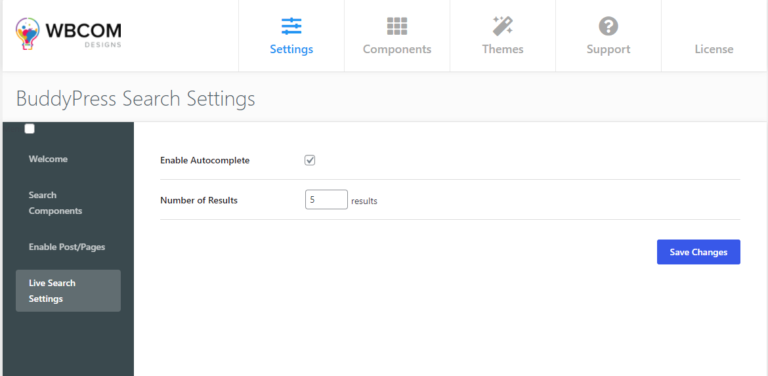
Live search is the setting that determines whether results appear as a member types or only after they submit the search. Enable Autocomplete turns auto-suggestions on or off. Number of Results controls how many suggestions show up in that live dropdown before a member needs to submit the full search to see everything. Communities with large member bases generally benefit from keeping this number modest, since a dropdown crowded with thirty suggestions defeats the purpose of a quick preview.
Frontend BuddyPress Search Activity Setting


These frontend screens show what a member actually sees once the backend settings are configured: a search box that returns activity results, member matches, and content matches in one place, formatted the way the rest of the community’s activity stream already looks. Consistency here matters. A search results page that looks visually disconnected from the rest of the community reads as an afterthought even when the underlying search logic works perfectly.
Display the Search Form in the Frontend

To display the BuddyPress search form, go to the WordPress Widgets section and add the BuddyPress Search widget to the right sidebar. The widget title can be customized to match the site’s voice, something more specific than a generic “Search” label tends to get clicked more often. Once added, the search widget appears on the right side of the site, visible on whichever pages the sidebar itself is active.
Live Search Settings

Live search settings provide two options worth understanding on their own. Enable Autocomplete turns the auto-suggestion feature on or off entirely. Number of Results defines how many matches show up in the search form’s dropdown before a member has to open the full results page. Autocomplete itself gets enabled from the backend and, once active, starts surfacing suggestions the moment a member starts typing rather than waiting for a full query to be submitted.
Setup Mistakes Worth Avoiding
The most common mistake is treating the settings panels as a one-time configuration and never revisiting them as the community’s profile fields evolve. A site that adds three new XProfile fields six months after initial setup often forgets to go back and enable search on those new fields, which means members searching for that new data quietly get nothing, with no obvious error to alert anyone that something’s missing.
A second mistake is leaving live search results uncapped on a large community. A dropdown that tries to show fifty results as a member types slows the search experience down and buries the results a member actually wants under ones they don’t. Keeping the result count modest, somewhere around five to ten suggestions, tends to feel faster even when the underlying query is doing the same amount of work either way.
A third, subtler mistake is enabling search for every possible component without thinking about what members will actually search for. A community built around discussion groups probably doesn’t need product search cluttering results if it isn’t running a storefront, and disabling components nobody uses keeps the search experience focused on what actually matters to that specific community.
A fourth mistake, easy to miss because it never triggers an error, is never checking search from a regular member’s account. Testing exclusively as an administrator hides permission-related gaps, since admins typically see more than a standard member does. A search feature that works perfectly for an admin but returns nothing for a regular member because of a permissions mismatch is a bug that only shows up once someone actually files a support ticket about it.
Getting the Most Out of It
The plugin does the most good on communities that have already invested time in building out custom XProfile fields, since those fields are exactly what the default WordPress search can’t touch. A site that only uses the standard name and email fields will see a smaller benefit than one running a detailed member directory with location, interests, or professional details attached to every profile.
Placement of the search widget matters more than most site owners initially assume. A search box hidden below the fold on a rarely-visited page gets a fraction of the use that the same box gets sitting in a persistent sidebar or header. Test a few placements and watch which one actually gets used, rather than assuming the default widget position is the right one.
Why the Visual Layer Matters as Much as the Search Logic
A search plugin can return exactly the right results and still feel broken if the page displaying them looks disconnected from the rest of the site. Search results rendered in a default, unstyled layout while the rest of the community runs a polished theme create a jarring moment right at the point where a member is trying to find someone or something specific. That’s usually the wrong moment to make the site suddenly look unfinished.
This is where the theme running underneath BuddyPress earns its keep. A theme built specifically for BuddyPress communities, like BuddyX, carries its own design language into search results, member directories, and activity feeds alike, so a member moving from browsing the activity stream to searching for a specific person doesn’t experience a visual seam between the two. Themes not built with BuddyPress in mind tend to render search results in whatever generic template WordPress falls back on, which works, but rarely matches the rest of the site closely enough to feel intentional.
Search and Member Retention
Search functionality rarely gets credit for retention the way a redesigned homepage or a new feature launch does, but it’s doing quiet work in the background every time a member successfully finds what they were looking for on the first try. The alternative, a frustrating or empty search result, is a small moment of friction that adds up across a community’s member base over time, even if no single instance of it looks like a serious problem in isolation.
Communities built around a specific shared interest, whether that’s professional networking or a course cohort, tend to see the clearest benefit from good search, since members joining that kind of community usually have a specific reason for being there: finding people with the same interest, the same role, or the same question. A search tool that surfaces those connections quickly is doing exactly the job the community exists to do.
Where This Fits
BuddyPress Search Plugin allows site members to search BuddyPress profiles using created fields such as age, name, and all XProfile field components. That alone improves the overall user experience on a community site, since members finding each other quickly is one of the quieter drivers of whether a community stays active or slowly goes quiet. This walkthrough should help with integrating these features into your WordPress site .
Checking It Actually Works
Once the backend settings are configured, the only real test that matters is a member’s actual search experience, not the settings panel showing a toggle turned on. Log in as a test member, or use a second browser profile, and run a handful of realistic searches: a partial name, a custom profile field value, a topic that should return an activity post. Confirm the results are accurate and that the page they land on looks like the rest of the site rather than a bare, unstyled results template.
Repeat that test periodically as the community grows, not just once at launch. A search configuration that worked fine for two hundred members can behave differently once a community crosses a few thousand, particularly around live search response time. Catching a slowdown early, while it’s a minor annoyance, beats discovering it after members have already started complaining that search feels sluggish.
None of this requires specialized skills, just a habit of actually using the feature the way a member would rather than trusting that a green toggle in the settings panel means everything downstream is working correctly. That habit, applied to search and to most other community features, catches more problems before launch than any amount of reading documentation does.
Interesting Reads:
Best Knowledge Management Software