

A nonprofit, association, or agency running a BuddyBoss community needs more than a standard member profile to represent itself properly. It needs somewhere to state its mission, list its programs, take messages from donors and volunteers, and read as a legitimate organization rather than one more entry in the member directory. On a BuddyBoss community, a dedicated plugin gets you there faster than trying to stretch the default profile template to cover all of that.
What BuddyBoss Provides on Its Own
BuddyBoss is the underlying platform: member profiles, groups, activity feeds, private messaging, course delivery for anyone running training alongside the community, tiered memberships with payment integrations, and a path to a branded mobile app if you need one.
None of that is built for an organization specifically. For a profile that represents the group itself rather than any one person in it, you need BuddyPress Business Profile.
Profile vs. Page: Worth Clarifying Before You Start
Before getting into setup, it helps to settle some terminology that trips people up with this exact plugin. “Organization profile” and “organization page” get used interchangeably a lot, and functionally, inside this plugin, they’re the same object: a Business Profile entry categorized however you choose to label it. There’s no separate “profile” structure and “page” structure under the hood; the wording difference is how a given community chooses to talk about the feature, not a technical distinction in the plugin itself.
Even so, the framing matters for how you introduce it to whoever runs the organization’s side of things. “Profile” suggests something closer to a mission statement and a set of facts, who you are, what you do, how to reach you. “Page” suggests something closer to a live channel: updates, event announcements, an ongoing feed. Most organization setups end up needing both, but deciding which one to lead with in onboarding shapes what gets filled in first, and a mismatch here is a common reason a profile goes live with a polished mission statement and an activity feed that’s been empty for three weeks.
Why This Beats Customizing the Default Profile
A fair question before committing to a separate plugin: why not just heavily customize the standard member profile with custom xprofile fields instead? It’s possible, and for a very small, informal group it might even cover the basics. But it runs into real limits once an organization needs to do more than display a paragraph of text.
Custom xprofile fields show information well, but they don’t give you a feed distinct from any individual member’s personal activity, a follower relationship distinct from BuddyBoss’s mutual friend-connection model, or role-based management that lets a communications volunteer post updates without handing over a staff member’s personal login. A dedicated feed, an asymmetric following relationship, and delegated management are structural differences, not cosmetic ones, and no amount of custom-field tinkering on a standard profile reproduces them. That’s the actual reason a dedicated plugin earns its place here.
BuddyPress Business Profile Plugin

BuddyPress Business Profile handles businesses, brands, celebrities, and organizations under the same underlying page type, category is what separates them. Current version (v2.1.0):
- Custom profile fields, logo, cover image, contact info, social links.
- A dedicated activity feed, separate from personal member activity, with comments and likes.
- Private messaging through a per-page inbox.
- Role management, admins, editors, moderators, with control over who can create, edit, or delete pages.
- Reviews and star ratings, a searchable directory with map view, and LocalBusiness SEO schema.
No limit on how many organization profiles a community can host, or how many a single admin can manage.
Building Out the Programs and Impact Section
The About tab’s repeater fields are where an organization profile earns its keep over a plain member profile. Rather than one long paragraph describing everything the group does, structure it as distinct entries, individual programs, campaigns, or past initiatives, each with its own short description rather than one undifferentiated block of mission-speak. A visitor scanning the profile should be able to find the specific program they care about quickly, not read a full organizational history to locate it.
Lead with active or recent programs rather than a strict chronological list, especially if there’s a current campaign that’s the actual reason someone is checking the profile right now. The repeater structure supports reordering, so revisit it whenever a program wraps up or a new one launches instead of just appending everything to the bottom.
Photos attached to each entry make a real difference in how the section reads. A list of program names with no images feels closer to an annual report than a genuine showcase, while even one photo per entry, volunteers at an event, a completed project, gives a visitor something to actually look at.
Setting Up the Profile
Go to the plugin’s Businesses page and click Create New Business.
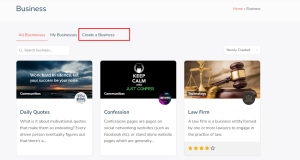
Enter the organization’s name, description, and category. Click Continue, upload a logo, click Next Step, upload a cover image, then click Visit to see the profile live.
That’s the bare-minimum path. Before announcing the profile publicly, go back through the About tab and fill in the structured fields properly, an empty or sparse profile undercuts the credibility a dedicated organization presence is supposed to establish in the first place.
Handling Volunteer and Donor Messages Without Overwhelming One Person
The private-messaging inbox is genuinely useful for direct contact from donors, volunteers, and members asking how to get involved, but it doesn’t scale to one inbox forever once a profile has any real reach. The role-management system exists for exactly this: assign a communications volunteer or staff member to handle day-to-day inbox and comment moderation, escalating anything that actually needs a director’s or board member’s personal attention rather than routing every message through one person by default.
Decide this division of labor before the profile goes live, not after messages start piling up. A profile that launches with unclear ownership tends to end up either neglected, nobody feels responsible for it, or bottlenecked, everything waits on one overloaded staff member, and neither is a good first impression for someone reaching out about volunteering.
Worth revisiting this arrangement periodically, too. A profile that starts with a handful of inquiries a month and grows significantly during a campaign or after local press coverage may need a heavier moderation setup than the original one-person arrangement can sustain. Catching that transition early, before the inbox visibly falls behind, is a lot easier than recovering from a backlog that’s already built up in public view.
Extending the Rest of Your Community
A few other Wbcom Designs add-ons worth pairing with this one:
- BuddyPress Member Type (free), custom member classifications, useful for separating staff, volunteers, and general members.
- BuddyPress Member Blog / Member Blog Pro (free / from $49), frontend blogging from a member’s profile, handy for volunteer updates or field reports.
- BuddyPress Check-ins / Check-ins Pro (free / from $49), location tagging with maps on the Pro tier, useful for organizations running events at multiple sites.
- BuddyPress Statistics (from $49), registration, post, and engagement tracking across your community.
Check free BuddyPress plugins and premium BuddyPress add-ons for current pricing on the full lineup.
Volunteer Opportunities and Job Listings: When It’s Worth the Extra Setup
Organizations that regularly recruit volunteers or post open staff roles get more out of pairing the profile with an events or job-listing integration than one that just posts occasional updates. Listing a specific volunteer shift or open position directly through the profile, rather than linking off to a separate recruitment page, keeps the entire relationship, discovery, application, and eventual involvement, inside the same community members already use.
This is worth the setup time for an organization with a recurring need, ongoing volunteer shifts, a rolling hiring process, seasonal event staffing, but it’s more overhead than it’s worth for a single one-off ask. For a group with recurring recruitment needs, though, keeping it inside the profile members already follow removes friction: no separate site, no separate account, which tends to convert better than sending an interested volunteer off-platform to fill out a form they may never finish.
Onboarding Your Board or Staff, Not Just One Admin
In practice, the person setting up this profile is rarely the same person who ends up managing it long-term. It’s often a single staff member or volunteer at launch, and then, ideally, a small team once the organization’s involvement grows. Worth designing onboarding with that in mind rather than assuming whoever built the profile will still be the one running it a year from now.
A short written walkthrough, or a quick screen-recorded tutorial covering the fields relevant to your organization’s setup, saves a lot of repeated questions compared to expecting each new volunteer or staff member to figure out the interface from scratch. Include in that walkthrough who to contact if something breaks or needs adjusting. A clear internal support path matters more for an organization’s public-facing profile than for an individual member’s, since a visible problem on it reflects on the whole group, not just one person.
What to Do Before the Public Announcement
Treat the actual public unveiling of an organization profile as a small event rather than something that happens automatically the moment it’s technically live. Before announcing anywhere, confirm every field that’s supposed to be filled in actually is, test the inbox by sending a message from a separate test account, and check how the profile renders on mobile, since a meaningful share of supporters will click through from a phone rather than a desktop browser.
It’s also worth having the first few pieces of activity-feed content ready to post immediately after launch rather than leaving the feed empty when supporters first arrive. An empty feed on day one reads as an unfinished setup even if the rest of the profile is polished, while a feed with three or four posts already up gives new visitors something to engage with right away.
Coordinate the announcement with whatever other channels the organization already uses, email newsletter, social accounts, a physical newsletter for older supporters. If the profile launches quietly a week before the public push, that gives time to catch remaining issues without the pressure of an audience already arriving, and the actual announcement can then point to something that’s already been live-tested rather than debugged in public.
Writing a Mission Statement That Actually Works
The main description field is the single highest-traffic piece of text on the entire profile, most visitors read it before anything else, so it deserves more editorial care than it usually gets. A common mistake is treating this field like formal grant-application language, dense with jargon and passive voice, when a more direct, conversational tone, still credible, but written like something a real person would say to a new supporter, tends to hold attention better and reads as more approachable to someone deciding whether to get involved.
Length matters too. Two or three tight paragraphs beat one long one, both for scannability and because the plugin’s search index weighs the description field when surfacing results in the directory, and clear, natural writing tends to outperform a dense, keyword-stuffed block even when both are trying to say the same thing. Update this periodically as the organization’s programs shift, a mission statement that hasn’t been touched in two years reads as neglected even if everything else on the profile is current.
Whoever drafts this text should have it reviewed by someone with institutional knowledge before it goes live. A wrong program name, an outdated statistic, an old partner organization that’s no longer involved, these are exactly the kind of details that are easy to get slightly wrong when writing on behalf of a group rather than yourself, and a factual error in the most-read part of the profile undermines credibility more than almost anything else on the page.
Choosing Visibility: Public, Private, or Hidden
Public visibility fits the overwhelming majority of organization profiles, since the entire point is usually discoverability, supporters and volunteers finding the profile through search or the community directory. Private visibility, requiring a follow or approval step before full content is visible, suits a smaller or more closed group, useful for an internal association that wants a members-only presence rather than open public reach.
Hidden visibility mostly makes sense during setup itself, building the profile out fully before any public announcement, rather than as a long-term state. A hidden profile earns nothing from the search and directory visibility that’s the main advantage of using this plugin over a plain member profile in the first place, so treat it as a temporary staging state, not a permanent configuration.
Keeping the Profile Current Over Time

An organization profile set up once and never revisited slowly drifts out of date, finished programs still listed as active, an old contact number, a cover image from an event three years past. None of this breaks the profile technically, but it erodes credibility gradually in a way that’s easy to miss because there’s no error message flagging it, just a visitor noticing the content feels stale.
A light quarterly review, checking the programs section for anything that’s wrapped up or newly launched, confirming contact and social-link fields still point to active channels, refreshing the cover image if it’s tied to a specific past event, keeps the profile feeling maintained without demanding constant attention. Assigning this to whoever’s already managing the inbox and comments folds it into an existing responsibility instead of creating a separate task nobody owns.
A simple shared checklist, even a single page listing every field that needs periodic review and who’s responsible for it, turns this from a vague good intention into something that actually happens on schedule. Without that structure, maintenance tends to only happen reactively, after a supporter points out something’s outdated, rather than proactively before anyone notices.
Frequently Asked Questions
Can the profile be verified so supporters know it’s authentic? The plugin doesn’t include a built-in verification badge. Communities handle this at the policy level instead, either restricting profile creation for known organizations to admin-only setup, or applying a manually managed verified indicator communicated through onboarding materials so members know what to look for.
Is there a difference in how search engines treat this versus a personal profile? Yes, the LocalBusiness schema markup applied to Business Profile entries gives search engines more structured information than a standard personal profile carries, which can help visibility for organizations that want the profile to surface in relevant local or cause-related searches.
Can multiple staff members log in and manage the same profile at once? The role-management system supports multiple assigned managers with different permission levels, so a small team can share management responsibilities without everyone needing the same login credentials. Each person keeps their own account with role-appropriate access.
What happens to the profile if the organization stops being active in the community? The profile persists until someone with admin or owner access deletes or deactivates it. Communities should have a clear offboarding process for this scenario, deciding whether to archive, hide, or fully remove a profile when an organization’s relationship with the community ends, rather than leaving a stale, unmanaged profile live indefinitely.
Does upgrading from the free tier of a related plugin carry any settings over automatically? Business Profile is its own standalone product rather than a free/Pro pair, so there’s no separate upgrade path to worry about. Whatever’s configured in the current version is what’s live, and licensing tiers, Personal, Professional, Agency, affect site count rather than feature availability.
Can an organization profile be linked to a group it runs? There’s no automatic linking between a Business Profile entry and a BuddyBoss group, but nothing stops you from cross-referencing them manually, a link to the group in the profile’s About section, and a mention of the profile in the group’s description, so members navigating from one naturally discover the other.
Interesting Reads:
How does Profile Pro enhance the functionality of BuddyPress Profiles?
How To Create A Favorite Notification Feature in BuddyPress?
Tutor LMS Review 2025: Build, Sell & Manage Online Courses Effortlessly