

A multivendor marketplace plugin turns a single WooCommerce store into a platform where multiple sellers list and manage their own products. Vendors sign up, list products, handle their own orders, and get paid directly; you handle commissions, oversight, and the platform itself. WC Vendors is one of the longer-running options in this space, and this review covers what it actually does, where it falls short, and how it compares to the alternatives.
Overview
WC Vendors is a WooCommerce extension, so it inherits WooCommerce’s payment processing, product catalog, and order system rather than rebuilding any of it from scratch. Vendors get their own dashboard for products, orders, and payments; you set commission rates and manage the overall platform. It’s currently on version 2.7.1, actively updated, with 3,000+ active installs on WordPress.org, smaller than some of its competitors, worth knowing going in.
Key features
- Vendor management and per-vendor dashboards
- Commission system with configurable rates
- Order and product management on the vendor side
- Product reviews and ratings
- Multiple payment gateway support (PayPal, Stripe, Square)
- Storefront customization options
- Notification system for vendors and admins
Compatibility
WC Vendors requires WooCommerce and works with most standard WordPress themes and page builders, including Elementor, Divi, and Beaver Builder. It’s compatible with the usual supporting cast, Yoast SEO, WPForms, Gravity Forms, Jetpack, though as with any plugin that touches a lot of surface area, it’s worth checking compatibility before installing on a heavily customized site.
Setting it up
You’ll need WooCommerce installed and active first, since WC Vendors is an extension rather than a standalone plugin.
1. Install and activate WooCommerce (Plugins > Add New, search “WooCommerce”).
2. Install and activate WC Vendors the same way.
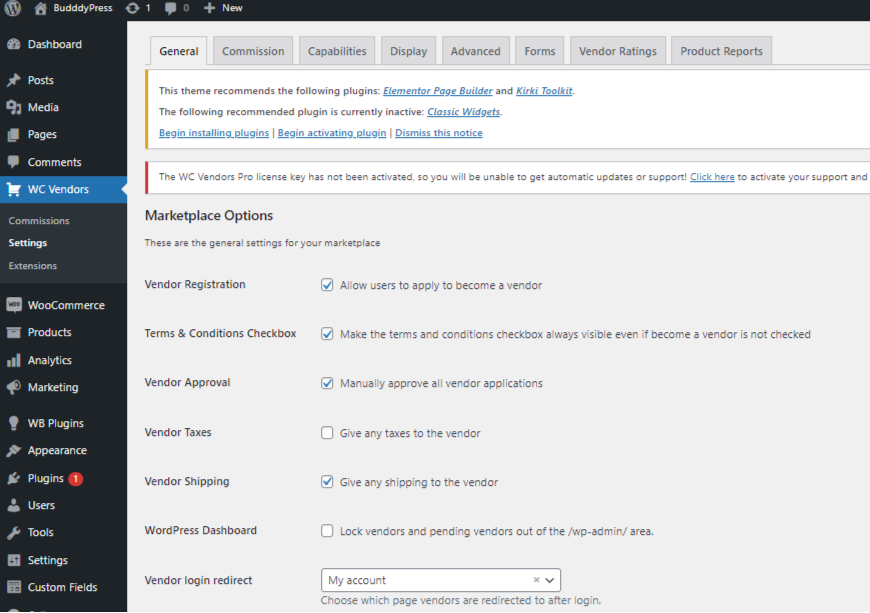
3. Configure commission rates, payment options, and shipping under WC Vendors > Settings.
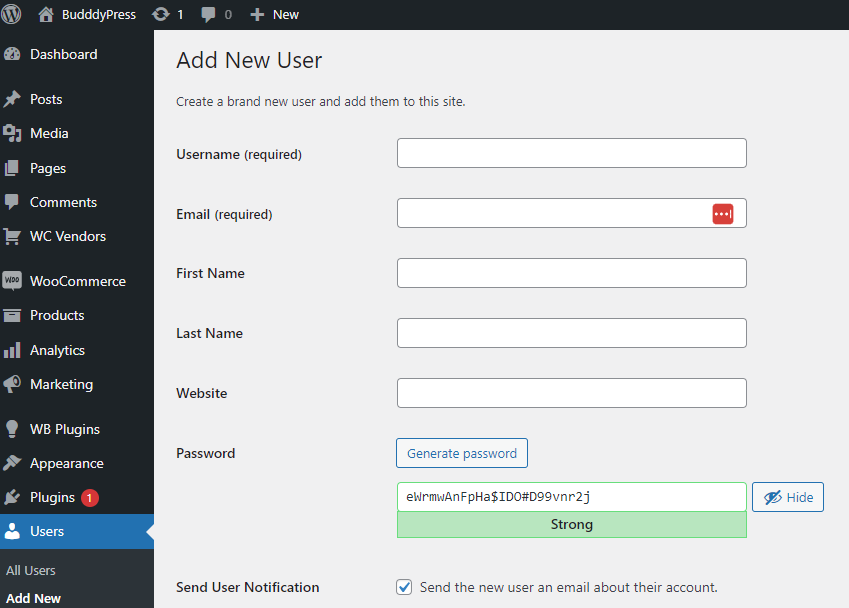
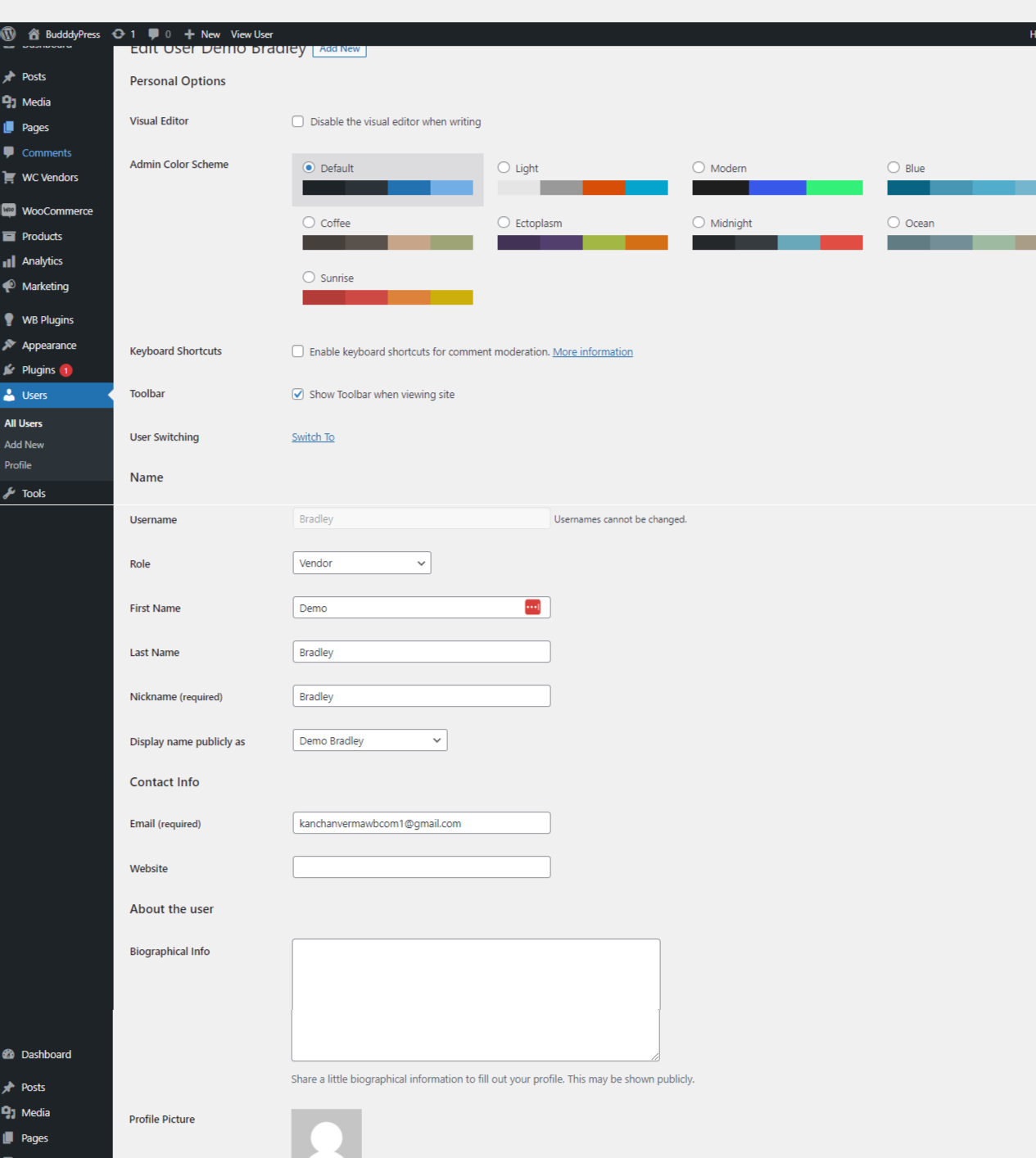
4. Create vendor accounts under Users > Add New, setting the role to “Vendor.”
5. Customize the storefront look and feel from the same Settings screen, colors, fonts, layout.
Before going live: back up your site first, only install from the official WC Vendors site or the WordPress.org repository, activate your license if you bought the paid tier, and test the full flow, vendor signup, product listing, checkout, and payment, before opening the marketplace to real vendors.
Pick a theme built for it
A generic WooCommerce theme will technically work, but a theme built specifically for WC Vendors ships with the right templates for vendor dashboards, commission displays, and storefronts already in place. StoreMate WC Vendors (the Reign theme paired with the Reign WC Vendors add-on) is one option, built around lightweight marketplace setups for handmade goods, B2B suppliers, service marketplaces, and digital downloads.

Day-to-day use
Vendors register through a customizable signup form, you decide what information you actually need, business name, contact details, tax ID, whatever applies. From their dashboard, they manage products (titles, descriptions, images, pricing, inventory, variations), orders (marking shipped, processing refunds, messaging customers), and can view detailed transaction logs. On your side, you can filter payments by vendor, date, or method, and the plugin integrates with PayPal, Stripe, and Square out of the box.
Pricing and licensing
The core WC Vendors plugin on WordPress.org is free and covers the basics: vendor registration, product management, and commission handling. Advanced functionality, subscription commissions, front-end vendor registration customization, and additional payment options among them, sits behind three paid tiers: Pro, Growth, and Business. First-year introductory pricing runs roughly $99.50, $199.50, and $299.50 respectively, each about half the standard renewal rate, with a 14-day refund window and a license covering one production site plus a staging copy. Pricing on these plans changes periodically, so checking the current rates directly on WC Vendors’ site before budgeting is worth the two minutes it takes.
Commission models and vendor payouts
Commission structures matter more to a marketplace’s long-term health than most first-time builders expect. WC Vendors supports flat-rate commissions, percentage-based commissions, and tiered rates that vary by product category or individual vendor, which covers most business models without needing custom development. A handmade-goods marketplace might charge a flat percentage across the board, while a B2B supplier platform might negotiate different rates per vendor based on volume.
Payout scheduling is the other half of this equation. Vendors need to know when they’ll actually see their money, and inconsistent or unclear payout timing is one of the fastest ways to lose vendor trust on a new marketplace. Setting a clear, published payout schedule, weekly, biweekly, or monthly, and sticking to it consistently tends to matter more to vendor satisfaction than the exact commission percentage charged.
SEO for a multivendor marketplace
A marketplace with hundreds of vendor-submitted product listings runs into SEO challenges a single-store site never has to deal with. Duplicate or thin product descriptions are the biggest recurring problem, since vendors copying manufacturer descriptions word for word creates duplicate content across the web that search engines tend to rank poorly. Setting a minimum description length and providing vendors with writing guidelines during onboarding heads off a lot of this before it becomes a site-wide problem.
Vendor storefront pages also need their own attention. A storefront page that’s just a bare product grid with no unique text gives search engines little to index meaningfully. A short vendor bio or shop description, even a few sentences, gives each storefront a fighting chance at ranking for the vendor’s own brand name searches.
Security and data ownership
Handing product and order management to third-party vendors introduces a layer of access control that a single-owner store doesn’t need to think about. WC Vendors scopes vendor permissions to their own products and orders by default, so one vendor can’t see another’s sales data or customer information, but it’s worth confirming this boundary holds after installing any additional plugins that touch products or orders, since a poorly configured plugin can occasionally widen access unintentionally.
Payment data itself stays with whichever gateway is processing transactions, PayPal, Stripe, or Square, rather than being stored directly by WC Vendors, which limits the platform’s own liability if a breach were ever to happen elsewhere in the stack. That said, vendor personal information (tax IDs, business details, banking info for payouts) does live in the WordPress database, so standard WordPress security practices, strong passwords, two-factor authentication for admin accounts, and regular backups, apply with extra weight on a marketplace site.
Role-based access control is worth double-checking beyond the default vendor role too. A marketplace that adds staff accounts for order support or content moderation needs those roles scoped correctly so a support staffer can see what they need without gaining full admin access. WordPress’s role and capability system supports this, but it takes deliberate configuration rather than working correctly by default the moment new roles get added.
Migrating from another marketplace plugin
Switching from Dokan or WCFM to WC Vendors, or the other way around, isn’t a simple plugin swap. Vendor accounts, product-vendor associations, and commission history are all stored in ways specific to each plugin, so a direct migration usually needs either a dedicated migration tool (where one exists) or a manual export-and-rebuild process. Testing this thoroughly on a staging copy of the site before touching the live marketplace is non-negotiable; losing vendor-product associations mid-migration on a live site with active vendors creates a mess that’s far harder to clean up after the fact than to prevent beforehand.
Communicating a migration to active vendors well ahead of time matters just as much as the technical execution. Vendors who log in one day to find their dashboard rearranged, or worse, missing historical order data, lose confidence in the platform fast. A short heads-up email explaining what’s changing and why, sent a week or two before the switch, goes a long way toward keeping that trust intact through the transition.
Marketplace models it fits well
A handmade or craft goods marketplace tends to suit WC Vendors particularly well, since vendor counts stay manageable, product catalogs are usually modest per vendor, and the storefront customization options give individual sellers enough room to establish their own visual identity within a shared platform. This is close to the use case the plugin’s default settings assume.
B2B supplier directories, where a smaller number of vendors each carry larger catalogs and negotiate individual commission rates, also work well given the plugin’s flexible per-vendor commission settings. Digital product marketplaces, selling templates, courses, or software licenses through multiple creators, fit too, since WooCommerce’s native handling of downloadable products carries over cleanly.
Where WC Vendors starts to strain is at genuinely large scale, thousands of vendors, extremely high order volume, or marketplaces needing heavy custom development around vendor onboarding flows. That’s less a flaw in the plugin than a reasonable limit of what any WooCommerce extension can comfortably handle before custom engineering becomes necessary regardless of which plugin sits underneath it.
Common setup mistakes to avoid
Skipping the staging test is the most common and the most costly mistake. Marketplace plugins touch checkout, payments, and user roles simultaneously, and a conflict that only shows up under real vendor activity can go unnoticed until a vendor’s payout fails or an order gets mis-attributed. Running a full test cycle, vendor signup through payout, on a staging copy before opening registration to real vendors catches most of these problems while they’re still cheap to fix.
Under-configuring commission rules before launch is the second common issue. Changing commission percentages after vendors are already active and earning under the old rate creates friction and, in some cases, contractual questions about which rate applies to orders placed before the change. Locking in commission logic during the planning phase, before the first vendor signs up, avoids that entirely.
Leaving default email notifications unedited is a smaller but common gap. WC Vendors ships with functional but generic notification templates for vendor signups, order updates, and payout confirmations. Rewriting these with actual brand voice and clear next steps takes an hour or two and meaningfully improves how professional the platform feels to a vendor going through it for the first time.
Customer experience considerations
Buyers on a multivendor marketplace interact with vendors more directly than they would on a single-owner store, and that changes what a checkout flow needs to communicate. An order containing products from three different vendors typically needs separate shipping notifications and, depending on configuration, separate tracking numbers, since each vendor ships independently. Making that clear at checkout, rather than letting a buyer assume one unified shipment, heads off a predictable wave of “where’s my order” support tickets.
Return and refund policies also get more complicated with multiple vendors involved. Deciding upfront whether returns route through the platform or directly to the vendor, and making that policy visible before checkout rather than after a problem arises, is one of the more overlooked pieces of marketplace planning. It’s a policy decision more than a technical one, but the plugin’s settings need to reflect whatever policy gets chosen.
Free tier versus paid tier: making the call
The free core plugin is enough to launch a functional marketplace: vendor registration, product listings, order management, and commission handling all work without paying anything. Where the paid tiers earn their cost is in the details that matter once a marketplace has real vendors and real volume, custom vendor registration fields, more granular shipping rules per vendor, subscription commission handling, and priority support access.
A reasonable approach for a first-time marketplace builder is launching on the free tier, running it for a month or two with real vendors, and then upgrading to whichever paid tier addresses the specific friction points that show up in actual use rather than guessing at features needed in advance. This avoids paying for capability that ends up unused while still leaving room to grow into a paid tier once the marketplace proves out.
Where it’s strong
- Genuinely easy to run day to day, the interface doesn’t demand deep technical knowledge once it’s set up.
- Flexible commission and storefront settings that adapt to different marketplace models.
- A real support community, forums, docs, and third-party tutorials beyond just official support.
- One-time plugin cost rather than an ongoing per-transaction fee.
Where it falls short
- Initial setup has a learning curve, especially for a first-time marketplace builder.
- Official support is limited relative to the size of some competitors, you’ll lean on the community more than direct vendor support.
- Smaller install base (3,000+) than Dokan or WCFM, which can mean fewer third-party integrations built specifically for it.
- Some advanced features are Pro-only, so the free version alone won’t cover every use case.
How it stacks up against alternatives
Dokan is the closest direct competitor and covers similar ground, vendor management, payments, customer communication, with a somewhat more polished interface and a much larger install base (30,000+). It also tends to cost more once you need its full feature set. WCFM Marketplace is another actively maintained option (10,000+ installs) worth comparing directly if Dokan’s pricing doesn’t work for you.
One plugin that used to come up in these comparisons, YITH WooCommerce Multi Vendor, was closed permanently at the author’s request back in 2021 and isn’t a live option anymore, if you see it recommended elsewhere, treat that as outdated advice.
Frequently asked questions
Can vendors sell digital products through WC Vendors?
Yes, since it inherits WooCommerce’s product types directly, digital and downloadable products work the same way they would in a standard WooCommerce store, just attributed to the vendor who listed them.
Does WC Vendors support subscription products?
Subscription-based products and recurring vendor commissions are part of the paid tiers rather than the free core plugin, so a marketplace planning to sell subscriptions needs to budget for at least the Pro tier.
How many vendors can a WC Vendors marketplace realistically support?
There’s no hard cap built into the plugin itself; the practical limit comes down to hosting capacity and database performance as product and order volume scale up. A marketplace expecting hundreds of active vendors should plan for hosting that can handle the increased database load well before it becomes a bottleneck.
Can a marketplace switch payment gateways after launch?
Yes, WC Vendors supports adding or changing payment gateways after going live, though vendors already set up on a previous gateway need to reconnect their accounts under the new one, so communicating the change clearly ahead of time avoids a wave of support requests.
Does WC Vendors work well on mobile for vendors managing their store?
The vendor dashboard is responsive and functions on a phone browser, though managing a large product catalog or bulk-editing inventory is still noticeably easier on a desktop screen. Vendors handling quick tasks, checking a new order, marking something shipped, will find the mobile experience adequate; anyone doing heavier catalog work will likely prefer a laptop.
Vendor onboarding checklist
A clean onboarding process directly affects how quickly a marketplace fills with active, well-listed products rather than half-finished vendor profiles. A short checklist covering the essentials, business verification, tax information, payment account connection, at least one complete product listing before approval, catches most of the gaps that otherwise turn into support tickets weeks later.
Requiring a minimum number of complete listings before a vendor’s storefront goes public also helps the marketplace’s overall first impression. A buyer landing on a storefront with one half-finished product listing and no photos forms a bad impression of the entire platform, not just that one vendor. A short approval delay that ensures a baseline level of storefront completeness pays for itself in how the marketplace looks to its first wave of buyers.
Clear written guidelines, covering photo requirements, description length, prohibited categories, and pricing rules, save far more time than they cost to write. Vendors without guidelines default to whatever habits they picked up on other platforms, which rarely matches what a specific marketplace actually needs.
Should you use it
WC Vendors is a solid, actively maintained choice if you want a one-time-cost plugin rather than a subscription, and you’re comfortable with a somewhat smaller ecosystem in exchange for that. If you want the largest community and the most polished out-of-the-box experience, Dokan is worth pricing out first. Either way, test the full vendor-to-checkout flow before letting real vendors onto the platform, that’s true regardless of which plugin you pick.
Interesting Reads:
How Load More Products for WooCommerce Plugin Benefits E-Commerce Sites?