
Ask five people what an online community is and you’ll get five different answers, and none of them will be wrong exactly. A Reddit thread, a private Slack workspace for a paid course, a comment section that somehow turned into a real friendship group, a forum that’s been running since 2004. They’re all communities. They just don’t look anything alike.
That vagueness is part of why so many businesses get community-building wrong from the start. They copy the surface features of a community they admire without understanding what actually made it work. This is a practical breakdown of what an online community actually is, the different shapes it takes, and what separates the ones people stay in from the ones that quietly empty out.
None of this is complicated once it’s laid out clearly. Most of the confusion comes from treating “community” as one thing when it’s really a handful of different structures that happen to share a name.
Defining Online Community Without the Fluff

- What is Online Community
An online community is a group of people who connect around something specific, not a general audience passively consuming content. The word “specific” is doing a lot of work in that sentence. A general social media following is not a community by this definition. A group of a hundred people who all show up to discuss the same niche hobby and recognize each other’s usernames is.
Most online communities fall into a handful of recognizable shapes:
A discussion community centers on ongoing conversation about a topic, without a single fixed goal. A support community exists to help members through something specific, a health condition, a life transition, a shared struggle. An event community forms temporarily around a single occasion and sometimes persists afterward. An action community organizes around a cause and mobilizes members toward a concrete outcome. A brand community gathers people around a product or company they already use. A learning community centers on acquiring a skill together, often alongside a course or cohort.
Most real communities blend two or three of these rather than fitting one category cleanly. A brand community for a fitness app is also, functionally, a support community for people trying to lose weight.
Looking at Each Type a Little Closer
A discussion community works best when the topic is deep enough to sustain years of conversation without running dry. Photography, personal finance, home renovation, these topics never really get “finished,” which is exactly what keeps a discussion community alive long after the initial excitement of launch fades.
A support community lives or dies on trust and privacy. Members share things they wouldn’t say publicly, so moderation quality matters more here than almost anywhere else. A single bad actor who isn’t handled quickly can undo months of carefully built trust.
An event community has a natural lifecycle: it spikes around the event and usually fades afterward, unless organizers deliberately give members a reason to keep talking once the event itself has ended. The ones that persist tend to do so because they evolved into something closer to a discussion or brand community.
A learning community works differently from the others because it usually has an end date built in, a course finishing, a cohort graduating. The strongest ones plan for what happens after the formal learning ends, since members who built real relationships during the course often want somewhere to keep those connections going.
Online Communities Versus Social Networks
These get confused constantly, and the confusion has real consequences for anyone trying to build one. A social network connects people for personal reasons, staying in touch or maintaining loose ties with people they already know. The connections are broad and mostly unstructured.
An online community forms around a specific reason for being there. Members join with a concrete purpose, whether that’s getting help or learning a skill. That purpose shapes everything, from what gets posted to how long people stick around.
A social network is closer to a public square. An online community is closer to a specific clubhouse. Both have value. They’re just built for different jobs, and treating one like the other usually disappoints whoever’s trying to build it.
This distinction shows up constantly in how each is measured too. A social network’s success is usually reach and impressions. A community’s success is depth: how often the same people return, and whether the group would survive if the brand stopped posting entirely.
What Building One Actually Gets a Brand

- What is Online Community
A Direct Line to Customers
Most customer relationships happen through a support ticket or a review, both of which are transactional by nature. A community gives a brand an ongoing, informal channel to its actual audience, one where people talk honestly because they’re not filling out a form, they’re just chatting. That informality is what makes it worth so much more than a transaction log ever could be.
Cheaper, More Honest Market Research
A well-run community becomes a place to learn what customers actually think, in real time, without paying for a formal study. Watching how members respond to a new idea before it launches often reveals problems a focus group would have missed entirely, since the reactions are unscripted.
Loyalty That Compounds Over Time
An active member of a brand’s own community is a different kind of customer than someone who just buys the product occasionally. Communities turn regular customers into people invested enough to recommend the brand unprompted, which is a form of marketing no ad budget buys directly. That loyalty tends to survive a bad product update or a price increase in a way an average customer’s would not.
Real Feedback From People With Nothing to Gain
Community members tend to be more candid than customers responding to a formal survey, since there’s no incentive structure shaping their answers. That honesty is uncomfortable sometimes. It’s also exactly what a business needs to actually improve, and it arrives without the diplomatic softening a formal review process tends to encourage.
Lower Support Costs
Once a community reaches a critical mass of active members, they start answering each other’s questions before support ever needs to get involved. That doesn’t replace a support team. It reduces the volume of repetitive, easy questions clogging up the queue.
Privacy and Control Social Platforms Can’t Offer
Running a community on owned infrastructure means the brand sets the rules, not a platform that could change its terms overnight. Members can talk openly about the brand’s products without wading through unrelated ads and content from a general social feed. That control also means the brand decides what data gets collected and how it’s used, rather than inheriting whatever policy a third-party platform has in place this year.
Matching the Community Type to the Platform
A discussion or support-focused community lives or dies on how easy it is to find relevant threads and get a reply. A dedicated forum or Q&A platform handles this far better than a generic social feed, where a good question gets buried within hours. Jetonomy, a free standalone forums and Q&A platform, is built specifically for this kind of community, giving members threaded discussions and searchable answers instead of a scrolling feed that loses older content fast.
A brand or learning community, on the other hand, usually benefits more from member profiles and activity feeds, the kind of features a broader community platform provides. The right choice depends entirely on what members are actually there to do: ask and answer questions, or connect and belong. Picking the wrong one doesn’t just look mismatched. It actively makes the community harder to use for the exact thing members came there to do.
Who Actually Runs a Community Day to Day
Communities don’t run themselves, no matter how good the initial idea was. Someone has to review new posts, welcome new members, and step in when a conversation goes sideways. Underestimating this workload is one of the most common reasons a promising community stalls within its first few months.
Small communities can run on a single dedicated person, often the founder, checking in daily. Larger ones need a moderation team, usually recruited from the community’s own most engaged members rather than hired externally. Those internal recruits already understand the culture, which an outside hire would need months to learn.
Titles matter less than clarity about who’s responsible for what. A community with three vague volunteer moderators and no clear division of duties often ends up worse off than one with a single person clearly owning the job, since diffuse responsibility tends to mean nobody actually acts until a problem is already serious.
Building Something Worth Joining
- what is online community
There are two broad paths to building a community: setting up shop inside an existing social platform, or hosting a dedicated space of its own. Both work. The rented version is faster to launch and easier to discover. The owned version keeps the data and the relationship with members entirely under the brand’s control.
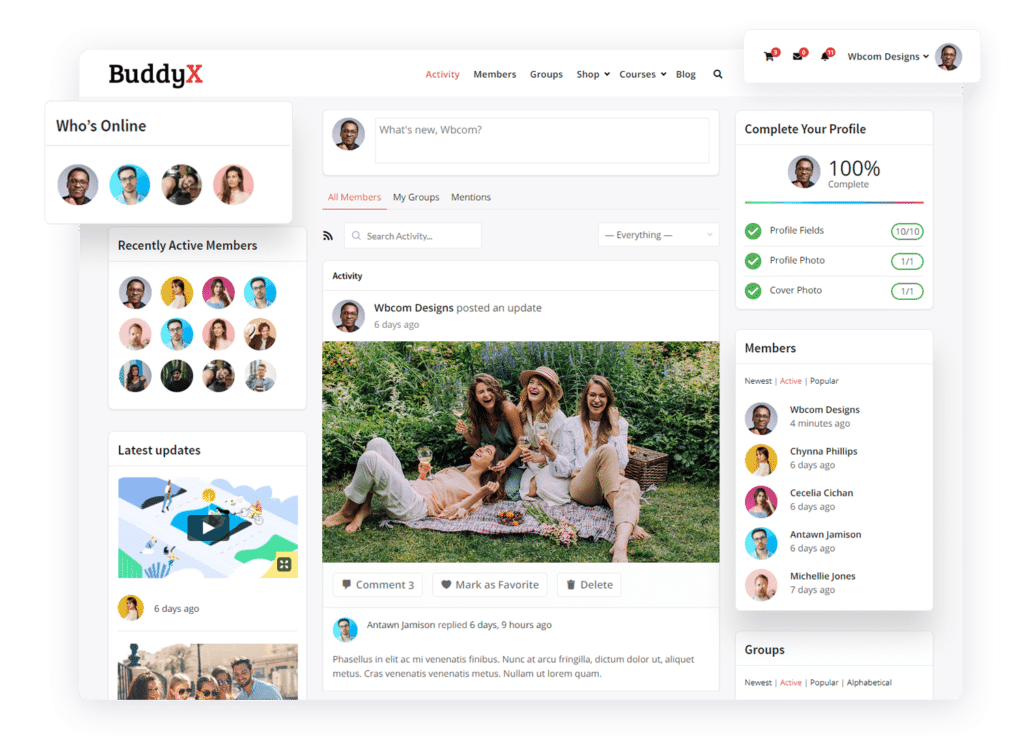
A free theme like BuddyX makes the owned path realistic without a development budget. It handles member profiles and private groups out of the box, and it’s compatible with popular community frameworks, so a brand can launch a functional, branded space without building the infrastructure from scratch.
What New Members Actually Need in Their First Visit
The first ten minutes inside a community shape whether someone becomes a regular or quietly leaves and never comes back. A confusing landing page, no obvious place to introduce yourself, no visible sign that real people are actually active there, and most visitors bounce before they ever post. None of that requires a redesign to fix. It usually just requires someone actually looking at the space through a stranger’s eyes for the first time.
A short, clear prompt, something as simple as “introduce yourself here,” gives new members an easy first action that doesn’t require them to have something profound to say. That low-stakes entry point matters more than any onboarding sequence built around flashy features.
Where Communities Go Wrong Early On
Launching without a clear purpose is the most common failure. A community started because “brands should have one” tends to sit empty, since nobody joins something without knowing what it’s actually for.
Treating the space as a marketing channel rather than a genuine gathering place kills engagement fast. Members can tell within a few posts whether a space exists to serve them or to sell to them, and the second reading empties a community quickly.
Launching too big is a quieter mistake. Opening the doors to an entire mailing list on day one, before there’s any culture or content to greet new members with, produces a huge, silent group instead of a small, active one. A slower, more deliberate launch to a handful of engaged early members almost always produces a healthier long-term result.
Copying another community’s rules and tone word for word is a subtler version of the same mistake. What works for one audience often falls flat with another, because the culture that made the original work grew out of that specific group’s particular quirks, not a template that transfers cleanly.
Measuring a Community Honestly
Vanity metrics look good in a slide deck and mean very little in practice. Total membership tells almost nothing about whether the community is healthy. A far more honest number is the percentage of members who posted, commented, or reacted in the last thirty days.
Watching that percentage over time reveals whether a community is actually growing or just accumulating dormant sign-ups. A community that plateaus in active percentage while total membership keeps climbing is quietly diluting itself, even as the headline number looks like a success story.
Response time is another number worth tracking honestly. A question that sits unanswered for three days signals neglect, even if the community’s overall member count looks fine. The same question answered within a few hours signals a space that’s actually alive, regardless of how big it is.
Signs a Community Is Actually Working
Returning participation matters more than total membership. A community where the same people keep showing up, week after week, is healthier than one with ten times the membership and almost no repeat activity.
Members helping each other unprompted is one of the clearest signs a community has developed real culture. When someone answers another member’s question before an admin even sees it, that’s the community running itself, which is exactly the goal. It’s also the point where the workload on whoever’s running the space actually starts to ease.
New members getting a reply to their first post within a day, rather than a week, predicts whether they’ll stick around. That first interaction sets the tone for everything that follows, far more than any welcome sequence or feature ever will.
Frequently Asked Questions
How big does a community need to be before it feels like a real community?
Much smaller than most people assume. A group of thirty to fifty consistently active members generates more genuine activity and connection than a passive group of several thousand. Size matters far less than engagement.
Can a community exist across multiple platforms at once?
Yes, and many do, a discussion happening on a dedicated forum that spills into a social media conversation and eventually an in-person event. What makes it one community isn’t the platform. It’s the consistent group of people and the shared reason they keep showing up.
Is it too late to start a community if competitors already have one?
Rarely. Most existing brand communities are quieter and less well-run than they appear from the outside. A newer, more attentive community with genuine engagement can outperform an older, neglected one within months, since members go where they’re actually heard.
Should a community be free to join, or is a paid gate ever a good idea?
It depends on what the community is actually offering. A support or discussion community usually works better free, since the priority is volume and reach. A community built around exclusive access or structured coaching can justify a paid tier, but only once there’s already proof members find real value in being there.
What’s the fastest way to kill a new community?
Silence. A new member who posts and gets no response within a day or two rarely tries again. The single most valuable habit for anyone launching a community is simply replying fast, especially in the first few weeks before the community has any momentum of its own.
The Short Version
An online community is a group of people connected by a specific reason to be together, not a generic audience. Understanding which type fits a specific goal, and picking a platform that matches how members actually want to interact, matters more than chasing size. Start with a clear purpose and the right people show up.
Everything else, the platform and the growth tactics, is secondary to that first decision. Get the purpose right and most of the rest follows on its own.
Interesting Reads:
How to Create Your Own Social Networking Website?