

Every open registration form on a community site is a target for bots, fake signups, credential-stuffing login attempts, spam comments. A CAPTCHA is the standard way to filter those out before they reach your database, and for BuddyPress sites specifically, BuddyPress reCaptcha is a free plugin built to cover the forms a generic reCAPTCHA plugin might miss.
How reCAPTCHA actually works
Older CAPTCHAs asked users to type out distorted, hard-to-read text, something computers struggled with more than humans. Google’s reCAPTCHA has moved past that for most sites. Version 2 is the familiar “I’m not a robot” checkbox, with a visual challenge only shown if the request looks suspicious. Version 3 skips the checkbox entirely: it scores traffic in the background based on behavior, with no interaction required from real users at all. Both versions are supported by BuddyPress reCaptcha, so you can choose the level of friction that fits your site.
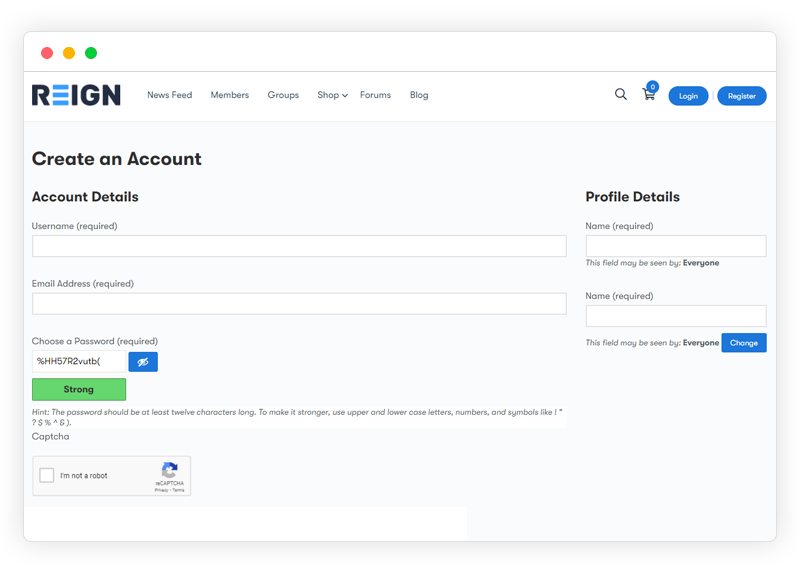
v2 vs. v3: Which One Actually Fits Your Site
The choice between the two versions isn’t purely a technical preference, it changes the actual visitor experience in a way worth thinking through deliberately. v2’s checkbox adds a small, visible step to every registration or login attempt, genuine visitors have to click it (and occasionally solve an image challenge if their traffic pattern looks unusual), which introduces friction that can measurably reduce completion rates on a form, even a small amount of friction costs some percentage of visitors who abandon partway through. v3, by contrast, is invisible: it runs a behavioral risk score in the background and only intervenes (blocking submission or triggering a fallback challenge) when the score suggests bot activity, meaning the overwhelming majority of genuine visitors never see anything at all. The tradeoff is that v3’s scoring is a black box, you get a numeric risk score rather than a definitive human/bot verdict, and you have to decide what threshold counts as suspicious, which requires some tuning and monitoring rather than a set-and-forget configuration. For a community site prioritizing frictionless signup, v3 is generally the better starting point; for a site that’s already dealing with active, sophisticated bot abuse and needs a harder gate, v2’s explicit challenge provides a clearer, more deterministic block. Some sites split the difference, running v3 as the default and falling back to a v2 challenge only when the behavioral score comes back genuinely suspicious, which keeps friction low for the vast majority of visitors while still holding a firmer line against traffic that actually looks automated.
What it actually protects against
Brute-force login attempts
Bots that hammer a login form with password combinations are one of the more common attacks on any WordPress site. A CAPTCHA on the login form stops most of them cold, since scripted attempts can’t solve the challenge or clear the behavioral score.
Fake account signups
Open registration on a community site is an easy target for bots creating accounts in bulk, usually to post spam later. Requiring a CAPTCHA on registration cuts this down significantly without adding real friction for genuine members.
Checkout and order abuse on WooCommerce
If your community includes a store, the same bot problem shows up at checkout, fraudulent orders, card testing, and abuse of order forms. Covering WooCommerce’s login, registration, and checkout pages closes that gap too.
Where BuddyPress reCaptcha covers you
Unlike a generic reCAPTCHA plugin that only handles the default WordPress login form, this one extends coverage across the pages a community site actually needs protected: WP login, WP registration, WP lost password, BuddyPress registration, WooCommerce login, WooCommerce registration, WooCommerce lost password, WooCommerce order pages, and bbPress topic/reply forms.
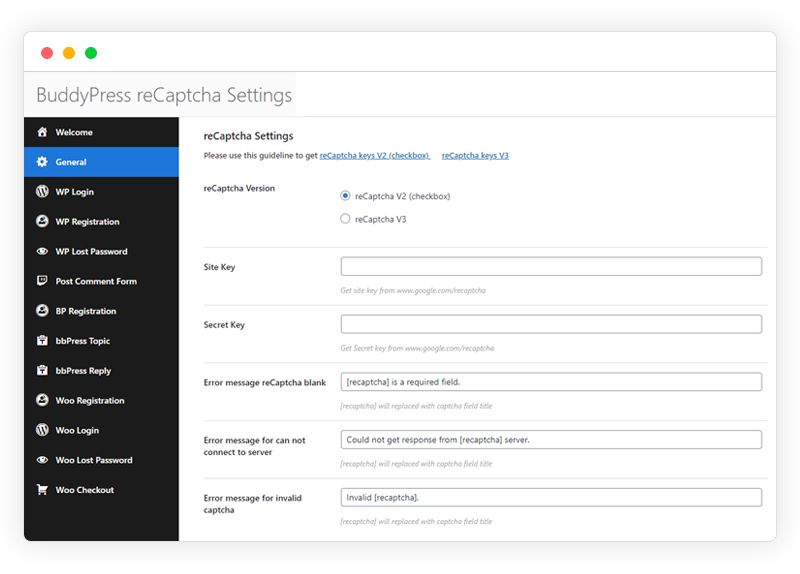
- reCAPTCHA v2 and v3 support, pick checkbox verification or invisible scoring per form.
- Light and dark theme options for the CAPTCHA widget itself, to match your site design.
- Per-page control, turn the CAPTCHA on or off for each form individually rather than site-wide.
It’s free (v2.0.2 as of this writing), requires BuddyPress to be active, and setup is a matter of installing it, adding your reCAPTCHA API keys from Google, and toggling which forms you want covered.
Getting Your reCAPTCHA API Keys
Before the plugin can do anything, it needs a site key and a secret key from Google’s reCAPTCHA admin console, a step that trips up first-time setups more often than the plugin’s own configuration does. Register your domain at Google’s reCAPTCHA site, choose v2 or v3 depending on which mode you’re deploying (you can register for both if you want to switch later without redoing this step), and Google generates the two keys: the site key goes into your page’s frontend code to render the widget, the secret key stays server-side and is what actually verifies a submission with Google’s servers. A common early mistake is registering the wrong reCAPTCHA type, registering for v2 when the plugin’s expecting v3 keys (or the reverse) produces a widget that either doesn’t render at all or fails verification silently, worth double-checking the version selected during key registration matches what you’re configuring in the plugin.
Is it worth adding
If your community allows open registration or runs a WooCommerce store, yes, bot signups and login attempts are close to guaranteed once a site gets any traffic, and the cost of adding this is one free plugin and a few minutes of setup. Sites that gate registration through invitation or manual approval already have less exposure and may not need it as urgently.
Testing That It’s Actually Working
Installing and activating a CAPTCHA plugin isn’t the same as confirming it’s doing its job, and it’s worth a deliberate testing pass rather than assuming a green “connected” status in the settings screen means every covered form is actually protected. Submit each form type you’ve enabled the CAPTCHA on (registration, login, a WooCommerce checkout if applicable) from a logged-out browser session and confirm the widget actually appears or, for v3, that submission still succeeds normally for a genuine attempt. If you have access to server logs or a security plugin that tracks failed login attempts, compare volume before and after enabling the CAPTCHA, a meaningful drop in automated login attempts is the clearest real-world confirmation that it’s filtering effectively rather than just present but inactive.
What a CAPTCHA Doesn’t Protect Against
It’s worth being clear-eyed about the limits here so a CAPTCHA doesn’t end up as a false sense of complete security. A CAPTCHA filters automated, scripted abuse, it does essentially nothing against a genuine human spammer manually creating accounts and posting spam by hand, since a real person can solve the challenge as easily as any legitimate visitor. It also doesn’t protect against a compromised legitimate account being used maliciously, since that login already passes as human. And it doesn’t substitute for other baseline security practices, strong password requirements, two-factor authentication for admin accounts, a web application firewall, keeping plugins and core updated. A CAPTCHA is one layer in a broader security posture, the right tool specifically for the automated-bot-traffic problem, not a comprehensive fix for every way a community site can be abused.
Accessibility Considerations
CAPTCHA challenges have a real, documented history of creating accessibility barriers, older text-distortion CAPTCHAs in particular were close to unusable for visually impaired users relying on screen readers, and even image-based challenges can be genuinely difficult for some users with visual or cognitive disabilities. reCAPTCHA v3’s invisible, no-interaction approach sidesteps this concern almost entirely for the majority of legitimate traffic, since there’s simply no challenge to solve under normal circumstances. v2’s checkbox format is generally more accessible than older CAPTCHA styles, and Google has built in audio-challenge fallbacks for users who can’t complete a visual challenge, but it’s still worth being aware that any additional interactive step is a potential friction point for some users, one more reason v3 is often the more accessible default choice when the choice is available.
Privacy and Data Considerations
Because reCAPTCHA runs through Google’s infrastructure regardless of which version you deploy, it does involve sending some data (the visitor’s IP address and browser behavior signals, for v3 scoring in particular) to Google’s servers as part of the verification process. This is worth disclosing in your site’s privacy policy if you’re operating under GDPR or a similar regulation, since it represents a third-party data flow distinct from your own server. If reliance on Google’s infrastructure specifically is a concern for your site’s privacy posture, a small number of alternative CAPTCHA services exist that don’t route through Google, though BuddyPress reCaptcha itself is built specifically around Google’s reCAPTCHA API, so switching providers would mean a different plugin entirely rather than a setting change within this one. Either way, keeping your privacy policy specific about which third-party services touch visitor data, rather than a generic boilerplate statement, is worth the small amount of extra effort during setup.
CAPTCHA vs. Other Anti-Spam Approaches
reCAPTCHA isn’t the only tool for filtering automated abuse, and it’s worth understanding how it compares to the alternatives, since some communities layer multiple approaches together. A honeypot field, a form input hidden from human view via CSS but visible to a script that reads the raw HTML, catches unsophisticated bots that fill in every field they find, without adding any visible friction to genuine visitors at all. It’s a genuinely useful complementary layer specifically because it costs nothing in user experience, though it’s less effective against more sophisticated bots that specifically parse CSS to avoid hidden fields. Rate limiting, capping how many submission attempts a single IP can make within a time window, catches brute-force patterns regardless of whether an individual attempt could pass a CAPTCHA, and works well paired with a CAPTCHA rather than as a replacement for it. Email verification (requiring a confirmed email link before an account is fully active) doesn’t stop the initial signup attempt but does filter out throwaway or fake addresses used purely for spam. None of these fully replace reCAPTCHA on their own, but combining a honeypot and rate limiting alongside reCAPTCHA covers a broader range of abuse patterns than any single layer would catch in isolation.
Common Configuration Mistakes
Enabling the CAPTCHA on every form site-wide without considering the tradeoff on each one. A CAPTCHA on your registration form is close to essential on any open-signup community site. A CAPTCHA on, say, a simple newsletter signup widget embedded in a footer might introduce disproportionate friction relative to the actual spam risk that specific form faces. Evaluate each covered form individually rather than toggling everything on by default just because the option exists.
Never revisiting the v3 score threshold after initial setup. If you’re running v3 and configured a specific risk-score threshold at launch, that threshold isn’t necessarily still correct months later as your traffic patterns and the sophistication of bot traffic both evolve. A threshold set too loosely lets more bot traffic through than intended; one set too strictly can start blocking legitimate users whose behavior happens to look unusual (someone on a VPN, a first-time visitor with no browsing history on your domain). Periodically reviewing actual submission data against your threshold is worth the occasional check-in rather than a pure set-and-forget configuration.
Forgetting to test the mobile experience specifically. reCAPTCHA v2’s checkbox and occasional image-challenge widget render differently on a small screen than on desktop, and a widget that’s slightly cramped or awkward to interact with on mobile can measurably hurt completion rates on a form, given how much registration and login traffic on a community site increasingly happens from a phone. Test the actual widget rendering at a genuine mobile viewport width, not just assume desktop testing covers it.
Not monitoring for a sudden spike in CAPTCHA failures. A sharp, sudden increase in legitimate-looking users failing the CAPTCHA challenge is worth investigating rather than ignoring, it can indicate anything from a misconfiguration after a plugin update to Google adjusting its underlying risk-scoring model in a way that’s now flagging more of your genuine traffic as suspicious. Treat an unexpected spike as a signal worth a few minutes of investigation, not background noise.
Frequently Asked Questions
Can I run reCAPTCHA v2 and v3 on different forms of the same site?
The plugin’s per-page controls allow enabling or disabling the CAPTCHA per form, though running two different reCAPTCHA versions simultaneously across different forms typically requires registering separate key pairs for each version and configuring accordingly. Confirm the specific version-mixing behavior in your plugin’s current settings screen, since this is more advanced than a single-version deployment.
Will this plugin work if I’m running BuddyBoss Platform instead of standalone BuddyPress?
The plugin explicitly requires BuddyPress to be active, and since BuddyBoss Platform is built as a fork of BuddyPress sharing much of its core structure, compatibility is generally good, though it’s worth testing registration and login flows directly after activation to confirm the CAPTCHA renders correctly within BuddyBoss’s specific templates rather than assuming universal compatibility.
Does enabling reCAPTCHA on every form slow down page load?
There’s a small overhead from loading Google’s reCAPTCHA script, generally not significant enough to be a real performance concern on its own, but worth being deliberate about only enabling the CAPTCHA on forms that actually need it (registration, login) rather than every single page on the site, since each additional instance of the widget on a page adds incremental script weight.
What happens to a submission if Google’s reCAPTCHA service is temporarily unreachable?
This is a genuine edge case worth understanding before relying on the plugin in production: if the verification request to Google’s servers fails or times out, the specific fallback behavior (block the submission entirely versus allow it through) depends on how the plugin is configured to handle a verification failure. Worth confirming this behavior directly, since a plugin that fails closed (blocks everything during an outage) versus fails open (allows everything through) has very different implications for both security and legitimate user access during a rare outage.
Is there a cost to using Google’s reCAPTCHA service itself?
Google’s reCAPTCHA v2 and the standard tier of v3 are free for typical site volume. Google does offer a paid Enterprise tier with additional features and higher volume allowances aimed at larger organizations, but a typical WordPress community site’s usage falls comfortably within the free tier’s limits.
Can I use this plugin without a BuddyPress community, just for standard WordPress login and registration?
No, the plugin explicitly requires BuddyPress to be active as a dependency, so a site not running BuddyPress at all would need a different, more general-purpose reCAPTCHA plugin instead. Plenty of standalone options exist that cover just core WordPress login and registration without the BuddyPress requirement, worth searching for specifically if BuddyPress isn’t part of your stack.
How do I know if bot traffic is even a real problem on my specific site before adding this?
Check your user registration list for obviously fake-looking accounts, gibberish usernames, disposable email domains, dozens of signups within a short burst with no corresponding activity afterward. A spike in failed login attempts in your server or security plugin logs is another clear signal. If you’re not seeing any of these patterns yet, that’s a reasonable sign the exposure is currently low, though it’s worth revisiting the question periodically as your site’s traffic and visibility grow, since bot targeting tends to increase once a site starts ranking or getting linked to more broadly.
Interesting Read:
How Load More Products for WooCommerce Plugin Benefits E-Commerce Sites?
Adding Community Reactions and Status Plugin to Your Website