

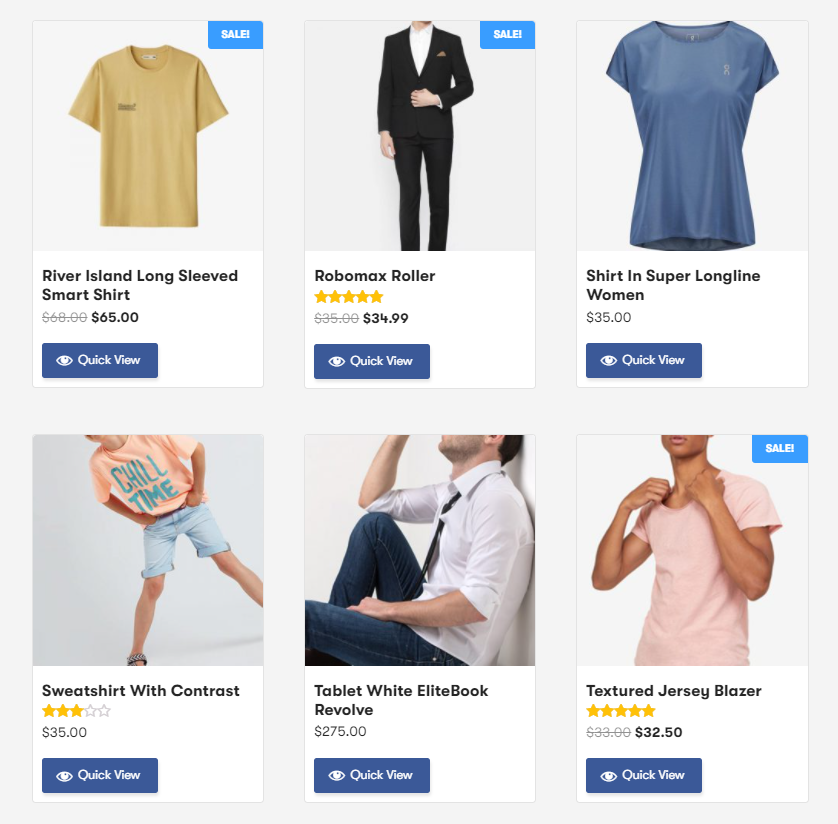
Quick view lets a shopper preview a product, image, price, description, right on the shop page, without clicking through to the full product page and then clicking back to keep browsing. That round trip is exactly the kind of friction that makes people give up scrolling a catalog.
What It Actually Does
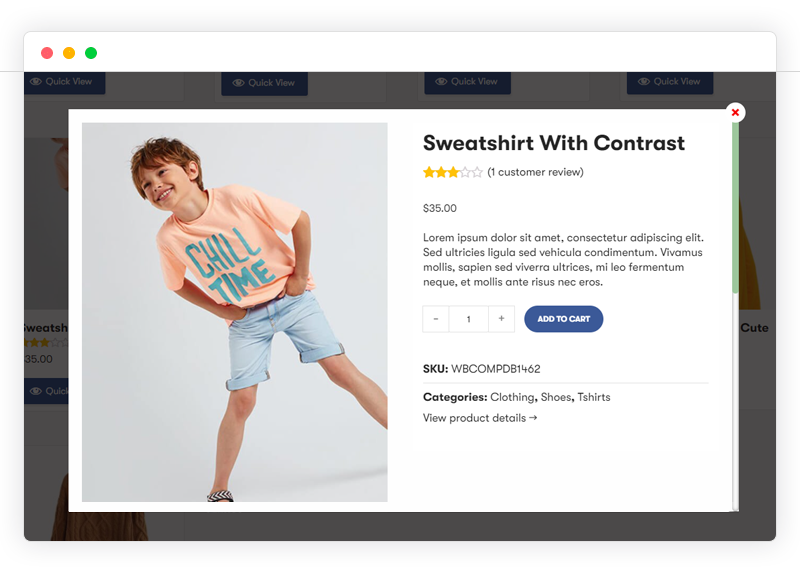
Clicking a “Quick View” button on the shop page opens a popup with the product’s image, price, short description, and an add-to-cart button, all without leaving the shop grid. It’s not a replacement for the full product page, it’s a shortcut for the products a shopper is only casually considering.
Why It’s Worth Adding
- Fewer clicks to browse. Fewer round trips to product pages means less chance of someone giving up mid-scroll.
- Fits most themes’ branding. Button placement and popup styling are usually customizable enough to match your store rather than looking bolted on.
- Add to cart from the popup. Most quick view plugins let shoppers add to cart or wishlist directly from the popup, no page load required.
- Price and description at a glance. Enough information to decide whether a product’s worth a closer look, without committing to a full page load.
Real Plugins to Use
YITH WooCommerce Quick View is the most established option (free, WordPress.org, 6.4M+ downloads, updated June 2026). It’s a solid default: no-code setup, and enough popup customization to control which fields show.
If you want more granular control over which quick-view popups are shown are on which product types, or need better theme-specific styling, Addonify Quick View and Quick View WooCommerce (by xootix) are both active, free alternatives worth comparing.
How the Three Options Actually Compare
All three plugins do the core job (popup, image, price, add to cart), but they differ in the details that matter once you’re actually running a store rather than just testing a feature.
- YITH WooCommerce Quick View wins on maturity and community size. Its download count means most theme conflicts have already been reported and fixed by someone else before you hit them. YITH also sells a broader suite of WooCommerce plugins (wishlist, badges, request a quote), so if you’re already using one of those, the quick view popup tends to match their styling out of the box.
- Addonify Quick View tends to be lighter in terms of assets loaded, which matters if your shop page is already carrying a lot of JavaScript from other plugins. Its settings panel exposes more granular per-field toggles (show/hide SKU, stock status, categories) without needing custom CSS.
- Quick View WooCommerce by xootix ships with a handful of pre-built popup layout styles you can switch between visually, useful if you want a quick view popup that doesn’t look like the default YITH template, which shoppers who browse a lot of WooCommerce stores may have seen dozens of times already.
If you’re not sure which to pick, start with YITH. It’s the safest default specifically because of its install base, if something’s going to conflict with your theme or another plugin, YITH is the most likely to already have a documented fix or a settings toggle for it.
Setting Up YITH WooCommerce Quick View Step by Step
- Install and activate. From your dashboard, go to Plugins > Add New, search “YITH WooCommerce Quick View,” install, and activate. No license key needed for the free version.
- Check the button placement. Under YITH > Quick View, you’ll find settings for where the button appears on your shop grid, on hover, always visible, or as an icon overlay on the product image.
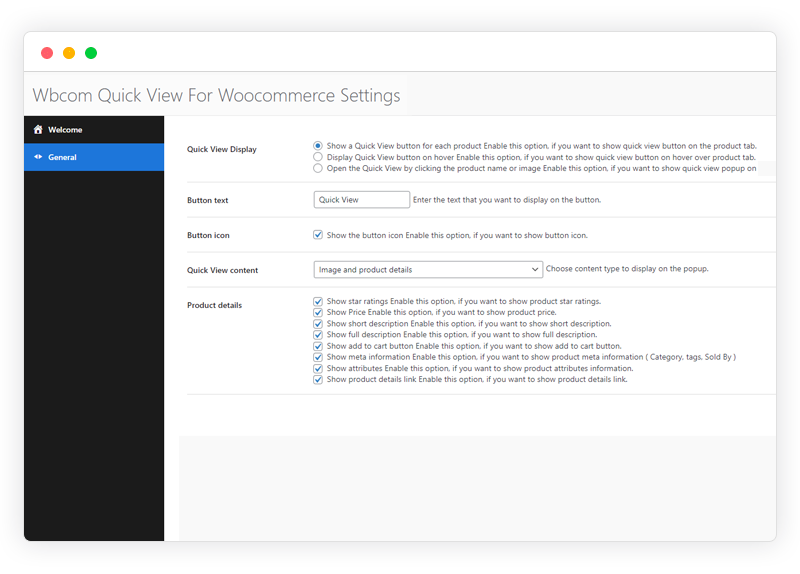
- Choose what shows in the popup. Toggle on or off the short description, stock status, SKU, and product meta. Fewer fields generally means a cleaner popup and a faster perceived load.
- Set the add-to-cart behavior. Decide whether adding to cart from the popup redirects to checkout, shows a mini-cart notification, or simply updates the cart count silently.
- Preview on the live shop page. Settings changes usually apply immediately, but always check the popup on both desktop and mobile before considering it done, popup width and image scaling behave differently across breakpoints depending on your theme.
Styling It to Match Your Store
Out of the box, quick view popups inherit a fair amount of styling from your active theme, but the button itself (icon, hover state, position) is usually the part that needs the most manual adjustment to look intentional rather than default. Most quick view plugins let you add custom CSS through their own settings panel or your theme’s Additional CSS section. Common tweaks worth making:
- Match the popup’s add-to-cart button color to your store’s primary button color, rather than leaving the plugin’s default accent color.
- Adjust the quick view icon’s size and position so it doesn’t overlap sale badges or wishlist icons if you’re running more than one WooCommerce extension on the same product grid.
- Set a max-width on the popup itself for large desktop screens, an unconstrained popup can end up awkwardly wide on a 27-inch monitor even though it looks fine on a laptop.
Performance: What to Watch For
Quick view plugins generally load their popup markup and scripts on every shop page regardless of whether a shopper ever clicks the button, which adds a small amount of overhead to every page load. On a shop with a large catalog and heavy product images, that overhead is rarely the biggest performance issue on the page, but it’s worth checking with your browser’s network tab after installing, particularly if your shop page already scores poorly on Core Web Vitals. A few practical mitigations:
- Make sure product images used in the quick view popup are served in a modern format (WebP or AVIF) and properly sized, not the full-resolution original scaled down with CSS.
- If you’re running a page speed plugin that defers JavaScript, test the quick view button after enabling that optimization, aggressive deferral occasionally breaks the popup’s click handler until the page fully settles.
- Disable quick view on category archive pages with very large grids (100+ products per page) if you notice a measurable slowdown, and rely on pagination or lazy-loaded grids instead.
Mobile Behavior
Quick view was originally designed with desktop hover interactions in mind, hover over a product, a quick view icon fades in. On mobile, there’s no hover state, so most plugins fall back to always showing the icon, or showing it after a tap on the product image. Test this specifically on a real phone rather than just your browser’s responsive mode, popup sizing and touch target size for the close button are common places where quick view breaks on smaller screens. A close button that’s too small to tap accurately is one of the most common quick view complaints in plugin support forums.
Accessibility Considerations
A popup that traps keyboard focus, doesn’t have a labeled close button for screen readers, or doesn’t return focus to the triggering button when closed creates a real barrier for anyone navigating your store without a mouse. Before shipping quick view on a live store, tab through the popup using only your keyboard: open it, confirm you can reach the add-to-cart button and any quantity field, and confirm Escape or a visible close button returns you to where you were. Most established plugins like YITH handle this reasonably well by default, but any custom CSS you add on top (especially hiding elements with display: none in ways that break focus order) can undo that.
Common Issues and Fixes
- Popup doesn’t open at all. Usually a JavaScript conflict with another plugin, or a theme that’s aggressively minifying/combining scripts in a way that breaks the quick view button’s click handler. Test with other plugins temporarily deactivated to isolate the conflict.
- Popup opens but shows no image. Often caused by lazy-loading plugins that haven’t loaded the image into the popup’s DOM yet. Check whether your lazy-load plugin has a documented exclusion or compatibility setting for quick view popups.
- Add to cart in the popup doesn’t update the mini-cart. This typically means your theme’s mini-cart widget isn’t hooked into WooCommerce’s AJAX cart fragments correctly. Confirm your theme supports
woocommerce_add_to_cart_fragmentsif you’re troubleshooting a custom or heavily modified theme. - Popup styling looks broken on a specific page builder layout. Elementor and other builders sometimes wrap product grids in containers with CSS that conflicts with the popup’s positioning. Check the plugin’s support forum for known conflicts with your specific builder before assuming it’s unfixable.
Handling Variable Products in the Popup
Simple products (one price, one image, add to cart) work fine in a quick view popup by default. Variable products, ones with size or color options that change the price or image, are where quick view gets genuinely more complicated, and where a lot of poorly configured stores end up with a confusing popup. If a shopper needs to select a size before adding to cart, that selector has to actually appear and function correctly inside the popup’s constrained space, not just be copied over visually from the full product page.
Test this specifically if your catalog includes variable products: open quick view on a product with at least three variation attributes (say, size and color) and confirm the price updates correctly as you change selections, the correct variation image swaps in, and the add-to-cart button is disabled until a valid combination is selected. If any of that breaks in the popup, some quick view plugins offer a setting to fall back to a “View Full Details” link instead of a broken add-to-cart button specifically for variable products, which is a reasonable compromise if fixing the popup behavior itself proves difficult.
Quick View vs. the Full Product Page: When Each One Wins
It helps to think of quick view as a filter, not a replacement. A shopper scanning twenty products in a category is deciding which two or three deserve a real look. Quick view lets them eliminate the obvious no’s fast, without a full page load and a back button for each one. Once they’ve narrowed down to something they’re seriously considering, they’ll click through to the full page anyway, that’s where reviews, detailed specs, sizing guides, and related products actually influence the final decision. Don’t treat a high quick-view open rate as success on its own; the number that actually matters is whether quick view opens correlate with more product page visits and more add-to-carts, not just more popup clicks.
Measuring Whether It’s Actually Helping
Most store owners install quick view and never check whether it changed anything. If you’re running Google Analytics 4 or a plugin like MonsterInsights, set up an event to track quick view button clicks and, separately, add-to-cart actions that originate from the popup versus the full product page. A few weeks of data will tell you whether quick view is meaningfully reducing cart abandonment on category pages or whether shoppers are largely ignoring it in favor of clicking straight through to product pages, which does happen on stores where the catalog skews toward complex products.
If you don’t want to set up custom event tracking, a simpler gut check works too: compare your shop page bounce rate and average session duration for a couple of weeks before and after installing quick view. A meaningful drop in bounce rate alongside a similar or higher session duration is a reasonable (if imperfect) signal that the feature is reducing the friction it’s meant to reduce.
If You’re Using a Page Builder Theme
Themes built around Elementor, Divi, or a similar page builder sometimes render the shop archive through the builder’s own product grid widget rather than WooCommerce’s native template. When that’s the case, a standard quick view plugin’s button may not appear at all, because the plugin is hooking into a WooCommerce template hook that the builder’s widget doesn’t call. Before assuming a quick view plugin is broken, check whether your shop page is using the builder’s custom product grid or WooCommerce’s default archive template. If it’s the builder’s widget, look for a quick view option built into that specific widget’s settings, Elementor Pro’s WooCommerce widgets, for example, include their own quick view toggle that works independently of any third-party plugin.
Getting Started
Install one, activate it, and most of these plugins auto-add a quick view button to your shop page grid with no further configuration. From there, the settings typically let you control popup layout, which fields show (price, short description, stock status), and button placement. Worth testing on staging first if your theme has custom product-grid styling, quick view popups occasionally clash with theme CSS. Keep the default settings for your first day or two live, resist the urge to immediately start tweaking every option, and let a small amount of real shopper behavior tell you what actually needs adjusting rather than guessing upfront.
Is Quick View Right for Every Store?
Quick view earns its keep on stores with a large catalog and simple products, apparel, home goods, accessories, anything where a shopper is comparing a lot of similar items quickly. It matters less on stores selling a small number of complex products with variations, configurable options, or long, detail-heavy descriptions, where shoppers are going to want the full product page anyway and a stripped-down popup just adds an extra click before they get there. If your product pages carry a lot of weight (size charts, detailed specs, multiple variation-dependent images), consider skipping quick view on those categories and reserving it for simpler product types in your catalog.
A Reasonable Rollout Order
Rather than flipping quick view on store-wide and hoping for the best, a more deliberate rollout catches problems before they affect every shopper. Start by enabling it on a single category, ideally your simplest, highest-traffic one with mostly simple (non-variable) products. Check the popup on desktop and mobile, confirm add-to-cart actually works end to end including the mini-cart update, and let it run for a week or two before expanding it store-wide. This also gives you a clean before-and-after comparison for that one category if you decide to measure the impact using analytics, rather than a single site-wide change that’s harder to isolate from everything else happening on the store at the same time.
Quick Answers
Does quick view hurt SEO? No, quick view content is loaded via JavaScript into a popup and doesn’t replace or duplicate your indexable product page content, search engines still crawl and index the full product pages normally. It has no meaningful effect on SEO either way.
Can I show quick view only on certain product categories? Most plugins apply the button store-wide by default, but YITH and Addonify both support per-category or per-product exclusions through custom code hooks if you need finer control, check each plugin’s documentation for the specific filter hook, since exact function names differ between them.
Will quick view conflict with a wishlist or compare plugin? Generally no if all plugins are actively maintained and reasonably popular, since they’re all hooking into standard WooCommerce template locations. Conflicts do occasionally happen with less common or abandoned plugins, which is one more reason to favor actively updated options with a large install base.
Do I need the paid version of YITH for basic quick view? No, the free version on WordPress.org covers the core popup functionality (image, price, description, add to cart) completely. The premium version adds extras like product image zoom inside the popup and support for additional product types, worth it for larger stores but not required to get quick view working.
Interesting Reads:
How to Disable a WooCommerce Store
WooCommerce Removes Home From Category Path
How Load More Products for WooCommerce Benefits E-Commerce Sites