
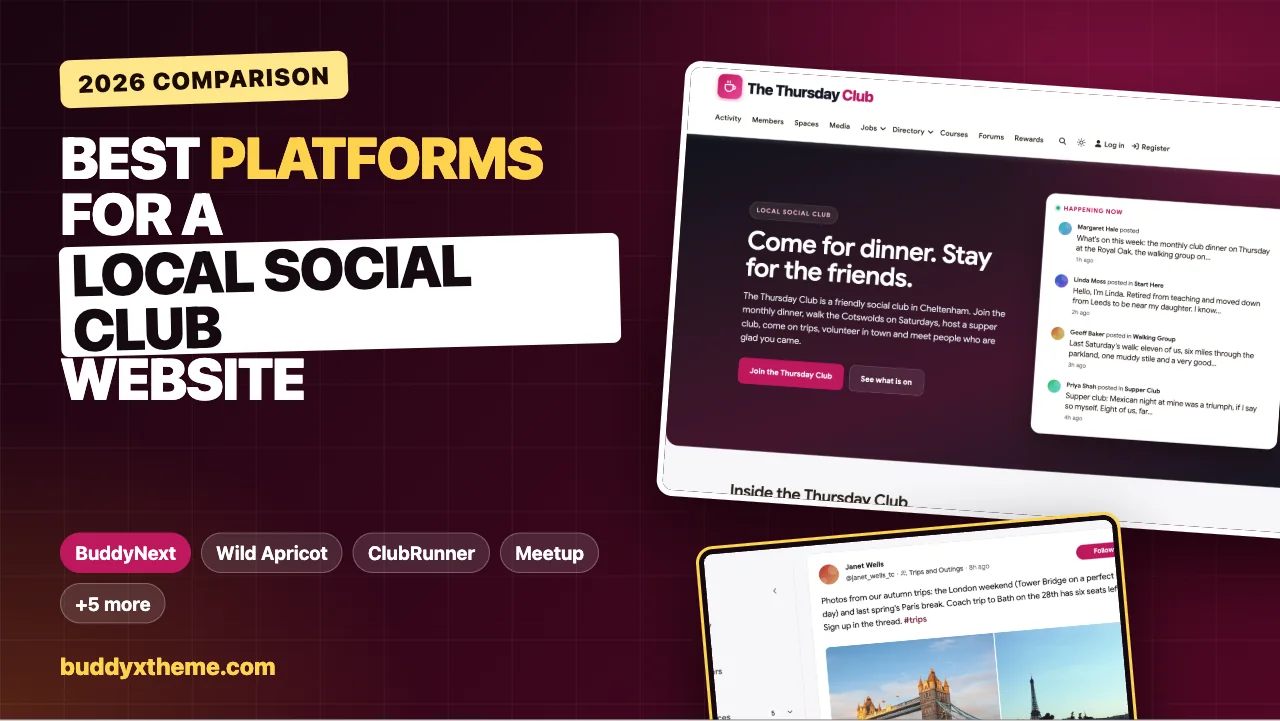
Every town has a club like this. It might be a newcomers’ club, a supper club, a service club, a walking society or a members’ club that has met on the same evening for thirty years. It runs on a handful of generous volunteers, a printed newsletter, an email list, a phone tree and a website that one member built a decade ago. It does something rare: it turns strangers into friends. And it often struggles to reach the people who need it most, because they cannot find it or do not know what to expect.
A local social club community website gives the club a friendly front door and a home for everything between meetings: what’s on with RSVPs, interest groups, trips and photos, volunteering, a newsletter, a committee space and a warm welcome for new members. This guide compares the platforms local clubs use, from club management software to event apps to community platforms you own. We built a working social club for the first entry and checked every competitor claim on the vendor’s own pages in November 2026.
Quick answer
If you run a local social club and want a website and community you own, BuddyNext is the strongest choice: events with RSVPs, interest group spaces such as walking and supper clubs, trips with photos, volunteering sign-ups, a newsletter and notices, a private committee space, member questions with accepted answers and an ideas roadmap, all on your own website. Wild Apricot, ClubExpress, MemberClicks, Join It, Raklet and ClubRunner handle membership administration, Meetup helps new people find you, Spond organises activity groups, and Mighty Networks is a general community option.
In this guide
- Why social clubs matter, and why they need a better website
- Club software, event apps or a community website?
- The social club scorecard
- 1. BuddyNext: best for a social club website and community you own
- 2. Wild Apricot: best membership management for small clubs
- 3. ClubExpress: best all-in-one club administration
- 4. MemberClicks: best for associations with committees
- 5. Join It: best simple membership with digital cards
- 6. Raklet: best membership software with a community board
- 7. ClubRunner: best for Rotary and service clubs
- 8. Meetup: best for being discovered by new people
- 9. Spond: best for activity groups and sports clubs
- 10. Mighty Networks: best hosted community with native apps
- Making events easy to say yes to
- Running interest groups
- Helping the committee and volunteers
- Moving an older club online
- Keeping the club friendly online
- Celebrating the club’s history
- Questions to ask before you choose
- A 30-day launch plan
- Which platform fits your club?
- More community platform comparisons
- How we built and checked this list
- Frequently asked questions
- The bottom line
Why social clubs matter, and why they need a better website
Loneliness is common. In England, the government’s Community Life Survey found that “7% of people (approximately 3.1 million people in England) reported that they felt lonely often or always” (UK Government). And people still value meeting face to face: in Pew Research Center’s 2026 study of online community, “About half of adults say it’s not as meaningful as in-person relationships” (Pew Research Center).
That is exactly what a local social club offers: real friendships, in person, close to home. The website’s job is to help people find the club, feel welcome before they arrive and stay connected between meetings. It has a handful of jobs:
| Job | What goes wrong without it | What the platform needs |
|---|---|---|
| What’s on | Members miss events they would have loved | Events with RSVPs and reminders |
| Interest groups | Smaller groups organise in side chats | A space for each group with its own posts |
| Welcoming newcomers | New people come once and never return | Introductions, a buddy and a friendly reply |
| Trips and photos | Photos sit on one member’s phone | Trip spaces with photo posts |
| Volunteering | The same few people do everything | Sign-up threads and events |
| Newsletter and notices | The printed newsletter misses younger members | Pinned notices and files |
| Running the club | Committee business clutters everything | A private committee space |
Club software, event apps or a community website?
Clubs usually compare three kinds of platform.
| Kind | What it does | Examples |
|---|---|---|
| Club and membership management | Member records, renewals, directories, events and emails | Wild Apricot, ClubExpress, MemberClicks, Join It, Raklet, ClubRunner |
| Event and activity apps | Public discovery or team-style scheduling | Meetup, Spond |
| Community platforms | A website and community with spaces, events and members | BuddyNext, Mighty Networks |
Membership software is excellent at administration: renewals, records and email. A community website is where members actually talk, plan, share photos and make friends. Some clubs run both; many small clubs need mostly the second.
The social club scorecard
How each option handles what matters most. “Not found” means we could not confirm it on the vendor’s own pages, not that it is impossible.
| Platform | Events and RSVPs | Interest groups | Photos and trips | Member directory | Newsletter | Committee space | Volunteering |
|---|---|---|---|---|---|---|---|
| BuddyNext | Events with RSVPs | Group spaces | Photo posts | Yes | Pinned notices, files | Private space | Sign-up threads |
| Wild Apricot | Event registration | Not found | Not found | Yes | Email templates | Not found | Not found |
| ClubExpress | Events, RSVPs | Not found | Not found | Member records | Emails and texts | Not found | Not found |
| MemberClicks | Registration | Not found | Not found | Not found | Automated emails | Committee management | Not found |
| Join It | Events | Not found | Not found | Member directory | Not found | Not found | Not found |
| Raklet | Events, RSVPs | Boards and posts | Not found | Directories | Newsletters | Not found | Not found |
| ClubRunner | Event planner | Committees | Not found | Directory with photos | Newsletter templates | Committees | Volunteers |
| Meetup | Events | Groups | Not found | Not found | Not found | Not found | Not found |
| Spond | Events, time polls | Subgroups | Not found | Not found | Not found | Not found | Not found |
| Mighty Networks | Weekly events | Not found | Not found | Not found | Not found | Not found | Not found |
1. BuddyNext: best for a social club website and community you own
BuddyNext is a complete community platform that runs on your own WordPress site. Open, private and secret spaces, events with RSVPs, photo posts, Q&A with accepted answers, polls, direct messages, member profiles and a directory, an ideas roadmap and paid memberships work together. A social club can run what’s on, interest groups, trips, volunteering, the newsletter and the committee in one place under its own name.
To show it in practice, we built The Thursday Club, a demo social club in Cheltenham. It has 20 members: a retired teacher who moved from Leeds to be near her daughter, a man who moved for work and whose colleagues all have young children, a woman widowed last year, a translator who works from home and joined for company, the club’s youngest member in her thirties, a founding member of thirty years, a walking group leader, a supper club host, a baker who brings cake to everything, a birdwatcher, an allotment veteran, a quiz master, a photographer, a minibus driver, and the committee: chair, secretary, treasurer, membership secretary, social secretary, trips organiser and volunteering lead.

The homepage is the club’s front door. A visitor sees what is on this week, a newcomer’s introduction, the walking group’s latest outing and the supper club, and knows within seconds that this is a friendly place.
Welcoming newcomers
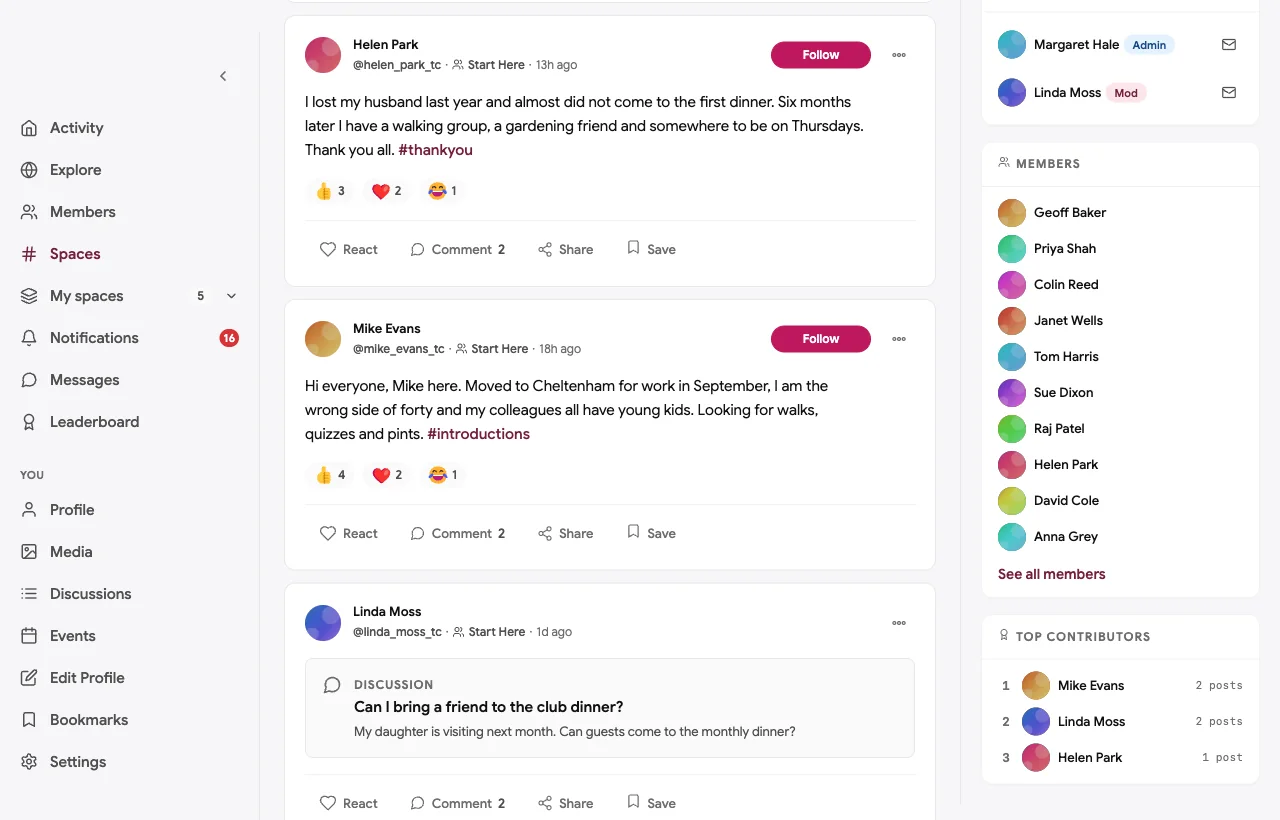
Start Here is where new members introduce themselves, and every introduction gets a reply. A retired teacher who knows nobody in town posts her hello; the walking group leader invites her on Saturday’s gentle walk, and the membership secretary becomes her buddy for the first month.
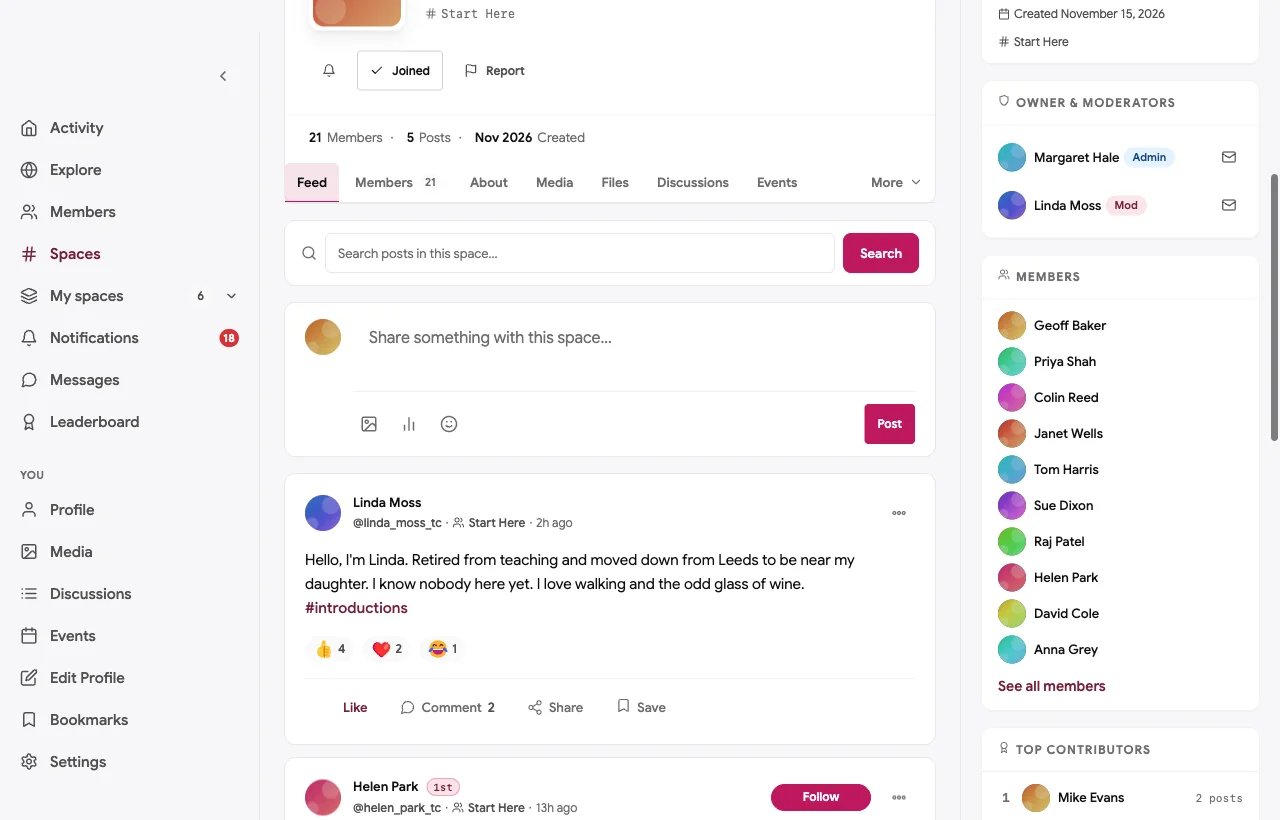
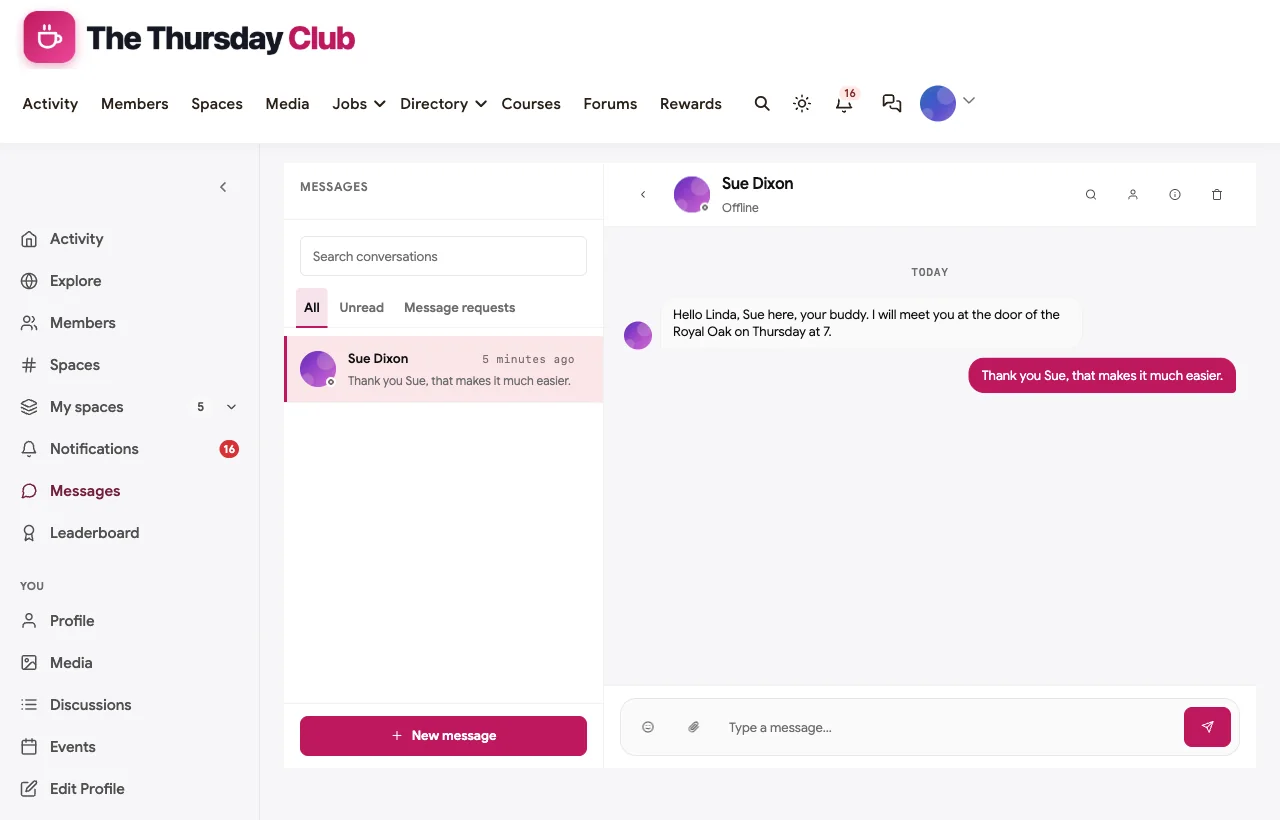

The most moving post in the demo is from a member widowed last year, who almost did not come to her first dinner. Six months later she has a walking group, a gardening friend and somewhere to be on Thursdays. That is what a social club is for.
What’s on
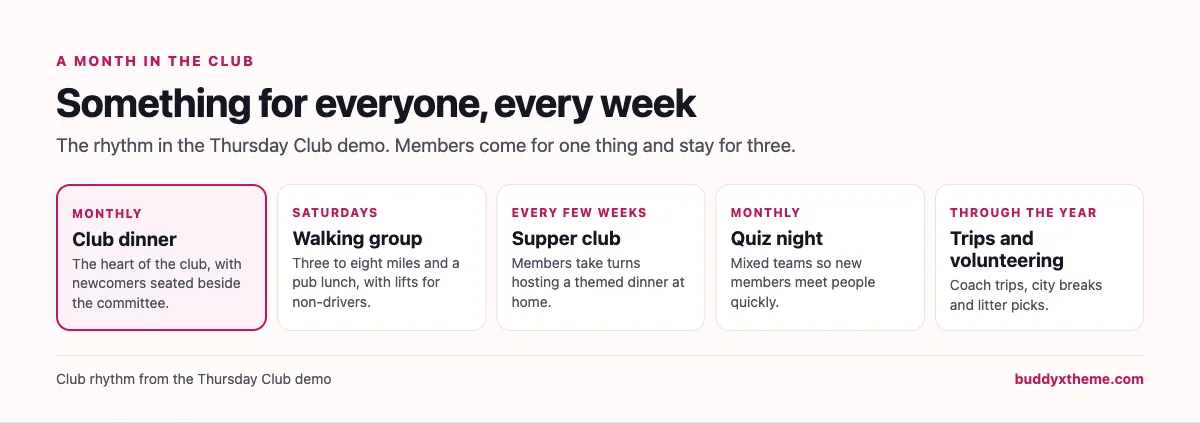
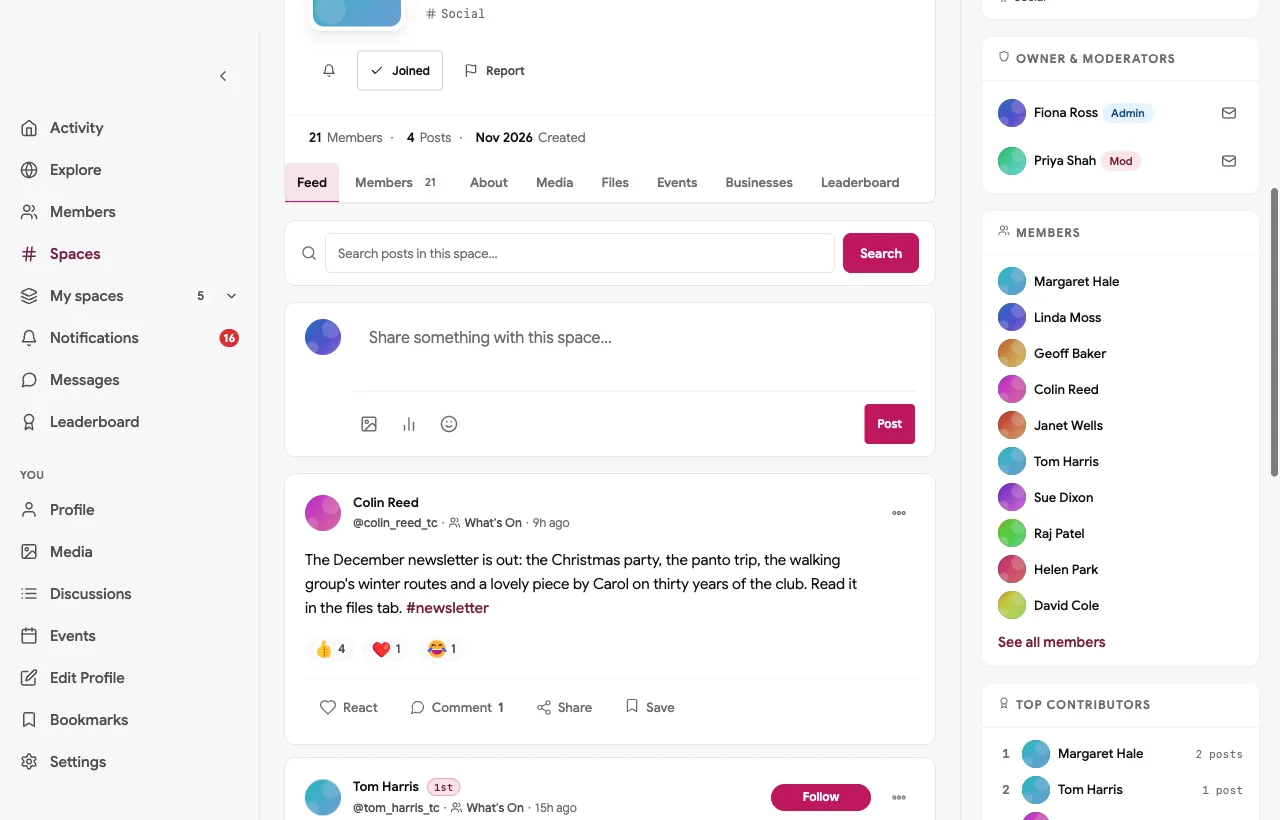
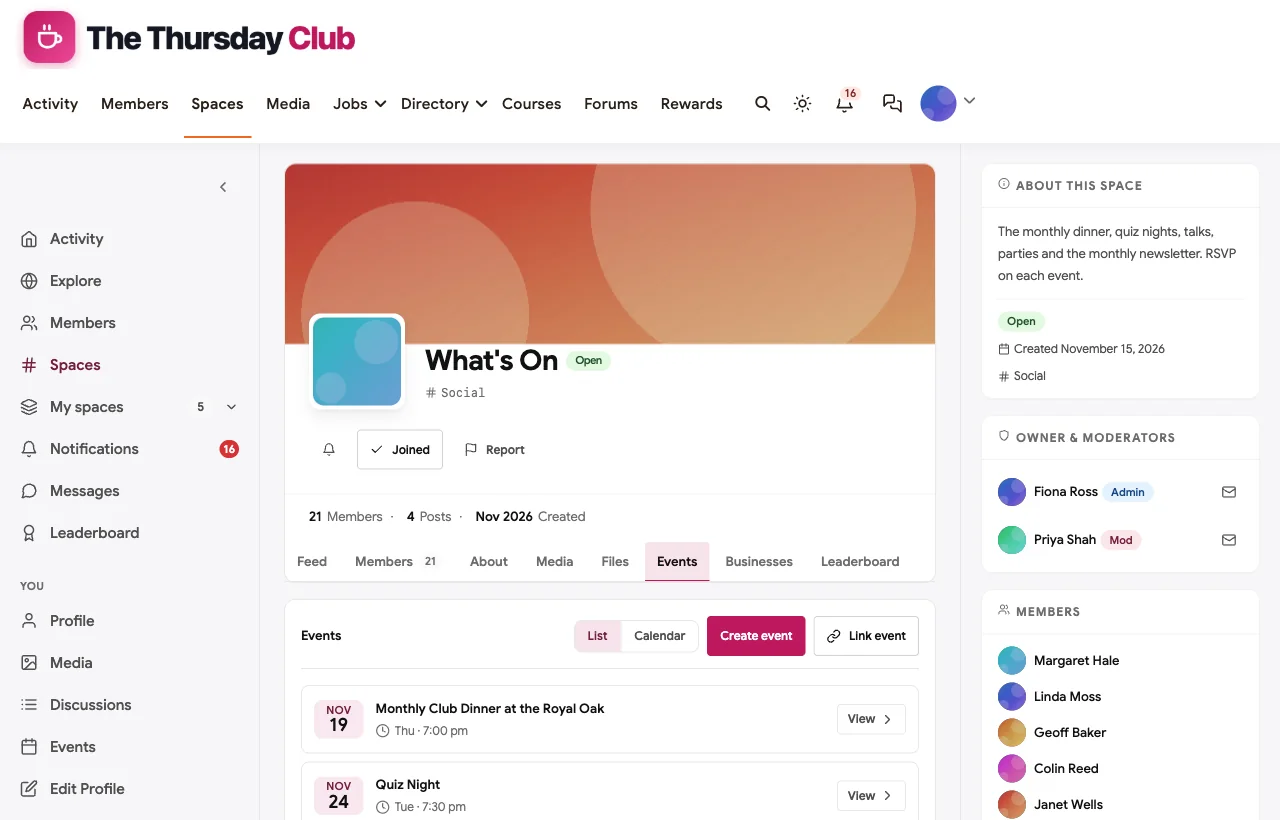
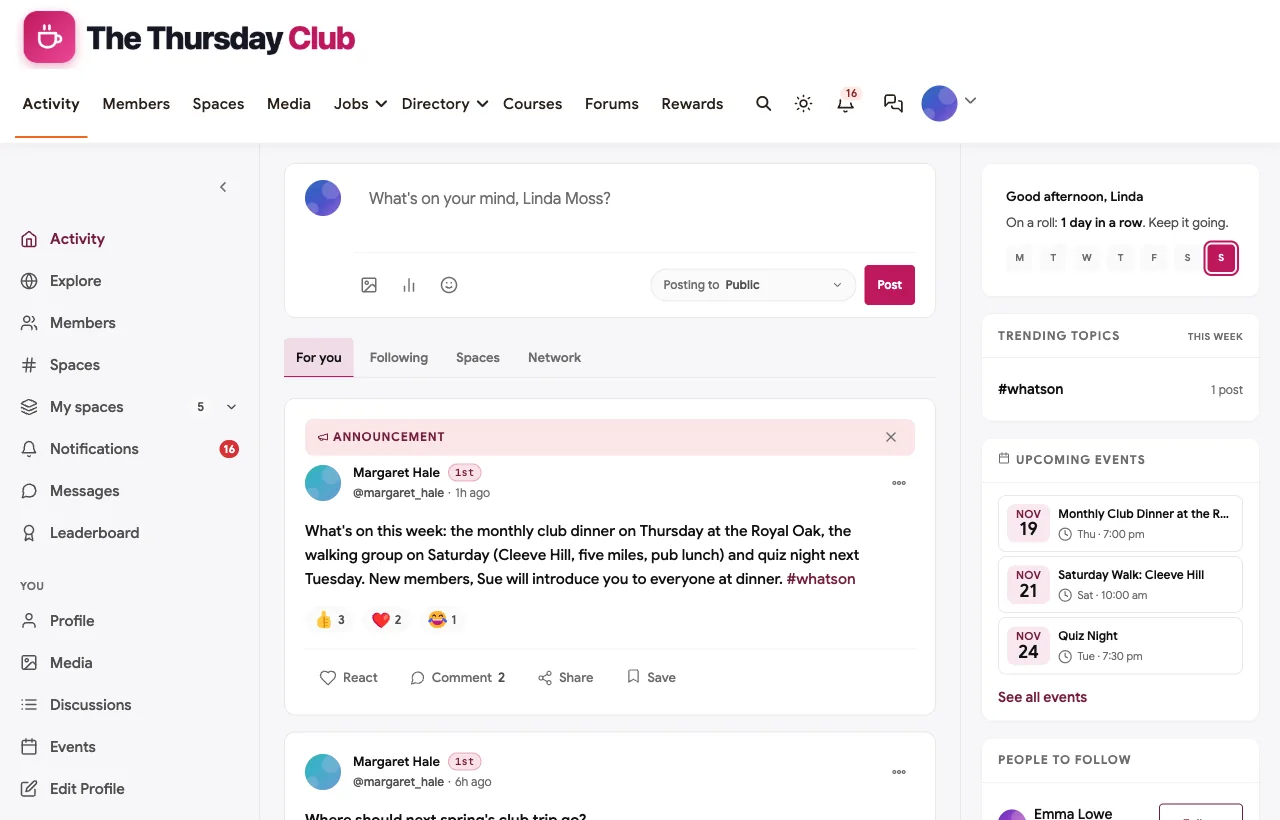
The What’s On space holds the monthly dinner, quiz nights, talks and parties as events with RSVPs, plus the monthly newsletter in the files. The pinned post sets out the week.
Interest groups
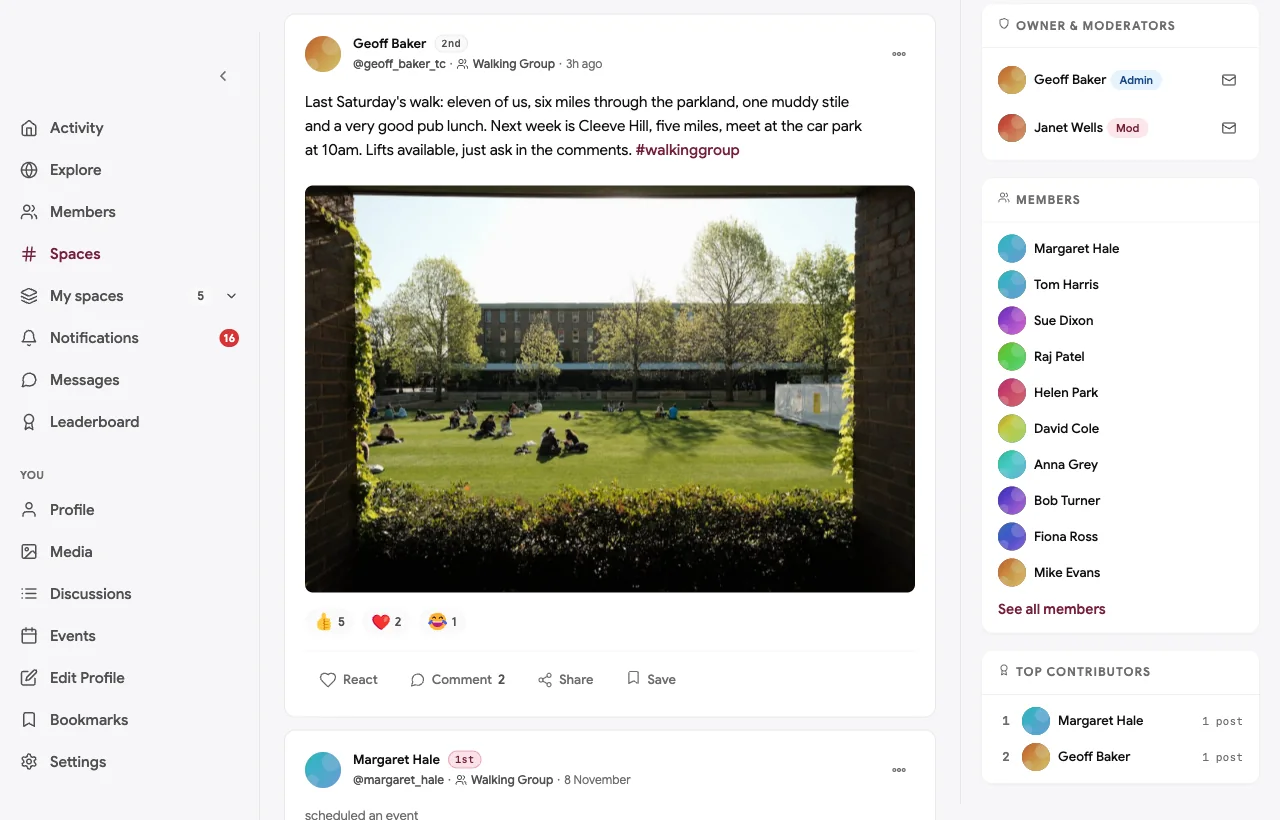
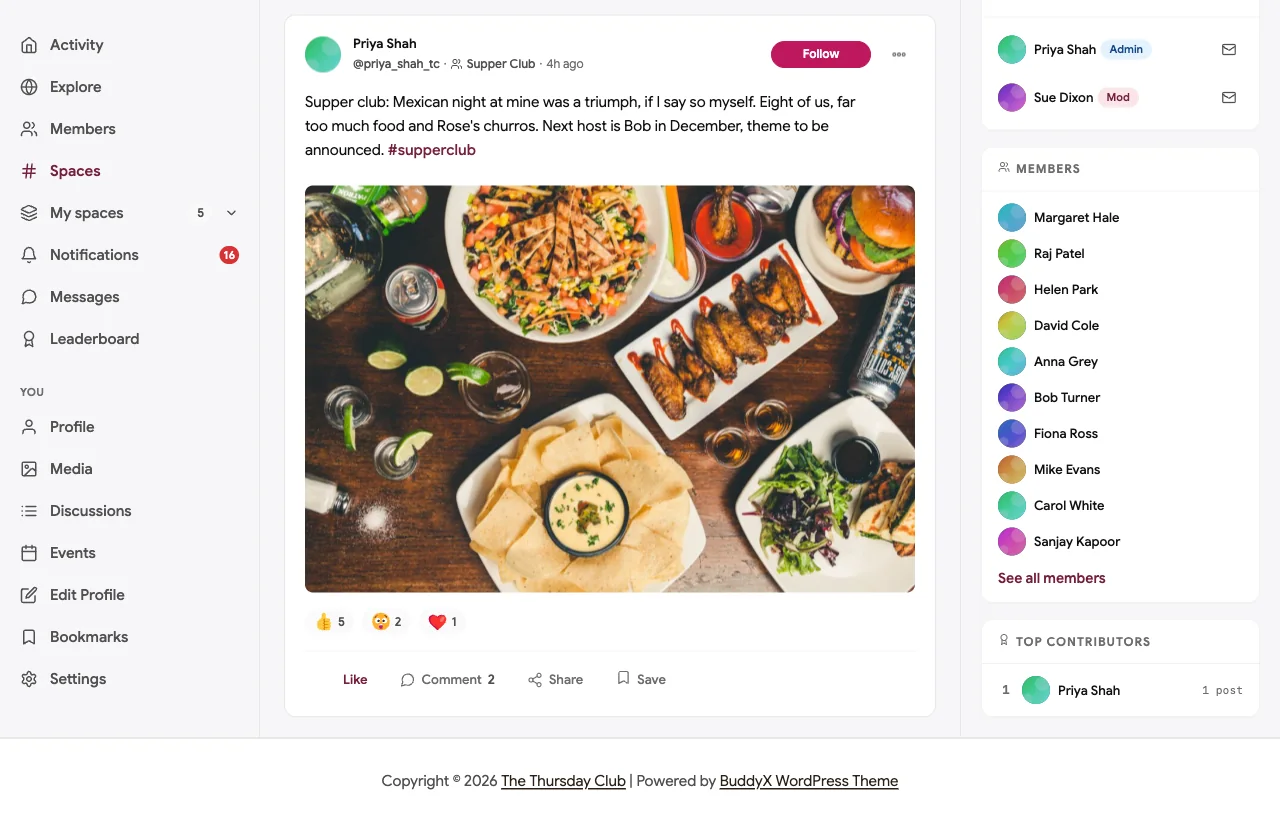
Each interest group has its own space. The Walking Group posts routes and photos, with lifts arranged in the comments. The Supper Club, where members take turns hosting a themed dinner for eight at home, posts menus and photos.
Trips and photos
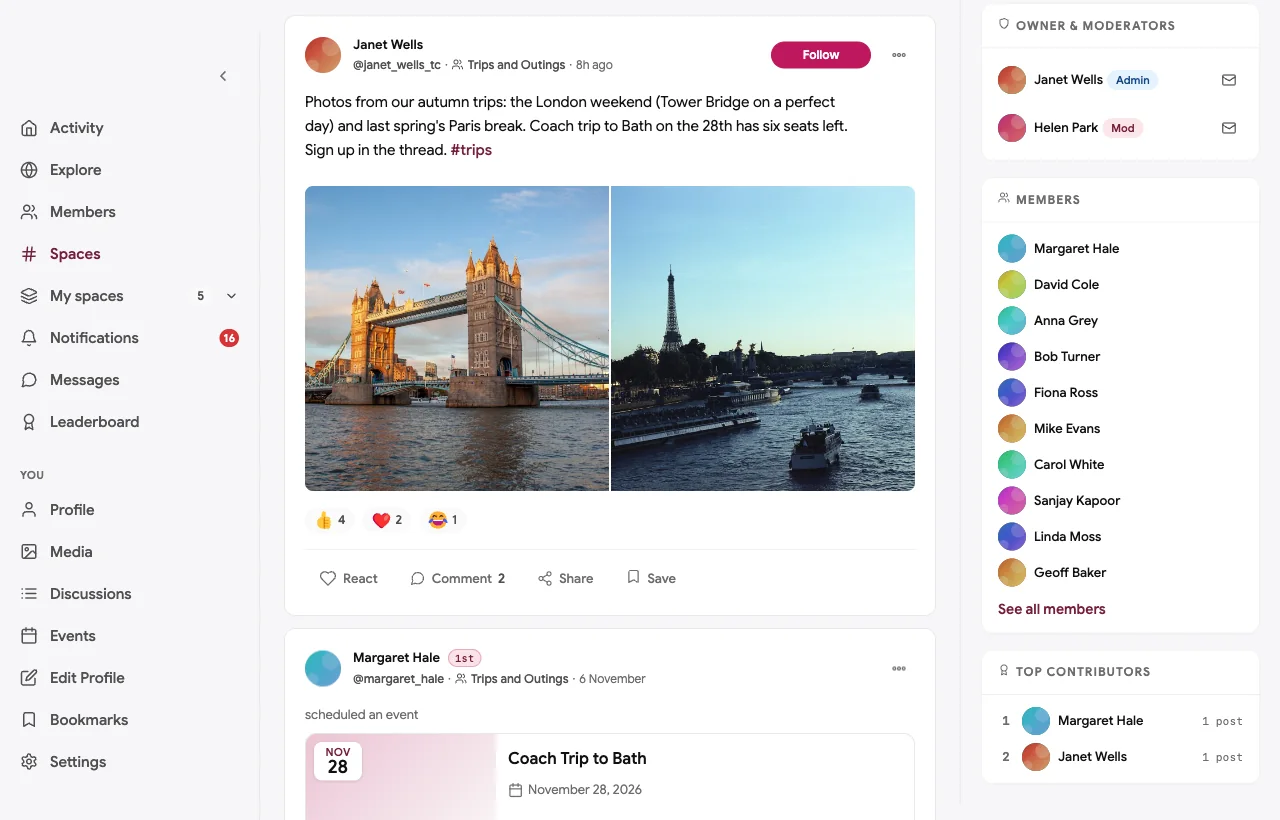
Trips and Outings holds coach trips, city breaks and theatre outings, with sign-ups in the thread and photos afterwards. A poll chooses next spring’s destination.
Volunteering
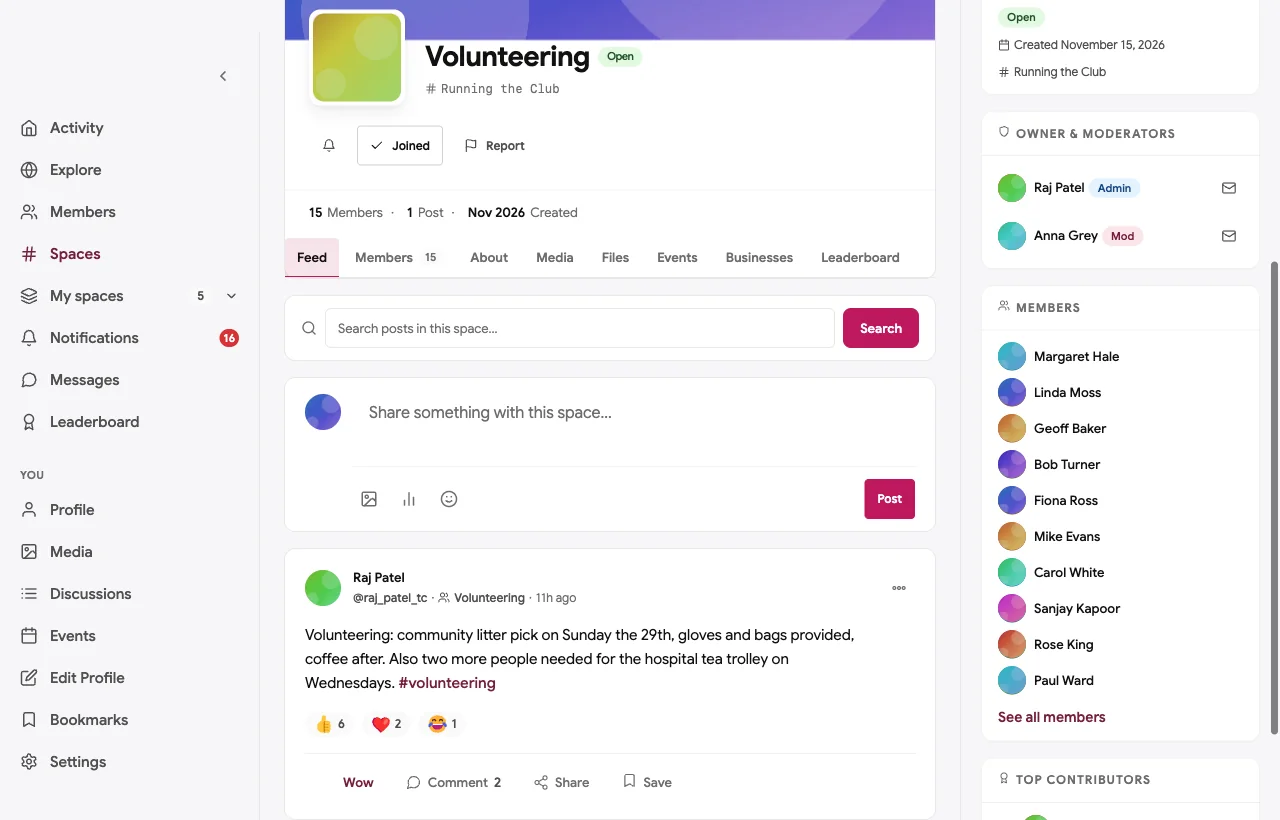
Many social clubs give back to their town. The Volunteering space holds sign-ups for a community litter pick, the hospital tea trolley and the town festival.
Questions for the committee
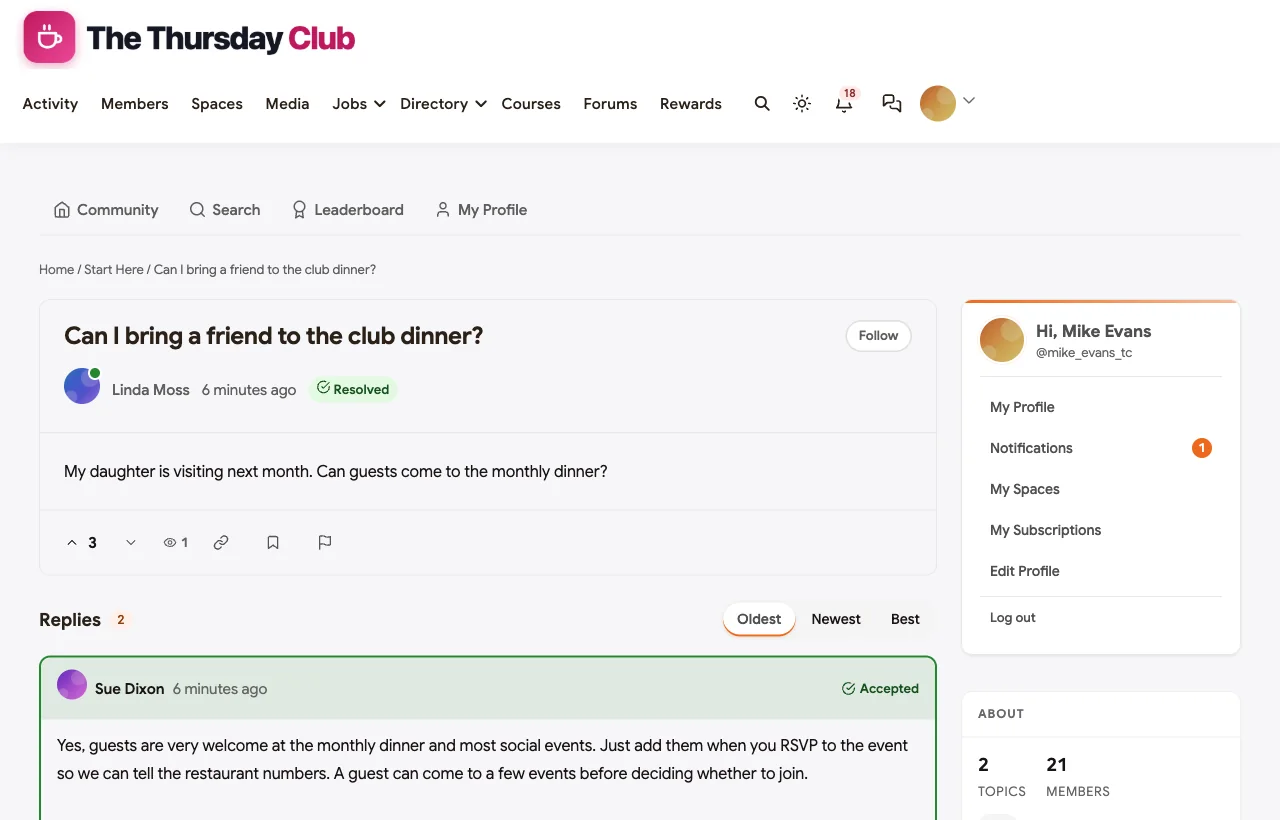
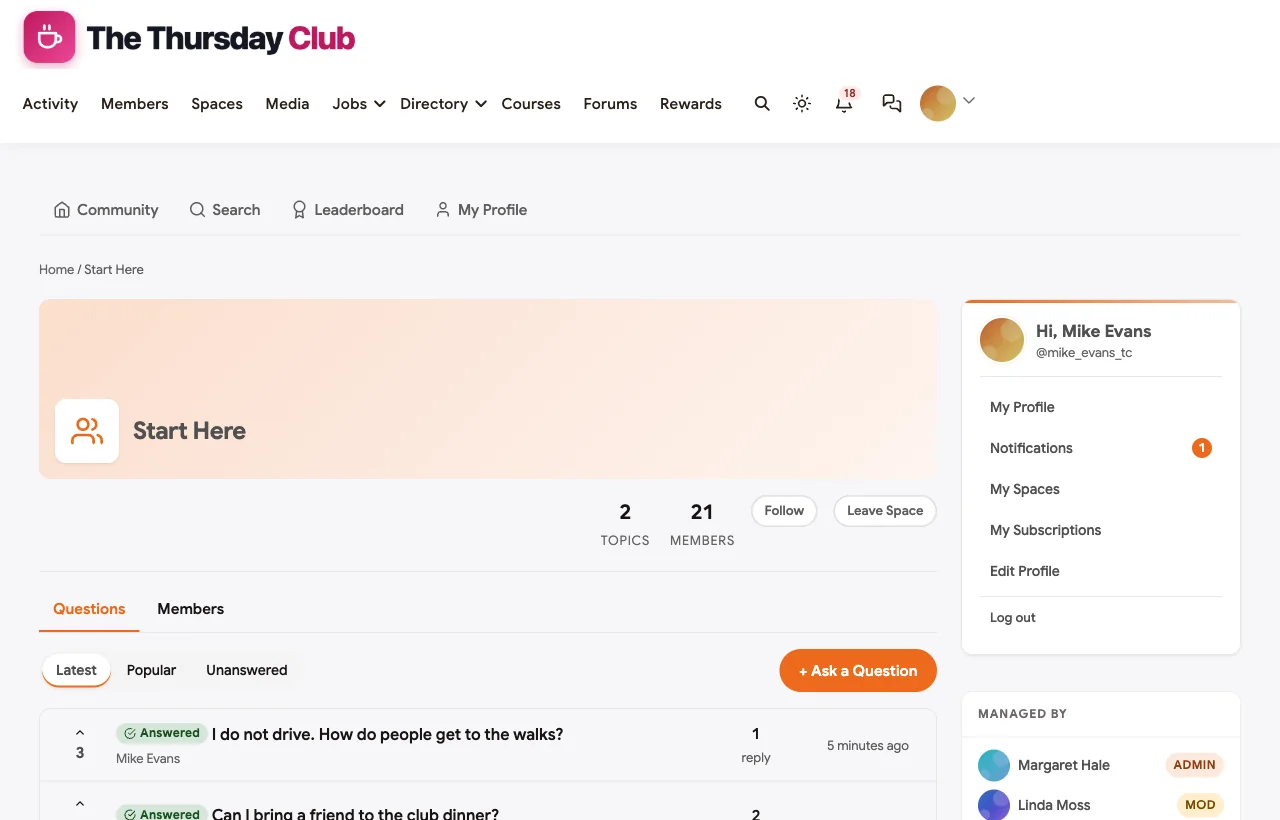
New members always have the same questions. A Q&A in Start Here collects them, and the best answer is marked: can I bring a guest to dinner, and how do people get to walks without a car?

The committee and ideas
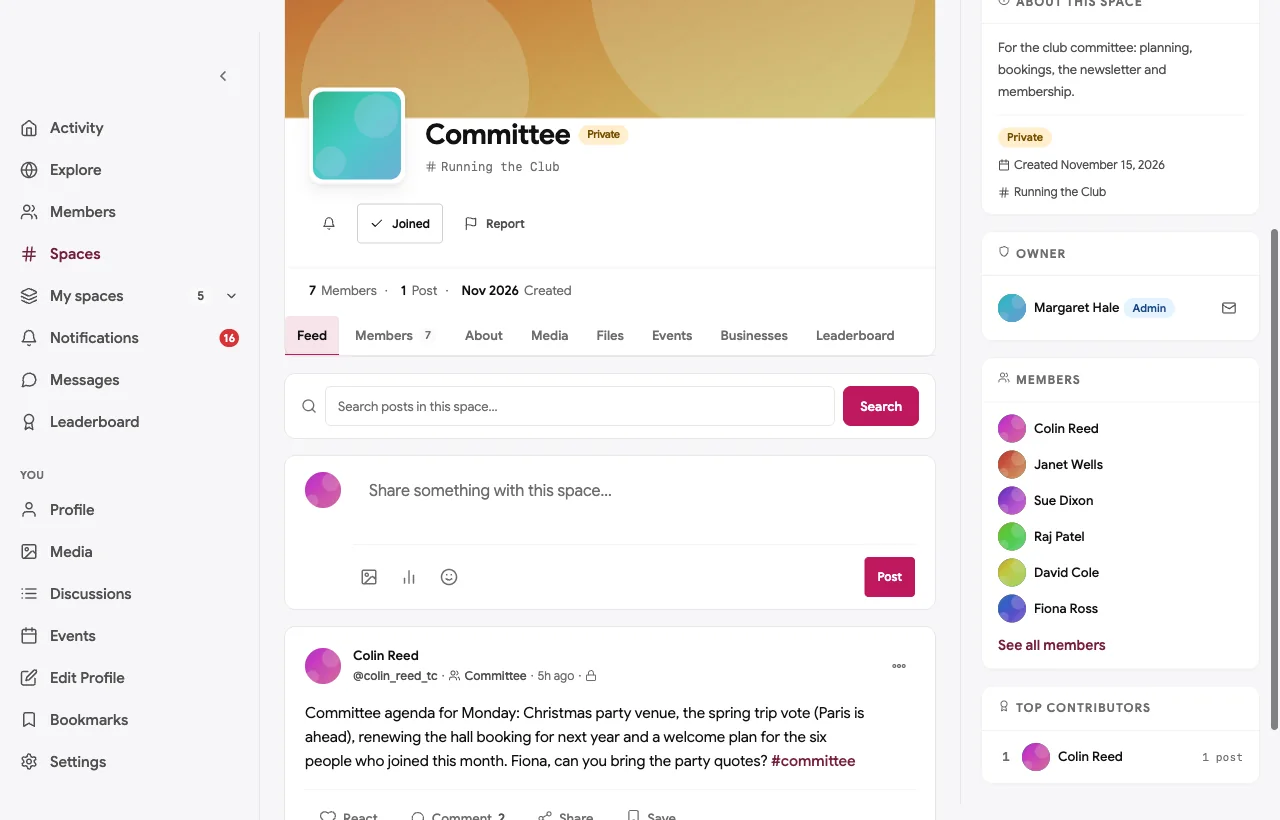
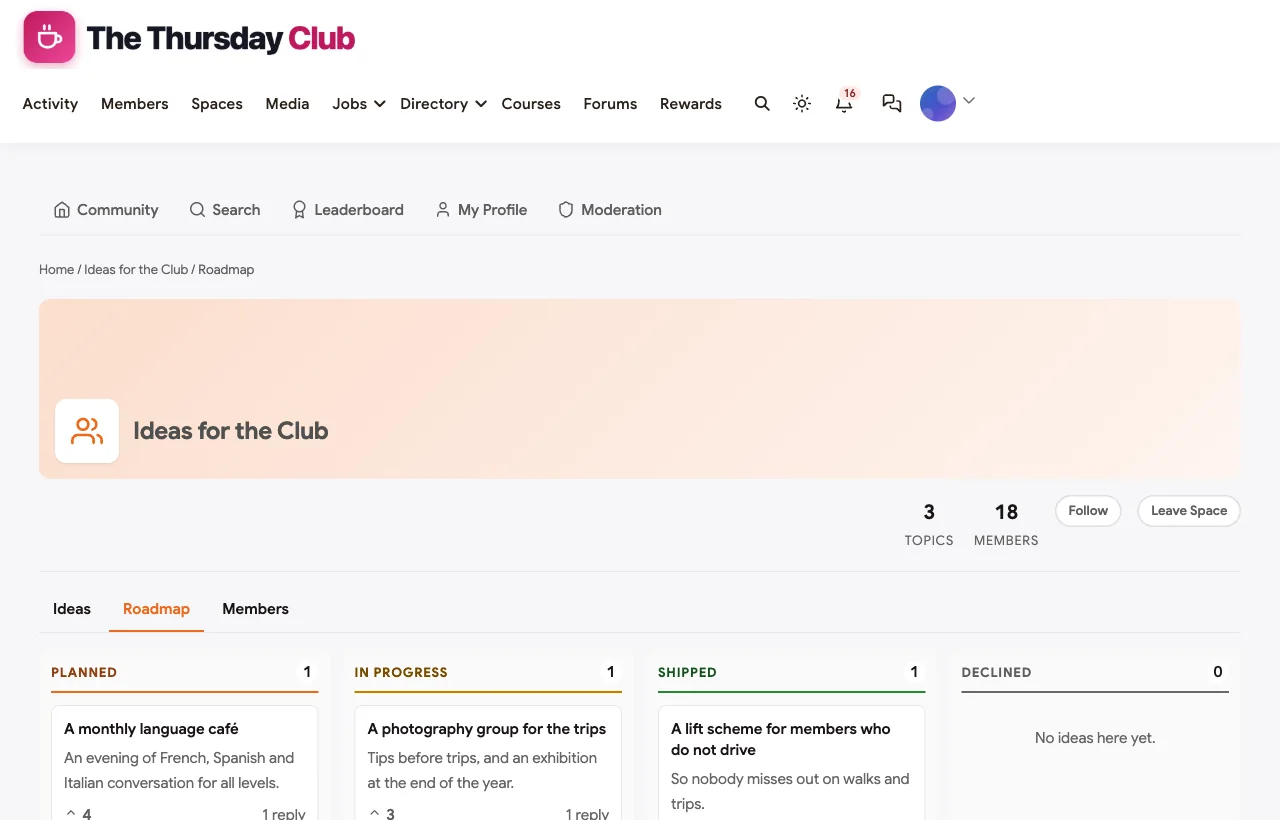
The committee has a private space for agendas, bookings and the newsletter, so club business does not crowd the main feed. Members suggest new groups and outings and vote; the committee marks ideas as planned, in progress or done.
Members and mobile
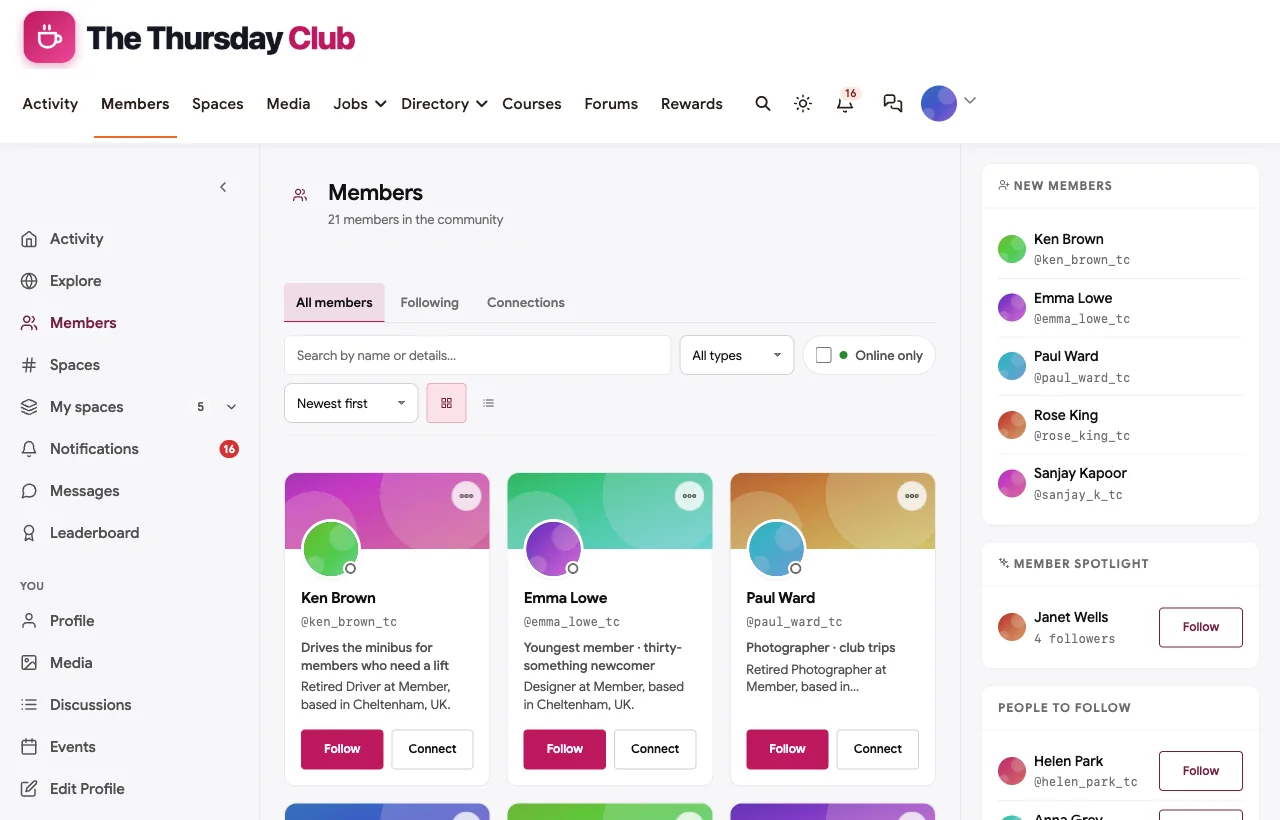

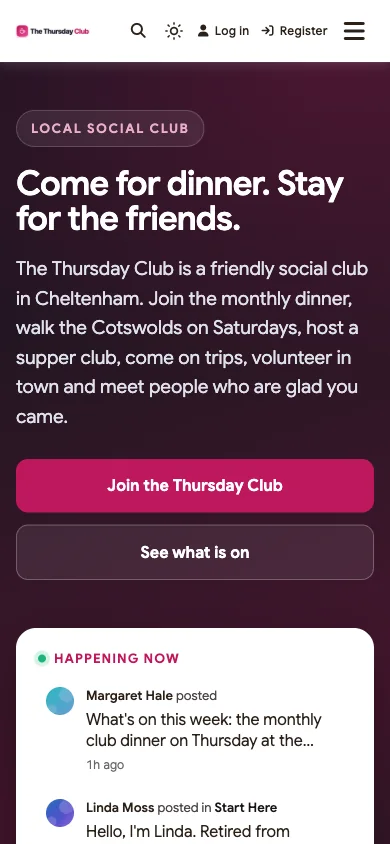
Many members check what’s on from their phones, so the whole club works in the mobile browser without an app download.
Also built in. Polls for trips and dates, hashtags, files for the newsletter, notifications, moderation and reporting, badges, and memberships with renewals if your club collects an annual subscription.
Not built for: full association accounting, printed membership cards or ticketing with seat plans. Use club management software or a ticketing tool for those if you need them. It is self-hosted, so you run WordPress or use a managed host, and a volunteer with basic website skills can look after it.
What’s included, and how it is delivered
BuddyNext is one platform made of a core and add-on platform modules. Everything shown in the demo above runs on the BuddyNext platform. This table shows which parts come with the core, which are platform modules you install and activate alongside it, and which need a third-party plugin, another system or custom work.
| Capability | How it is delivered |
|---|---|
| Open, private and secret spaces for interest groups and the committee | Core platform |
| Activity feed, pinned notices, polls and hashtags | Core platform |
| Member profiles and directory | Core platform |
| Reporting and moderation queue | Core platform |
| Trip and outing photos as posts | Platform module, installed alongside |
| Direct messages | Platform module, installed alongside |
| Dinners, walks, quiz nights and trips as events with RSVPs | Platform module, installed alongside |
| Club questions with accepted answers and an ideas roadmap | Platform module, installed alongside |
| Points and badges (optional) | Platform module, installed alongside |
| Memberships with renewals | Platform module, installed alongside |
| Association accounting | Another system (membership or accounting software) |
| Ticketing with seat plans | Another system (ticketing service) |
Want to click around yourself? The Thursday Club in this guide was built on a private test site, so it is not public. The BuddyNext live demo is a general community you can open in your browser and explore without installing anything.
2. Wild Apricot: best membership management for small clubs
Wild Apricot, part of Personify, helps clubs “Manage Your Organization All in One Place” (Wild Apricot), with tools to “Automate membership renewals and recurring payments,” a “Membership directory,” “Customizable event pages and registration forms” and “Build professional emails from customizable templates.”
Strengths: reliable renewals, directory, events and email for small organisations.
Gaps: no interest group spaces, photo sharing or member conversation found.
3. ClubExpress: best all-in-one club administration
ClubExpress offers “All-in-One Management for Clubs and Associations” (ClubExpress). Clubs can “Add, renew, and organize members,” “Schedule events, manage RSVPs, sell tickets, and send reminders,” and “Send emails, texts, or post updates using built-in messaging tools.”
Strengths: a broad admin toolkit with chapter support.
Gaps: no interest group spaces or photo galleries found.
4. MemberClicks: best for associations with committees
MemberClicks, part of Momentive, offers “Association management solutions built to connect members to your mission” (MemberClicks), with “Flexible member types & committee management,” “set-it-and-forget-it renewal reminders” and “online registration, attendance tracking and email automation tools.”
Strengths: committee management and automation for formal associations.
Gaps: no interest groups or photo sharing found; more than many small social clubs need.
5. Join It: best simple membership with digital cards
Join It promises to help you “Stop wrestling with spreadsheets and clunky software” (Join It), with “Profiles, memberships, payments, notes and activity in one searchable database,” digital membership cards for phone wallets, a member portal and “Member directory and community access.”
Strengths: easy memberships, digital cards and a member portal.
Gaps: no committee space, interest groups or photo galleries found.
6. Raklet: best membership software with a community board
Raklet offers “Membership management software for organizations people are proud to join” (Raklet), with tools to “Engage members with boards, posts, likes and comments,” “Organize online or offline events,” “Send beautiful emails and newsletters” and “Build directories with custom filters.”
Strengths: memberships with a simple community board and newsletters.
Gaps: no committee space or photo galleries found.
7. ClubRunner: best for Rotary and service clubs
ClubRunner, widely used by service clubs, offers “Your own dedicated section to organize and manage all your committees in one place,” newsletter templates and a volunteers module (ClubRunner), and lets clubs “Maintain an up to date member directory with photos in a secure members-only area” (ClubRunner).
Strengths: committees, directory and volunteering built for service clubs.
Gaps: no photo galleries or informal interest groups found.
8. Meetup: best for being discovered by new people
Meetup is “The people platform. Where interests become friendships,” and says “members have used Meetup to make new friends, meet like-minded people, spend time on hobbies” (Meetup). Anyone can “Create your own Meetup group.”
Strengths: local discovery, so new people in town can find your club.
Gaps: no member directory, renewals, committee or newsletter found. Many clubs list events on Meetup to attract newcomers and run the club itself elsewhere.
9. Spond: best for activity groups and sports clubs
Spond calls itself “The app that makes sports happen” (Spond), with “single events, repeating events, season planner, and time poll events,” payment requests within “your group or subgroups” and a “fully GDPR-compliant” messaging tool (Spond).
Strengths: easy scheduling and messaging for activity groups.
Gaps: no member directory, newsletter, committee space or photo galleries found.
10. Mighty Networks: best hosted community with native apps
Mighty Networks promises “monthly themes, weekly events, daily questions” and “Native mobile apps you won’t find anywhere else,” noting “84% of activity on Mighty is created by members with other members” (Mighty Networks).
Strengths: member engagement and branded apps.
Gaps: no club-specific features such as a committee space, RSVPs for dinners or volunteering sign-ups found.
Making events easy to say yes to
People join social clubs for the events, and they decide in a few seconds whether to come. Make every event easy to say yes to: a clear title, the day and time, the place with a map, who it suits (“gentle, five miles”), how to get there without a car, and an RSVP button. Post the events a few weeks ahead, remind people the day before, and share a photo afterwards so people who missed it want to come next time.
Running interest groups
Interest groups keep a club lively between big events and let members find their people. Start a group when two or three members want it and one will lead it, give it a space with its own posts, and let it set its own rhythm. Walking groups, supper clubs, book circles, gardening, photography, languages and crafts all work well. Keep groups open so new members can try them, and celebrate them in the main feed.
Helping the committee and volunteers
Clubs run on volunteers, and the same few people often carry the load. A private committee space keeps agendas, bookings and decisions in one place. Sign-up threads make volunteering visible and easy, and thanking volunteers by name, every time, keeps them coming back. Share the load: rotate roles, invite newer members onto the committee and write down how things are done so it is easy to hand over.
Moving an older club online
Many members of long-running clubs are not used to online communities. Keep the printed newsletter for those who want it and post the same newsletter online, run a short “how to use the website” session at a club dinner, ask a confident member to be the helper for others, and make the first steps simple: log in, RSVP to an event, reply to a post. Keep a phone number for the membership secretary on the Start Here page.
Keeping the club friendly online
A social club’s reputation rests on being a kind place, and the website should feel the same. Write a short set of house rules in Start Here (be kind, keep politics out of club spaces, ask before posting photos of other people), give the committee moderation tools and a report button on every post, and keep personal details such as phone numbers and addresses out of public posts. Let members choose what others can see on their profiles. Most clubs rarely need to moderate anything, but having the tools and the rules in place means problems are handled quickly and fairly when they do happen.
Celebrating the club’s history
Long-running clubs have stories worth keeping: founding members, memorable trips, past chairs and photographs from decades ago. A dedicated space or a regular newsletter feature, like the demo’s piece on thirty years of the club, gives newer members a sense of belonging to something with roots, and gives long-time members a chance to be recognised. Ask founding members to share a photo and a memory, and post them alongside today’s events.
Questions to ask before you choose
- Do you mainly need administration or community? Membership software for renewals; a community for conversation and friendship.
- Can members RSVP to events easily? Look for events with RSVPs and reminders.
- Can interest groups have their own spaces? Group spaces keep the main feed clear.
- Where will photos and the newsletter live? Photo posts and files.
- Can the committee work privately? A private space.
- Who will look after it? Choose something a volunteer can manage.
A 30-day launch plan
- Week one: foundations. Create Start Here, What’s On and the committee space, and invite the committee first.
- Week two: events. Add the next month’s events with RSVPs and post the newsletter.
- Week three: groups. Open spaces for your most active interest groups.
- Week four: welcome. Invite all members, reply to every introduction and run a short how-to at the club dinner.
Which platform fits your club?
| If you… | Choose |
|---|---|
| Want events, interest groups, trips, photos, volunteering and a committee space on a club website you own | BuddyNext |
| Mainly need renewals, a directory and email | Wild Apricot, ClubExpress, Join It or Raklet |
| Run a formal association with committees | MemberClicks |
| Run a Rotary-style service club | ClubRunner |
| Want new people in town to find you | Meetup |
| Run activity groups with simple scheduling | Spond |
| Want a general hosted community | Mighty Networks |
More community platform comparisons
Running a different kind of local or membership community? These guides use the same method: a working demo community and vendor claims checked at the source.
- Best software for a private neighborhood community: local groups, events and noticeboards.
- Best platforms for a running club community website: group runs, beginners and volunteering.
- Best platforms for a private book club community: reading together, votes and meetings.
- Best platforms for a faith-based membership community: small groups, prayer and serving.
- How to set up a community space on WordPress: the step-by-step setup guide behind every demo in this series.
How we built and checked this list
We built the Thursday Club demo on a local WordPress site running BuddyNext, with fictional members, a committee, interest groups, events and trips created for this guide. The photos in the demo are stock images used for illustration. Every BuddyNext screenshot is from that demo. Competitor features were checked against each vendor’s own website in November 2026, and the figures come from the UK government’s Community Life Survey and Pew Research Center. We left out Membermojo to keep the list balanced, Eventbrite because it is mainly ticketing, and Nextdoor and Facebook Groups because they lack club membership and committee features. Where we could not confirm a feature on a vendor’s own pages, the scorecard says “Not found”. We did not run a hands-on trial of every product, so features can change; confirm anything critical with the vendor. buddyxtheme.com is published by the team behind BuddyNext, which is why BuddyNext is listed first; we have tried to be fair about its gaps as well as its strengths.
Frequently asked questions
What is the best platform for a local social club website?
BuddyNext is the best choice for a social club website and community you own, with events and RSVPs, interest groups, trips and photos, volunteering, a newsletter and a committee space. For membership administration alone, Wild Apricot is a strong choice.
Do we still need membership software?
If you need detailed renewals, accounting or printed cards, membership software helps. BuddyNext includes memberships with renewals, which is enough for many small clubs.
How do we help new members feel welcome?
Reply to every introduction, give each newcomer a buddy for the first month, seat them with a committee member at their first event and mix teams at quiz nights.
How do we get older members online?
Keep the printed newsletter, run a short how-to session at a club event, ask a confident member to help others, and start with simple steps like replying and RSVPing.
Can interest groups have their own spaces?
Yes. Each group can have its own space with posts, photos and events, while the whole club stays in one community.
Can we share trip photos?
Yes. Members post photos in the trips space after each outing, so everyone can enjoy them and people who missed out want to come next time.
Can members use the club website on their phones?
BuddyNext works in the mobile browser without an app download.
The bottom line
A social club turns strangers into friends, and a good website helps more people find it and feel welcome. If you want events, interest groups, trips, volunteering, a newsletter and a committee space on a club website you own, BuddyNext is the strongest foundation. For membership administration alone, Wild Apricot leads, and for being discovered by newcomers, Meetup.
And give your club a front door as warm as its welcome.