

A running club runs on a surprising number of moving parts. There is the weekly timetable and the routes, the beginners’ group that needs a run leader at the back, the race calendar and who is entering what, the monthly challenge, the volunteers for the club 10K, the committee, and the coffee afterwards. Most clubs spread all of this across a running app, a messaging group, an email list and a website nobody has updated since the AGM. New members do not know where to look, and the volunteers who hold it together get tired.
A running club community website brings it into one place the club owns: the timetable, routes, beginners, races, challenges, volunteering and committee, alongside the running apps members already use to record their runs. This guide compares the platforms running clubs, run crews and running coaches use, from running apps with clubs to club management software to community platforms. We built a working running club for the first entry and checked every competitor claim on the vendor’s own pages in November 2026.
Quick answer
If you run a running club and want a website and community you own, BuddyNext is the strongest choice: group runs as events with route posts, a New Runners space with a nine-week beginner course, a race calendar, monthly challenges with leaderboards, volunteering sign-ups, Ask the Coaches, a private committee space and club membership, all on your own website. Strava, Garmin Connect and Nike Run Club record runs and run clubs inside their apps, RunSignup handles race registration and club memberships, Spond, TeamSnap and Heja organise teams, and Meetup and Circle are general community options.
In this guide
- What a running club needs from a website
- Running apps, club software or a community website?
- The running club scorecard
- 1. BuddyNext: best for a running club website and community you own
- 2. Strava: best for recording runs and app-based clubs
- 3. Garmin Connect: best for Garmin device owners
- 4. RunSignup: best for club memberships and race registration
- 5. Spond: best for organising events and groups
- 6. TeamSnap: best for youth and team sports organisations
- 7. Heja: best simple team communication app
- 8. Meetup: best for attracting new local runners
- 9. Circle: best hosted community with courses
- 10. Nike Run Club: best for guided runs and personal challenges
- Running a beginners’ group that keeps runners
- Planning routes and pace groups
- Keeping volunteers happy
- Making winter running easier
- Questions to ask before you choose
- A 30-day launch plan
- Which platform fits your running club?
- More community platform comparisons
- How we built and checked this list
- Frequently asked questions
- The bottom line
What a running club needs from a website
Running is one of the easiest ways to meet the recommended amount of exercise. The CDC says adults need “150 minutes of moderate-intensity physical activity a week,” or “Vigorous-intensity aerobic activity (such as jogging or running) for 75 minutes (1 hour and 15 minutes) every week” (CDC). Organised running is popular too: on Thanksgiving Day 2025, RunSignup recorded “1,330,726 participants registered to participate in 1,056 races across the country,” and “Registrations on RunSignup increased 20% compared to 2024” (Running USA).
Clubs turn that interest into a habit: a time, a place and people who expect you. A club website and community has a handful of jobs:
| Job | What goes wrong without it | What the platform needs |
|---|---|---|
| Timetable and routes | People turn up at the wrong place, or not at all | Group runs as events, route posts with maps |
| Beginners | New runners feel too slow and stop coming | A beginners space, a course and leaders at the back |
| Races | Nobody knows who is running what | A race calendar and race reports |
| Motivation | Training drifts in winter | Monthly challenges and a leaderboard |
| Volunteering | The same five people do everything | Sign-up threads and events for club races |
| Coaching | Questions go unasked | Q&A with coaches |
| Running the club | Committee business clutters the main feed | A private committee space |

Running apps, club software or a community website?
Clubs usually combine several kinds of tool. Each solves a different part of the job.
| Kind | What it does | Examples |
|---|---|---|
| Running apps with clubs | Record runs with GPS, follow friends, join clubs and challenges inside the app | Strava, Garmin Connect, Nike Run Club |
| Club and race software | Memberships, renewals, race registration, rosters, schedules and payments | RunSignup, Spond, TeamSnap, Heja |
| Community websites | The club’s own home with spaces, events, Q&A, courses and members | BuddyNext, Meetup, Circle |
Most members will keep recording runs in a running app. The club website is where the club itself lives, under the club’s own name, open to members whatever app they use.
The running club scorecard
How each option handles what matters most. “Not found” means we could not confirm it on the vendor’s own pages, not that it is impossible.
| Platform | Group runs and routes | Beginners | Race calendar | Challenges | Volunteering | Club website | GPS tracking |
|---|---|---|---|---|---|---|---|
| BuddyNext | Events, route posts | Space, course, leaders | Race space | Challenges, leaderboard | Sign-ups, events | Yes, your own | Not built in |
| Strava | Clubs, shared routes | Not found | Running events and races | Clubs and challenges | Not found | No | Yes |
| Garmin Connect | Groups | Garmin Coach plans | Not found | Step and distance challenges | Not found | No | Yes |
| RunSignup | Not found | Not found | Race registration | Not found | Not found | Club website | Not found |
| Spond | Events, repeating events | Not found | Not found | Not found | Not found | No | Not found |
| TeamSnap | Schedules | Not found | Not found | Not found | Not found | No | Not found |
| Heja | Schedules with RSVP | Not found | Not found | Not found | Not found | No | Not found |
| Meetup | Events | Not found | Not found | Not found | Not found | Group page | Not found |
| Circle | Events | Courses | Not found | Gamification | Not found | Hosted | Not found |
| Nike Run Club | Not found | Guided runs | Not found | Challenges | Not found | No | Yes |
1. BuddyNext: best for a running club website and community you own
BuddyNext is a complete community platform that runs on your own WordPress site. Open, private and secret spaces, photo posts, events, Q&A with accepted answers, courses with certificates, direct messages, polls, points, streaks and leaderboards, and paid memberships work together. A running club can run its timetable, routes, beginners, races, challenges, volunteering and committee in one place under the club’s own name.
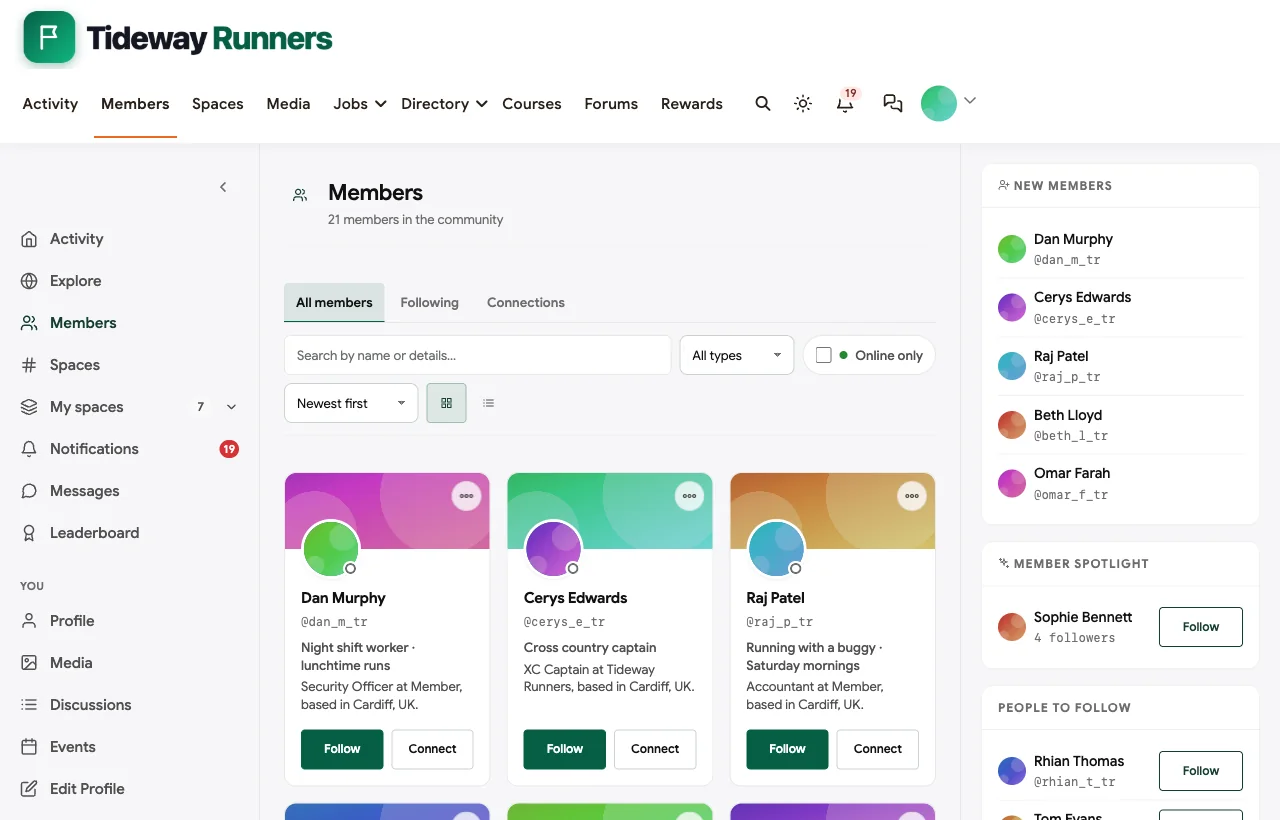
To show it in practice, we built Tideway Runners, a demo running club in Cardiff. It has 20 members: a marathon trainee, a trail and fell runner, an ultra runner who makes the long-run routes, a 68-year-old chasing age group records, a parkrun regular chasing a sub-25 5K, a student training for a first half marathon, a beginner in week six of the club’s beginner course, a recent graduate of it, a runner coming back from injury, a dad who runs with a buggy, a night shift worker who runs at lunchtime, a club coach, run leaders, a volunteer coordinator, a welfare officer, a club secretary, a social secretary, a cross country captain and a physiotherapist from a partner clinic.
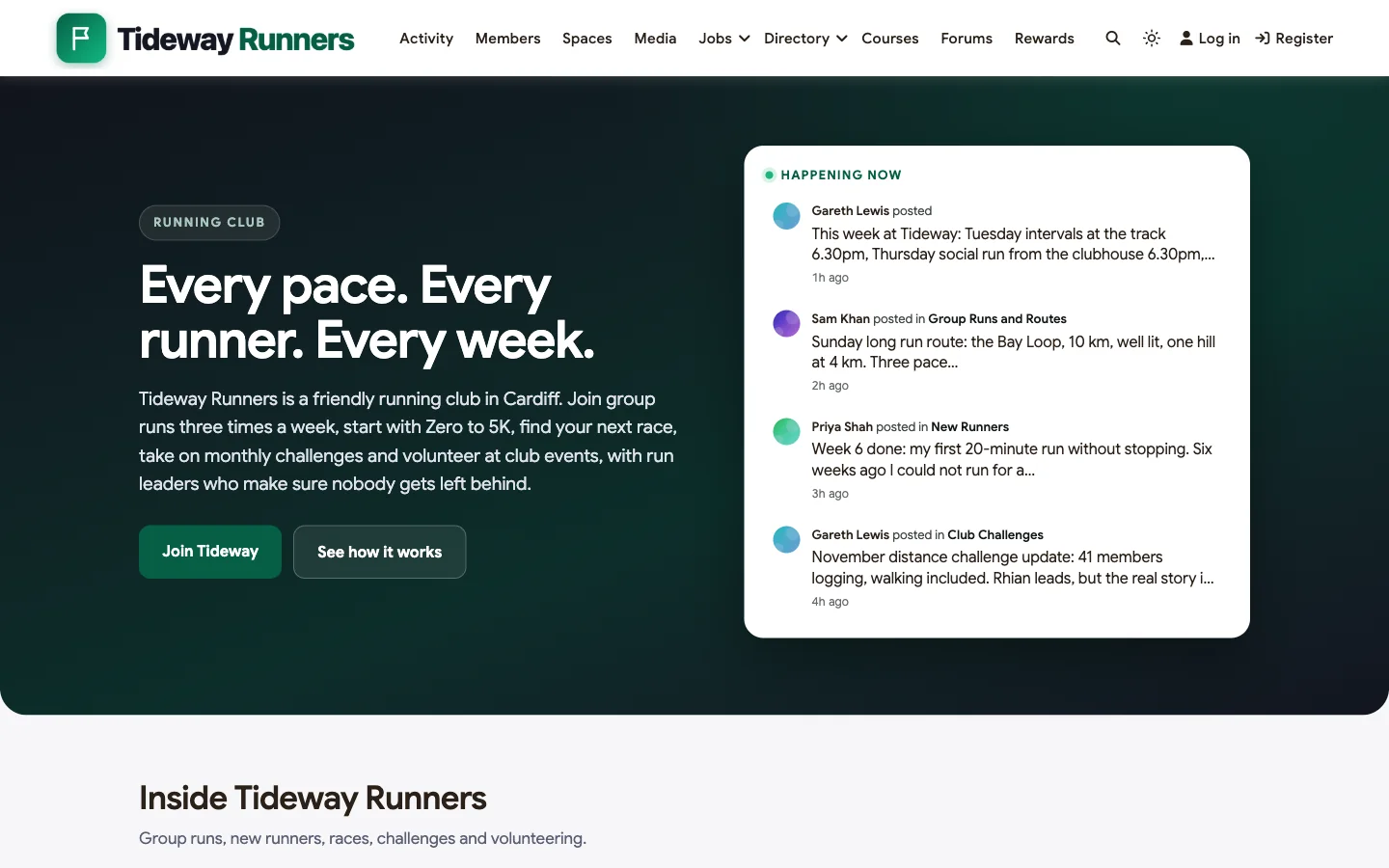
The homepage shows a visitor what the club is like before they ever turn up: this week’s runs, the Sunday long run route, a beginner’s first 20-minute run and the November challenge.
Group runs, routes and the timetable
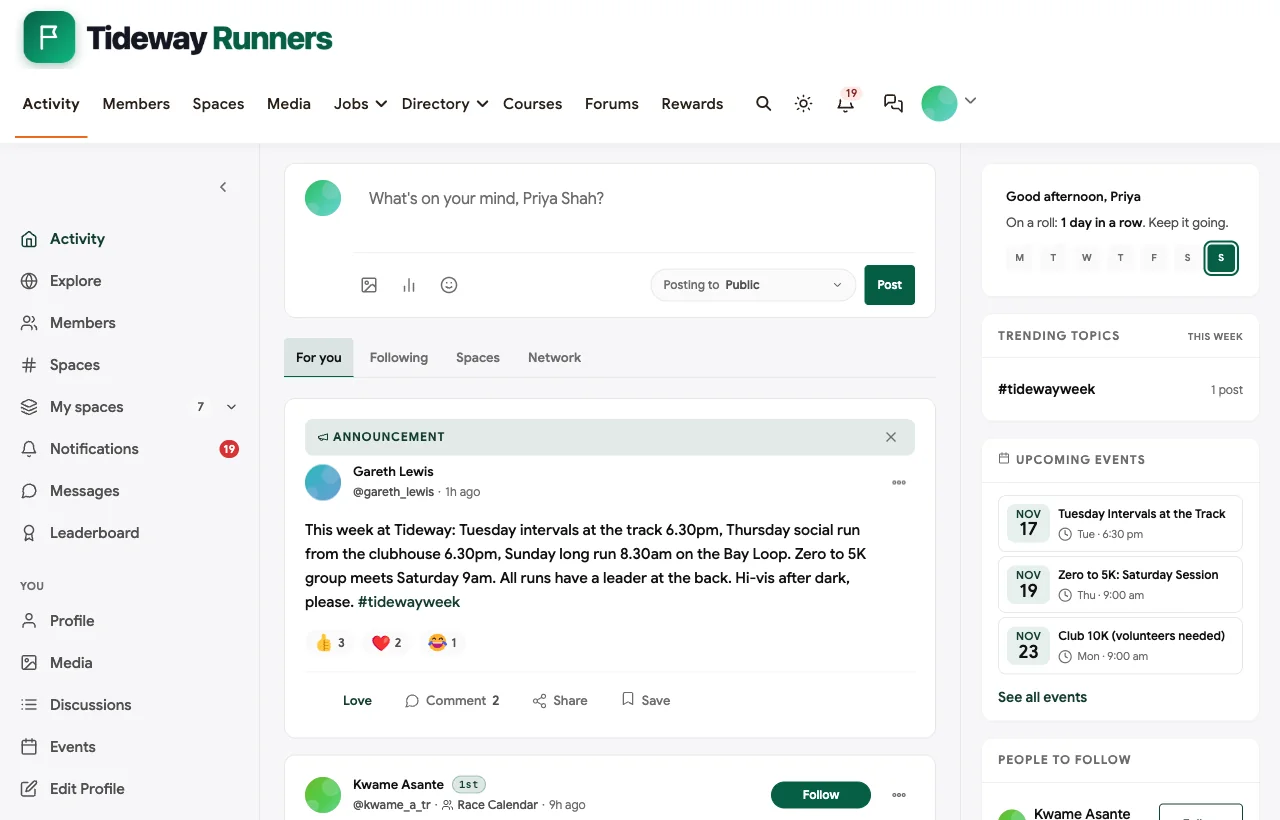
Tuesday intervals at the track and the Sunday long run are events in the Group Runs and Routes space, and a pinned post sets out the whole week, including the Thursday social run. Route posts show the course on a map with regroup points.
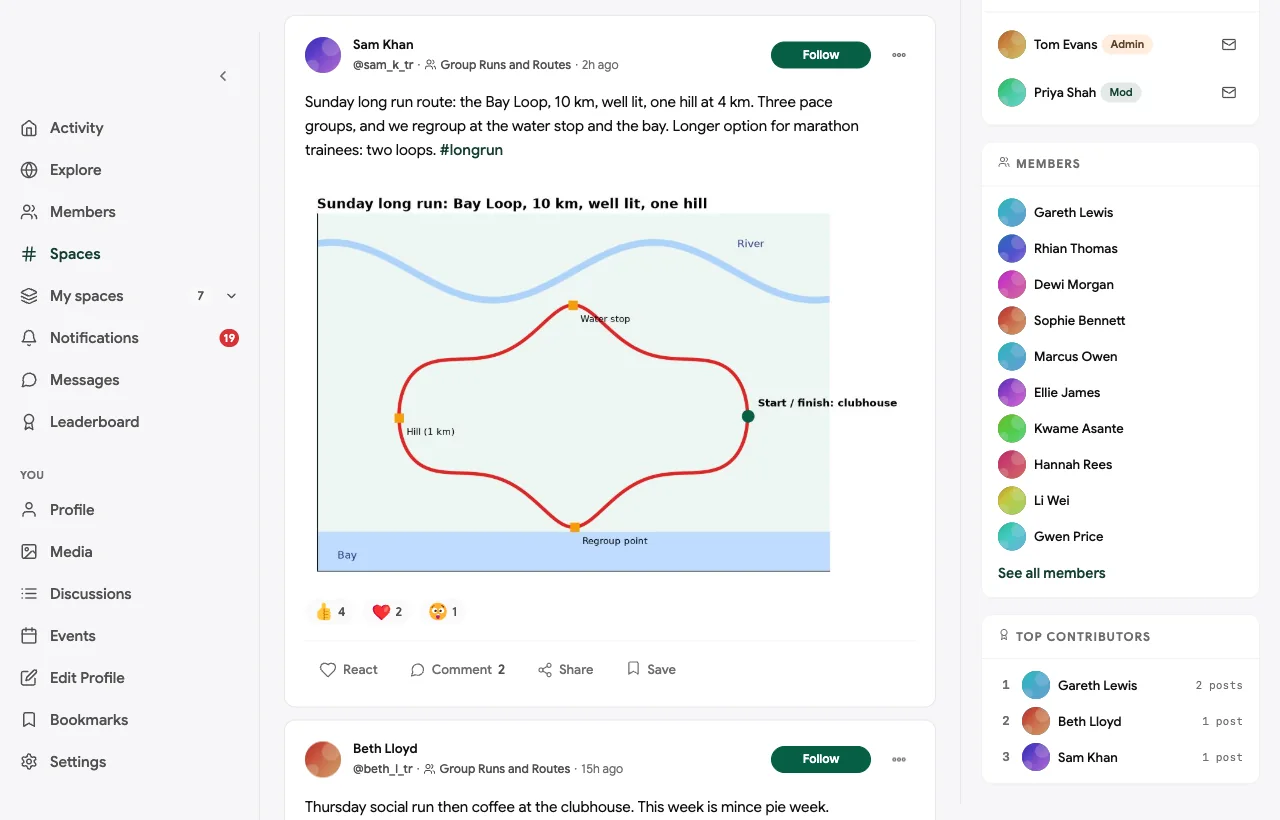
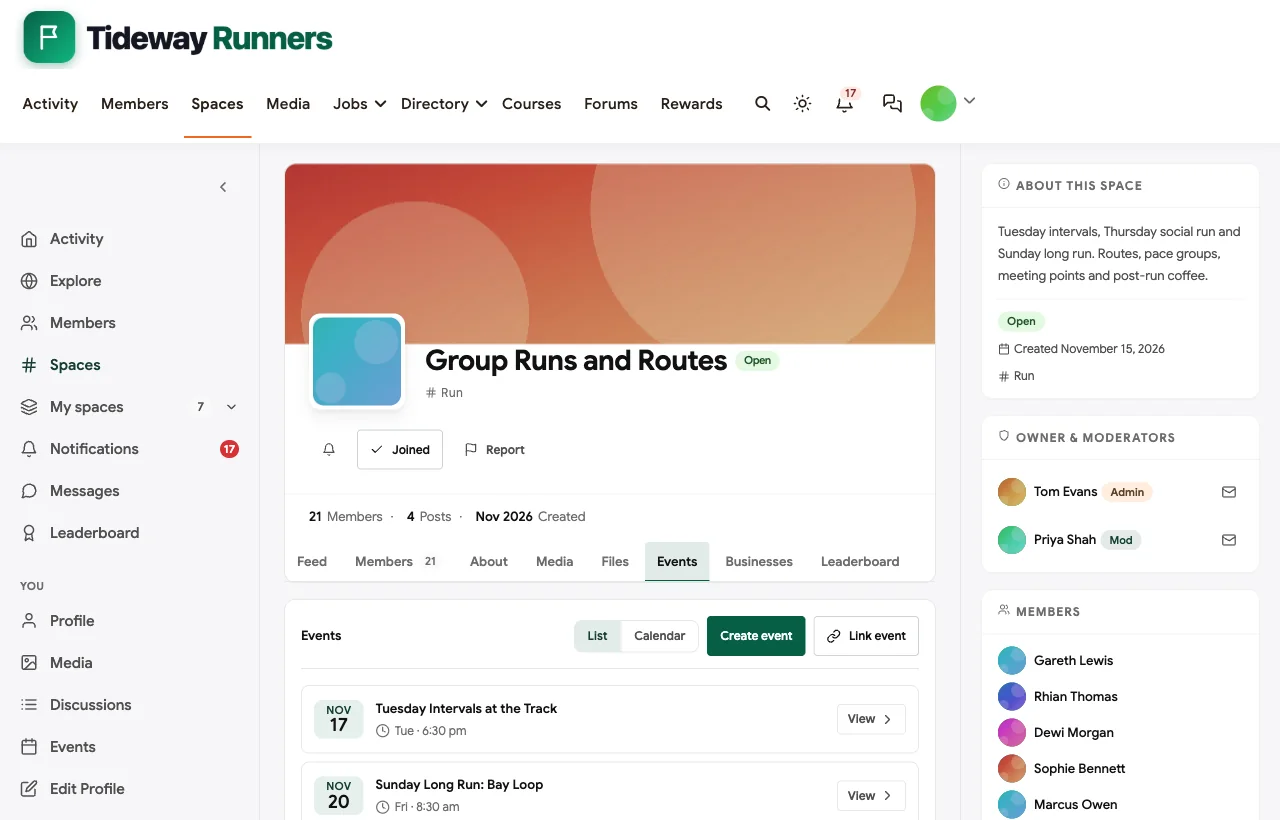
The ultra runner posts the Bay Loop for Sunday: 10 km, well lit, one hill at 4 km, three pace groups and two regroup points, with a double loop for marathon trainees. A runner coming back from injury replies that the regroup points are why he can join the slow group without worrying.
New runners and the beginner course
Zero to 5K with Tideway Runners is a nine-week walk-run course, from the first run to 30 minutes of continuous running, with a run leader every Saturday. Beginners log their runs in the New Runners space, and run leaders cheer every week.
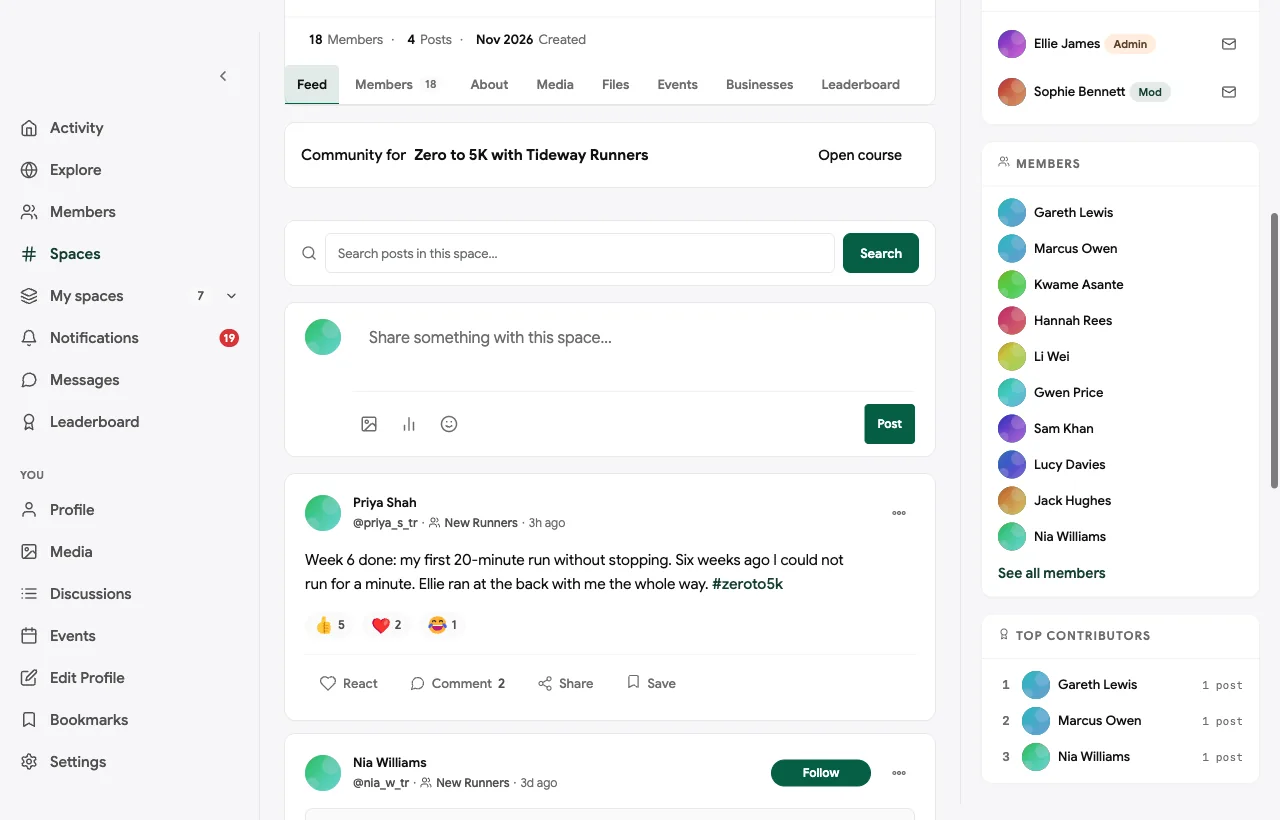

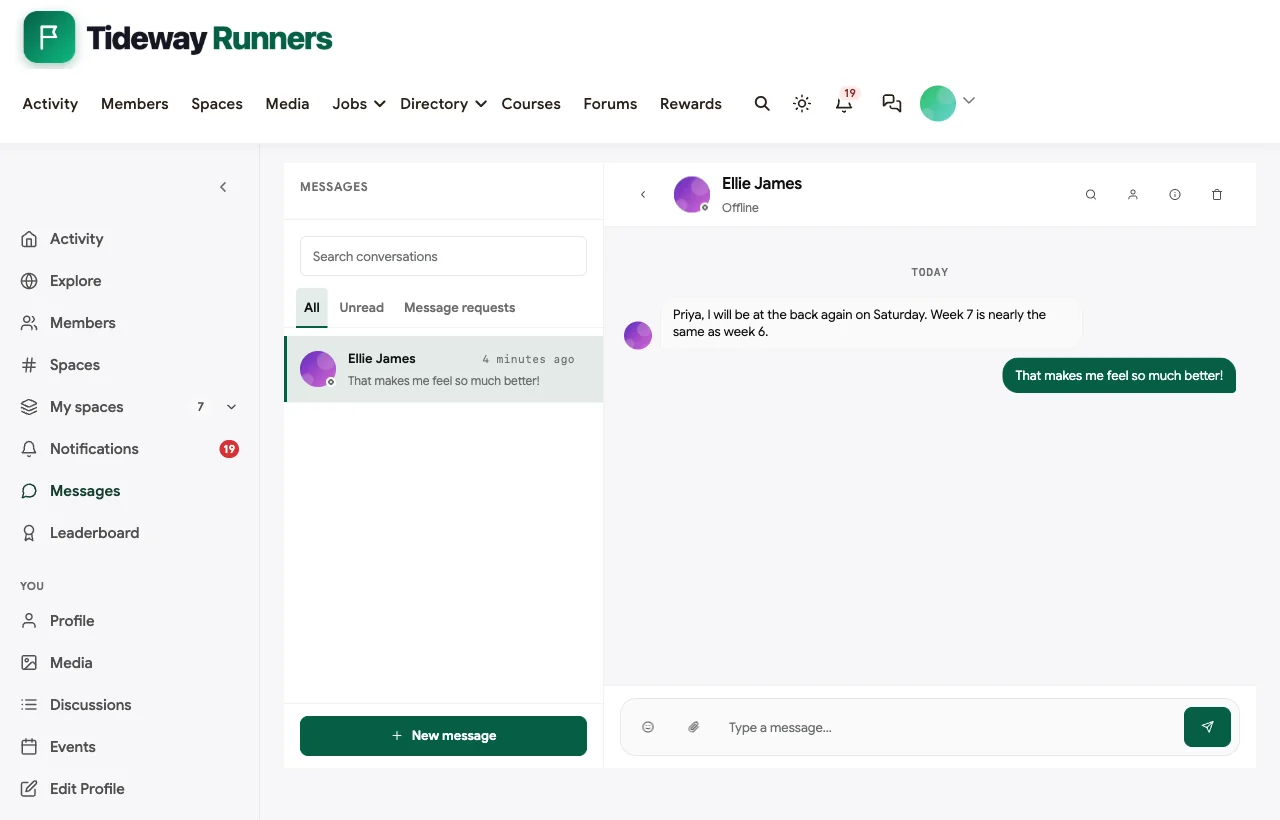
A beginner posts that she has just run 20 minutes without stopping, six weeks after she could not run for one minute, with a run leader at the back the whole way. A recent graduate replies that she cried at her first 20 minutes too. A direct message from the run leader promises she will be at the back again on Saturday.
The race calendar
The Race Calendar space is where members share the races they are entering, organise club trips and post race reports. A poll chooses next spring’s club trip.

A parkrun regular posts his first sub-25 5K and credits eight weeks of Tuesday intervals. The 68-year-old member promises an age group record next.
Club challenges and the leaderboard
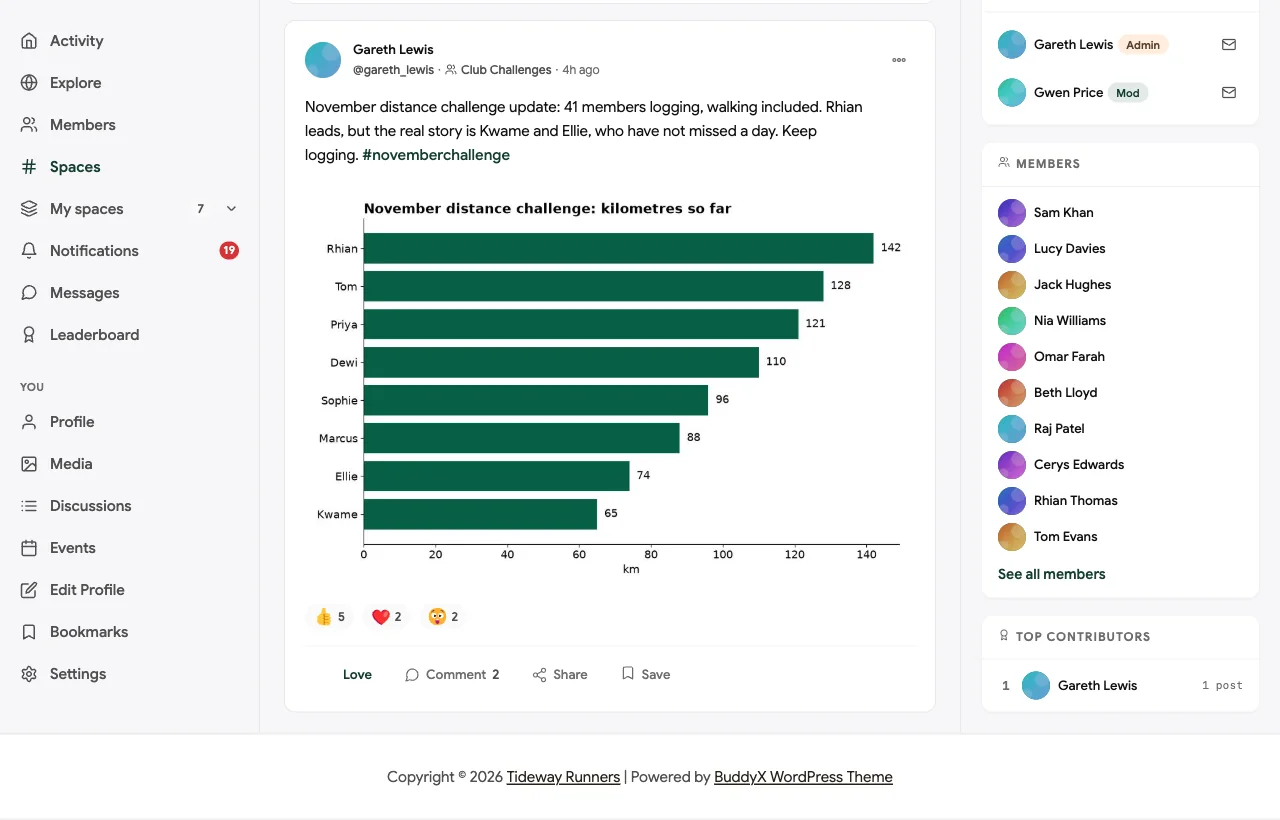
Monthly challenges keep training going through winter. In November, members log distance, walking included, and a chart shows the leaders. The host points out that the real story is the members who have not missed a day.
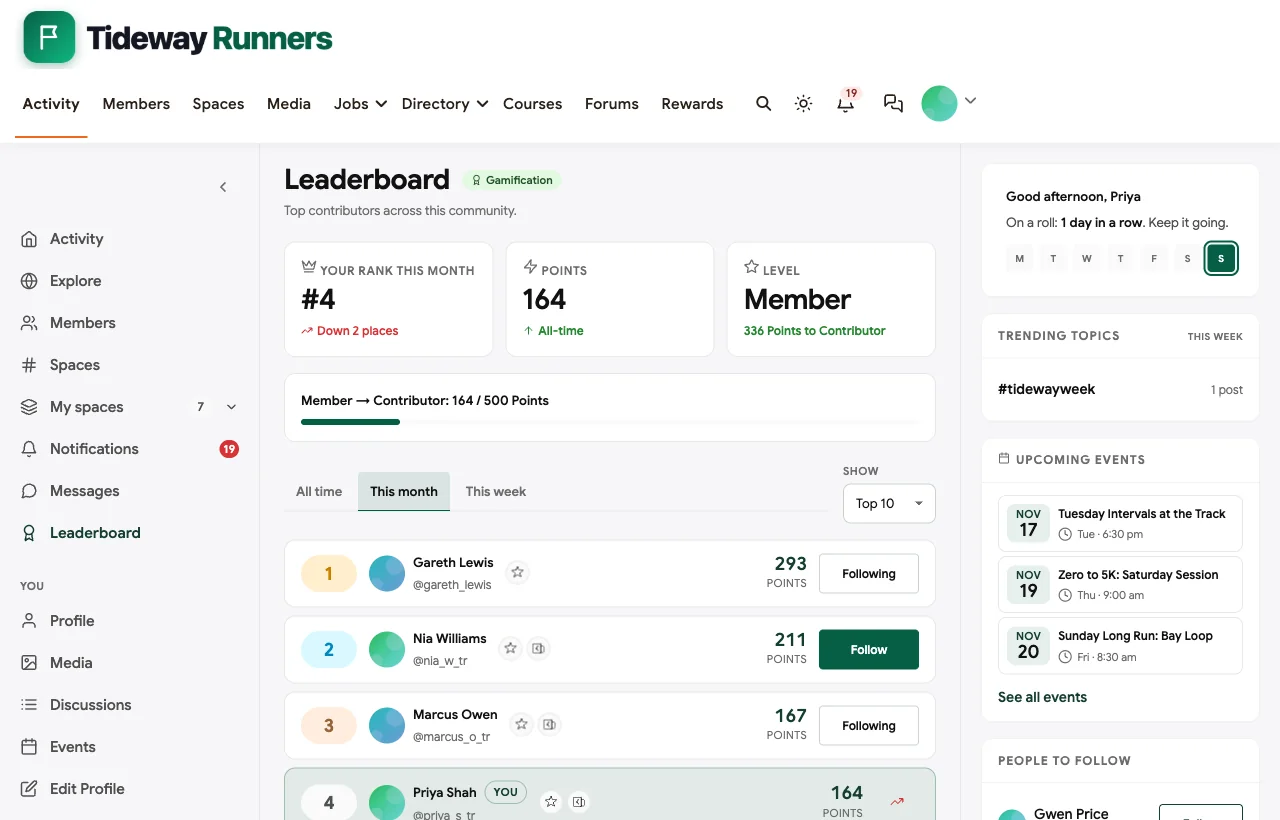
Points for logging runs, joining challenges and volunteering feed the leaderboard, and the streak counter in the sidebar shows each member’s run of active days.
Volunteering
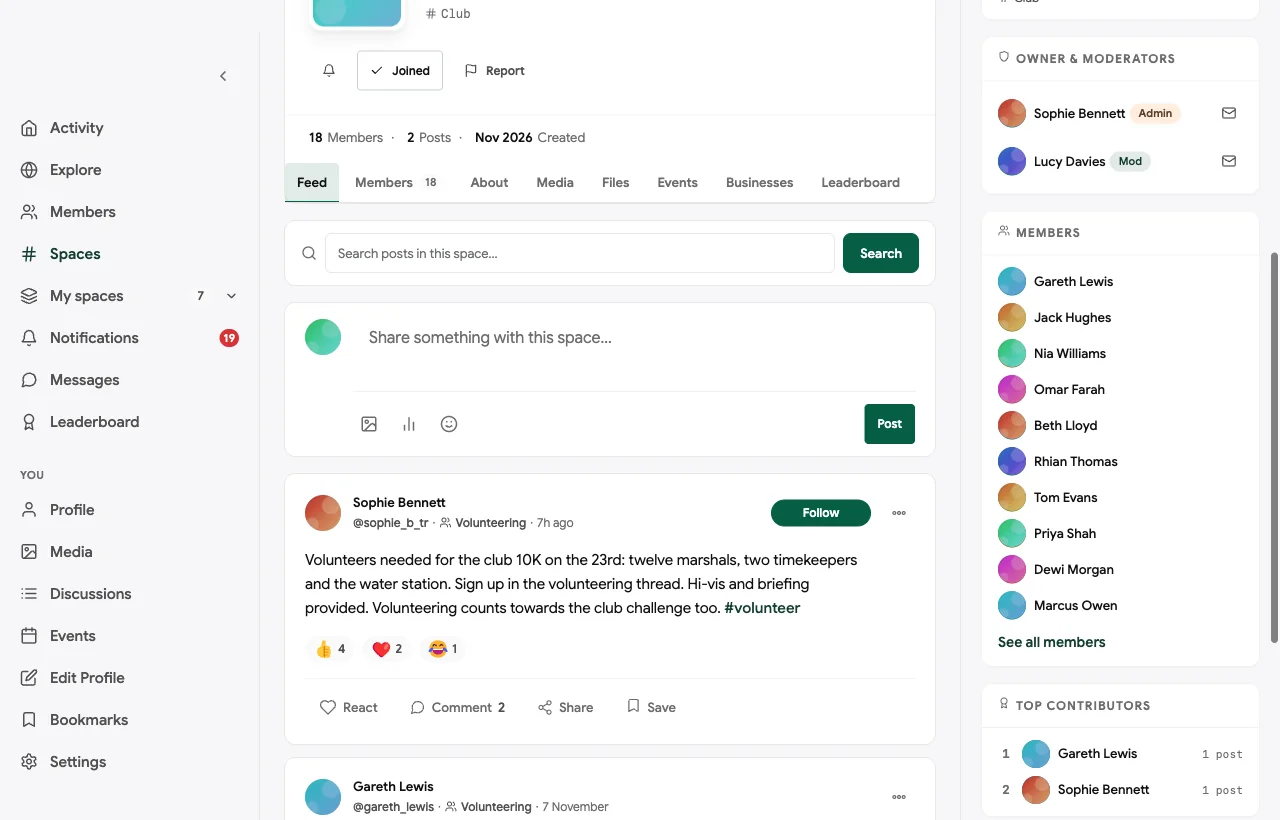
Club races and community runs depend on volunteers. The Volunteering space holds sign-up threads for marshals, timekeepers and the water station, and the club 10K is an event with a briefing time. Volunteering counts towards the club challenge, so helping is rewarded.
Ask the Coaches
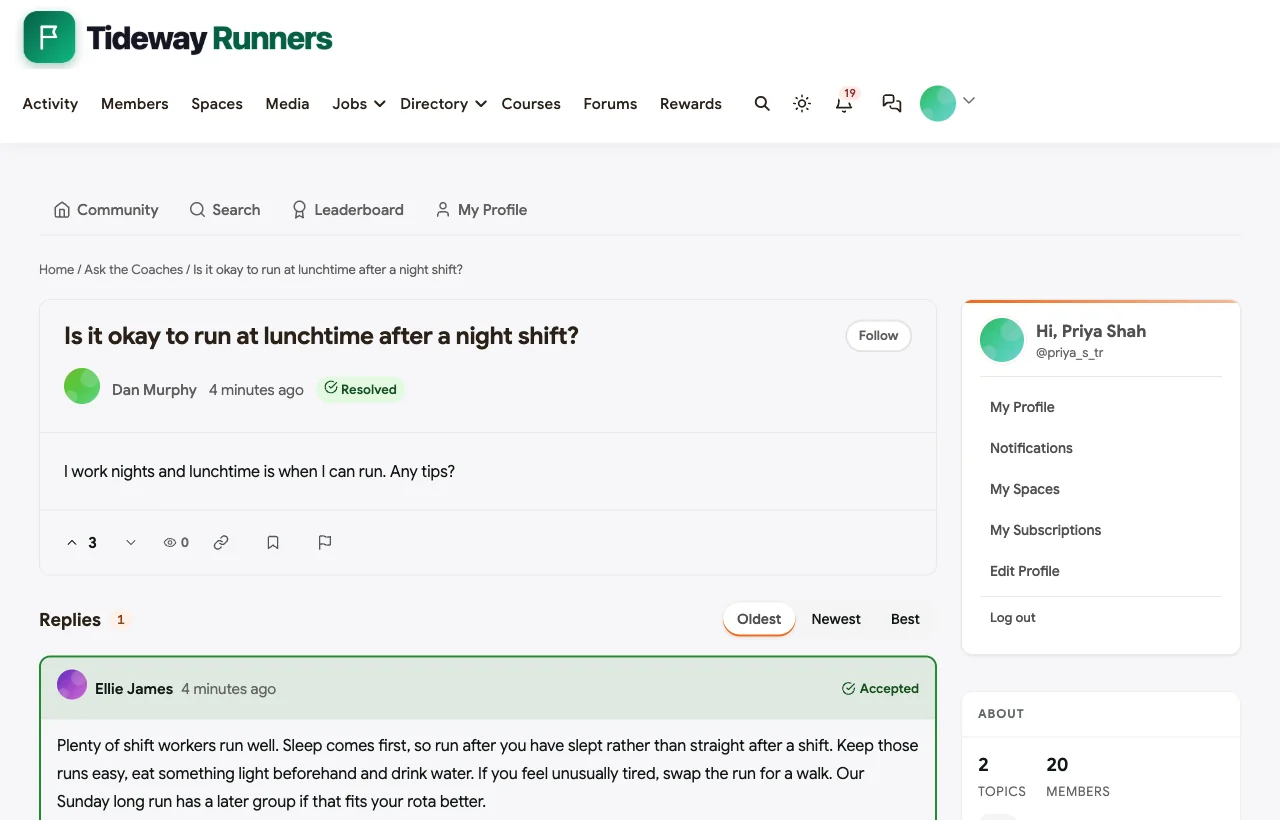
Ask the Coaches is a Q&A space for training, pacing, kit and race-day questions, with the best answer marked accepted. Injuries go to a physio or doctor, and the space description says so.


Safety and welfare
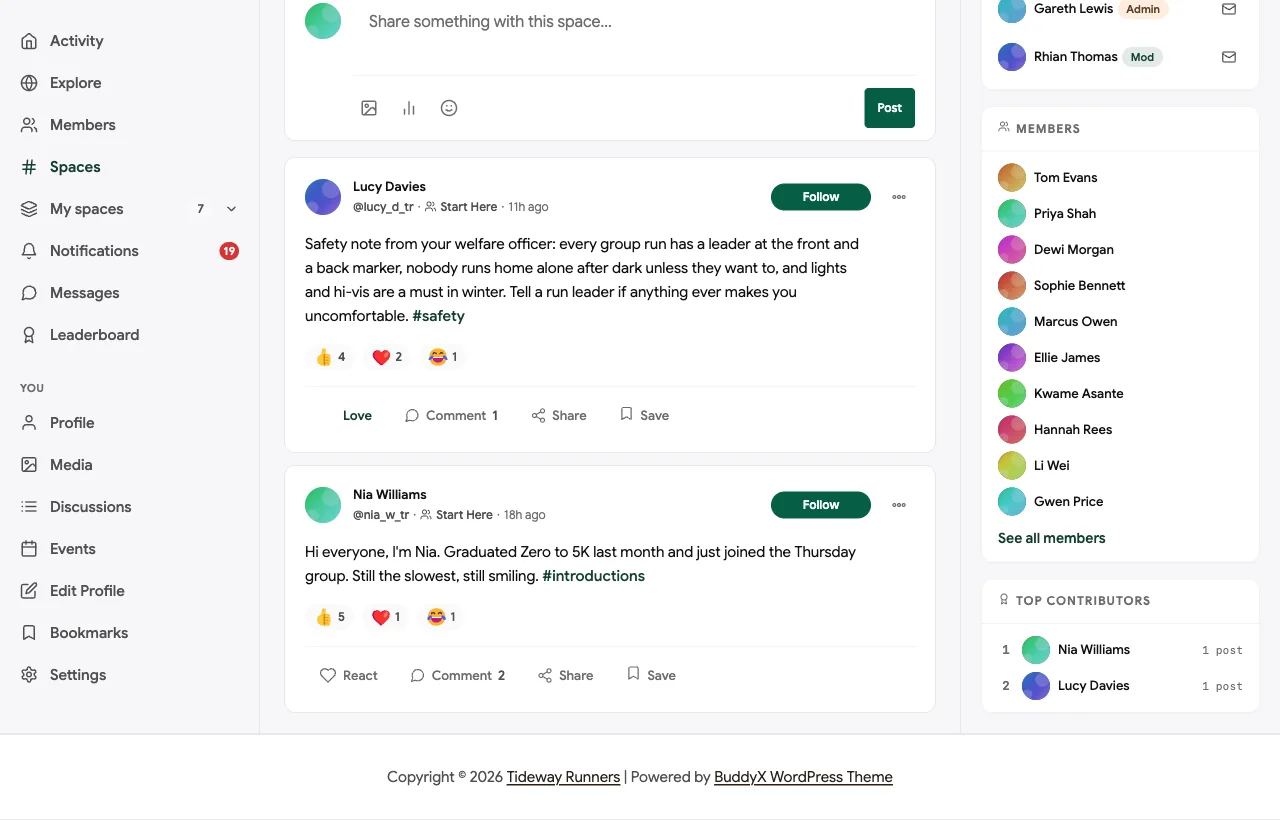
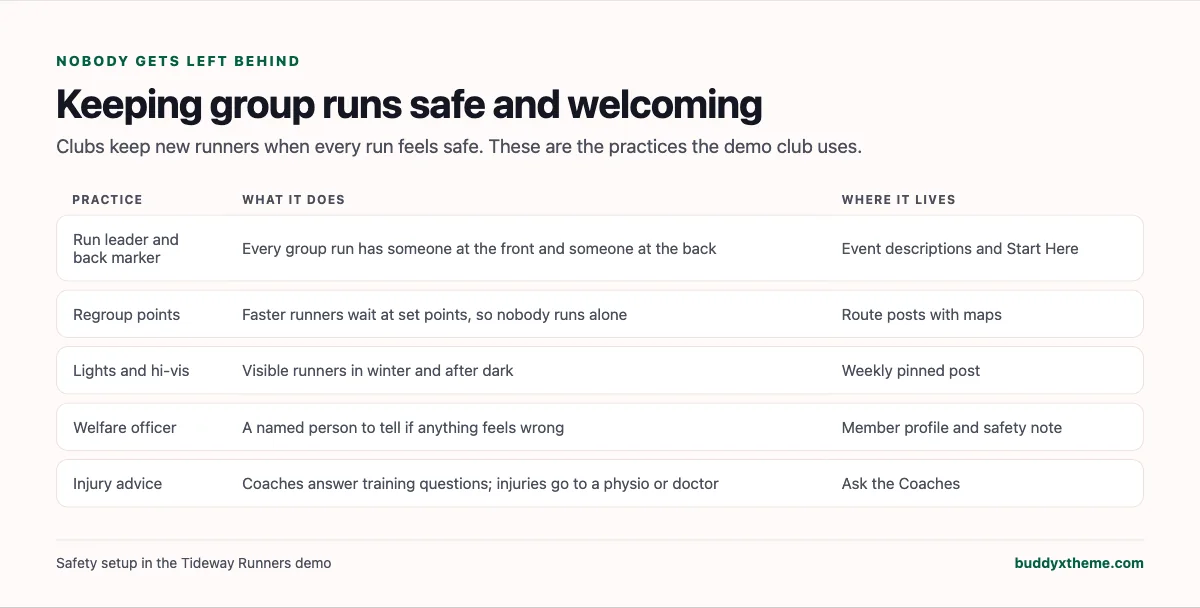
Every group run has a leader at the front and a back marker, regroup points on the route, and a reminder about lights and hi-vis after dark. The welfare officer posts a safety note in Start Here and is named in the directory, so members know who to tell if anything feels wrong.
The committee
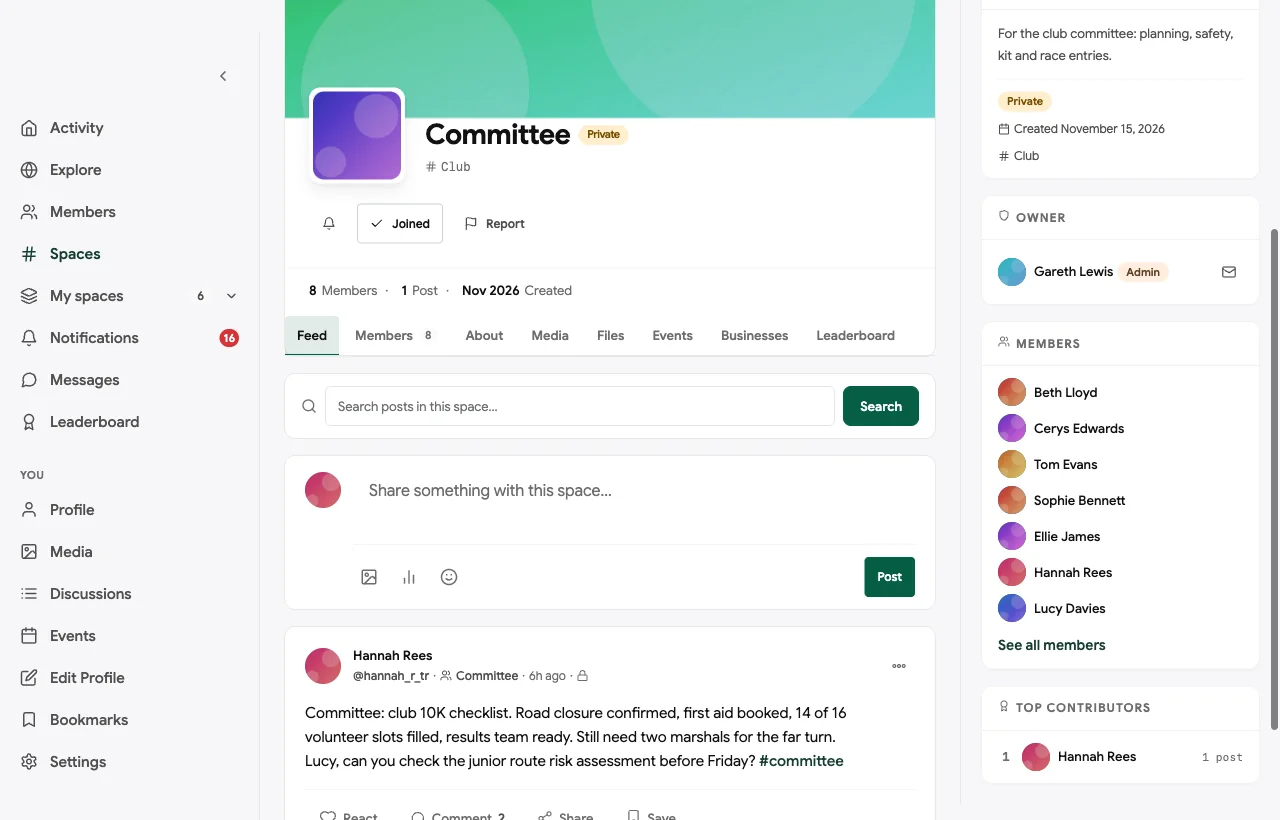
The committee has a private space for planning: road closures, first aid, volunteer numbers and risk assessments for the club 10K, without cluttering the main feed.
Members and mobile
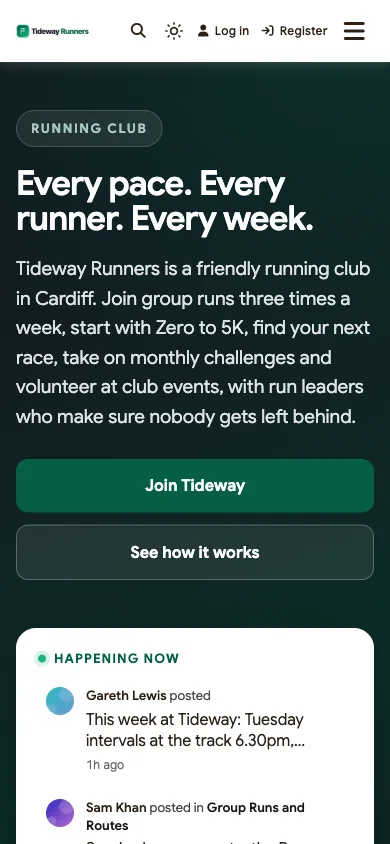
Runners check the timetable and routes on their phones on the way to a run, so the whole club works in the mobile browser without an app download.
Also built in. Polls for race trips and run times, hashtags, a member directory, notifications, moderation and reporting, badges, and paid club memberships with trials and coupons for annual membership.
Not built for: recording runs with GPS, timing races, or race registration with bibs and results. Members keep recording in Strava, Garmin Connect or Nike Run Club, and clubs that run races use RunSignup or a timing company for entries and results. It is self-hosted, so you run WordPress or use a managed host.
What’s included, and how it is delivered
BuddyNext is one platform made of a core and add-on platform modules. Everything shown in the demo above runs on the BuddyNext platform. This table shows which parts come with the core, which are platform modules you install and activate alongside it, and which need a third-party plugin, another system or custom work.
| Capability | How it is delivered |
|---|---|
| Open, private and secret spaces for runs, beginners, races and committee | Core platform |
| Activity feed, pinned timetable, polls and hashtags | Core platform |
| Member profiles and directory | Core platform |
| Reporting and moderation queue | Core platform |
| Route maps and race photos as posts | Platform module, installed alongside |
| Direct messages | Platform module, installed alongside |
| Group runs, beginner sessions and club races as events | Platform module, installed alongside |
| Ask the Coaches with accepted answers | Platform module, installed alongside |
| Beginner running course with certificates | Platform module, installed alongside |
| Points, streaks, badges and leaderboards for challenges | Platform module, installed alongside |
| Paid club memberships with trials and coupons | Platform module, installed alongside |
| GPS run recording | Another system (Strava, Garmin Connect, Nike Run Club) |
| Race registration, timing and results | Another system (race registration or timing service) |
Want to click around yourself? The Tideway Runners club in this guide was built on a private test site, so it is not public. The BuddyNext live demo is a general community you can open in your browser and explore without installing anything.
2. Strava: best for recording runs and app-based clubs
Strava describes “a global community of athletes who record, share, and connect with one another through their runs, rides, and other activities every day” (Strava), where members “track your activities, follow friends, and join clubs and challenges.” Its new club messaging gives “clubs a dedicated place to keep conversations going between activities,” where clubs can “Share routes, photos, and updates, create polls, and organize discussions with channels” (Strava). Strava has also acquired the training app Runna.
Strengths: the app most runners already use, with clubs, routes and challenges.
Gaps: the club lives inside Strava rather than on the club’s own site; no volunteer sign-ups, committee space or club membership management found.
3. Garmin Connect: best for Garmin device owners
Garmin Connect is for “tracking, analyzing and sharing health and fitness activities from your Garmin device” (Garmin Connect). Users can “compete in step and distance challenges, create groups or cheer each other on with likes and comments,” “earn badges for accomplishments,” and follow Garmin Coach “customized workouts that adapt to your ability.”
Strengths: detailed tracking, groups and adaptive training plans for Garmin users.
Gaps: groups are informal; no club website, race calendar, volunteering or club admin found.
4. RunSignup: best for club memberships and race registration
RunSignup “gives running clubs one connected platform for memberships, renewals, your club website, email, and races” (RunSignup), with “Automated Renewals,” “On-site member check-in and attendance tracking” and member race discounts “set by membership level.”
Strengths: the strongest admin tool here for renewals, race registration and member communication.
Gaps: no social feed, route posts, beginners’ space or challenges found. Many clubs pair it with a community.
5. Spond: best for organising events and groups
Spond describes itself as a “club management solution, created to simplify how people manage their clubs, teams and groups” (Spond). It offers “single events, repeating events, season planner, and time poll events,” payment requests for things like “annual membership fees or new uniforms,” and an integrated messaging tool that “is fully GDPR-compliant.”
Strengths: easy event organising and messaging for clubs and groups.
Gaps: no route posts, race calendar, challenges or coaching Q&A found.
6. TeamSnap: best for youth and team sports organisations
TeamSnap calls itself “The world’s leading platform for youth sports management” (TeamSnap): “Registration. Payments. Rosters. Schedules,” with “All messages, alerts, and organization-wide updates, finally in one place.”
Strengths: rosters, schedules and registration for team-based youth sports.
Gaps: built around teams and seasons rather than endurance running; no routes, challenges or race calendar found.
7. Heja: best simple team communication app
Heja is “Where teams grow together” (Heja), helping teams “Keep your team on schedule” with RSVPs and reminders, and making sure “Everything doesn’t have to go through the coach.”
Strengths: simple schedules, RSVPs and team chat.
Gaps: no routes, race calendar, challenges or club website found.
8. Meetup: best for attracting new local runners
Meetup is “The people platform. Where interests become friendships,” where organisers can “Create your own Meetup group, and draw from a community of millions” and “Start a group to host events” (Meetup).
Strengths: local discovery for clubs that want new members to find them.
Gaps: events only; no routes, challenges, race calendar or volunteering found.
9. Circle: best hosted community with courses
Circle calls itself “The complete community platform,” with tools to “Customize your spaces, prompt discussions, host live events, and launch your course,” and “Support one-time purchases, memberships, or recurring subscriptions” (Circle).
Strengths: a polished hosted community with courses, events and memberships.
Gaps: no running-specific features found: no route posts, race calendar or volunteering setup.
10. Nike Run Club: best for guided runs and personal challenges
Nike Run Club promises “everything you need to start running, keep running, and enjoy running more” (Nike), with “Audio-Guided Runs” from Nike coaches and the ability to “Create Challenges” and “share them with friends, family, classmates, and coworkers.”
Strengths: excellent guided runs for beginners and friendly challenges.
Gaps: no club administration, website, race calendar or volunteering found.
Running a beginners’ group that keeps runners
A beginners’ group is the best way for a club to grow, and the easiest place to lose people. A few habits keep new runners coming back:
- A leader at the back, always. Nobody should ever be last and alone.
- A structured plan. A walk-run plan over eight or nine weeks gives a clear path and a finish line.
- One session with the club each week. Run the other sessions alone, then meet the group on Saturday.
- Celebrate every milestone. The first 20 minutes without stopping matters as much as a marathon.
- Graduate into the club. Finish with a group run, then invite graduates to the slowest social group.
Planning routes and pace groups
Good routes make group runs work. Choose well-lit loops for winter evenings, mark regroup points where faster runners wait, and offer a shorter and a longer option from the same start. Post each route with a map and the distance, and split the run into at least two pace groups, each with a leader. Repeat favourite routes, so new members learn them and can run them alone safely.
Keeping volunteers happy
Clubs run on volunteers, and the same few people burn out. Post volunteer roles early with clear times and a briefing, count volunteering towards challenges or club awards, thank volunteers by name after every event, and rotate roles so no one marshals the same corner every year. A sign-up thread makes gaps visible, and a committee space keeps the planning out of the main feed.
Making winter running easier
Winter is when clubs lose members. Move the long run to a later start, choose well-lit routes, remind everyone about lights and hi-vis, and run a monthly challenge that counts walking and treadmill runs. Social runs with coffee afterwards give people a reason to turn up on cold, dark evenings, and a strong community feed keeps members connected when the weather keeps them indoors.
Questions to ask before you choose
- Do you need a club website or just a group in an app? An app group is easy; a website is yours.
- How will beginners be supported? A space, a plan and run leaders.
- Where will routes and the timetable live? Events and route posts members can find.
- Do you run races? Keep registration and timing with a specialist and link to it.
- How will you organise volunteers? Sign-up threads and events.
- Will members pay an annual membership? Look for memberships with renewals.
A 30-day launch plan
- Week one: foundations. Create Start Here with the safety note, Group Runs and Routes, and New Runners.
- Week two: timetable. Post the weekly runs as events and the first route maps.
- Week three: beginners. Open the beginner course and start a Saturday session with a leader at the back.
- Week four: club life. Launch a monthly challenge, the race calendar and volunteer sign-ups.
Which platform fits your running club?
| If you… | Choose |
|---|---|
| Want routes, beginners, races, challenges, volunteering and a committee space on your own club website | BuddyNext |
| Want a club inside the app runners already use | Strava or Garmin Connect |
| Need club renewals and race registration | RunSignup |
| Want simple events and messaging for groups | Spond or Heja |
| Run youth teams with rosters and seasons | TeamSnap |
| Want new local runners to find you | Meetup |
| Want a general hosted community | Circle |
| Want guided runs for beginners | Nike Run Club |
More community platform comparisons
Running a different kind of fitness or local community? These guides use the same method: a working demo community and vendor claims checked at the source.
- Best platforms for an online fitness community: challenges, streaks and leaderboards.
- Best platforms for a yoga and wellness membership community: live classes, 30-day challenges and retreats.
- Best software for a private neighborhood community: local groups, events and noticeboards.
- Best software for a nonprofit volunteer community: volunteer shifts, sign-ups and recognition.
- How to set up a community space on WordPress: the step-by-step setup guide behind every demo in this series.
How we built and checked this list
We built the Tideway Runners demo on a local WordPress site running BuddyNext, with fictional runners, coaches, volunteers, a course, routes and events created for this guide. The route map and challenge chart are illustrative images. Every BuddyNext screenshot is from that demo. Competitor features were checked against each vendor’s own website in November 2026, and the participation figures come from the CDC and Running USA. We left out Runna because it is now part of Strava, and general website builders because they have no club features built in. Where we could not confirm a feature on a vendor’s own pages, the scorecard says “Not found”. We did not run a hands-on trial of every product, so features can change; confirm anything critical with the vendor. buddyxtheme.com is published by the team behind BuddyNext, which is why BuddyNext is listed first; we have tried to be fair about its gaps as well as its strengths.
Frequently asked questions
What is the best platform for a running club website?
BuddyNext is the best choice for a running club website and community you own, with group runs, routes, a beginners’ space and course, a race calendar, challenges, volunteering and a committee space. Strava is the best app for recording runs, and RunSignup for race registration and renewals.
Do members still need Strava or another running app?
Yes, for recording runs with GPS. The club website holds the timetable, routes, beginners, races, challenges and club business.
How do I start a beginners’ group?
Use a structured walk-run plan, meet once a week as a group, always have a leader at the back, and celebrate every milestone in a beginners’ space.
How should a club organise volunteers?
Post roles early in a volunteering space, run the race as an event with a briefing time, count volunteering towards club challenges and thank volunteers by name.
How do I keep group runs safe?
Have a leader and a back marker on every run, use regroup points, ask for lights and hi-vis after dark, and name a welfare officer members can talk to.
Can a running club collect annual memberships?
Yes. BuddyNext supports paid memberships with renewals, trials and coupons, and clubs that also run races often use RunSignup for entries.
Can members use the club website on their phones?
BuddyNext works in the mobile browser without an app download.
The bottom line
A running club is a timetable, a route and people who expect you. If you want group runs, routes, beginners, races, challenges, volunteering and a committee space on a club website you own, BuddyNext is the strongest foundation, with Strava or Garmin for recording runs and RunSignup for race entries.
And make sure nobody at your club runs alone.