
Every fitness coach knows the real competitor is not another coach. It is the third week, when motivation fades, the novelty of a new program wears off, and a client quietly stops logging in. Workout videos do not fix that. People do: a challenge group that notices when you miss a day, a coach who replies to your check-in, a crew that waits for you at the Saturday run.
This guide compares the platforms you can use to build an online fitness community around that idea, whether you are a personal trainer moving clients online, a studio adding a membership, a running coach with a club or a fitness creator turning followers into members. We built a working fitness community for the first entry, checked every competitor claim against the vendor’s own pages in November 2026, and judged each platform on the things that keep people training: challenges, accountability, live classes, recognition and privacy for progress.
Quick answer
If you want an online fitness community you own and control, BuddyNext is the strongest choice: monthly challenges with daily check-ins, points, streaks and leaderboards, private progress check-in spaces, accountability pods, live classes and local group runs, coach Q&A with accepted answers and a trusted-partners directory, all on your own WordPress site. Mighty Networks is the strongest hosted community with branded apps, Skool is the simplest gamified option, and coaching apps such as Trainerize and Everfit lead on workout programming.
In this guide
- The consistency problem, and why community solves it
- Community platform, coaching app or social group?
- 1. BuddyNext: best for a fitness community you own
- 2. Mighty Networks: best hosted community with branded fitness apps
- 3. Skool: best for simple gamified fitness groups
- 4. Trainerize: best coaching app for personal trainers
- 5. Everfit: best coaching platform with built-in challenges
- 6. Circle: best for a polished fitness membership
- 7. Heartbeat: best for small coaching cohorts
- 8. Kajabi: best all-in-one for fitness businesses selling programs
- 9. Uscreen: best for studios with a video library
- 10. Strava clubs: best free social layer for running and cycling groups
- 11. Facebook Groups and Discord: best as free starting points
- Fitness community platforms compared
- Choosing by business model
- Running a 30-day challenge that people finish
- Privacy for progress photos and health information
- Launching your fitness community
- More community platform comparisons
- How we built and checked this list
- Frequently asked questions
- The bottom line
The consistency problem, and why community solves it
Group exercise has a long research record. A realist review of group-based physical activity interventions published in BMC Public Health opens with the finding that “participation in group-based physical activity (GBPA) interventions has been found to result in higher levels of exercise adherence and program compliance” (BMC Public Health). The review looked at for whom and under what conditions these programs work, and social support between group members is one of the mechanisms it examines.
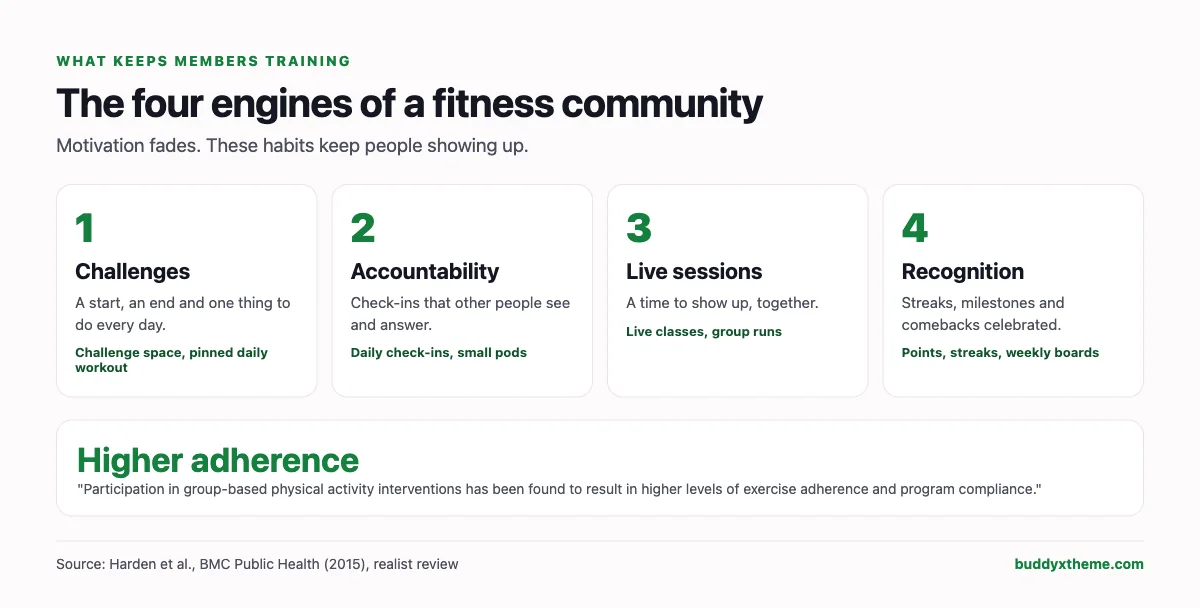
Online, the same principle holds, but the group has to be designed. A feed of workout videos is not a group. What turns members into a group is a set of habits the platform makes easy:
- Challenges with a start date, an end date and something to do every day.
- Accountability, through check-ins that other people see and respond to.
- Live sessions, which give people a time to show up.
- Recognition, from coaches and peers, for streaks, milestones and showing up.
Any platform you choose should make those four habits effortless for members and for you.
Community platform, coaching app or social group?
| Type | Built around | Strengths | Gaps | Examples |
|---|---|---|---|---|
| Community platform | Members interacting with each other | Challenges, feeds, events, recognition, memberships | Workout programming is lighter than coaching apps | BuddyNext, Mighty Networks, Skool, Circle, Heartbeat |
| Coaching app | Coach-to-client programming | Workout builders, habit tracking, check-in forms, branded apps | Member-to-member community is secondary | Trainerize, Everfit |
| Course and video platform | Selling content | Video on demand, live streams, courses, memberships | Community sits beside the content | Kajabi, Uscreen |
| Social layer | An existing app or network | Free, members already there | No ownership, no coaching tools | Strava clubs, Facebook Groups, Discord |
Many coaches use two: a coaching app for individual programming and a community platform for the group. If you run group programs, challenges or a membership, the community platform is the core.
1. BuddyNext: best for a fitness community you own
BuddyNext is a complete community platform that runs on your own WordPress site. Spaces, a social feed, member profiles, messaging, events, Q&A, courses, a business directory, paid plans and built-in gamification with points, badges, streaks and leaderboards work together in one product.
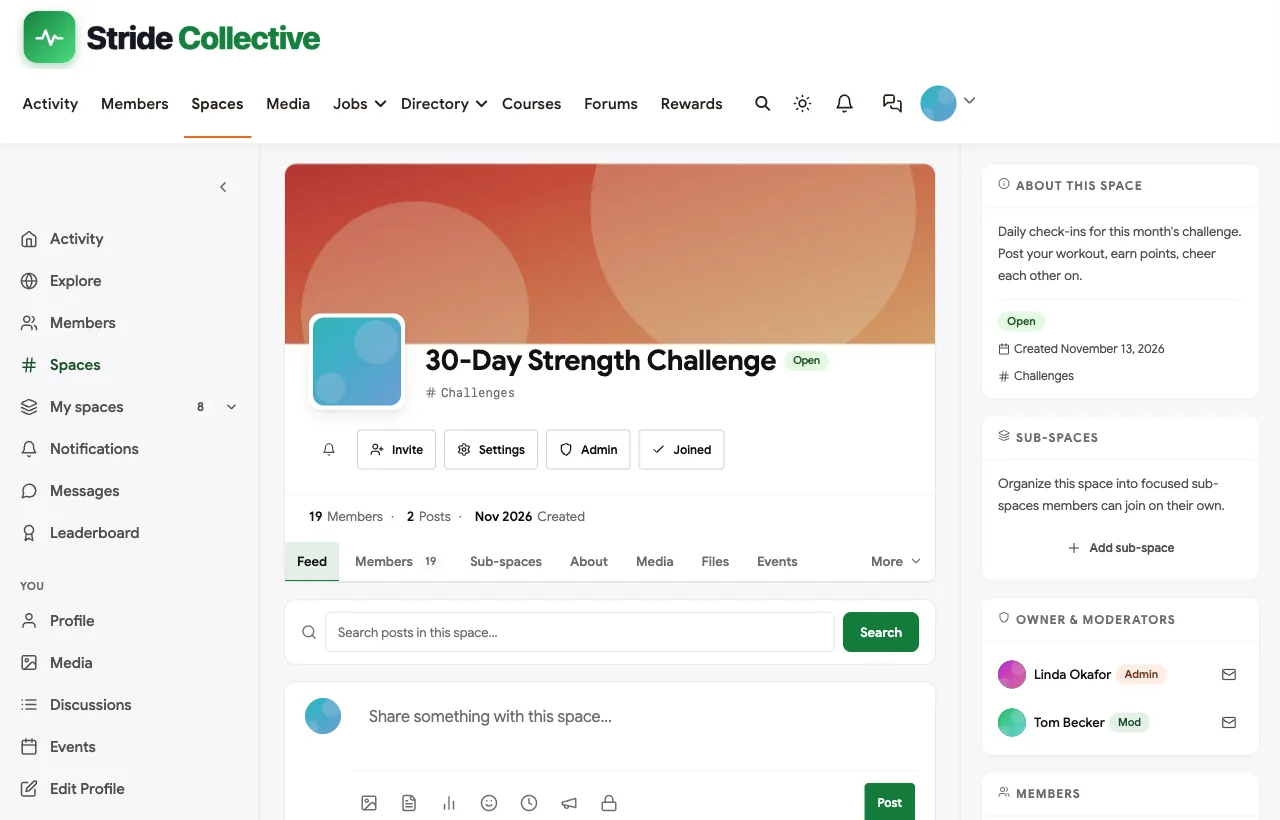
To show it in a fitness context, we built Stride Collective, a demo coaching community for strength and running with 20 fictional members, two coaches, a 30-day strength challenge, a private progress check-in space, a morning accountability pod, a run club, a local crew and a trusted-partners directory.

Best for: coaches, studios and fitness creators running group programs, challenges and memberships.
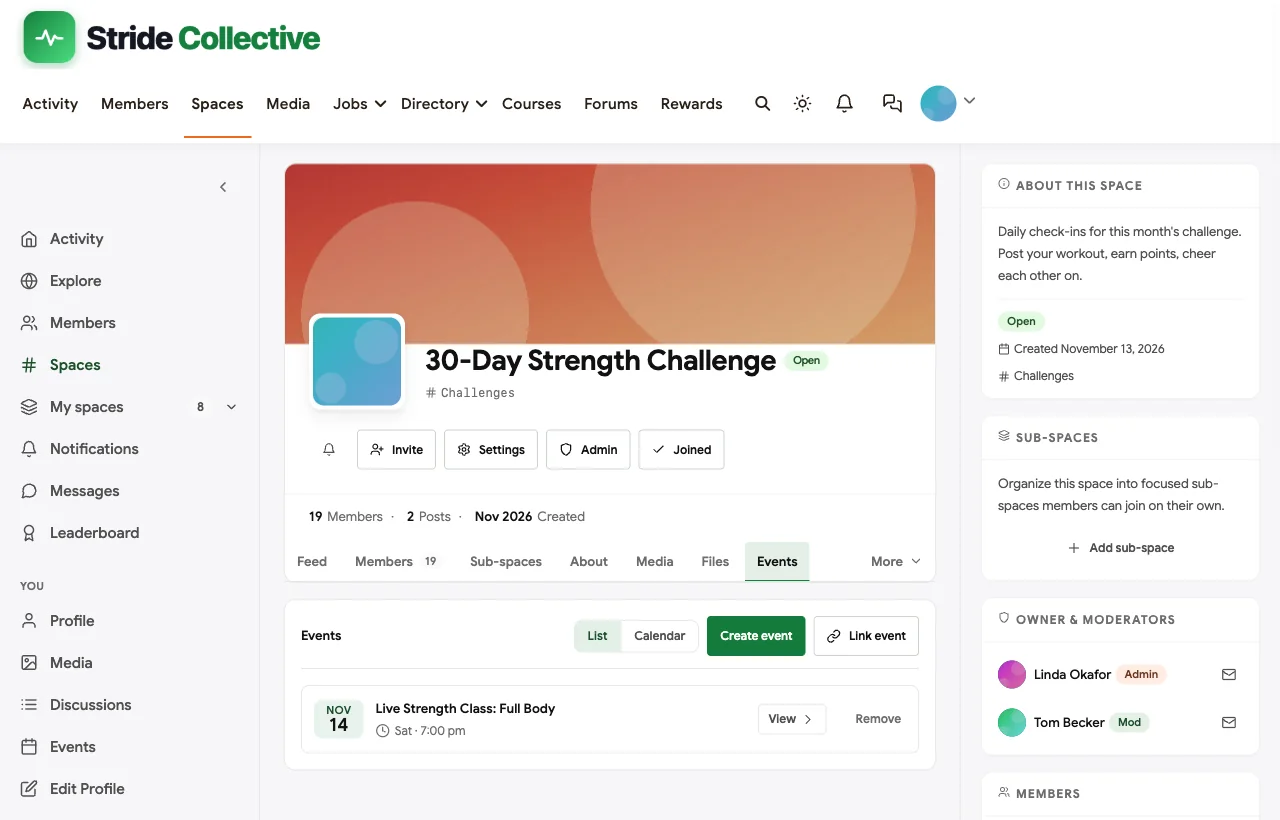
Challenges with daily check-ins. The 30-Day Strength Challenge is its own space. The coach pins the day’s workout to the community feed, members post their check-ins in the challenge space, and every post, comment and reaction earns points. In the demo, a beginner posts that she finished all three rounds without stopping for the first time, and the coaches reply within the hour.
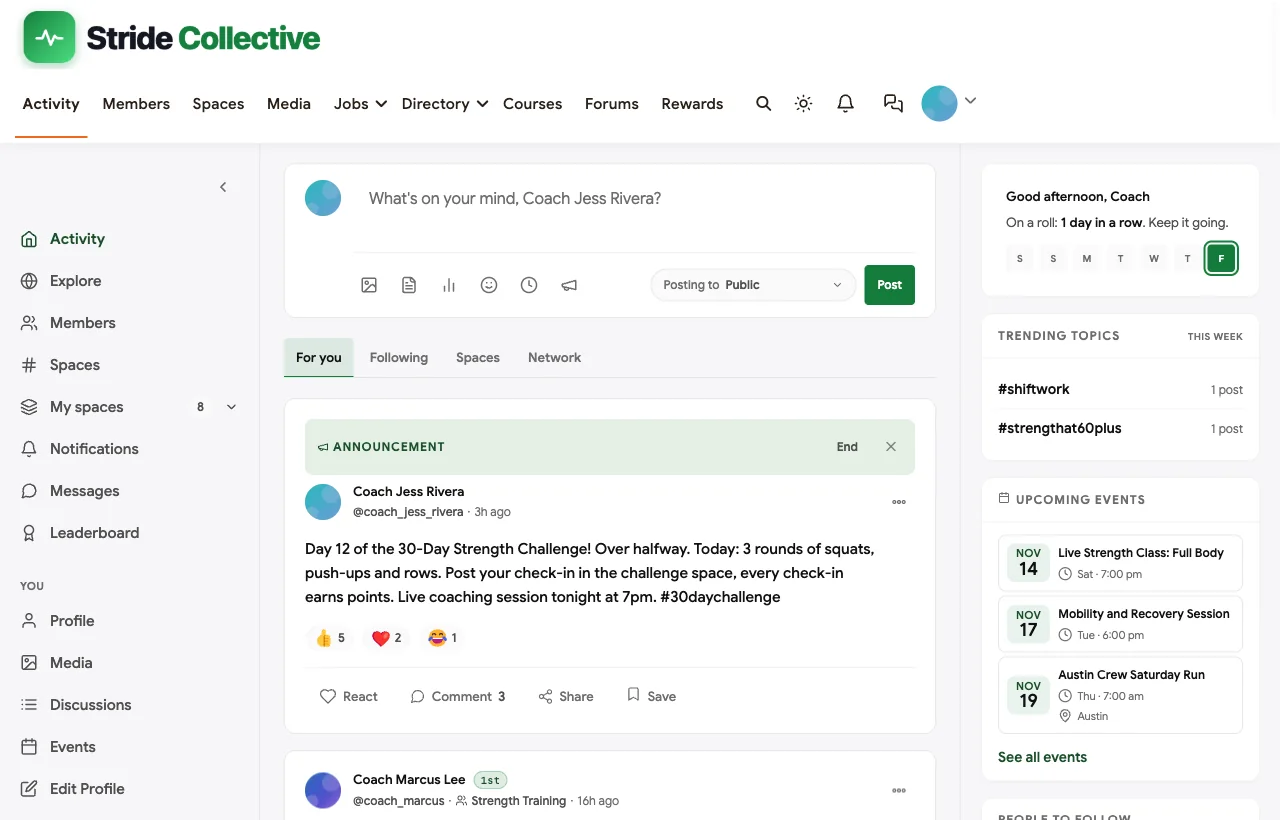
Streaks, points and leaderboards. Built-in gamification tracks points for activity, shows a streak counter for consecutive days of participation, and ranks members on all-time, monthly and weekly leaderboards. Monthly and weekly views matter for fitness: a beginner can top this week’s board even if long-time members lead all-time. For more on designing points and badges, see how to gamify courses with points and badges.


Private progress check-ins. Progress photos and measurements are personal. The Progress Check-ins space is private: members request to join, a coach approves them, and only members of that space see what is posted there. Members who prefer not to share with the group can message their coach directly instead.
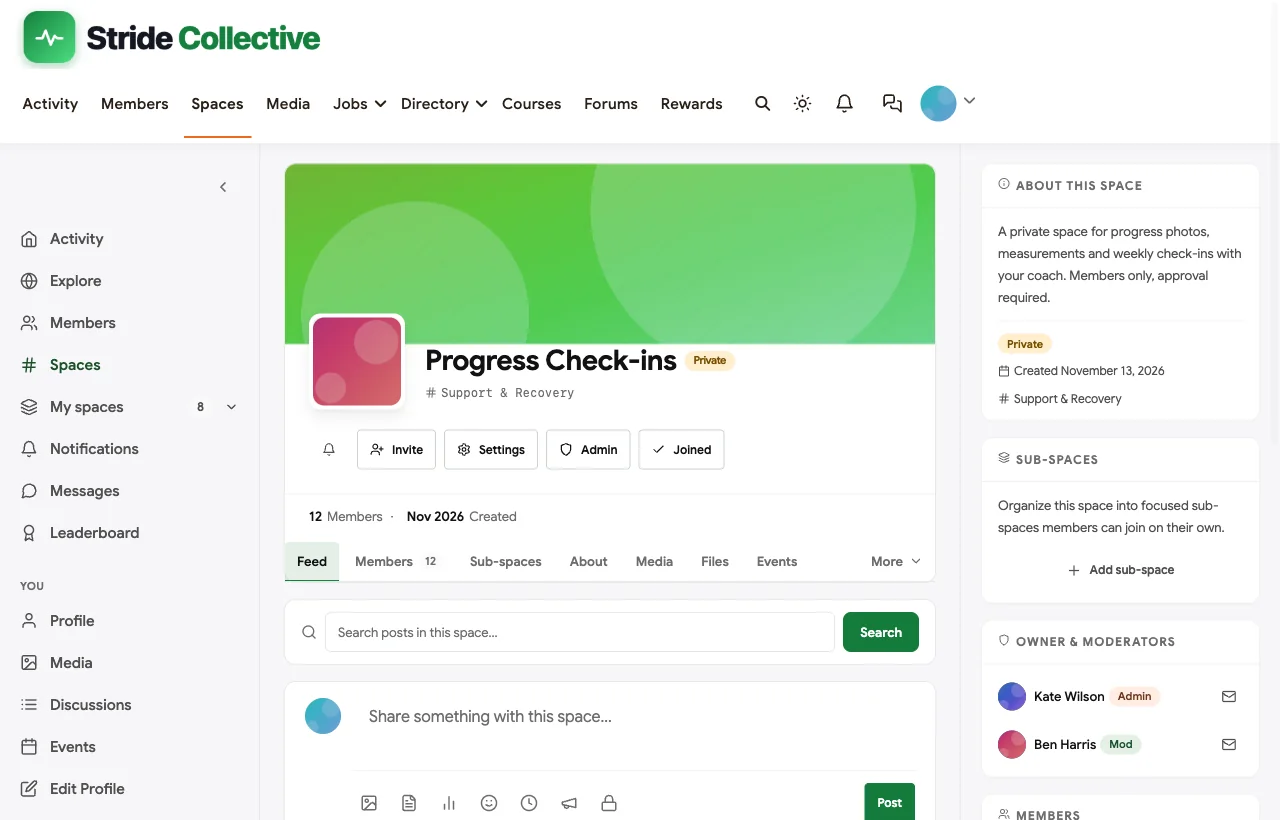
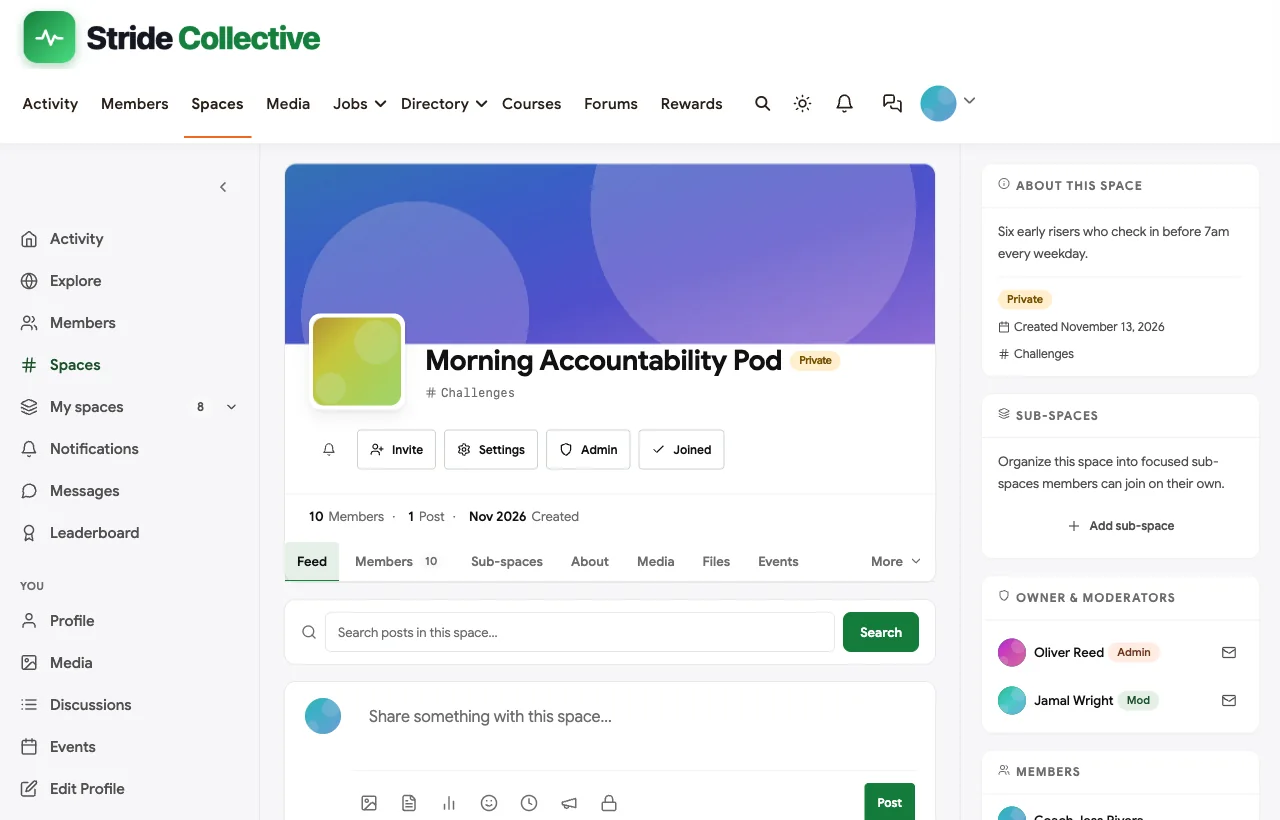
Accountability pods. The Morning Accountability Pod is a small private space for early risers who check in before 7am every weekday. Small pods create the kind of mutual responsibility that large groups cannot.
Live classes and group runs. Events can be online, for live classes and coach Q&As, or in person with a venue, for local group runs. The demo schedules a live full-body class inside the challenge space, a mobility session, a monthly coach Q&A and a Saturday run in Austin.
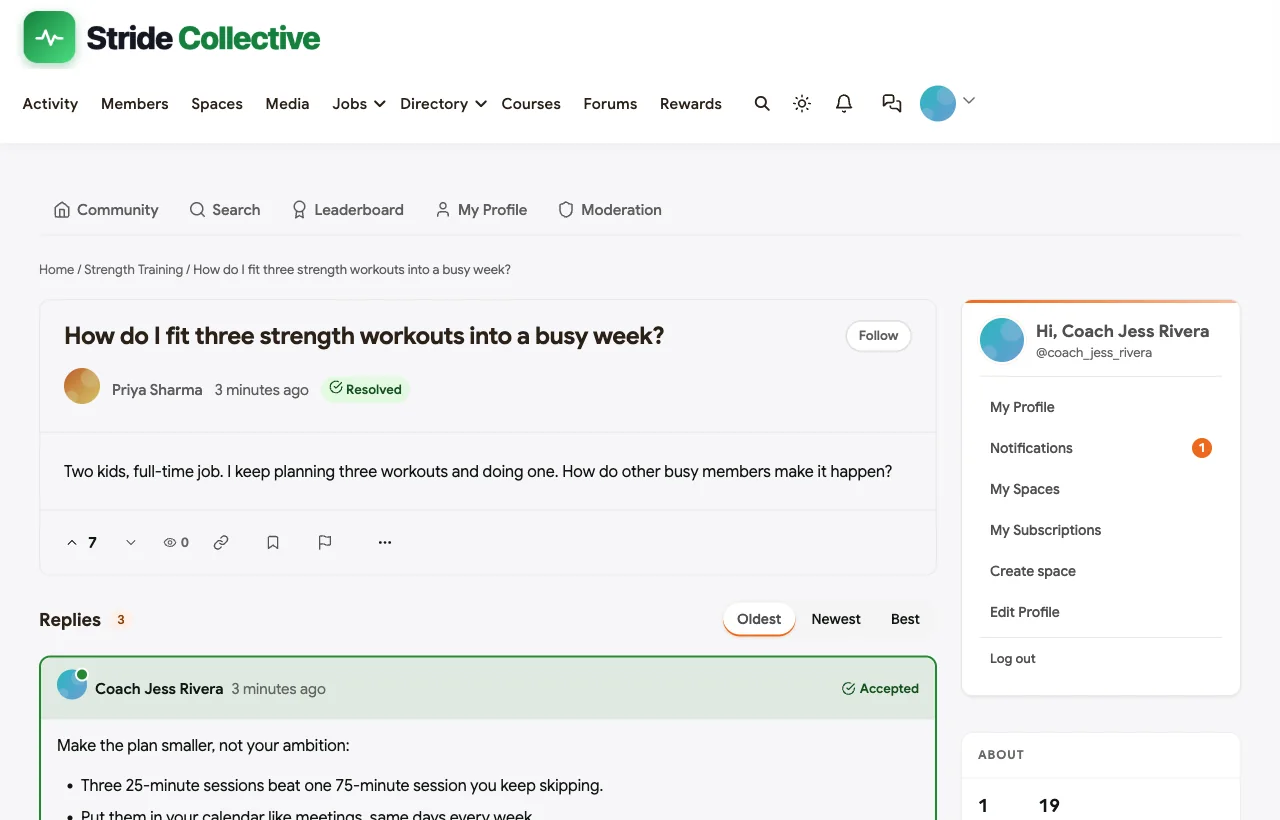
Coach Q&A that keeps the best answers. Training spaces support questions with accepted answers. In the demo, a busy parent asks how to fit three workouts into a week; the head coach answers with a practical plan, another member adds what worked for her, and the asker reports her first three-workout week. The accepted answer stays findable for every future member with the same problem.
Trusted partners. A partners space lists the physio, nutritionist, yoga teacher and recovery studio the coaching team recommends, so members get expert referrals without the feed turning into ads.
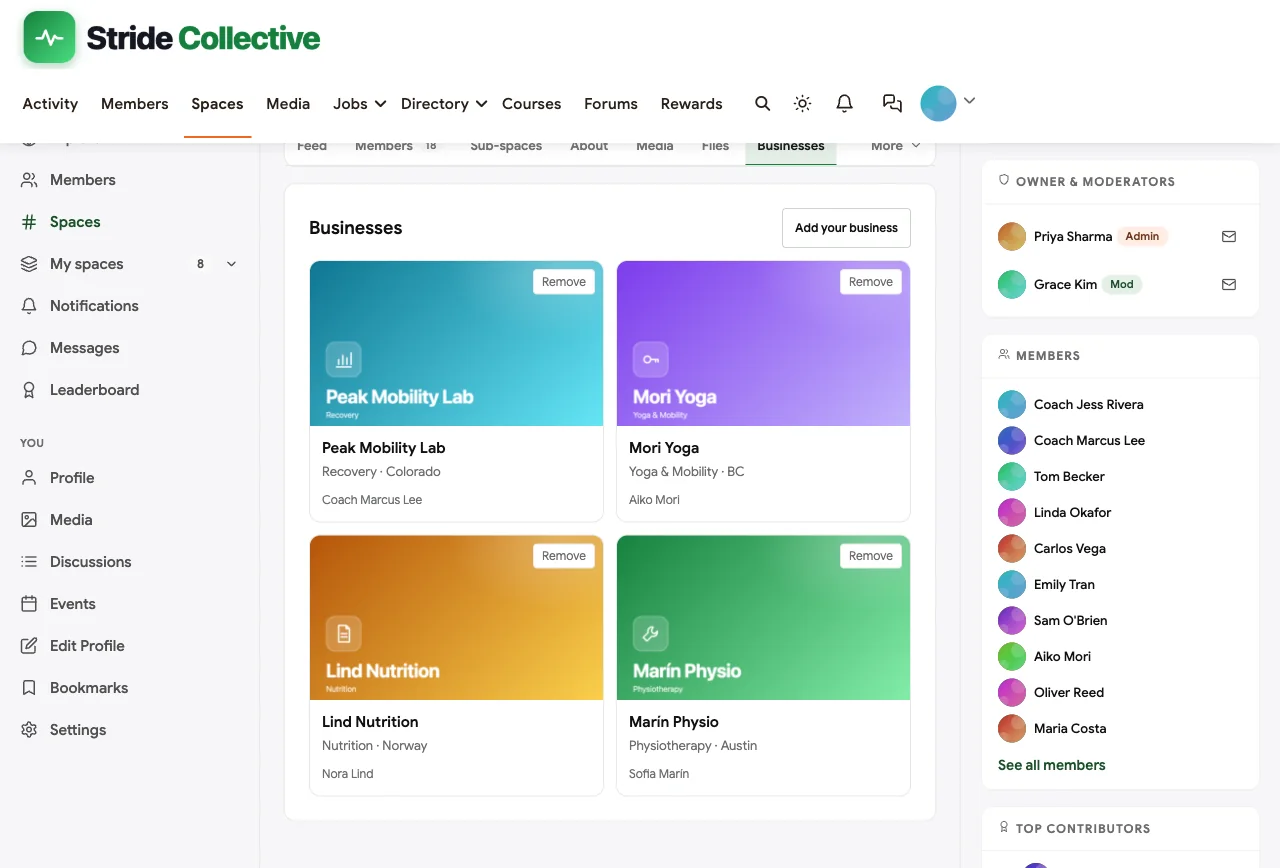
Also built in. Courses for structured programs, direct messages between coaches and members, polls to choose next month’s challenge, hashtags such as #30daychallenge, member profiles with goals, notifications, paid plans with trials and coupons, and a mobile layout that works without an app download.
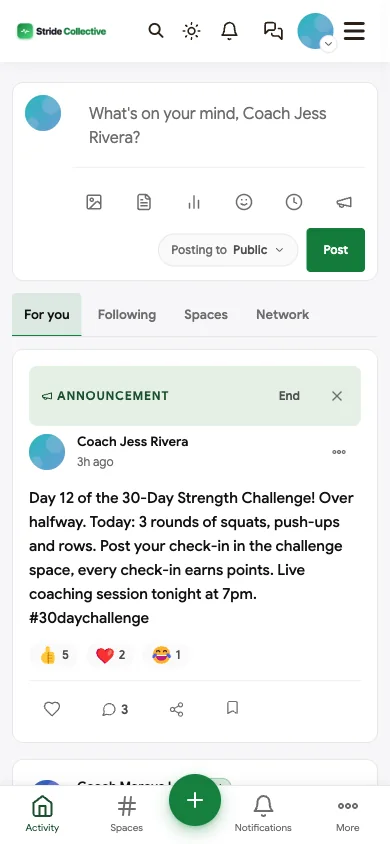
Gaps. BuddyNext does not include a workout builder with sets, reps and load tracking, and it does not sync with wearables such as Garmin or Apple Health. Coaches who program individually often pair it with a coaching app. It is self-hosted, so you run WordPress or use a managed host.
What’s included, and how it is delivered
BuddyNext is one platform made of a core and add-on platform modules. Everything shown in the demo above runs on the BuddyNext platform. This table shows which parts come with the core, which are platform modules you install and activate alongside it, and which need a third-party plugin, another system or custom work.
| Capability | How it is delivered |
|---|---|
| Open, private and secret spaces | Core platform |
| Activity feed, pinned announcements and hashtags | Core platform |
| Member profiles and searchable member directory | Core platform |
| Direct messages | Platform module, installed alongside |
| Polls | Core platform |
| Paid plans with trials and coupons | Platform module, installed alongside |
| Q&A with accepted answers and code highlighting | Platform module, installed alongside |
| Courses and certificates | Platform module, installed alongside |
| Events with RSVPs, online or in person | Platform module, installed alongside |
| Business and partner directory listings | Platform module, installed alongside |
| Points, badges, streaks and leaderboards | Platform module, installed alongside |
| Live video streaming | Your streaming tool (events link to it) |
| Wearable and fitness app sync | Not available |
Want to click around yourself? The Stride Collective community in this guide was built on a private test site, so it is not public. The BuddyNext live demo is a general community you can open in your browser and explore without installing anything.
2. Mighty Networks: best hosted community with branded fitness apps
Mighty Networks combines community, courses and events, with native mobile apps and fully branded apps on its Mighty Pro plan. Its best-known fitness example is the Slow AF Run Club, launched in August 2019 by Martinus Evans as “a free community for ‘back of the pack’ runners,” which Mighty Networks describes as home to “20,000+” runners (Mighty Networks).
Best for: fitness creators with a large audience who want a branded app.
Challenge and accountability tools: posts, events and courses; no dedicated challenge or streak engine on its features page.
Content delivery: courses and events, with live streaming.
Gaps: branded apps sit on the higher Mighty Pro plan; no wearable integrations; hosted only.
3. Skool: best for simple gamified fitness groups
Skool combines a community feed, a classroom for courses and a calendar. Its gamification is simple and visible: according to Skool’s help center, “1 like = 1 point” for the post or comment author, members level up as points accumulate, levels show next to names, and admins can unlock courses at certain levels (Skool).
Best for: coaches who want a quick, gamified group with courses.
Challenge and accountability tools: points, levels and leaderboards; challenges run as posts and calendar events.
Content delivery: courses and live calls.
Gaps: no private sub-spaces for progress check-ins or pods; points come from likes rather than workouts completed; hosted only.
4. Trainerize: best coaching app for personal trainers
Trainerize positions itself as “the #1 coaching app to better engage your clients.” Its site describes workout program delivery for online, in-person and hybrid coaching, an AI workout builder, progress and nutrition tracking, habit coaching, custom branded apps, and community features with “badges, reactions, and more” (Trainerize).
Best for: personal trainers who program individually for each client.
Challenge and accountability tools: habit coaching, badges and coach messaging.
Content delivery: workout programs and progress tracking.
Gaps: the community is coach-to-client first; member-to-member community is lighter than on community platforms.
5. Everfit: best coaching platform with built-in challenges
Everfit describes itself as an all-in-one platform for fitness coaches, gyms, studios and nutrition coaches. Its site lists workout building, check-in forms, habit tracking, fitness challenges, community forums, integrated payments with one-time or recurring billing and free trials (Everfit).
Best for: coaches and studios running group programs for many clients.
Challenge and accountability tools: native challenges, habit tracking and community forums.
Content delivery: programs, check-ins and payments.
Gaps: community is one part of a coaching toolkit rather than the center; specific wearable integrations are not named on its homepage.
6. Circle: best for a polished fitness membership
Circle is an all-in-one community platform with spaces, courses, live events, paid memberships and an optional branded app for iOS and Android.
Best for: fitness creators who want a clean, premium community with courses.
Challenge and accountability tools: spaces, events and gamification features.
Content delivery: courses and live events.
Gaps: no fitness-specific challenge or habit tools; the branded app is an add-on; hosted only.
7. Heartbeat: best for small coaching cohorts
Heartbeat offers channels, threads, messaging, cohort and self-paced courses with progress tracking, live events with recordings and replays, and paid tiers (Heartbeat).
Best for: coaches running small paid cohorts with recorded live sessions.
Challenge and accountability tools: channels, messaging and course progress.
Content delivery: courses and recorded live sessions.
Gaps: no challenge or habit-tracking feature on its homepage; hosted only.
8. Kajabi: best all-in-one for fitness businesses selling programs
Kajabi offers separate products for courses, coaching, memberships and communities, describing communities as a space “where connection drives retention and recurring revenue” (Kajabi).
Best for: fitness businesses selling programs, coaching and memberships from one tool.
Challenge and accountability tools: community spaces; no named challenge or habit features on its homepage.
Content delivery: courses, coaching and memberships.
Gaps: community is one product among many; hosted only.
9. Uscreen: best for studios with a video library
Uscreen is a video membership platform with video on demand, live streaming with real-time chat, a community space alongside the video library, and branded mobile and TV apps (Uscreen).
Best for: studios and instructors whose main product is a class library.
Challenge and accountability tools: community channels and live chat.
Content delivery: on-demand and live classes on web, mobile and TV.
Gaps: community supports the video library rather than leading; no challenge or habit features on its homepage.
10. Strava clubs: best free social layer for running and cycling groups
Strava clubs give run and ride groups a shared feed and weekly leaderboards built from members’ synced activities. Strava’s help center explains club features, group challenges and how private activities stay out of club totals.
Best for: run clubs and cycling groups whose members already use Strava.
Challenge and accountability tools: weekly club leaderboards and group challenges powered by activity data from watches and phones.
Content delivery: none; there are no courses, classes or memberships.
Gaps: it is a social layer, not a coaching business; you cannot charge for a club or own its member list. Many coaches use Strava for activity data and a community platform for everything else.
11. Facebook Groups and Discord: best as free starting points
Facebook Groups are where many fitness coaches start, with posts, live video and admin tools. Discord suits younger audiences with voice channels for live workouts.
Best for: testing an idea before investing in a platform.
Challenge and accountability tools: posts, and bots on Discord.
Content delivery: live video on Facebook, voice and video channels on Discord.
Gaps: no ownership of the member list, no paid membership for most coaches, no private progress spaces beyond group-level privacy, and feeds that decide who sees each post.
Fitness community platforms compared
| Platform | Challenges and check-ins | Streaks and leaderboards | Private progress spaces | Live classes | Programs and courses | Wearable data | Paid membership | Ownership |
|---|---|---|---|---|---|---|---|---|
| BuddyNext | Challenge spaces, pinned daily workouts | Points, streaks, weekly and monthly boards | Private and secret spaces | Built-in events, online and in person | Built-in courses | No | Built-in plans | Self-hosted, you own the data |
| Mighty Networks | Posts and events | Not documented | Private spaces | Yes, with live streaming | Courses | No | Yes | Hosted |
| Skool | Posts | Points from likes, levels | No sub-spaces | Live calls | Courses | No | Yes | Hosted |
| Trainerize | Habit coaching | Badges | Coach-client | Not documented | Workout programs | Not named | Not documented | Hosted |
| Everfit | Native challenges | Challenges | Coach-client | Not documented | Workout programs | Not named | Integrated payments | Hosted |
| Circle | Spaces | Gamification | Private spaces | Yes | Courses | No | Yes | Hosted |
| Heartbeat | Channels | Not documented | Channels | Yes, with recordings | Courses | No | Yes | Hosted |
| Kajabi | Community | Not documented | Not documented | Not documented | Courses and coaching | No | Yes | Hosted |
| Uscreen | Community channels | No | Private channels | Live streaming | Video library | No | Yes | Hosted |
| Strava clubs | Group challenges | Weekly club boards | Activity privacy | No | No | Yes | No | Strava’s platform |
| Facebook Groups and Discord | Posts | Bots on Discord | Group or channel level | Live video, voice | No | No | Limited | Their platforms |
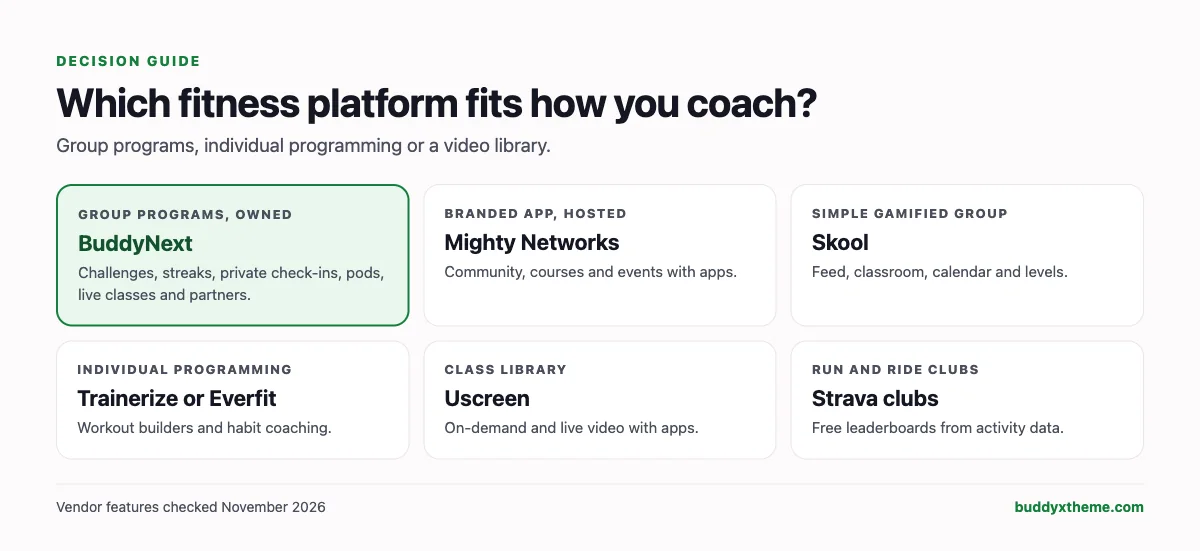
Choosing by business model
The right platform depends less on features than on how you make money and how you coach.
| You are | What matters most | Good fit |
|---|---|---|
| A personal trainer moving clients online | Individual programming, check-ins, messaging | A coaching app such as Trainerize or Everfit, plus a community for group motivation |
| A coach running group programs and challenges | Challenges, streaks, live classes, private check-ins | BuddyNext, or Skool for the simplest start |
| A studio with classes and members | Live and on-demand classes, member community, local events | Uscreen for a class library; BuddyNext for a community with events and partners |
| A fitness creator with a large following | A branded experience, paid membership, scale | Mighty Networks or Circle hosted; BuddyNext if you want to own it |
| A run or ride club | Group runs, leaderboards from activity data, race reports | Strava clubs for activity data, plus a community for everything else |
Two questions settle most decisions. First, will members mainly talk to you or to each other? If mostly to you, start with a coaching app; if to each other, start with a community platform. Second, do you want to own the member list? If your community is your business, a self-hosted platform keeps it yours if a vendor changes prices, features or direction.
Running a 30-day challenge that people finish
For the full setup, screen by screen, see our step-by-step guide to creating a paid fitness community with groups and challenges.
Challenges are the single best engagement tool for a fitness community, and the easiest to get wrong. This is the structure we used in the demo:
| Phase | Days | What happens |
|---|---|---|
| Warm-up | 7 days before | Announce the challenge, open the challenge space, ask members to post their “why” |
| Kick-off | Day 1 | Live class, first check-in, pinned day one workout |
| Build | Days 2 to 10 | Daily pinned workout, coach replies to every check-in, first streak shout-outs |
| The wall | Days 11 to 20 | Expect drop-off. Run a mid-point live class, celebrate whoever came back after missing days, share member wins |
| Finish | Days 21 to 30 | Count-down posts, final live class, finisher badges and a celebration post |
| After | Day 31 | Poll for next month’s challenge, invite finishers into a pod or paid program |
Three rules make the difference:
- Make missing a day normal. Celebrate people who come back, not just unbroken streaks. Most people miss at least one day.
- Scale every workout. Post a beginner and an advanced version so nobody feels it is not for them.
- Respond fast. A coach reply within hours, especially on a first check-in, is the strongest retention tool you have.
Privacy for progress photos and health information
Progress photos, weights and measurements are sensitive. Before choosing a platform, check:
- Can you create a private space where only approved members see posts, separate from the main feed?
- Can members message a coach privately instead of posting to a group?
- Is anything visible to search engines or logged-out visitors? Progress spaces should never be.
- Who owns the data, and can you delete a member’s content if they ask?
- What do your rules say? Write down that progress photos must never be shared outside the space, and enforce it.
Avoid medical advice in the community. Coaches can share training guidance; injuries and health conditions belong with a qualified professional, which is why a partners directory of physios and nutritionists is useful.
Launching your fitness community
Weeks 1 and 2: start with your existing clients. Invite current clients first, with a simple welcome post asking for their goal for the next 90 days. Set up Start Here, one challenge space, one training space and a private check-ins space.
Weeks 3 and 4: run your first challenge. Keep it simple, such as 15 minutes a day for 14 days, with one live class per week. Reply to every check-in.
Weeks 5 to 8: add rhythm. A weekly live class, a monthly Q&A, and an accountability pod for members who ask for one. Add a local crew if enough members live nearby.
After two months: decide on your model. Keep the community as a free layer for clients, or launch a paid membership with challenges, classes and coach access included. Our comparison of platforms for a paid coaching membership community covers the paid side in more depth.
More community platform comparisons
Building a different kind of community, or one that overlaps with this one? These guides use the same method: a working demo community and vendor claims checked at the source.
- Best platforms for a running club community website: group runs, routes, beginners, races and volunteering.
- Best platforms for a yoga and wellness membership community: live classes, 30-day challenges, teacher Q&A and retreats.
- Best platforms for a gaming and esports community: LFG, community cups, VOD reviews and private roster rooms.
- How to create a paid fitness community with groups and challenges: the step-by-step build behind this demo, from trials and spaces to 30-day challenges, streaks and leaderboards.
- Best software for a paid coaching membership: coaches selling group programs and memberships.
- Best software for a content creator community: fan challenges, voting and supporter tiers.
- Best software for an online course community: course creators who want learners to finish.
- Best software for a private neighborhood community website: residents-only access, safety alerts and local decisions.
- How to set up a community space on WordPress: the step-by-step setup guide behind every demo in this series.
How we built and checked this list
We built the Stride Collective demo on a local WordPress site running BuddyNext, with fictional coaches, members, partners and events created for this guide; every BuddyNext screenshot comes from it. Competitor features come from each vendor’s own website or help center, checked in November 2026 and linked where we quote them. The Slow AF Run Club example comes from Mighty Networks’ case study, and the research finding from the BMC Public Health review. We did not run paid accounts on every competitor, and features change, so confirm anything critical with the vendor. Nothing here is medical advice. buddyxtheme.com is published by the team behind BuddyNext, which is why it is listed first; we have tried to be fair about its gaps as well as its strengths.
Frequently asked questions
What is the best platform to build an online fitness community?
BuddyNext is the best choice for a fitness community you own, with challenge spaces, daily check-ins, points, streaks and leaderboards, private progress spaces, accountability pods, live classes and a partners directory on your own WordPress site. Mighty Networks is the strongest hosted option with branded apps, and Skool is the simplest gamified group.
Does an online community help people stick to exercise?
Research on group-based physical activity programs links them to higher exercise adherence and program compliance. Online, the effect depends on design: challenges, check-ins that others respond to, live sessions and recognition.
Should I use a coaching app or a community platform?
Use a coaching app if you mainly write individual programs and track each client’s training. Use a community platform if you run group programs, challenges or memberships. Many coaches use both: the app for programming and the community for motivation.
How do I keep progress photos private?
Create a private space with approval for progress check-ins, separate from the main feed, and allow members to send photos directly to their coach instead. Make sure the space is not visible to logged-out visitors or search engines, and write clear rules about sharing.
What makes a good fitness challenge?
A fixed start and end, a simple daily action that every level can do, scaled options, a coach reply to check-ins, live sessions at key points and a celebration at the end. Most importantly, make it easy to come back after missing a day.
Can I connect wearables like Garmin or Apple Watch?
Strava aggregates activity from many watches, and some coaching apps offer device integrations. Most community platforms, including BuddyNext, do not sync wearable data directly; members can share results in their check-ins instead.
Do I need a branded mobile app?
Not to start. Most members are happy with a community that works well in their phone’s browser. Branded apps can help large communities and are offered on higher plans of platforms such as Mighty Networks and Circle.
How should I price a fitness membership?
Price for the outcome and the coaching, not for content access. Include challenges, live classes and coach responses, and keep a free layer, such as a Start Here space or a free challenge, so people can try the community first.
How do I stop a fitness community feeling intimidating for beginners?
Use weekly and monthly leaderboards so newcomers can rank, celebrate first check-ins loudly, scale every workout, and ban comparison talk about bodies. Beginners stay when they feel seen.
Can a local run club use an online community?
Yes. Use an online space for training plans, race reports and chat, and events with venues for group runs. Members who already use Strava can keep using it for activity data.
The bottom line
A fitness community works when it makes consistency social: challenges with a daily action, check-ins that people respond to, live sessions to show up for and recognition for coming back. If you want that on a platform you own, with your members’ data in your own database, BuddyNext is the strongest foundation. If you prefer a hosted community with branded apps, choose Mighty Networks; if you program individually, pair a coaching app with your community.
And build a fitness community that keeps people training.