

Every community site owner eventually asks the same question: how do you make money from a space people joined to talk, not to shop? Subscriptions work for some communities. Sponsorships work for a few. But for most WordPress community websites, advertising ends up being the first revenue stream that actually pays the hosting bill, because it doesn’t require members to pull out a credit card at all.
The catch is that bad ad placement can undo months of community-building in a matter of weeks. Members who feel like they’re navigating a billboard instead of a conversation leave, and they don’t usually come back to explain why. This guide walks through what actually matters when picking an ads plugin for a WordPress community, and where a purpose-built plugin like BuddyPress Ads earns its keep.
What a Community Ads Plugin Is Actually Solving
A generic WordPress ad plugin knows how to put a banner in a sidebar or above a footer. That’s fine for a blog. It’s not enough for a community site, where the content isn’t static pages but a constantly scrolling activity feed, member profiles, and group pages, each with its own rhythm and its own risk of an ad showing up at the wrong moment.
A community-specific ads plugin understands the difference between placing an ad between two blog posts and placing one inside a live activity stream where members expect to see other members, not sponsored content. Get that placement wrong and it reads as an interruption. Get it right and most members won’t even register it as an ad, just another item in the feed.
That’s the gap BuddyPress Ads is built to close, and it’s worth understanding why before deciding whether it, or any competing plugin, is the right fit for your site.
Why Ad Placement Is Worth This Much Attention
Nobody Sticks Around on a Cluttered Site
You already know what it feels like to land on a page buried in pop-ups and banners. You leave, usually within seconds, and you probably don’t remember the name of the site well enough to complain about it later. Members treat community sites the exact same way. The tolerance for advertising on a site people visit to connect with others is lower than on a site they visit to read one article and move on, so the margin for error on placement is thinner.
Device Behavior Isn’t Uniform
An ad format that looks fine on a laptop screen can break a mobile layout entirely, pushing content off-screen or making a tap target overlap with a close button that isn’t actually there. Since a large share of community traffic happens on phones, especially for casual check-ins between other tasks, a plugin needs genuine device-aware rendering, not a single ad size stretched to fit every screen.
Easy Setup Actually Matters
Most community owners are not developers, and even the ones who are don’t have hours to spend configuring an ad rotation system. A plugin that requires manually editing template files to place an ad in a specific spot will get set up once and then never touched again, even when a placement is clearly underperforming. Look for something you can adjust from the WordPress dashboard in minutes.
What to Look For When Comparing Options
Compatibility With Your Community Platform
An ads plugin built generically for WordPress often has no concept of BuddyPress activity streams, member profiles, or group pages. That means no way to place an ad inside an activity feed at all, which cuts off one of the highest-visibility placements on a community site. Confirm any plugin you’re considering explicitly supports BuddyPress and, if relevant, BuddyBoss, before you install it.
Targeting Controls
Not every ad belongs in front of every visitor. A plugin worth using lets you choose whether an ad shows to logged-in members, logged-out visitors, or both, and ideally lets you target by device type too. This matters both for revenue, since some advertisers pay more for logged-in, identifiable audiences, and for user experience, since showing the same promotional banner to a member who has already converted on it is a wasted impression that annoys more than it earns.
Format Flexibility
Plain text links work in some contexts. Rich HTML content works in others. Image banners work in still others. A plugin locked into a single ad format limits what you can sell to advertisers and how naturally an ad can blend into the surrounding content. Look for support across formats, plus the ability to embed custom code when an advertiser hands you their own script.
Reporting You Can Actually Use
An ads plugin that shows a raw click count and nothing else makes it hard to know whether a placement is working. Impressions matter as much as clicks, since a low click-through rate on a high-impression placement tells a very different story than the same click count on a low-visibility one. If you’re planning to sell ad space directly to sponsors rather than through a network, you’ll want reporting detailed enough to send a sponsor proof their money was well spent.
Why BuddyPress Ads Fits This Use Case

BuddyPress Ads was built specifically to solve the placement problem described above. It’s free, it’s compatible with both BuddyPress and BuddyBoss, and it gives you control over where ads appear without touching a line of code.
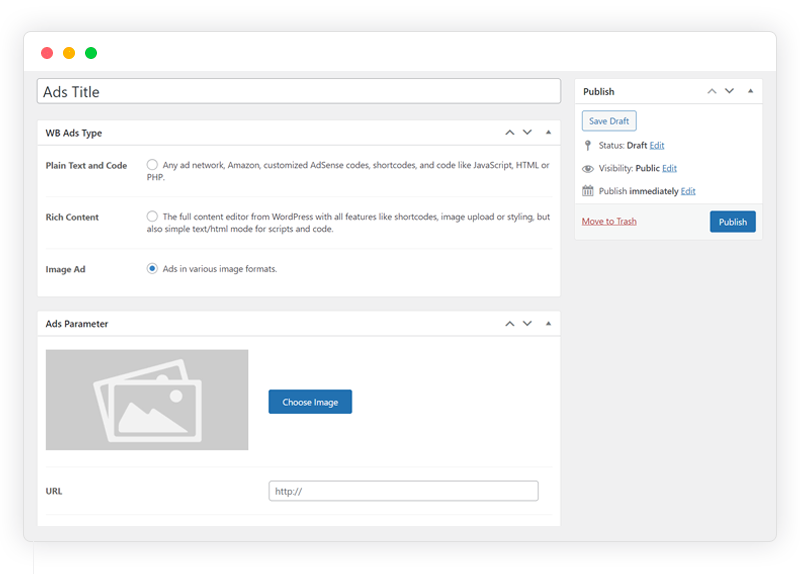
Installation is a normal plugin install through your dashboard, no manual file editing, no developer required. Once it’s active, the key features worth knowing about include:
Ads can be placed as plain text, rich content, or image banners, so the format matches whatever an advertiser sends you. Display targeting lets you choose specific devices, mobile, tablet, or desktop, so a banner sized for a laptop screen never breaks a phone layout. You can show or hide ads based on login state, which matters if you’re running promotions aimed only at logged-out visitors considering membership. Placement options cover multiple spots across the site rather than a single fixed location, and there’s a setting to let page content float around an ad instead of forcing an awkward break in the layout. Advertisements can be created directly from the WordPress backend, and if you need something more custom, the plugin supports embedding PHP code inside an ad slot. You can also hide a specific advertisement from the public ads listing without deleting it, useful for pausing a campaign temporarily, and choose which activity types, groups, member profiles, or site-wide streams, a given ad appears in.
A Practical Walkthrough of Setting Up Your First Placement
Once BuddyPress Ads is installed and active, the fastest way to learn the plugin is to set up one placement end to end rather than reading through every setting first. Start with a single ad unit in a low-risk spot, the sidebar of a group page rather than the main activity feed, and pick a plain text or small image format rather than anything animated. A simple first placement gives you a baseline to compare against once you start experimenting with feed placements later.
Set the display targeting to logged-in members only for this first test. That keeps the audience consistent while you’re still learning how the reporting works, since mixing logged-in and logged-out traffic in your early numbers makes it harder to tell what’s actually happening. Let the placement run for at least two weeks before drawing conclusions. Community traffic patterns often have a weekly rhythm, heavier on certain days, quieter on others, and a few days of data will mislead you about what’s actually typical.
Once you’re comfortable with how a single placement performs, add a second one in a different location and compare the two directly. This is how you build an actual sense of which spots on your specific site earn attention, rather than assuming what worked for someone else’s community will translate to yours.
Ad Networks Versus Direct Sponsorships
Most site owners eventually choose between two paths, or some mix of both. An ad network fills your placements automatically, handles billing, and pays you a share of what advertisers spend, with essentially no manual work beyond installing the tracking code. The tradeoff is lower revenue per impression and less control over what actually gets shown to your members, which matters if your community has strong opinions about the kind of brands associated with it.
Direct sponsorships mean reaching out to businesses relevant to your niche and negotiating a placement yourself. It takes real effort, cold emails, a media kit, follow-up conversations, but the payoff is usually a meaningfully higher rate per impression and full control over which brands appear in front of your members. For a community with a clearly defined niche, a fitness-focused space or a professional network in a specific industry, direct sponsorships tend to be worth the extra effort because the audience is specific enough that a relevant sponsor gets real value out of the placement.
Consent and Disclosure Aren’t Optional Extras
Running third-party ad networks usually means third-party tracking cookies, which brings your site under the same consent requirements as any other tracking technology. If your community has visitors from the EU, that means a working cookie consent mechanism, not just a banner that appears and does nothing when someone clicks decline. Direct sponsorships carry a lighter technical burden here since you control what’s actually being tracked, but disclosure still matters. Label sponsored content as sponsored. Members who feel misled about what’s an ad and what’s organic content tend to become the most vocal critics of a community once they notice, and that kind of complaint spreads faster inside an active community than almost anything else.
If You Need Something Broader Than Community Ads
BuddyPress Ads is purpose-built for placements inside BuddyPress activity streams and profiles specifically. If your monetization plans extend beyond that, say you also want to run affiliate links across your whole site, cloak long affiliate URLs so they look cleaner in a post, or add a lightweight classifieds section unrelated to member activity, that’s a different job. WB Ad Manager is a free standalone plugin built for exactly that: rotating ads, cloaking affiliate links, and running classifieds site-wide, independent of any community platform. Worth pairing with a community-specific plugin rather than trying to force one tool to do both jobs.
Setting Realistic Expectations About Revenue
Ad revenue from a community site scales with active members, not total signups. A community with five thousand registered accounts but two hundred people actually logging in weekly will earn closer to what a two-hundred-member community earns, not what the signup number suggests. Advertisers who buy space directly, rather than through a network, will usually ask for engagement numbers before committing, so keep basic activity stats on hand.
Direct sponsorships tend to pay better per impression than automated ad networks, but they take more work to line up. A hybrid approach, network ads filling unsold inventory while you separately pitch a handful of relevant sponsors for premium placements, is a reasonable way to start without needing either channel to carry the whole revenue load on its own.
Common Mistakes Worth Avoiding
Placing ads inside the first few items of an activity feed tends to backfire, since that’s exactly where members are scanning most closely for real content from people they follow. Push ad placements a little further down, where they’re still visible but not the first thing anyone sees. Running too many ad units at once is another common misstep. Two or three well-placed spots usually out-earn six scattered ones, because engagement drops sharply once a page starts to feel more like an ad server than a community.
Also worth avoiding: ads that visually mimic member content so closely that people can’t tell what’s sponsored. It might boost short-term clicks, but members who feel tricked once tend to stop trusting the feed altogether, which costs you more in departed members than the extra clicks were ever worth.
Frequently Asked Questions
Do I need a developer to set up BuddyPress Ads? No. Installation and placement configuration happen entirely through the WordPress dashboard. A developer is only needed if you want custom PHP embedded inside a specific ad.
Can I run ads only for logged-out visitors? Yes. The plugin lets you choose visibility by login state, so you can, for example, show membership promotions only to visitors who haven’t signed up yet.
Will ads slow down my activity feed? Any additional content adds some load time, but a well-optimized ad plugin with proper image sizing and minimal external scripts has a negligible impact compared to unoptimized ad networks that load multiple third-party trackers per impression.
Is BuddyPress Ads compatible with BuddyBoss too? Yes, it works with both BuddyPress and BuddyBoss platforms.
How many ad placements is too many? There’s no fixed number, but if a member scrolling through five activity items sees more than one ad in that stretch, it’s probably too many. Watch engagement metrics after adding each new placement rather than adding several at once, so you can tell which one, if any, is hurting participation.
Should I run different ads for mobile and desktop? If your plugin supports device targeting, yes. A banner sized well for a desktop sidebar often gets awkwardly cropped or ignored on mobile, where screen real estate is limited and members are scrolling faster. Running a separate, mobile-optimized creative for the same campaign usually performs better than forcing one asset to fit both.
What happens if a member complains about an ad? Take it seriously even if it’s a single complaint, since for every member who takes the time to say something, there are usually several more who felt the same way and just left quietly instead. Check the specific placement they’re referencing, review whether it’s appearing too frequently or in a disruptive spot, and adjust before it becomes a pattern.
Timing Your Ad Strategy Around Community Activity
Ad performance on a community site isn’t flat across the calendar. Engagement tends to spike around events you host yourself, a live AMA, a launch announcement, a seasonal campaign, and dip during quiet stretches when there’s less reason for members to check in. If you’re running direct sponsorships, timing a placement to coincide with a high-engagement event gets a sponsor meaningfully more visibility than the same placement running during a slow week, and it’s a reasonable thing to charge more for.
On the flip side, don’t schedule your first-ever ad test during a major community event. You want a clean baseline reading from a typical week before you start layering in variables like unusual traffic spikes.
Wrapping Up
Advertising is not a consolation prize for communities that can’t sell memberships. Done with the right tool and the right restraint on placement, it’s a legitimate, ongoing revenue stream that doesn’t ask a single member to pay anything. Choose a plugin built for the platform you’re actually running, keep placements sparse enough that they don’t compete with real content for attention, and revisit the numbers every few months instead of setting it once and forgetting about it.
The plugin choice matters, but it’s the smaller decision. The bigger one is restraint: knowing when a placement is earning its keep and when it’s quietly pushing members toward the exit. Check both regularly, and the ad revenue will grow alongside the community instead of at its expense.
Interesting Read:
How to Check Recent Profile Visitors in Your Community Website?
Why Are Private Community Groups Necessary?
How Private Communities Can Promote Healthy Nutrition and Physical Fitness?