
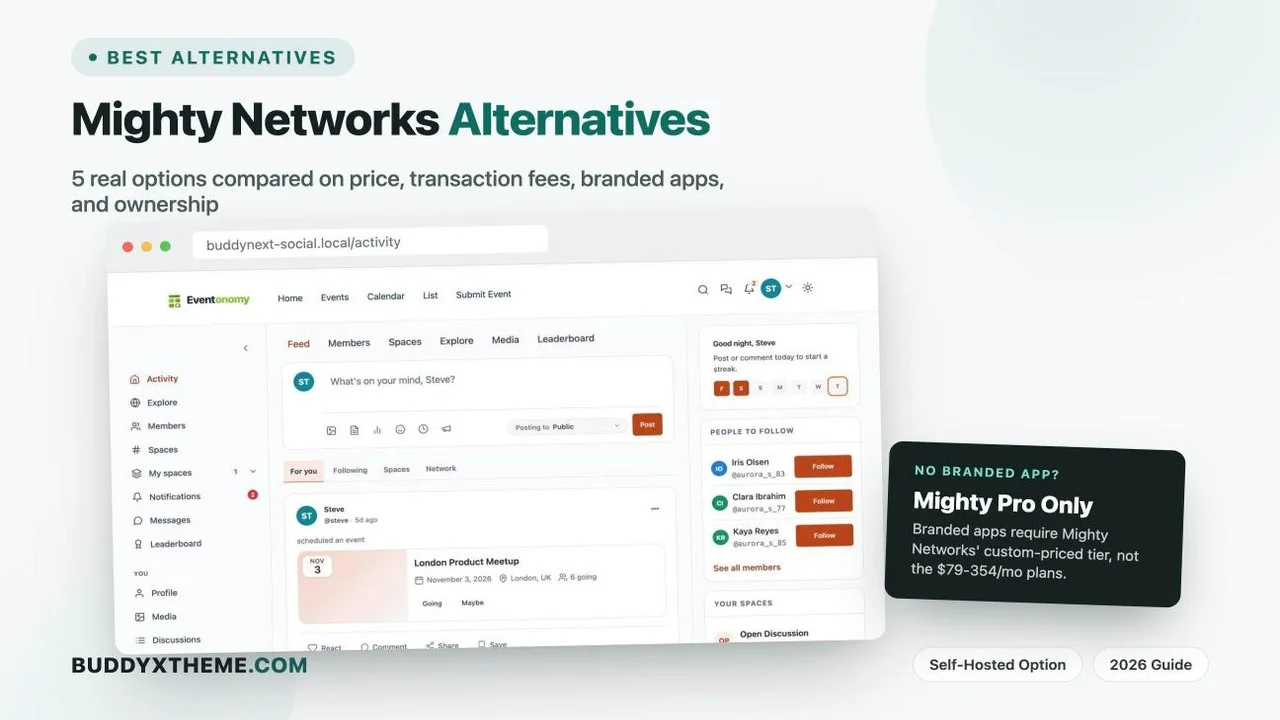
Mighty Networks is one of the most polished all-in-one community platforms on the market, combining spaces, courses, events, and livestreams in a single hosted product. But two things send a steady stream of people looking for a Mighty Networks alternative. The first is a pricing surprise: the visible plans, Launch at $79/month, Scale at $179/month, and Growth at $354/month, all include generic iOS and Android apps, but a branded app with your own name and icon in the app stores is locked behind Mighty Pro, a custom-quoted tier with no public price. Creators who assumed a branded app was somewhere in the $79-354/month range find out otherwise only after they go looking for it in settings. The second reason is more structural: Mighty Networks is a SaaS product, which means your member data, your pricing, and your platform’s future all live on someone else’s infrastructure and someone else’s roadmap, not yours.
This guide covers five real alternatives to Mighty Networks as a standalone roundup, not a head-to-head comparison. It includes three other SaaS platforms (Circle, Skool, and a WordPress-native option in BuddyBoss), one proven open-source forum platform (Discourse), and one self-hosted option, BuddyNext, for teams who want to stop paying a recurring per-member platform fee and own their community’s code and data outright.
Last updated: 6 November 2026
Quick answer: Circle is the closest like-for-like alternative to Mighty Networks, Skool is the simplest and cheapest to start, and BuddyNext is the pick if you want a self-hosted community you own without per-member fees. Discourse suits technical teams that want an open-source forum. Choose by how much you sell through the community, since transaction fees decide the real cost.
Table of Contents
- Market snapshot
- Why People Look for a Mighty Networks Alternative
- Circle
- Skool
- BuddyBoss
- Discourse
- BuddyNext
- A Real-World Scenario: Hitting the Branded App Wall
- A Migration Checklist Before You Switch
- What Transaction Fees Actually Cost at Scale
- What a Year Actually Costs
- Comparison Table
- How to Choose
- FAQs
- Sources
The global community platform market is projected to grow from roughly $2.94 billion in 2026 to $10.18 billion by 2035, a 14.8% CAGR, as more businesses and creators move member engagement off rented social platforms onto owned, dedicated software. That growth is exactly why pricing structure matters so much when picking a platform: a tool that looks affordable at a few hundred members can become a very different cost once transaction fees and tier jumps compound over years, not months.
Market snapshot
- Mighty Networks lists Launch at $79, Scale at $179 and Growth at $354 per month, with transaction fees of 2%, 1% and 0.5%; branded apps are only on the custom-priced Mighty Pro tier (Mighty Networks pricing, November 2026).
- Skool charges $9 per month (Hobby, 10% transaction fee) or $99 per month (Pro, 2.9% fee) (Skool pricing, November 2026), while Circle runs $89, $199 and $419 per month on annual billing (Circle pricing).
- Discourse hosting is $100 per month (Pro) or $500 per month (Business), and self-hosting is free (Discourse pricing).
Why People Look for a Mighty Networks Alternative
Mighty Networks earns its reputation. The member experience is genuinely polished, course delivery, community spaces, and live events sit together in one product without feeling bolted on, and the generic mobile apps included on every paid tier are a real convenience most competitors don’t match at the same price point. For a creator running cohort-based courses or a paid community with a few hundred to a couple thousand members, it’s a strong, mature option.
The friction shows up in two specific places. First, the branded-app gap: Launch, Scale, and Growth all ship a shared, generic Mighty Networks app with your community living inside it, not a standalone app with your own name on the home screen. That requires Mighty Pro, priced on request rather than published, and typically positioned for larger, established creators and brands rather than someone just getting started. It’s a reasonable business decision on Mighty’s part, but it’s also a detail easy to miss until you’ve already built on the platform and go looking for it. Second, the transaction fee structure stacks on top of the subscription at every tier, 2% on Launch, 1% on Scale, 0.5% on Growth, which means the subscription price alone never tells you the real cost of a platform that’s actually generating revenue from paid memberships or course sales.
The branded-app gap isn’t a flaw in Mighty Networks specifically, it’s the standard SaaS pattern: the features that matter most once a community has real traction are often the ones gated behind the tier with no public price. Knowing that going in changes how you plan, not just which platform you pick.
Circle
Circle is the closest like-for-like competitor to Mighty Networks in feel and audience. Pricing: Professional $89/month annual (unlimited members, 3 admins, 10 moderators, 20 spaces, 2% transaction fee), Business $199/month annual (5 admins, 15 moderators, 30 spaces, 1% fee), Scale $419/month, and a custom-priced Circle Plus tier for the largest deployments. There’s no free plan, only a 14-day trial.
Key strengths: a modern, course-first interface that cohort programs and paid communities lean on heavily; strong native content delivery alongside discussion spaces; live streaming and events built in rather than added on; a large and active creator ecosystem with extensive documentation.
Where it falls short: pricing climbs fast once you need more admins or moderators than the entry tier allows; the 2% transaction fee at the entry tier matches Mighty Networks’ own Launch rate exactly, so switching from one to the other doesn’t solve the fee problem on its own; no self-hosting path at any price, which means the same data-ownership tradeoff as Mighty Networks, just with a different vendor.
Skool
Skool takes the opposite approach to pricing complexity: two tiers, both including unlimited members, courses, video, and live calls. Hobby runs $9/month ($7.50 billed annually) but carries a steep 10% + $0.30 transaction fee. Pro runs $99/month ($82 annually) and drops that fee to 2.9% + $0.30 on transactions up to $899, rising to 3.9% above that threshold.
Key strengths: the cheapest entry point of any SaaS option on this list at $9/month; a simple, gamified interface, points, levels, a leaderboard, that genuinely drives engagement for course-and-community hybrids; minimal setup decisions, which means a fast launch for someone who just wants to start.
Where it falls short: the Hobby plan’s 10% fee is brutal the moment you’re actually selling memberships at volume, worse than Mighty Networks’ worst tier by a wide margin; reaching Pro’s lower 2.9% fee requires an 11x jump in subscription price; far less customization than Mighty Networks, Circle, or a WordPress-based option; no data export path that preserves your full community structure if you ever leave.
BuddyBoss
BuddyBoss is a WordPress-based community and course platform built on top of BuddyPress, with its own app builder and LMS integration layered on. Platform licensing runs roughly $228-468/year depending on tier and site count, with native mobile apps available through a separate, additional app-builder cost rather than bundled into the base license.
Key strengths: deep BuddyPress lineage, which means mature community primitives, groups, activity feeds, member profiles, that have been refined over many years; a genuine app-builder path to a branded native app, unlike Mighty Networks’ Launch through Growth tiers; a large existing WordPress plugin and theme ecosystem to extend it; real LMS integration for course-plus-community sites.
Where it falls short: the annual license fee recurs indefinitely even though the platform is self-hosted, so you’re paying every year for software running on your own server; the app-builder add-on for a branded mobile app is a separate ongoing cost on top of the base license; built on an older BuddyPress architecture rather than a ground-up modern codebase, which shows at the edges in performance and customization flexibility.
Discourse
Discourse is mature, open-source forum software. It’s free to self-host if you cover your own server, or available as hosted plans: Pro at $100/month and Business at $500/month, with Enterprise on custom pricing.
Key strengths: battle-tested software running some of the largest public discussion communities on the internet; genuinely free at the software layer if you self-host; moderation tooling shaped by years of real-world abuse patterns that newer platforms haven’t had to solve yet; a strong plugin ecosystem for niche extensions.
Where it falls short: forum-first design, not built around the member profiles, spaces, and course delivery that Mighty Networks or Circle center on; self-hosting Discourse well takes real server and DevOps comfort, Docker, reverse proxies, backups, it isn’t a one-click install; the interface is noticeably more utilitarian than the polished SaaS options on this list; no native courses or events module, those need separate tools bolted on.
BuddyNext
BuddyNext is a self-hosted community platform for WordPress. You install it on your own site and own the code and the data outright, with no per-member SaaS subscription and no transaction fee on anything sold through the community, at any size. It ships with an activity feed, member profiles and spaces, forums, a jobs board, an events system, and a member marketplace, built in-house as one connected product rather than assembled from a pile of third-party add-ons.
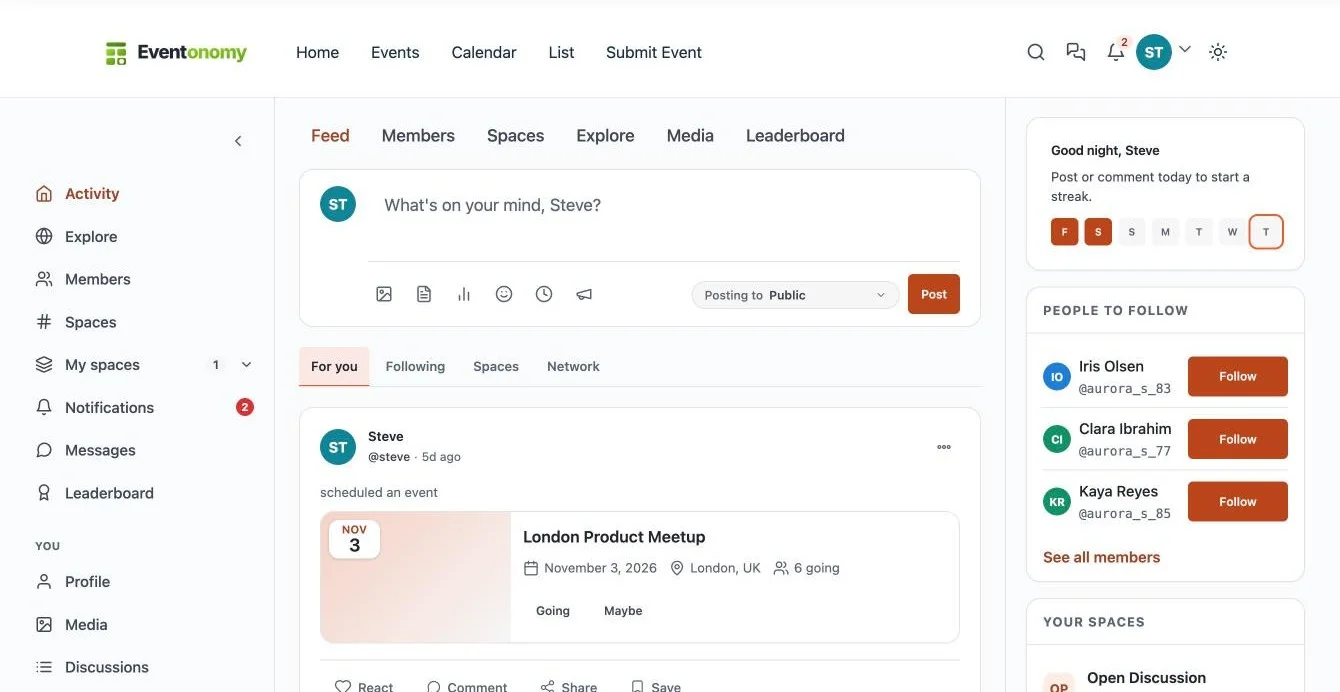
The practical difference from every SaaS platform on this list, including Mighty Networks itself: there’s no monthly bill that scales with member count, host or moderator seats, or how much revenue your community generates. Your only recurring cost is whatever WordPress hosting you’re already paying for, or would pay for any site, not a platform subscription stacked on top of it, and not a percentage cut of every sale. For a community that’s expected to keep growing for years, that difference compounds the longer the platform stays in use.

Key strengths: no per-member, per-host, or per-moderator seat limit to run into as the community grows, unlike every tiered SaaS option here; no transaction fee on paid memberships or anything sold through the platform, a direct answer to the fee structure on Mighty Networks, Circle, and Skool alike; full ownership of the member database, which lives on infrastructure you control rather than a third-party vendor’s servers; topic-based spaces with their own membership and visibility settings, shown above, that work the same way whether you’re running one space or dozens; a jobs board, member directory, and marketplace built in rather than sold as separate add-ons.
Where it falls short: requires a WordPress site and basic comfort with WordPress hosting and maintenance, it isn’t a zero-setup hosted SaaS product you can sign into in five minutes; a smaller third-party integration marketplace than Circle or Mighty Networks, since it’s a newer, more self-contained product; no managed-infrastructure option for teams who specifically want someone else running the servers; browser and PWA-based rather than native-app-first, so a branded app store listing isn’t part of the product the way it is on BuddyBoss’s app-builder path.
A Real-World Scenario: Hitting the Branded App Wall
Picture a course creator who launched on Mighty Networks’ Launch tier two years ago. The community grew past a thousand paying members, feedback was strong, and the natural next step was a branded app, their own name and icon in the App Store and Google Play, instead of the shared Mighty Networks app their members had been using. That’s when they discovered the branded app lives behind Mighty Pro, priced on a call with sales rather than listed anywhere on the pricing page. The 2% transaction fee on Launch had already been quietly compounding against thousands of dollars in course sales by that point, a cost that doesn’t show up anywhere on the monthly invoice itself.
The creator’s evaluation split into the same two paths most people in this position end up considering. Staying on Mighty Networks meant a sales conversation and an undisclosed price for Mighty Pro, with no public number to budget against ahead of time. Moving to Circle or BuddyBoss meant rebuilding spaces, course structures, and member permissions from scratch on a new platform, while still carrying a transaction fee on Circle or a separate app-builder cost on BuddyBoss. Going self-hosted on BuddyNext meant a one-time WordPress setup project, after which the ongoing cost became whatever the creator’s existing WordPress hosting already cost, with no per-member fee and nothing taken off the top of every course sale going forward. For a community that had already proven its revenue and was expected to keep growing, the self-hosted path’s cost curve flattened out in a way no SaaS tier, Mighty Pro included, would have matched.
A Migration Checklist Before You Switch
Whichever direction you’re headed, don’t move a live community without a plan. Before switching off Mighty Networks, or any platform:
- Export everything the current platform allows - member list, posts, course progress, badges - even if the new platform can’t import all of it directly, it’s your record of what existed.
- Notify members before, not after. A surprise migration with broken links and a new login flow is the fastest way to lose the engagement you built.
- Set up redirects from old community URLs to new ones wherever possible, especially for any content indexed in search or linked from elsewhere on your site.
- Rebuild permission structures deliberately rather than assuming a 1:1 mapping exists between the old platform’s roles and the new one’s.
- Run the new platform in parallel for a short window if the old one allows it, so you can compare real member behavior before fully cutting over.
- Budget real time for support questions in the first few weeks after any migration, even a smooth technical move generates member confusion about where things are now.
What Transaction Fees Actually Cost at Scale
Transaction fees are the part of this decision that’s easiest to underweight early and hardest to ignore later. On a $50,000 year of course sales and paid memberships, Mighty Networks’ Launch rate of 2% is $1,000 off the top, on top of the $948-1,140 annual subscription. Scale’s 1% rate cuts that to $500, but only after the subscription itself has already climbed to roughly $2,148/year. Skool’s Hobby tier at 10% turns that same $50,000 into $5,000 gone before a single other cost is counted, which is why Skool’s own Pro tier exists, to drop the rate to 2.9% at an 11x higher subscription price. Circle’s entry-tier fee matches Mighty Networks’ Launch rate exactly at 2%. BuddyBoss and BuddyNext both charge nothing on transactions, since BuddyBoss’s cost is a flat annual license and BuddyNext has no platform fee of any kind to apply a percentage to. The pattern across every tiered SaaS platform here is the same: the fee rate only drops when you pay more in subscription, so a growing community’s two cost levers, subscription tier and transaction percentage, tend to pull against each other rather than both shrinking at once.
What a Year Actually Costs
Pricing comparisons across these platforms get murky fast because of transaction fees and tier-gated seat limits. Here’s a rough single-community, moderate-traffic comparison for year one, not counting transaction fees on paid memberships:
| Platform | Entry tier, 1 year |
|---|---|
| Mighty Networks | ~$948 (Launch, annual) + 2% transaction fee |
| Circle | ~$1,068 (Professional, annual) + 2% transaction fee |
| Skool | $90 (Hobby, annual) + 10% transaction fee |
| BuddyBoss | ~$228-468 (platform license) + app-builder if added |
| Discourse | $0 self-hosted (your own server cost) or ~$1,200 hosted (Pro, $100/month) |
| BuddyNext | Self-hosted on your own WordPress hosting, no per-member platform fee, no transaction fee |
Figures are approximate, based on publicly listed pricing as of October 2026, and exclude WordPress hosting costs for the self-hosted options. Mighty Pro is omitted since its price isn’t published.
Comparison Table
| Free plan | Self-hosted | Branded mobile app | Transaction fees | |
|---|---|---|---|---|
| Mighty Networks | No | No | Mighty Pro only (custom price) | 0.5-2% |
| Circle | No | No | No native app offering | 1-2% |
| Skool | No | No | Generic app only | 2.9-10% |
| BuddyBoss | No | Yes | Yes, via paid app-builder add-on | None |
| Discourse | Yes (self-hosted) | Yes | No native app | None |
| BuddyNext | n/a - self-hosted, no SaaS tier | Yes | Browser/PWA, no native app builder | None |
How to Choose
If you want the closest match to Mighty Networks’ polish with a slightly different admin-seat structure, Circle is the realistic alternative, with the caveat that its entry-tier transaction fee matches Mighty Networks’ own Launch rate almost exactly, so it doesn’t solve the fee problem on its own. If cost is the primary constraint and you’re starting small, Skool’s Hobby tier gets you running for $9/month, with the tradeoff of the steepest transaction fee on this list once you’re actually selling memberships. If you already run WordPress and want a branded native app without waiting on a sales call, BuddyBoss’s app-builder path is a genuine answer, at the cost of a recurring license fee plus the app-builder add-on. If you want proven, mature forum software and don’t need built-in courses or events, Discourse is worth evaluating, especially if your team already has the DevOps comfort to self-host it well.
If you already run WordPress, or are open to it, and want to stop paying a per-member platform fee or a transaction cut on every sale, while keeping full ownership of your community’s data and infrastructure, BuddyNext is worth evaluating before you commit to another year on a platform where the features you’ll eventually need, like a branded app, aren’t even priced yet.
FAQs
1. Why doesn’t Mighty Networks include branded apps on its main pricing tiers?
Branded native apps require separate App Store and Google Play listings under your own name, which carries ongoing review, support, and infrastructure overhead. Mighty Networks reserves that for Mighty Pro, its custom-priced tier aimed at larger, established creators and brands rather than the Launch through Growth audience.
2. How much does Mighty Pro actually cost?
It isn’t published. Mighty Networks requires a sales conversation to get a quote, which makes it hard to budget for in advance compared to the listed Launch, Scale, and Growth pricing.
3. Which of these alternatives has the lowest total cost at scale?
Self-hosted options, BuddyNext and self-hosted Discourse, avoid both per-member subscription growth and transaction fees entirely, so the gap versus SaaS platforms widens as a community’s membership and revenue grow, since SaaS tiers and transaction percentages both scale upward with that growth.
4. Does Circle charge lower fees than Mighty Networks?
Not at the entry tier. Circle’s Professional plan charges a 2% transaction fee, identical to Mighty Networks’ Launch tier. The fee only drops on both platforms by moving up to a higher, more expensive subscription tier.
5. Is Skool a good fit for a community that sells paid memberships at volume?
Only on the Pro tier. Hobby’s 10% + $0.30 fee is the steepest on this list and erodes margin fast once sales volume is meaningful, which is exactly why Skool built Pro around a much lower 2.9% rate at a materially higher subscription price.
6. Do I need technical skills to run BuddyNext?
Basic WordPress familiarity, installing plugins, managing a host, is enough for most setups. It doesn’t require the server administration skill that self-hosting Discourse well typically does.
7. Can I migrate an existing Mighty Networks community to another platform?
Migration tooling varies by destination platform and isn’t a one-click process anywhere on this list. Export what member and content data Mighty Networks allows and plan for manual reconstruction of spaces, courses, and permission structures on the new platform.
8. Which platform is the best fit for courses specifically?
Mighty Networks, Circle, and Skool all treat courses as first-class features alongside community spaces. BuddyBoss delivers courses through LMS integration rather than a native module. BuddyNext and Discourse are community and forum-first, so a dedicated course plugin or tool is the better pairing on either.
9. What happens to transaction fees if a community doesn’t sell anything through the platform?
They only apply to actual paid transactions, memberships, courses, and similar, processed through the platform. A free community pays the base subscription only, on platforms that charge one at all.
10. How long does it realistically take to set up a self-hosted alternative like BuddyNext?
For a team already running WordPress, initial setup, install, basic configuration, importing an existing member list if applicable, typically takes a few hours to a couple of days, well short of the multi-week migration projects that moving between two SaaS platforms with incompatible data models can require.
11. Is it risky to run a community on a newer platform compared to an established one like Mighty Networks?
Every platform was new once. The meaningful risk difference isn’t age, it’s who controls your community’s data and pricing going forward, a self-hosted platform you control directly carries less long-term pricing risk than a SaaS platform that can gate a feature like a branded app behind an undisclosed custom price.
Summary
Mighty Networks is a genuinely strong platform for creators who are comfortable with the SaaS model and don’t need a branded app right away. For everyone else, the five alternatives above cover most of what people actually search for: Circle for the closest SaaS-polish match, Skool for the cheapest and fastest start, BuddyBoss for a WordPress-native course-and-community combo with a real app-builder path, Discourse for proven, mature forum software, and BuddyNext for teams who want to stop paying a recurring per-member platform fee and a transaction cut on every sale, and own their community’s infrastructure outright instead.
Interesting Reads:
BuddyBoss vs Mighty Networks vs BuddyNext: Which Community Platform in 2026?
Skool vs Mighty Networks vs Jetonomy: Which Community Platform in 2026?