

Most real estate investor groups run on three disconnected tools: Meetup for the monthly meeting, a Facebook group for everything in between, and a shared spreadsheet of “good contractors” that is always out of date. It holds together until the group grows, someone posts a deal they are raising money for in a public thread, and the vendor list turns into a list of people who have moved on.
This guide compares the platforms investor communities actually use, from local real estate investor associations (REIAs) to rental-owner education groups and private investor clubs. We built a working investor community for the first entry so you can see it, checked every competitor claim against the vendor’s own pages in November 2026, and included a short, sourced note on sharing deals, because that is where investor communities get into trouble.
Quick answer
If you want a real estate investor community you own and control, BuddyNext is the strongest choice: chapter spaces with in-person meetups, a private deal room for approved members, a vetted vendor directory, deal-analysis discussions and paid membership on your own WordPress site. Wild Apricot suits associations focused on dues and events, Meetup is the default for local meetup discovery, and Circle or Mighty Networks work for hosted online-first communities.
In this guide
- Three kinds of real estate investor community
- Before you share deals: a short compliance note
- Real estate community platforms compared
- What real investor associations run on
- 1. BuddyNext: best for an investor community you own end to end
- 2. Wild Apricot: best for association back-office
- 3. Meetup: best for filling the room locally
- 4. Circle: best for a polished online-first community
- 5. Mighty Networks: best for hosted networks with in-person events
- 6. Skool: best for real estate education communities
- 7. Glue Up: best for multi-chapter association management
- 8. Facebook Groups: best for free reach
- 9. Discord and Slack: best for real-time investor chat
- 10. LinkedIn Groups: best for professional visibility
- 11. BiggerPockets: where your members already are
- The best setup for a local REIA
- A template for posting a deal for feedback
- Running a monthly meetup that feeds the community
- How to run a vetted vendor directory
- More community platform comparisons
- How we built and checked this list
- Frequently asked questions
- The bottom line
Three kinds of real estate investor community
“Real estate investor community” covers three quite different groups. Knowing which one you run decides which platform fits.
| Type | Typical members | What it must do well |
|---|---|---|
| Local investor association (REIA or club) | Landlords, flippers, wholesalers, lenders, agents and contractors in one metro | Monthly in-person meetings, chapters, member dues, sponsor and vendor relationships |
| Education community | New and growing investors learning a strategy (rentals, BRRRR, flips, short-term rentals) | Courses, deal analysis feedback, Q&A, accountability, engagement |
| Private investor club | Experienced investors, syndicators and their passive investors | Approved membership, private discussion, document sharing, discretion |
Many communities are a blend. A local association often runs an education track, and an education community often grows a private group for its most active investors. The best platform lets you run all three side by side, with different access for each.
Not sure which you are? Ask three questions. Do most members live within driving distance of each other? Do people join mainly to learn a strategy from you? Do members expect to see deals they could invest in? A yes to the first points to an association, a yes to the second to an education community, and a yes to the third means you need a private, approval-only space no matter what else you run.
Before you share deals: a short compliance note
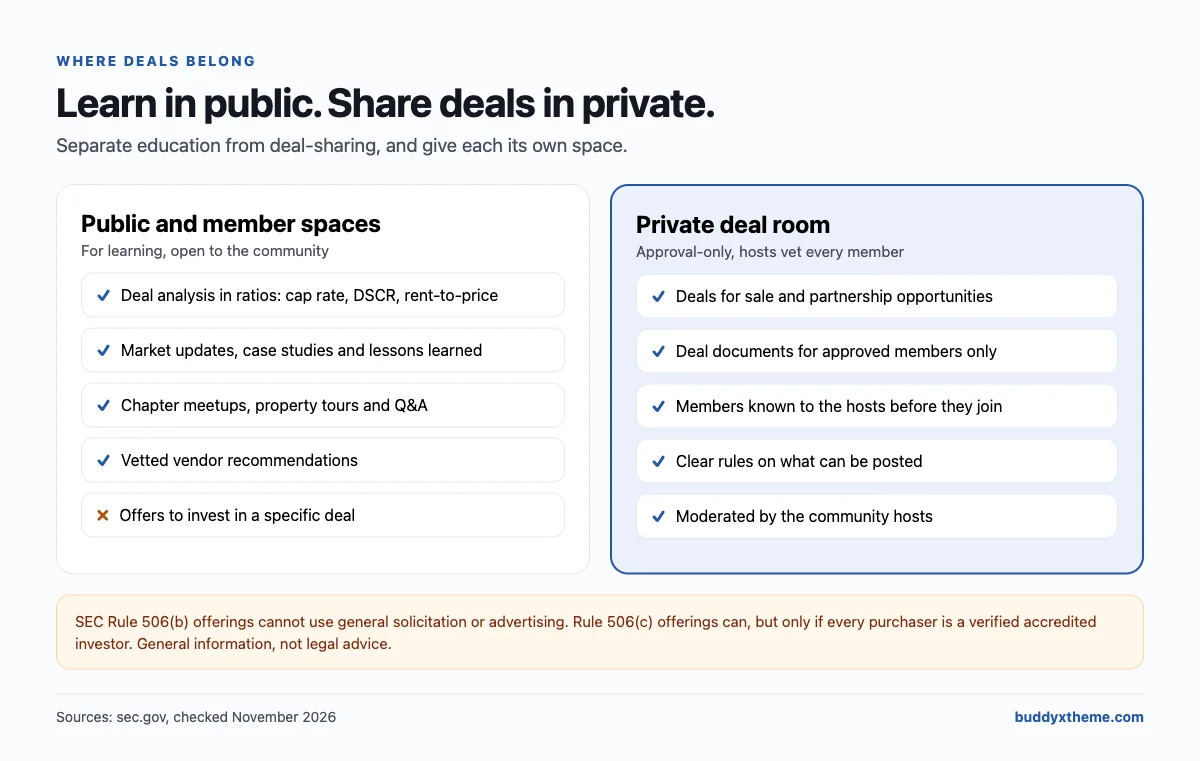
Investor communities regularly discuss specific properties, and some members raise money for them. If a deal involves selling a stake to other investors, it may be a securities offering, and US securities law limits how it can be promoted.
The SEC’s own guidance is clear on the two common private-placement routes:
- Rule 506(b) offerings are subject to “no general solicitation or advertising to market the securities” (SEC).
- Rule 506(c) offerings may “broadly solicit and generally advertise,” but only if all purchasers are accredited investors and the issuer “takes reasonable steps to verify” their status (SEC).
In practice, a deal pitched in a public Facebook group, an open LinkedIn group or a public Discord server looks a lot like general advertising. That is one reason serious investor communities keep deal-sharing inside a private, approval-only space, separate from public education and discussion.
This is general information, not legal advice. Anyone raising money for a deal should speak to a securities attorney about their own offering.
Real estate community platforms compared
| Platform | Private deal room | In-person meetups | Member and vendor directory | Dues and renewals | Self-hosted |
|---|---|---|---|---|---|
| BuddyNext | Private, approval-only spaces | Events with venues and RSVPs, per chapter | Member directory plus vetted vendor listings | Paid plans with renewal reminders | Yes |
| Wild Apricot | Membership levels, no discussion rooms | Event pages and registration | Membership directory | Automated renewals and payments | No |
| Meetup | Members-only details | Core strength, repeating events | Flat member list | Group dues | No |
| Circle | Access groups by tier | Events with live streaming | Member directory | Paid memberships | No |
| Mighty Networks | Tiered membership levels | Virtual and in-person gatherings | Member directory | Paid memberships | No |
| Skool | One feed per community | Calendar | Profiles, no directory search | Paid communities | No |
| Glue Up | Public and private groups | Event lifecycle management | Member directory and CRM | Renewal automation | No |
| Facebook Groups | Separate private groups | Facebook Events | No | No | No |
| Discord | Role-gated channels | Server events | No | Via add-ons | No |
| LinkedIn Groups | No | No | LinkedIn search only | No | No |
| BiggerPockets | No (you join, not host) | Forum meetup threads | Agent and lender finder | Individual memberships | No |
Features are as documented on each vendor’s own site in November 2026. Every platform except BuddyNext is hosted by the vendor.
What real investor associations run on
Local REIAs have been solving this problem for decades, and their choices are easy to verify.
| Association | Platform |
|---|---|
| Philadelphia Real Estate Investors Association, 9,674 members | Meetup (Meetup) |
| Coastal Carolina Real Estate Investors Association | Wild Apricot (site) |
| DFW Real Estate Investor Club | Wild Apricot (site) |
| Kalamazoo Area Real Estate Investors Association | Wild Apricot (site) |
| Property Investing Community | Skool (Skool) |
The pattern: associations reach for Meetup to fill the room and membership software such as Wild Apricot to collect dues, then bolt on a Facebook group for discussion. Education businesses lean toward Skool. Almost nobody has one place that does all of it, which is the gap the first entry fills.
The audience is substantial. National REIA, the nonprofit umbrella for local associations, describes itself as having “over 120 Local Chapters and Local Associations and 40,000 members” (National REIA).
1. BuddyNext: best for an investor community you own end to end
Best for: associations, education communities and investor clubs that want chapters, meetups, deal analysis, a private deal room, a vendor directory and dues in one place, on their own site.
BuddyNext is a complete community platform that runs on your own WordPress site, with the BuddyX theme as its design layer. To show it in this niche, we built Keystone Investor Network, a demo community for rental owners, flippers and small multifamily investors in Texas and Arizona. Every screenshot below comes from it. The members, companies and deals are fictional, but every screen is real product behaviour.

How it handles chapters and meetups. Each city is its own space, with its own feed, members and event calendar. Events can be in person, with a venue and address, or online, and members RSVP inside the community. Our demo’s Austin and Phoenix chapters each list their monthly meetup, and the Austin chapter adds a members-only property tour.

How it handles deals. Public spaces such as Deal Analysis are for learning: members share the numbers on a property in ratios like cap rate and DSCR and get feedback. Deals for sale stay in a private Deal Room, where members must request access and the hosts approve each one. That separation is easy to enforce because every space has its own visibility and membership.

How it handles vendors. A Vetted Vendors space carries its own business directory: lenders, property managers, inspectors, contractors, title companies and accountants that members recommend and the hosts approve. Every listing links to a full profile with contact details and location.

How it handles dues and access. Paid membership plans support monthly or annual dues, trials, coupons and renewal reminders, with Stripe and PayPal checkout. Plans can unlock specific spaces, so a premium tier might include the Deal Room and the property tours.
How it handles trust and safety. Registration can require admin approval, so new members are vetted before they see anything. The whole community can be made members-only, and moderation includes reporting, banned words and link blocking, which matters in a niche that attracts spam and scams.
Strong at: combining association, education and private-club needs in one community, with chapter spaces, a private deal room and a vendor directory that most platforms lack.
Weak at: native app-store apps (members use the responsive site or install it as a web app) and hands-off hosting (self-hosting means you look after updates and backups).
Pricing model: self-hosted, with no per-member or platform transaction fees. You pay for hosting and your payment processor’s fees.
Bottom line: the strongest single home for an investor community that wants to grow beyond a meetup list and a Facebook group without giving up ownership.
What’s included, and how it is delivered
BuddyNext is one platform made of a core and add-on platform modules. Everything shown in the demo above runs on the BuddyNext platform. This table shows which parts come with the core, which are platform modules you install and activate alongside it, and which need a third-party plugin, another system or custom work.
| Capability | How it is delivered |
|---|---|
| Open, private and secret spaces | Core platform |
| Activity feed, pinned announcements and hashtags | Core platform |
| Member profiles and searchable member directory | Core platform |
| Direct messages | Platform module, installed alongside |
| Members-only mode, admin approval, invites and email verification | Core platform |
| Q&A with accepted answers and code highlighting | Platform module, installed alongside |
| Events with RSVPs, online or in person | Platform module, installed alongside |
| Business and partner directory listings | Platform module, installed alongside |
| Points, badges, streaks and leaderboards | Platform module, installed alongside |
Want to click around yourself? The Keystone Investor Network community in this guide was built on a private test site, so it is not public. The BuddyNext live demo is a general community you can open in your browser and explore without installing anything.
2. Wild Apricot: best for association back-office
Best for: established REIAs whose priority is dues, renewals, event registration and a member directory.
Wild Apricot is membership management software for associations, clubs and chapters, with automated renewals and recurring payments, event registration, a membership directory and an online store (Wild Apricot). Several REIAs run their sites on it, including Coastal Carolina, DFW and Kalamazoo associations.
Strong at: collecting dues and renewals, event registration and keeping a clean member database.
Weak at: community itself. There is no social discussion feed or member-to-member messaging comparable to a community platform, so associations usually pair it with a Facebook group.
Pricing model: paid plans.
Bottom line: excellent for running the association’s administration, not for the conversations between meetings.
3. Meetup: best for filling the room locally
Best for: local investor groups that want new attendees to discover their monthly meeting.
Meetup is built around in-person events. Organizers can create repeating events, attendees RSVP and get added to event chats, and groups can collect dues (Meetup help). Philadelphia’s REIA counts 9,674 members on its Meetup group.
Strong at: local discovery, RSVPs and recurring meetings.
Weak at: anything between meetings. Discussion, document sharing and a private deal room are not what Meetup is for, and there is no member directory beyond a flat list.
Pricing model: organizer subscription, with optional group dues.
Bottom line: keep it for discovery if it brings you new members, but do not make it the community’s only home.
4. Circle: best for a polished online-first community
Best for: education businesses and investor clubs that meet mostly online and want a premium, branded experience.
Circle calls itself “the complete community platform,” with spaces, access groups that gate content by membership tier, events with live streaming, a member directory and search (Circle).
Strong at: tiered access (access groups are the closest mainstream match to a deal room), events and a polished design.
Weak at: in-person, multi-chapter meetups with venues and local RSVPs, and you cannot self-host it.
Pricing model: tiered paid plans, with transaction fees that fall on higher tiers.
Bottom line: a strong hosted option for an online investor education community.
5. Mighty Networks: best for hosted networks with in-person events
Best for: investor networks that mix online community with occasional in-person gatherings and want strong member-to-member activity.
Mighty Networks supports tiered membership levels, virtual and in-person gatherings, a member directory and file sharing, and says hosts “retain ownership and control over member data, with export capabilities” (Mighty Networks).
Strong at: in-person and virtual events, tiered membership and documented member data export.
Weak at: a federated, multi-chapter structure. It is designed around one host-led network.
Pricing model: tiered paid plans.
Bottom line: a good hosted choice for a single investor network with real-world events.
6. Skool: best for real estate education communities
Best for: coaches and educators teaching an investing strategy who want a simple, engaging community with courses.
Skool combines a feed, a classroom and a calendar with points and leaderboards, and supports paid communities. Real estate education groups such as Property Investing Community run on it (Skool).
Strong at: courses plus engagement, with very fast setup.
Weak at: separate private rooms inside one community, local chapters and in-person RSVPs, and a searchable member or vendor directory.
Pricing model: paid plans with a transaction fee on member payments.
Bottom line: great for a single strategy course community, limited for associations and private clubs.
7. Glue Up: best for multi-chapter association management
Best for: larger associations with several chapters that want one management system.
Glue Up describes itself as “all-in-one association management software,” with chapter management through unified dashboards, event management for in-person and online events, a member directory and CRM, renewal automation and public and private groups (Glue Up).
Strong at: chapter administration, events and renewals in one dashboard.
Weak at: proven use by investor associations specifically. We could not find a REIA example to verify, so test it against your own workflow.
Pricing model: paid plans.
Bottom line: worth evaluating for multi-chapter associations that prioritise administration over discussion.
8. Facebook Groups: best for free reach
Best for: getting started with zero setup, or keeping a public top-of-funnel group.
Facebook Groups can be public or private, host Facebook Events, and offer admin tools such as membership questions, rule agreements and Admin Assist for automatic approvals (Meta).
Strong at: reach, familiarity and join screening.
Weak at: member and vendor directories, dues, documents and ownership. The group, its members and its history live on Meta’s platform, and a public group is a poor place to share private deals.
Pricing model: free.
Bottom line: fine as a free public front door, risky as the place where deals are discussed.
9. Discord and Slack: best for real-time investor chat
Best for: fast-moving groups such as wholesaling teams or masterminds that live in chat.
Discord offers role-gated channels, server events, AutoMod filters and verification levels (Discord). Slack offers public and private channels, file sharing and search (Slack).
Strong at: real-time conversation and private channels.
Weak at: member and vendor directories, dues and a searchable archive of deal analysis. Answers scroll away.
Pricing model: free plans, with paid upgrades.
Bottom line: useful alongside a community platform, not as the main home.
10. LinkedIn Groups: best for professional visibility
Best for: agents, lenders and service providers who want visibility among investors.
LinkedIn Groups are free discussion groups on top of members’ professional profiles, with group management able to remove and block members and duplicate posts flagged as spam (LinkedIn).
Strong at: professional identity and visibility.
Weak at: almost everything a community needs: no events, directory, files or dues.
Pricing model: free.
Bottom line: a visibility channel, not a community home.
11. BiggerPockets: where your members already are
BiggerPockets is the largest online hub for real estate investors, with forums, calculators and agent and lender finders (BiggerPockets). It is not a platform for hosting your own private community: there is no way to create your own group, deal room or chapter there. Treat it as a place to contribute, learn and be visible, and invite the people you meet into your own community.

The best setup for a local REIA
If you run a local association today, here is the setup we would recommend:
- Make your own community the home. Members, chapters, discussions, the deal room, the vendor directory and dues all live in one place you own.
- Keep Meetup only if it brings new members. Use it to list the monthly meeting and link people into your community to RSVP and continue the conversation.
- Keep a public Facebook group or BiggerPockets presence for reach, but move serious discussion and every deal into your own community.
- Run the vendor directory as a benefit, not an ad board. That is how you keep sponsors and members both happy.
If you choose BuddyNext, our step-by-step guide shows how to set up a community space on WordPress, including approval-only registration and private spaces. Education businesses that also sell coaching can compare options in our guide to the best platforms for a paid coaching membership.
A template for posting a deal for feedback
The most useful thing an investor community can do is give honest feedback on real deals. The quality of that feedback depends almost entirely on how the deal is posted. Pin a template like this in your deal-analysis space, and ask members to use it every time:
| Field | What to include |
|---|---|
| Strategy | Buy and hold, BRRRR, flip, short-term or mid-term rental, small multifamily |
| Market | City and neighbourhood, and why you chose it |
| Property | Type, units, age and condition, plus anything the inspection flagged |
| Key ratios | Rent-to-price, projected cap rate, cash-on-cash return and DSCR |
| Rehab scope | What you plan to do, how long it takes and how the budget was built |
| Rent comps | Where your rent estimate comes from: signed leases, listings or a property manager |
| Financing | Loan type, how you stress-tested the rate, and reserves after closing |
| Your question | The one decision you want help with |
Two norms make the feedback better:
- Ask for the downside, not reassurance. “What would make this deal fail?” gets far more useful answers than “Is this a good deal?”
- Share the outcome later. When members come back six months later with what actually happened, the whole community learns, and the archive becomes a library of real case studies.
Because ratios rather than raw numbers carry most of the analysis, members can share useful detail without exposing their exact finances in a public space.
Running a monthly meetup that feeds the community
In-person meetings are the heart of most investor associations, but the value disappears if nothing connects one meeting to the next. A simple routine keeps the energy going:
- Post the event inside the chapter space two to three weeks ahead, with the speaker, the topic and a members-only RSVP.
- Open with a local market update from a member who tracks it: rents, days on market, inventory and anything changing at city hall.
- Feature one real case study. A member walks through a deal from purchase to today, including what went wrong. These are the sessions people remember.
- Keep sponsor time short and educational. Sponsors get a table and a brief introduction, not a sales pitch from the stage.
- Run “haves and wants” carefully. Members can share what they are looking for and what services they offer. Offers to sell stakes in a deal belong in the private deal room, not the open room.
- Follow up online the same evening. Post the slides, the recording if you have one, and a thread for questions. Members who could not attend still feel part of it, and the discussion continues until the next meeting.
Over a year, this rhythm turns a monthly meeting into a year-round community, and the online archive becomes the reason new investors join.
How to run a vetted vendor directory
A vendor directory is one of the most valuable things an investor community can offer, and one of the easiest to ruin. A few rules keep it trustworthy:
- Require a member recommendation. A vendor is listed only when at least one member has used them and will vouch for them.
- Have the hosts approve every listing. Submissions wait for approval rather than appearing immediately.
- Separate sponsors from recommendations. Sponsors can be welcome, but members should always know who paid and who was recommended.
- Review the list once a year. Remove vendors who have closed or who members no longer recommend.
- Encourage public reviews in discussion. A thread about a renovation that went well, or badly, is worth more than any listing description.
For a deeper look at running listings inside a community, see our guide to building a community marketplace with BuddyNext and Listora.
More community platform comparisons
Building a different kind of community, or one that overlaps with this one? These guides use the same method: a working demo community and vendor claims checked at the source.
- Best software for a startup founder community: confidential pods, intros and fundraising rooms.
- Best software for a professional association community: chapters, committees, CPD and member directories.
- Best software for a private neighborhood community website: residents-only access, safety alerts and local decisions.
- Best software for a freelancer networking community: referrals, jobs and member directories.
- Best software for a paid coaching membership: coaches selling group programs and memberships.
- How to set up a community space on WordPress: the step-by-step setup guide behind every demo in this series.
How we built and checked this list
We built the Keystone Investor Network demo on BuddyNext for this guide: 20 fictional members, eight spaces including two city chapters and a private Deal Room, real deal-analysis discussions, six vetted vendor listings and four scheduled events, three of them in person. We did not run accounts on the other platforms. Every competitor claim comes from the vendor’s own website or help center, checked in November 2026 and linked above. Where we could not verify something, we say so. We do not list prices because they change often and vary by plan.
Disclosure: BuddyNext and the BuddyX theme are made by Wbcom Designs, the team behind this site. We have aimed to be fair, including about where BuddyNext is not the right fit. Nothing here is legal, tax or investment advice.
Frequently asked questions
What is the best platform for a real estate investor community?
For a community you own, BuddyNext is the strongest all-round choice: chapter spaces with in-person meetups, a private deal room, a vetted vendor directory, deal-analysis discussions and paid membership on your own site. Wild Apricot is best for association administration, and Meetup is best for local event discovery.
Should a REIA use Meetup or its own community platform?
Use both if Meetup still brings you new attendees, but make your own community the home. Meetup is excellent for RSVPs and discovery, but it is not built for ongoing discussion, private deal-sharing, documents or a vendor directory.
Can I share investment deals in my community?
Be careful. If a deal involves selling a stake to other investors, it may be a securities offering. The SEC says Rule 506(b) offerings cannot use general solicitation or advertising, while Rule 506(c) offerings can advertise but must verify that every purchaser is accredited. Keep deals inside a private, approval-only space and get advice from a securities attorney.
How do I verify members before they join?
Use a platform with admin-approved registration and membership questions. BuddyNext, Wild Apricot, Mighty Networks and Circle support controlled access, and Facebook Groups offer membership questions with Admin Assist.
Can my community include a directory of lenders and contractors?
Yes. BuddyNext can show a vetted vendor directory inside a space, with host approval for every listing. BiggerPockets has its own agent and lender finders, and association tools like Wild Apricot focus on member directories.
Is a Facebook group enough for an investor club?
It is enough to start, but not to grow. Facebook Groups have no dues, member directory or document library, the group lives on Meta’s platform, and a public group is a poor place for private deals.
How do I run several city chapters?
Give each city its own space with its own members, discussion and calendar, under one shared community. That keeps local meetups local while members still benefit from the whole network.
Can members pay annual dues online?
Yes on most dedicated platforms. BuddyNext supports monthly or annual plans with renewal reminders, Wild Apricot and Glue Up automate renewals, and Meetup supports group dues.
How do I keep a real estate investor community free of spam and scams?
Real estate communities attract fake lenders, “guaranteed return” pitches and wire-fraud attempts. Require approval to join, ask new members about their investing experience, block link domains and keywords that keep appearing in scam posts, and make reporting easy so members can flag suspicious messages. Remind members never to send money based only on a message inside the community.
What is the difference between a REIA and an online investing community?
A REIA is usually a local association built around in-person meetings, member dues and relationships with local vendors. An online investing community is often built around a strategy or an educator, with courses and discussion instead of meetings. Many groups now combine the two, with local chapters inside a wider online community.
The bottom line
A real estate investor community needs more than a meetup list and a Facebook group. It needs chapters, honest deal analysis, a private place for deals, vendors members trust and a way to collect dues. If you want all of that in one place you own, BuddyNext is the strongest foundation. If you mainly need association administration, Wild Apricot is proven, and Meetup remains useful for filling the room.
And build an investor community you own.