

A website with no search bar is frustrating to use, plain and simple, and on a platform built around people rather than products, that frustration compounds fast, a lost visitor on a blog just leaves, but a member who can’t find the group or person they came looking for stops trusting the whole community. On a community site, it’s the difference between members finding each other, the right group, or the right page in seconds versus giving up and leaving. This post covers what a search feature actually does for a community site, the main types you’ll run into, why WordPress’s built-in search struggles once a site grows, how to add one with a BuddyPress-specific plugin, and the configuration and privacy decisions that determine whether it actually gets used once it’s live.
Why WordPress’s default search isn’t enough
It’s worth being direct about this before getting into plugins: WordPress’s native search is genuinely weak, and it’s weak by design rather than by accident. Core search does a simple SQL LIKE match against post titles and content, no relevance ranking beyond a basic weighting, no understanding of plurals or synonyms, and critically, no awareness of anything that isn’t a standard post or page. On a BuddyPress community site specifically, that last limitation is the real problem, member profiles, groups, activity updates, and forum discussions live outside the searchable post content entirely, so core WordPress search simply can’t find them no matter how well-optimized your content is.
This isn’t a WordPress failing exactly, core search was never designed to be a full-text search engine, it was designed to be a lightweight fallback that works reasonably on a small blog. The moment a site has real scale, real content variety, or a genuine expectation that members can find other members, core search needs to be replaced, not just supplemented. Trying to patch it with theme tweaks or minor CSS styling changes doesn’t fix the underlying limitation, the problem sits in what’s being queried, not how the results are displayed.
Why It Matters for a Community Site
On a community platform specifically, a search bar isn’t optional decoration, it’s how members find each other. Without it, people scroll. With groups and pages layered on top of member profiles, a decent search bar is what makes an “advanced search” actually advanced instead of just a glorified filter.

3 Types of Search Features
Feature (faceted) search. Filters by price, color, type, or brand, the kind you see on most e-commerce sites. Useful for classifying items with tags so people can narrow down instead of scrolling. On a community site, the equivalent is filtering members by location, interest, or activity level, or filtering groups by topic and privacy setting, letting someone narrow a large member directory down to exactly the slice they actually care about.
Abstract search. Type a broad query, get related results back, the way Google returns recipes and variations when you search “seafood” without naming a specific dish. This kind of search relies on some level of relevance scoring and stemming (matching “running” when someone searches “run”), which is exactly the capability core WordPress search lacks and a dedicated search plugin adds.
Auto-complete search. Finishes the query as you type and shows suggestions before you hit enter. Reduces typing, especially useful on mobile where typing is slower and more error-prone. On a member directory specifically, autocomplete that surfaces matching names or usernames as someone types is a genuinely large usability improvement over forcing a full search-and-results-page round trip just to find one specific person.
Also read: how to create a BuddyPress community store.
What You Actually Get From Adding One
Faster navigation. On a large community site, this matters more as the site grows. Nobody wants to scroll an entire member directory to find one person.
Lower bounce rate. Poor navigation is a common reason visitors leave. A working search bar removes one of the biggest friction points in that journey.
Better mobile experience. Mobile users are less tolerant of scrolling than desktop users. A search filter that works well on a small screen keeps people engaged instead of giving up.
Retention through discovery. A member who can actually find a group matching their interest, or another member with shared interests, is a member who has a reason to keep coming back. Search isn’t just a convenience feature on a community platform, it’s directly tied to whether the community forms real connections or stays a directory nobody browses past the homepage.
BuddyPress Search Plugins
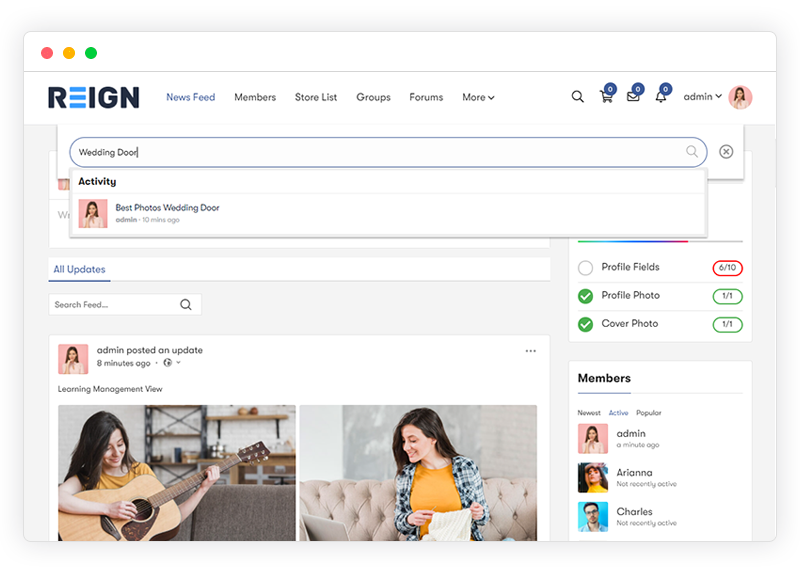
BP Profile Search is a solid, free, actively maintained option (WordPress.org, v5.9, most recently updated for a security fix in May 2026). It lets members search profiles by name, age, profession, and other XProfile fields, plus posts, pages, and groups.
WBCOM Designs also sells a dedicated BuddyPress Search plugin with a broader feature set, search components for BuddyPress activities/groups/members, custom post type search (WooCommerce products, LearnDash courses, Elementor pages), live search with autocomplete, and a widget/shortcode for placing the search form anywhere. We couldn’t confirm it’s still an active listing at the time of this refresh, worth checking wbcomdesigns.com directly for current availability before counting on it. See our full BuddyPress Search Plugin review for the detailed feature walkthrough.
General-purpose WordPress search plugins worth knowing
Beyond BuddyPress-specific tools, a couple of broader search plugins come up often enough in this space that they’re worth a direct comparison. SearchWP is the most established paid option, it re-indexes your entire site (posts, custom post types, even PDF content if configured) into its own search engine with relevance ranking, keyword stemming, and synonym support baked in, a genuine step up from core search’s basic matching. It’s not BuddyPress-aware out of the box the way BP Profile Search is, but it can be configured to include BuddyPress-related custom post types and, with additional setup, activity content, worth considering if your search needs extend well beyond just members and groups into a broader content library.
Relevanssi is the closest free alternative in spirit, it replaces core search with proper relevance-based full-text matching and has a long track record on WordPress.org. It’s a solid choice if you want meaningfully better search than core WordPress provides but don’t specifically need BuddyPress-aware profile and group search, in which case pairing it with a dedicated BuddyPress search plugin, rather than relying on it alone, gets you both improved general content search and native community search in one setup.
For sites with a genuinely large amount of content, tens of thousands of posts or a very active, high-volume community, ElasticPress is worth knowing about even if it’s a heavier lift to set up. It connects WordPress to Elasticsearch (or a hosted equivalent), and the performance and relevance difference at real scale is substantial, database-driven search, even with plugins layered on top, starts to strain under enough data volume, and a dedicated search index handles that load in a way a MySQL query fundamentally isn’t built for. It’s overkill for a small-to-medium community, but worth having on the radar as your site’s content and member count grows into the tens of thousands.
Setting up member and group search: what to configure first
Whichever plugin you land on, a few configuration decisions determine whether the search actually feels useful once it’s live. First, decide which profile fields are searchable versus private. XProfile fields can hold sensitive information (location, birthdate, contact details), and making every field searchable by default can expose more than a member expected when they filled out their profile, worth reviewing field-by-field which ones make sense as public search criteria versus private-only data.
Second, think through what happens with zero results, a search that returns “no results found” and nothing else is a dead end. A better experience suggests broadening the search, related groups, similar members, or a link back to browsing the full directory, so a member who searched for something slightly too specific isn’t left at a wall with no next step.
Third, if your community has grown past a few thousand members, check how the search plugin performs at that scale before assuming it’ll hold up, a plugin that felt instant during setup with fifty test profiles can slow down meaningfully once it’s querying against real member volume, particularly if it’s doing a broad LIKE-style match across several XProfile fields simultaneously rather than using proper indexing.
Performance, once your member count grows
A search feature that feels instant during setup and testing can slow down noticeably once real data volume kicks in, and it’s worth understanding why before it becomes a live problem. XProfile field search, in particular, tends to query across multiple custom database tables (BuddyPress stores profile field data separately from the core WordPress users table), and without proper indexing on those tables, a search across several fields simultaneously against a member base in the thousands can genuinely slow the search response time enough that members notice and stop trusting it.
If you’re seeing search slow down as your community grows, the fix path generally runs through three things in order: confirm the relevant database columns actually have indexes (a developer or your host’s support team can check this, it’s a database-level setting, not a plugin toggle), check whether the search plugin caches recent or common queries rather than re-running the full database query every single time, and, if you’re at genuinely large scale, tens of thousands of members with an active search feature, consider whether it’s time to move to a dedicated search index like Elasticsearch rather than continuing to push a relational database to do a job it wasn’t built for. Most communities never need to go that far, but it’s worth knowing the escalation path exists rather than being surprised by it later.
A note on search result relevance for groups specifically
Group search deserves separate thought from member search, since the criteria someone’s actually looking for differ. A member searching for a group cares about topic relevance first, but activity level runs a close second, a group with the right name but zero recent posts is a dead end, while a genuinely active group slightly further from an exact keyword match might be the better result. Some BuddyPress-aware search plugins let you factor recent activity into group search ranking, worth enabling if your plugin supports it, since it steers new members toward groups that will actually give them the engagement they joined a community site looking for in the first place, rather than toward whichever group happens to match the search string most literally.
Mobile search UX, worth testing directly
A search bar that’s genuinely usable on mobile needs more than just responsive CSS shrinking it to fit. The input field needs to be large enough to tap accurately, the keyboard that pops up should be the right type (a standard text keyboard, not a numeric one, unless you’re searching a numeric field specifically), and results need to render in a layout that doesn’t require horizontal scrolling on a small screen. If your search includes filters, faceted options like the ones described above, those filters need a mobile-friendly presentation too, a full desktop filter sidebar crammed into a phone screen is unusable, while a collapsible filter drawer or bottom sheet works. Test the actual flow on a real phone, not just a resized browser window, before considering search “done.”
Search analytics: the data most sites never look at
One of the most underused sources of insight on a community site is a log of what people actually search for, and specifically what they search for and find nothing. A recurring zero-result query is a direct signal, either content or a feature genuinely missing (members searching for a “book club” group when none exists yet, worth creating one), or a naming mismatch (members searching “meetups” when your groups are all tagged “events” internally), fixable with better tagging or category naming rather than new content at all. SearchWP and several BuddyPress-aware plugins log search terms, worth checking that logging is enabled and actually reviewing the results periodically rather than treating search as a fire-and-forget feature once it’s installed.
Beyond zero-result queries, tracking which results actually get clicked versus which searches end in the searcher immediately trying a different query tells you whether your ranking is surfacing the right things first. A search for a common term that returns the least useful matches at the top, buried under more tangentially related content, is a relevance-tuning problem worth fixing, most dedicated search plugins let you manually boost or demote specific content types in the ranking once you’ve identified the mismatch.
Privacy considerations specific to member search
Searchable profile data deserves more privacy thought than searchable blog content does, since you’re dealing with information about real people who may not have anticipated it being searchable when they filled out their profile. Beyond the field-level privacy point made above, consider whether your search respects each member’s own visibility settings, if BuddyPress lets a member mark their profile fields as “only me” or “friends only,” your search plugin needs to honor that setting rather than exposing hidden data to anyone who searches for it. Not every search plugin handles this correctly out of the box, worth testing directly, create a test member account, set some fields to a restricted visibility, and confirm a search from a different account genuinely doesn’t surface that restricted data before trusting it in production.
If your community includes users in the EU or UK, this crosses into GDPR territory too, a search feature that inadvertently exposes data a member explicitly restricted counts as a data handling failure, not just a UX bug. Worth treating this as a launch-blocking check rather than a nice-to-have, particularly on any community site handling real personal information beyond just a username and avatar.
How search fits into the BuddyX theme experience
On a BuddyX-powered community, search is typically surfaced in more than one place, a global site search in the header, a dedicated member directory search, and often a group-specific search inside an individual group’s activity stream. Keeping these consistent matters more than it might seem, a member who learns how search behaves in the member directory should find the same interaction pattern (same autocomplete behavior, same filter style) when searching within a group, rather than each search instance feeling like a differently built feature. When customizing or extending search on a BuddyX site, it’s worth auditing all the places search appears and confirming they share a consistent visual and interaction pattern rather than treating each as an isolated implementation.
Getting Started
Pick based on what you actually need: BP Profile Search if member/profile search is the whole job and you want something free and current, a dedicated commercial plugin if you need custom post type search and live autocomplete bundled together, or a broader tool like SearchWP or Relevanssi if general content search matters as much as community search specifically. Whatever you choose, spend real time on the configuration decisions above, field privacy, zero-result handling, and mobile usability, since those details determine whether search actually gets used or just sits there as an unused feature nobody trusts.
And revisit the choice periodically rather than treating it as a one-time setup task. A search feature that fit a community of two hundred members perfectly well can start showing real limitations at two thousand, and the signals covered above, zero-result queries, slowing response times, member complaints about not finding people they know are on the platform, are worth checking in on every few months rather than only reacting once search has quietly become a source of frustration nobody’s flagged directly.